How Long Do Greenworks Batteries Last? (Real Runtime + Lifespan Explained)
Greenworks batteries usually last about 2 hours per charge in real use. On lawn mowers, a 40V pack is often around 40 minutes, a 60V pack about 50 minutes, and an 80V pack up to 60 minutes under normal conditions. Bigger batteries in the same platform last longer too: an 80V 2Ah pack is often estimated at 45 minutes, while an 80V 4Ah pack can reach 90 minutes. That is the practical answer if you mean runtime per charge.
If you mean total battery lifespan, the usual estimate is closer to 4 years, with some sources putting well-cared-for packs at 5 years or even 5+ years. Those are different questions. One is how long the battery runs today; the other is how many years it keeps holding a decent charge before it starts to fade.
As a rough estimate, many Greenworks batteries provide:
runtime ≈ battery Ah × 15 to 25 minutes per Ah
This is not an exact factory formula. It is a practical estimate for normal residential use. A 2Ah battery may be enough for short trimming or small mowing jobs, while a 4Ah, 5Ah, or 6Ah battery usually gives more useful runtime for larger yards or heavier tools.
Quick Answer – Greenworks Batteries Lifespan
Recommended Products

If you want the simple answer, here it is:
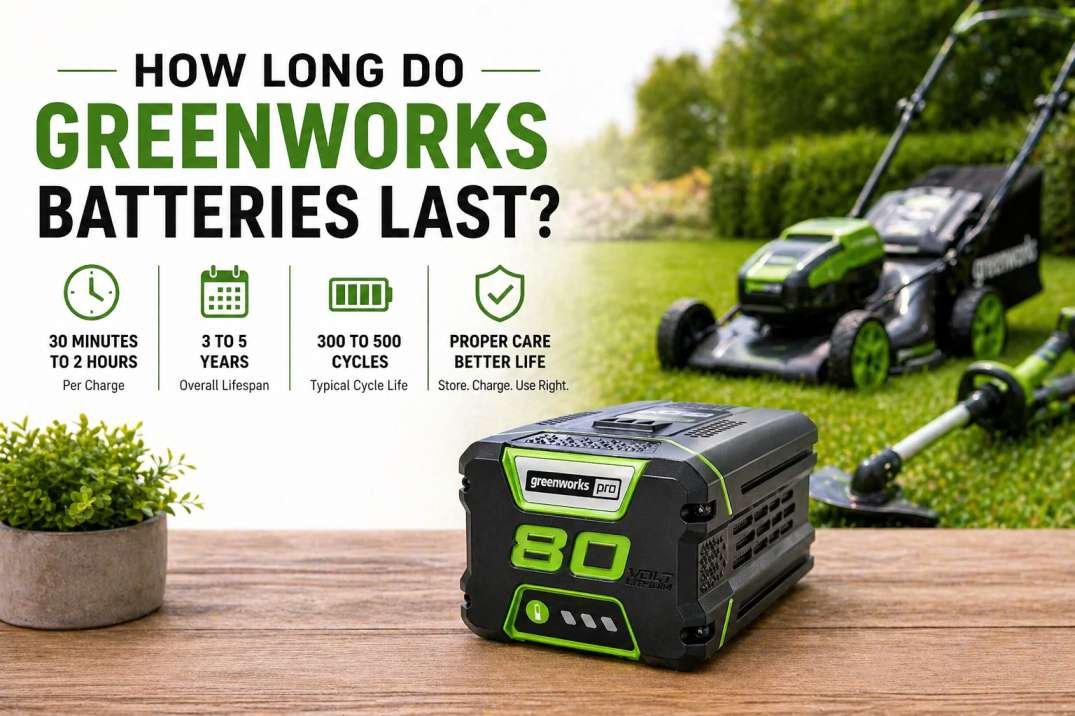
- Runtime per charge: usually about 30 minutes to 2 hours
- Overall battery lifespan: usually about 3 to 5+ years
- Typical cycle life: often around 300 to 500 charge cycles
- Best storage charge: around 40% to 60% if storing for a long time
- Main runtime killers: tall grass, wet grass, heavy load, cold weather, and old batteries
For mower-style use, the voltage platform gives a useful starting point:
- 40V Greenworks battery: about 30 to 40 minutes
- 60V Greenworks battery: about 45 to 50 minutes
- 80V Greenworks battery: up to about 60 minutes
Some higher-capacity mower setups can run longer. For example, larger 60V, 80V, or 82V batteries may provide more runtime in mower or zero-turn-style setups. However, those numbers should not be applied to every Greenworks tool. A mower, blower, trimmer, and chainsaw all drain batteries differently.
Runtime vs Lifespan: The Difference
Recommended Products


Many people confuse battery runtime with battery lifespan. Runtime is the amount of work you get from one full charge. Lifespan is how long the battery stays useful over months and years.
A battery can still work after several years, but it may not hold the same charge it did when new. That is normal for lithium-ion batteries. The real question is not whether the battery turns on, but whether it still gives enough runtime for your yard or tool.
A Simple Greenworks Runtime Formula
A practical way to estimate runtime is:
Estimated runtime = base runtime × capacity factor × workload factor × temperature factor
This means you should not judge runtime by Ah rating alone. A larger battery usually lasts longer, but the real job conditions can change the final result.
For example, a 4Ah battery may last much longer than a 2Ah battery in the same tool. But if you use that 4Ah battery in thick, damp grass, the runtime may still drop quickly. A bigger battery helps, but it cannot fully cancel out heavy resistance.
Greenworks Battery Runtime Examples
The following examples give a realistic starting point for Greenworks battery runtime. These are estimates, not guaranteed results. Your actual runtime may be higher or lower depending on the exact model, battery condition, and workload.
The same battery may perform differently in different tools. A battery that runs a trimmer for a long time may drain much faster in a mower or blower. This is because tools with higher motor load pull more current from the battery.
Greenworks Battery Runtime by Tool Type
The tool you use has one of the biggest effects on runtime. A mower needs more power because it spins a blade through grass resistance. A blower can also drain batteries quickly, especially at turbo speed. A string trimmer usually uses less power unless you are cutting thick weeds.
What Changes Greenworks Battery Runtime Most?
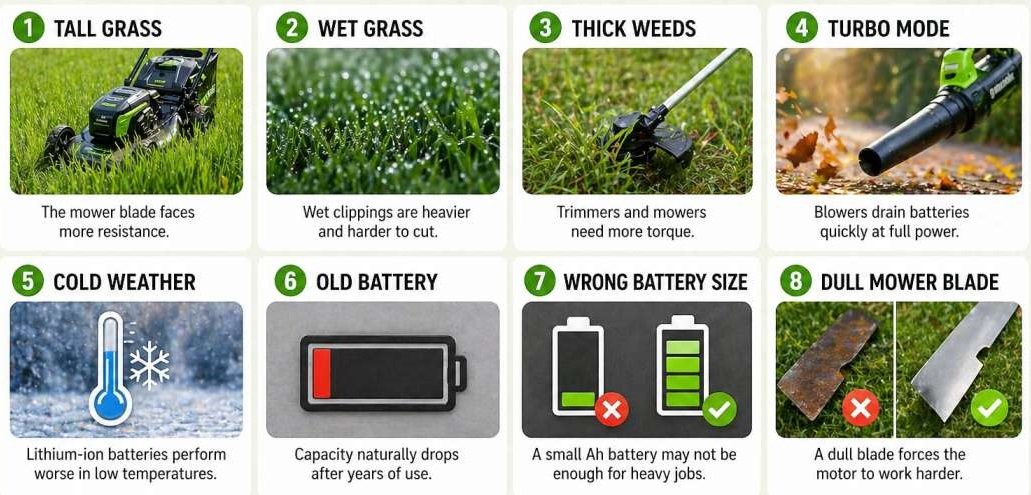
The biggest runtime factor is workload. If the motor has to work harder, the battery drains faster. This is why a mower may run well on short, dry grass but lose runtime quickly in tall, wet, or thick grass.
Here are the most common reasons a Greenworks battery does not last as long as expected:
- Tall grass: The mower blade faces more resistance.
- Wet grass: Wet clippings are heavier and harder to cut.
- Thick weeds: Trimmers and mowers need more torque.
- Turbo mode: Blowers drain batteries quickly at full power.
- Cold weather: Lithium-ion batteries perform worse in low temperatures.
- Old battery: Capacity naturally drops after years of use.
- Wrong battery size: A small Ah battery may not be enough for heavy jobs.
- Dull mower blade: A dull blade forces the motor to work harder.
If your battery runtime suddenly feels poor, do not assume the battery is bad immediately. First check the grass condition, blade sharpness, temperature, charger, and whether the battery is fully seated in the tool.
How Long Do Greenworks Batteries Last Overall?
Most Greenworks lithium-ion batteries should last about 3 to 5 years with normal care. In charge-cycle terms, many batteries stay useful for around 300 to 500 cycles. Some may last longer if used gently and stored properly.
A battery does not usually fail all at once. Instead, it slowly loses capacity. After a few years, you may notice that the same battery no longer runs your mower or trimmer as long as it once did.
The safer expectation for most homeowners is 3 to 5 years. Some batteries may last beyond that, but performance usually depends on charging habits, storage temperature, workload, and how often the battery is deeply discharged.
How to Make a Greenworks Battery Last Longer
You can extend battery life by reducing heat, avoiding deep discharge, and storing the battery correctly. Lithium-ion batteries do not like extreme heat, freezing conditions, or sitting empty for long periods.
- Do not store the battery fully empty. Recharge it before long-term storage.
- Avoid extreme heat. Do not leave the battery in a hot shed, car, or direct sun.
- Avoid freezing storage. Very cold conditions can reduce performance.
- Let the battery cool before charging. Charging a hot battery can stress the cells.
- Use the correct Greenworks charger. Avoid random third-party chargers.
- Keep terminals clean and dry. Dirty contacts can cause connection issues.
- Do not force the tool in heavy conditions. Slow down in tall or wet grass.
- Sharpen mower blades. A sharp blade reduces motor load and battery drain.
For long-term storage, it is better to keep the battery partially charged instead of completely full or completely empty. A storage charge around 40% to 60% is generally healthier for lithium-ion batteries.
Charging Mistakes That Reduce Battery Life
Charging habits can affect how long your Greenworks battery lasts overall. A charger does not just refill the battery; it also manages heat, voltage, and battery protection. Using the wrong charger or charging in bad conditions can shorten battery life.
A rapid charger is useful when you need to get back to work quickly. However, faster charging does not make the battery run longer. It only reduces downtime between uses.
Charger Time Versus Battery Runtime
Charging time and runtime are different. Charging time tells you how long it takes to refill the battery. Runtime tells you how long the battery powers the tool after charging.
If you have a large yard, buying a second battery may be more useful than relying only on a faster charger. One battery can charge while the other is being used.
Best Greenworks Battery Size by Yard Size
The right battery size depends on your yard and tool. A small battery may be fine for trimming, but mowing usually needs more capacity.
If you regularly run out of charge before finishing the job, the problem may not be the battery brand. You may simply need a higher Ah battery or a second pack.
Signs Your Greenworks Battery Is Getting Weak
The easiest sign of battery aging is shorter runtime. If the same battery used to finish your yard but now stops halfway through, the pack may be losing capacity.
- The battery drains much faster than before.
- The tool feels weaker under normal load.
- The battery takes longer to charge than usual.
- The charger shows an error light.
- The battery gets unusually hot during use or charging.
- The tool shuts off even when the battery shows some charge.
- The battery only works for a few minutes after a full charge.
One bad runtime session does not always mean the battery is failing. Wet grass, cold weather, or a dull blade can make a healthy battery seem weak. Look for a repeated pattern before replacing the battery.
Why Your Greenworks Battery Dies Fast
If your Greenworks battery dies fast, the cause may be simple. The battery may be too small for the tool, the workload may be too heavy, or the battery may be aging.
Can You Leave a Greenworks Battery on the Charger?
Modern lithium-ion chargers are designed with charging protection, but it is still better not to leave the battery on the charger for weeks or months. Once the battery is fully charged, remove it and store it in a cool, dry place.
For everyday use, leaving the battery on the charger for a short time after it finishes charging is usually not a major issue. For long-term storage, however, keeping it off the charger and partially charged is the safer habit.
Can You Use a Higher Ah Greenworks Battery?
In many cases, you can use a higher Ah Greenworks battery if it is from the same compatible voltage platform and physically fits the tool. For example, a 40V Greenworks tool generally needs a compatible 40V Greenworks battery, not a 60V or 80V battery.
The Ah rating affects capacity, not voltage. A higher Ah battery usually gives longer runtime, but it may also be heavier. That extra weight may be noticeable in handheld tools like trimmers, blowers, and chainsaws.
Can You Rebuild or Replace Greenworks Battery Cells?
Technically, lithium-ion battery packs can be rebuilt by replacing internal cells, but it is not a good DIY job for most users. Greenworks battery packs include internal electronics, protection circuits, and welded cells. Opening the pack can be dangerous and may void warranty coverage.
If the battery is weak or damaged, the safer option is usually to replace the battery with a compatible Greenworks pack. If the battery is still under warranty, check warranty support before buying a replacement.
When Should You Replace a Greenworks Battery?
You should consider replacing the battery when the runtime drop becomes consistent and affects normal use. A battery that used to run 60 minutes but now only runs 15 to 20 minutes under the same conditions is probably near the end of its useful life.
Replace the battery if you notice:
- Major runtime loss under normal conditions
- Failure to hold a charge
- Repeated charger errors
- Swelling, cracking, or physical damage
- Unusual heat, smell, or leaking
- Tool shutdown even with light use
Do not use a damaged lithium-ion battery. If the battery case is cracked, swollen, leaking, or overheating, stop using it and follow proper battery recycling or disposal rules in your area.
What To Check Before Buying a New Battery
Before replacing your Greenworks battery, check a few simple things first. Sometimes the issue is not the battery itself.
- Check the exact Greenworks tool model number.
- Confirm the required voltage platform.
- Check the battery’s Ah rating.
- Inspect battery terminals for dirt or corrosion.
- Try charging the battery with a known working charger.
- Test the battery in another compatible Greenworks tool if available.
- Look for charger error lights or unusual blinking patterns.
- Compare runtime in normal conditions, not extreme grass or weather.
If the battery is only weak in one tool, the tool may be the issue. If the battery performs poorly in multiple tools, the battery is more likely the problem.
Final Verdict
Most Greenworks batteries last about 30 minutes to 2 hours per charge and about 3 to 5 years overall. Smaller 2Ah batteries are better for short jobs, while 4Ah, 5Ah, and higher-capacity packs are better for mowing, blowing, and larger yards.
The best way to get longer battery life is to use the right battery size, avoid heavy overload, keep mower blades sharp, charge with the correct charger, and store the battery in a cool, dry place. If runtime has dropped sharply and consistently, the battery may be aging and ready for replacement.
FAQ
How long does a Greenworks battery last on one charge?
A Greenworks battery usually lasts about 30 minutes to 2 hours on one charge. The exact runtime depends on the battery size, voltage platform, tool type, workload, and temperature.
How long do Greenworks batteries last overall?
Most Greenworks batteries last about 3 to 5 years with normal use and proper care. Some may last longer, but runtime usually drops as the battery ages.
Why does my Greenworks battery drain so fast?
Your battery may drain fast because of tall grass, wet grass, turbo mode, cold weather, a dull mower blade, a small Ah battery, or normal battery aging.
Does a higher Ah Greenworks battery last longer?
Yes, a higher Ah battery usually lasts longer on one charge when used in the same compatible tool. However, heavy workload can still reduce runtime.
Is it okay to leave a Greenworks battery on the charger?
It is usually okay for a short time after charging, but it is better to remove the battery once fully charged. For long-term storage, keep it partially charged in a cool, dry place.
Should I store my Greenworks battery fully charged?
For long-term storage, it is better to store the battery around 40% to 60% charged. Avoid storing it fully empty or in extreme heat.
Can cold weather reduce Greenworks battery runtime?
Yes. Cold weather can reduce lithium-ion battery performance. The battery may run shorter in winter or cold morning conditions.
When should I replace my Greenworks battery?
Replace it when runtime becomes consistently poor, the battery will not hold a charge, the charger shows repeated errors, or the battery becomes damaged, swollen, or unusually hot.
Can I use an 80V Greenworks battery in a 40V tool?
No. You must use the correct voltage platform. A 40V tool needs a compatible 40V battery, while an 80V tool needs a compatible 80V battery.
Is a rapid charger bad for Greenworks batteries?
A rapid charger is useful for reducing downtime. However, for best battery health, avoid charging a very hot or very cold battery and always use the correct compatible charger.

- 10 Best Battery For Generator Battery Powered Lighting 2026 - October 11, 2026
- 10 Best Battery For Generator Battery Power Upgrade 2026 - October 11, 2026
- 10 Best Battery For Generator Battery Power System 2026 - October 11, 2026