What Is A Simple Battery Charge?
Charging a battery seems straightforward, plug it in, wait, done, but the method matters depending on what you’re powering.
Whether you need a gentle trickle to keep things topped off during storage or a rapid boost for a dead cell, picking the right approach prevents permanent damage and squeezes more life out of your batteries.
This breakdown covers the basics and points toward chargers that handle the job without fuss.
How Battery Charging Works
Recommended Products


Knowing how charging actually works helps you cut through the marketing noise. Batteries store energy via chemical reactions, and a charger simply reverses that process to put capacity back. The trick is matching the charger’s output to exactly what the battery can safely accept.
At its core, charging replenishes electrical energy by reversing discharge chemistry. But not all cells play by the same rules: lead-acid, lithium-ion, and nickel-metal hydride each have specific voltage and current limits.
Basic chargers push a steady stream until full, while smarter units tweak their output based on temperature and charge state. The goal isn’t just speed, it’s avoiding heat spikes, sulfation, or other stressors that kill batteries early.
Common Charging Methods
| Method | Use Case | Best For |
|---|---|---|
| Trickle Charging | Slow, constant charge | Maintenance for stored batteries |
| Rapid Charging | Fast power restoration | Emergency or time-sensitive needs |
| Smart Charging | Adjusts based on battery state | Long-term health and safety |
| Desulfation | Removes sulfate buildup | Reviving old or neglected batteries |
When Simple Charging Is Enough
Recommended Products


You don’t always need a high-tech rig. Simple charging fits fine when the battery is healthy and the specs align. Recognizing when basic gear suffices saves money and skips unnecessary complexity.
- Battery holds a charge but is slightly depleted.
- No visible damage or corrosion on terminals.
- Charger voltage matches battery requirements.
- Battery is not deeply discharged or sulfated.
- Ambient temperature is within safe charging range.
For routine upkeep or minor dips, a simple charge does the job. A trickle charger, for instance, keeps a car battery ready during winter months without risking overfill. Likewise, a standard smart unit handles a motorcycle battery that’s sagged but still alive.
However, if a battery is deeply drained or showing signs of wear, you’ll likely want features like desulfation or temp compensation to bring it back safely rather than forcing power into compromised cells.
Chargers That Simplify Battery Charging
Recommended Products


The best charger makes maintenance feel automatic rather than technical. Below are options ranging from low-amperage maintainers to heavy-duty recoveries, all focused on keeping your batteries safe and functional.
|
1
|
NOCO GENIUS1 1A 6/12V Smart Battery Charger, Trickle Charger & Maintainer | Overcharge Pro |

The NOCO GENIUS1 packs precision safety into a tiny footprint for mixed battery types.
This compact unit doubles as a charger, maintainer, and desulfator for both 6V and 12V lead-acid and lithium setups. Its thermal sensor tweaks the charge rate based on room temperature, stopping overheating in summer and undercharging in winter.
It can even wake up batteries down to 1 volt, which makes it surprisingly flexible for both light duty and rescue jobs.
If you want one reliable tool for various small batteries, this fits well. It’s easy to stash in a glovebox or garage shelf thanks to its size. The trade-off is the 1A output; larger batteries will take noticeably longer here compared to higher-amperage models.
|
2
|
NOCO GENIUS5 5A 6/12V Smart Battery Charger, Trickle Charger & Maintainer | Overcharge Pro |

The NOCO GENIUS5 balances quicker turnaround times with the same protective smarts.
Stepping up to 5A gives you faster results than the GENIUS1 without losing the safety nets. You get the same temperature adjustments, desulfation cycles, and Force Mode for reviving dead cells.
It handles 6V and 12V lead-acid and lithium batteries, striking a middle ground between speed and versatility for general users.
This suits people who find trickle charging too slow but don’t need industrial-grade power. It remains compact and user-friendly. Still, for massive RV or marine banks, 5A might feel like a drop in the bucket regarding total charge time.
|
3
|
POWEROWL 8 Bay AA AAA Battery Charger, USB High-Speed Charging, Independent Slot, for Ni-M |
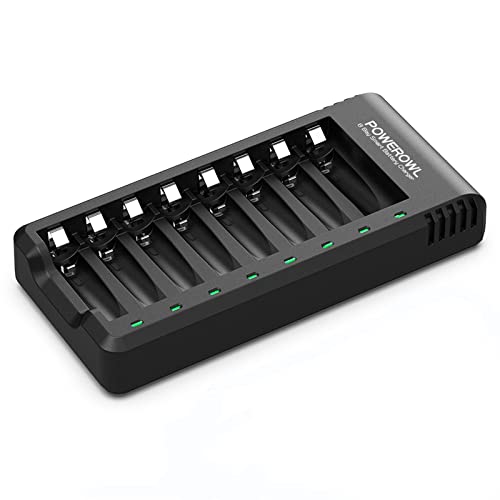
The POWEROWL 8-bay charger takes the hassle out of managing multiple AA and AAA cells.
Designed specifically for Ni-MH and Ni-CD rechargeables, this unit lets you load eight slots independently. It cuts power automatically once cells are full, preventing overcharge damage, and runs off USB so you can plug it into almost anything. The layout is tidy and built for everyday home use.
Households juggling flashlights, remotes, and toys will appreciate the batch processing. One catch: it doesn’t include a wall adapter, so you’ll need to supply your own USB source. Also, keep it strictly for small cylindrical batteries, it won’t touch car or marine sizes.
|
4
|
NOCO GENIUS10 10A 6/12V Smart Battery Charger, Trickle Charger & Maintainer | Overcharge P |
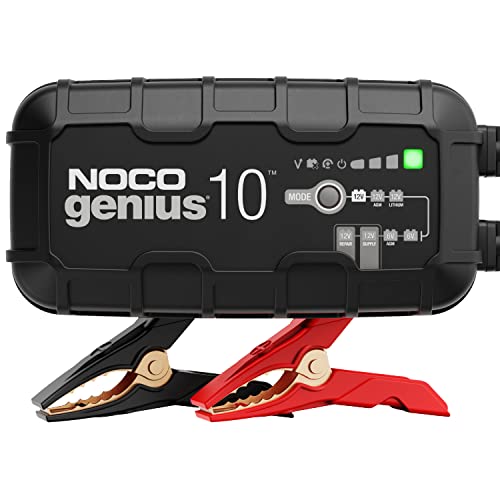
The NOCO GENIUS10 brings serious amperage to larger vehicle and deep-cycle applications.
With 10A output, this model targets bigger 6V and 12V batteries found in cars, boats, and RVs. It retains the family’s smart traits, temp compensation, desulfation, and revival modes, while cutting down wait times significantly. Monitoring adjusts dynamically to keep efficiency high during long-term storage.
Ideal for owners of larger vehicles or those maintaining deep-cycle banks where speed matters. The 10A flow clears bottlenecks faster than smaller units. Be aware, though, that it’s physically bulkier than its lower-power siblings, taking up more space on the bench.
|
5
|
E-FAST 25A Smart Car Battery Charger, 12V/24V Automatic Automotive Battery Maintainer & De |

The E-FAST 25A charger pairs rapid recovery with an emergency jump-start function.
Built for 12V and 24V systems, this unit offers adjustable currents from 2A up to 25A. It includes a dedicated booster mode that delivers a surge for 200 seconds to help crank dead engines, alongside an 8-stage process with repair capabilities. The aluminum casing helps dissipate heat during intense sessions.
This is a workhorse for trucks, SUVs, and boats needing quick turnarounds or occasional starting assistance. It’s overkill for small lawn equipment, though. Note that the jump-start feature only applies to 12V batteries, limiting its utility for 24V systems in that specific regard.
|
6
|
TowerTop 2/10/25 Amp 12V Smart Car Battery Charger, Fully Automatic Battery Maintainer wit |

The TowerTop charger mixes flexible amperage settings with automated repair routines.
Offering four current levels (2A/10A/25A/Auto), this unit adapts to different battery sizes efficiently. It claims to fill a 100Ah battery in under 3. 5 hours at max output.
The system runs an 8-stage cycle including desulfation, displays status on an LCD, and switches to pulse repair after full charge to maintain health.
Users wanting control over charge speed plus advanced restoration features will like this setup. The fast-charging capability is genuinely useful for large banks. Just remember that maximizing the repair benefits requires letting the device run its course uninterrupted.
|
7
|
Schumacher Electric 15A Car Battery Charger & Maintainer, 6V/12V – SC1280 | 3A Trickle Cha |

The Schumacher SC1280 consolidates charging, testing, and restoring into one handheld-style unit.
This 4-in-1 device handles 6V and 12V batteries with a 15A rapid charge option and smart trickle maintenance. It also tests battery health and runs desulfation cycles. Microprocessor control manages the stages, aiming to simplify the workflow for automotive and marine owners.
Good for anyone preferring a single gadget that diagnoses issues before fixing them. The added testing layer provides insight beyond just ‘is it charged?’. The missing piece here is a dedicated engine start assist, so it’s purely for servicing batteries, not cranking engines directly.
|
8
|
Schumacher Electric Wheeled 6/12V 250A Car Battery Starter/Charger – SC1445 | Manual Timer |

The Schumacher SC1445 prioritizes raw power and manual control for heavy-duty tasks.
Mounted on wheels for mobility, this unit boasts a 250A engine start capability and substantial boost charges. It uses a manual timer for precise control over duration across 6V and 12V systems. The build focuses on durability and delivering high amps for stubborn starts or large-capacity needs.
Best suited for workshops or garages dealing with large vehicles frequently. The manual nature means you stay involved in the process, lacking the set-and-forget automation of newer smart chargers. Portability is helped by the wheeled base, despite the heavier weight.
|
9
|
Car Battery Charger 12V 15A Smart Trickle Charger Fully Automatic | Battery Maintainer wit |

This 15A smart charger emphasizes seasonal adaptation and visual monitoring.
Targeted at 12V lead-acid and lithium batteries, it offers distinct Winter and Summer modes that adjust voltage based on ambient conditions. An LCD screen tracks progress in real-time, and pulse repair aims to extend longevity. It balances power delivery with contextual awareness.
A strong contender if you value clear feedback and climate-aware charging. The seasonal switching protects against common weather-related inefficiencies. One constraint: unattended operation caps around 12 hours, meaning you shouldn’t leave it running indefinitely without checking in.
|
10
|
Schumacher Electric 6A Car Battery Charger & Maintainer, 6V/12V – SC1281 | 100A Engine Sta |

The Schumacher SC1281 expands functionality to include engine starting alongside maintenance.
Acting as a 5-in-1 hub, it starts engines (up to 100A), charges, maintains, tests, and restores 6V and 12V batteries. Boost charges range from 12A to 30A. Multi-stage algorithms manage the process to optimize battery health while providing immediate starting power when needed.
Comprehensive care in one box, especially valuable for drivers facing cold mornings or neglected batteries. The inclusion of starting power adds significant utility over pure chargers. Downside is the physical bulk; it’s less convenient to store than slimmer alternatives.
From household AA management to truck-sized recovery, these units address distinct scenarios. Some focus on gentle preservation, others on brute-force restarts. Each simplifies the task at hand while guarding against common pitfalls like overcharging or sulfation.
How To Choose the Right Charger for Your Battery
Recommended Products


Choosing correctly hinges on matching the tool to the battery’s chemistry and capacity. Misalignment risks damage or wasted potential. Here’s what to weigh before buying.
Match Voltage and Chemistry
Voltage match is non-negotiable. Most automotive setups are 12V, but some smaller electronics use 6V. Chemistry compatibility matters equally, lithium needs different handling than lead-acid or nickel. Plugging a mismatched charger into a sensitive cell can cause failure or worse.
Consider Amperage Needs
Amperage dictates speed. High-output units refill large batteries quickly but aren’t essential for small ones. A 1-2A charger suffices for maintaining motorcycles or lawnmowers, whereas 10A+ helps with RVs or boats. Buying excess power often just costs more upfront unless you regularly service big banks.
Look for Smart Features
Smart features pay dividends over time. Temperature compensation, auto-shutoff, and desulfation protect battery integrity far better than dumb chargers. If you plan to keep batteries for years, investing in intelligence reduces replacement frequency and hassle.
Maintaining Your Charger and Battery
Longevity depends on consistent habits. Small oversights accumulate into major failures. Keep these practices in mind to preserve both the charger and the cells.
- Clean battery terminals regularly to prevent corrosion.
- Store batteries in a cool, dry place to avoid temperature extremes.
- Unplug chargers when not in use to prevent electrical hazards.
- Check battery voltage monthly if stored for long periods.
- Use desulfation mode periodically to maintain battery health.
- Avoid leaving batteries deeply discharged for extended periods.
Maintenance isn’t just for cars. Wiping terminals clean ensures proper contact, reducing resistance and heat. Utilizing desulfation modes actively fights the buildup that kills lead-acid batteries prematurely. Storage location counts too, keeping batteries away from extreme temperatures preserves their internal structure.
These steps compound to deliver more reliable performance season after season.
Common Mistakes To Avoid
Avoidable errors ruin good batteries. Understanding common traps helps you steer clear of them and maximize your equipment’s lifespan.
Never mix battery chemistries when charging; use a compatible charger for each type.
Avoid charging a frozen battery, as it can cause internal damage or explosions.
Do not leave a battery connected to a non-smart charger indefinitely, risking overcharge.
Check connections before starting to prevent sparks or poor contact.
Monitor charging progress for non-automatic chargers to prevent overcharging.
Using incompatible chargers is risky; putting a lead-acid profile onto lithium cells can trigger thermal runaway. Letting batteries sit completely dead for extended periods leads to irreversible sulfation, rendering them useless regardless of charger quality. Vigilance on these fronts keeps your investment protected and your devices operational.
Effective charging comes down to alignment: correct voltage, appropriate amperage, and compatible chemistry. Start by auditing your existing batteries’ needs, then select a charger that addresses those specifics without overshooting. Review your current setup today, if it lacks modern safeguards, upgrading could save you headaches later.

- 10 Best Battery For Generator Ev Battery Bank Marine 2026 - October 27, 2026
- 10 Best Battery For Generator Ev Battery Bank Lto 2026 - October 27, 2026
- 10 Best Battery For Generator Ev Battery Bank Low Voltage 2026 - October 27, 2026