Difference Between Car Battery And Marine Battery
A car battery and a marine battery both supply 12 volts, but the single most important spec to watch is whether the cell is a starting or deep-cycle type. A common mistake is using a starting car battery to run boat house loads, which causes early failure. First check the battery label for 12V and the words “starting”, “deep-cycle”, or “marine”, plus CCA or reserve capacity.
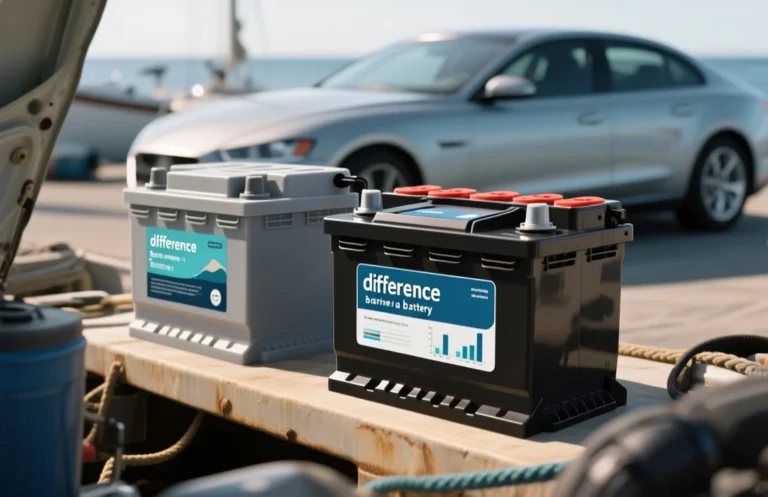
Difference between car battery and marine battery: both are 12V lead-acid batteries, but car batteries are tuned for short, high-current engine starts while marine batteries are built for repeated partial discharges and continuous house loads, and are often sold as “deep-cycle” or “dual-purpose”.
Car vs Marine Primer
Car batteries are built to deliver a large, short-duration current to crank an engine and then accept a quick recharge, while marine batteries are made to tolerate repeated shallow discharges, extra vibration, and sometimes continuous accessory loads. Manufacturers offer three functional types: starting, deep-cycle, and dual-purpose, and “marine” on the label usually means the battery is intended for boat environments rather than describing a single, standard build.
Starting batteries, often lead-acid sealed lead acid (SLA) or flooded types, have thinner plates that give high surface area for a strong cold start current but they lose life quickly if deeply discharged. Deep-cycle batteries have thicker plates and heavier internal structure so they can deliver steady current over longer periods and survive many more shallow discharge cycles. Dual-purpose batteries are a design compromise, thicker plates than starting batteries but thinner than true deep-cycle units, to handle occasional deep draws and engine starts.
Construction differences matter more than the “marine” badge. Plate thickness is the main physical change between starting and deep-cycle batteries; thicker plates reduce active material shedding during repeated cycles. Separators, glass-mat or gel, control electrolyte behavior and vibration protection. Marine designs often add stronger cases, reinforced terminals, and baffle paths to reduce electrolyte slosh when tilted or underway.
| Attribute | Starting | Deep-cycle | Dual-purpose / Marine-labelled |
|---|---|---|---|
| Primary use | Engine cranking | House loads, trolling motors | Both, compromise |
| Plate thickness | Thin | Thick | Intermediate |
| Cycle tolerance | Low | High | Moderate |
| Vibration / tilt | Standard | Improved | Often improved |
Label “marine” is not a single specification. Treat it as a usage hint and verify chemistry, Ah rating, cycle life, and mounting recommendations before buying.
For example, a weekend boat with a small outboard and a stereo wants a deep-cycle or dual-purpose battery that can run accessories without killing cranking ability; a car only needs a starting battery. Match the battery type to how you actually use the vehicle or boat, not to the badge on the case.
Performance Specs Compared
Marine batteries are built to deliver both high starting current and sustained accessory loads, so they usually show higher reserve capacity and better cycle tolerance for repeated partial discharges. Car batteries are optimized for very high peak cold cranking amps for short starts and typically have lower cycle life and smaller reserve capacity.
| Spec | What the label shows | Typical car battery | Typical marine battery | How it affects selection |
|---|---|---|---|---|
| Capacity (Ah) | Ampere-hours at 20 hour or specified rate | Moderate Ah, sized to start engine | Higher Ah options for longer accessory runs | Higher Ah gives longer runtime for accessories; verify usable DoD limits |
| Cold Cranking Amps (CCA) | Instant current available at low temp | High CCA priority | Good CCA but often lower than starting-focused car units | If you need short, reliable starts in cold, favor higher CCA |
| Reserve Capacity (RC) | Minutes at 25 A until voltage falls below cutoff | Lower RC | Higher RC for sustained loads | Higher RC means more runtime for lights, pumps, electronics |
| Cycle life | Number of partial/full cycles at specified DoD | Lower cycle tolerance | Higher cycle tolerance, thicker plates or different construction | Choose higher cycle life if you will discharge regularly |
| Weight / Dimensions | Group size and physical footprint | Optimized for engine bay fit | Varied sizes to fit consoles and trays | Check physical fit and terminal orientation before buying |
| Chemistry / Construction | Flooded, AGM, Gel, or hybrid | Mostly flooded or AGM for starts | AGM and flooded common; some are dual-purpose or deep-cycle | Chemistry affects charging profile and maintenance requirements |
Ah versus watts versus usable energy is a key practical check. Convert to watt-hours with the formula Wh = Volts × Ah, then multiply by expected depth of discharge to estimate usable Wh for runtime calculations.
For example, a 12 volt, 70 Ah battery has about 840 Wh of stored energy; at 50 percent usable DoD you can expect roughly 420 Wh available to run loads before recharge is required. Use that math to compare how long accessories will run on a car battery versus a marine battery with higher Ah or RC.
Label diagram example (top to bottom): Brand / Model | Group Size | Voltage | Ah (20h) | CCA | Reserve Capacity | Chemistry | Date Code | Terminal Type
Starting vs Deep-Cycle Roles
Car batteries are optimized to deliver a very large burst of current for a few seconds to crank an engine, while marine and deep-cycle batteries are built to supply steady current over hours and survive many repeated deep discharges. Using the wrong type for the job shortens life: a car battery will degrade quickly under frequent deep discharge, and a true deep-cycle battery will deliver weaker cranking performance.
Cranking current needs drive plate design. Car batteries use thinner, more numerous plates to increase surface area and produce high instantaneous current. Those thin plates accept rapid chemical reaction but wear faster when cycled deeply, because the active material sheds and the plates corrode.
Deep-cycle batteries use thicker, denser plates so they can be discharged and recharged repeatedly with less loss of active material. Thicker plates trade off peak current for durability; they have lower cold-start punch but higher usable capacity over many cycles and better recovery after deep discharge.
For example, a small boat that runs electronics and occasionally starts an outboard needs different performance than a commuter car. If the boat relies on onboard accessories while the engine is off, a deep-cycle or dual-purpose battery is better, but if you need strong cranking every start and can avoid deep draws, a starting battery is the right fit.
| Characteristic | Starting (Car) | Marine / Deep-Cycle |
|---|---|---|
| Primary role | Short high-current start | Sustained discharge, repeated cycles |
| Plate design | Thinner, high surface area | Thicker, durable active mass |
| Usable capacity | Low for deep discharge | Higher for repeated deep discharge |
| Recovery after deep drain | Poor, shortens life | Better, designed for it |
Using a starting battery as a house battery will reduce its life quickly; using a deep-cycle battery to crank a large engine may leave you with slow starts or repeated jump starts.
Safety reminder: avoid discharged, swollen, or overheated batteries and verify specs before swapping types. Choose the battery whose strengths match the dominant load, and accept tradeoffs when you need one battery to cover both roles.
Charger and Charging Compatibility
Car batteries and marine batteries need different charging approaches: car starting batteries tolerate fast alternator charging designed to restore a near-full starting charge, while marine deep-cycle and dual-purpose batteries need multi-stage charging and accurate voltage control to avoid undercharge or damage. Mis-matched chargers or alternators will shorten life, so always match the charger profile to the battery type shown on the battery label or manual.
Alternators on cars and boats deliver high current quickly but are often a single-stage source that rides up in voltage with engine RPM and load, which is fine for starting batteries but rough on deep-cycle bank charging. Shore power multi-stage chargers (bulk, absorption, float) and modern smart chargers apply controlled voltages and timed transitions that finish capacity and then float safely for long-term use.
For example, using only the alternator to recharge a discharged marine house bank after long use can leave the battery under-absorbed, causing sulfation or reduced capacity in flooded and some AGM batteries. Conversely, setting a shore charger to an aggressively high absorption voltage for a gel battery can permanently reduce capacity.
| Battery Type | Typical Bulk/Absorption | Typical Float | Note |
|---|---|---|---|
| Flooded (wet) | Approximately 14.4 to 14.8 V | Approximately 13.2 to 13.8 V | Needs watering and temperature compensation, verify manual |
| AGM | Approximately 14.2 to 14.6 V | Approximately 13.2 to 13.8 V | Handles faster charge but still needs proper absorption timing |
| Gel | Approximately 13.8 to 14.1 V | Approximately 13.2 to 13.6 V | Sensitive to over-voltage, follow manufacturer spec exactly |
| Lithium (LiFePO4) | Manufacturer defined, often 14.2 to 14.6 V | Not all lithium batteries require float; check manual | Needs BMS and specific charge profile, do not use generic settings |
Battery isolators and combiner switches keep a starting battery isolated from house or trolling banks so a discharged house bank cannot kill the starter. Automatic combiner relays and smart isolators can close during charging, but they do not manage charge profile or absorption timing. For true profile control and to handle long cable runs, a DC-to-DC charger between alternator and house bank is the safer choice because it produces the correct multi-stage profile and compensates for voltage drop.
Safety warning: Never apply a high absorption voltage meant for flooded cells to a gel battery, and never mix charge profiles across batteries of different chemistries without an isolator or DC-to-DC charger; doing so can permanently damage the batteries and create a fire risk.
Safety, Heat, Storage
Marine batteries are built to tolerate repeated deep or partial discharges, continuous charging from onboard systems, and heavy vibration, while car batteries are built to deliver short, very high cranking current and are less tolerant of deep discharge and prolonged nonstandard charging. Because of those different duties, venting behavior, thermal risk, mounting needs, and storage practices differ and must be matched to the battery type and its chemistry.
For example, a dual-purpose marine cranking battery may handle vibration and short cycling better than a plain automotive starting battery, but it can still vent hydrogen if overcharged; treat it like a venting device and keep charging systems in check. Verify the battery label and manual for venting and charging limits before installation.
Maintenance and Troubleshooting
Marine batteries and car batteries require different upkeep because marine batteries are often used for deep-discharge cycles and live in a harsher, vibratory, salty environment, while car batteries are optimized for short high-current starts and regular charging by the alternator. Treat flooded cells and sealed batteries differently, and follow a clear testing sequence to decide repair versus replacement.
For example, if a marine deep-cycle battery shows low hydrometer readings in several cells after charging, and load testing shows rapid voltage drop, document specific gravity, load results, dates, purchase receipt, serial number, and photos before contacting the seller for warranty claim steps. Keep all test logs and original packaging when possible, because manufacturers often request those when evaluating failures.
Choosing Between Them
Car batteries are built for short, high-current bursts to crank an engine, while marine batteries are built to handle both starting and extended deep discharge cycles, plus extra vibration and corrosion resistance. Choose a starting battery for daily drivers, a deep-cycle battery for house loads and trolling motors, and a dual-purpose marine battery when you need both functions occasionally.
| Attribute | Car (Starting) | Marine (Deep-cycle / Dual) |
|---|---|---|
| Primary design | High current for seconds | Sustained discharge and vibration resistance |
| Spec emphasis | Cold cranking amps | Amp-hours and reserve capacity |
| Use case | Daily starts | House loads, trolling, occasional starts |
Use separate cranking and house batteries when you need both reliable engine starts and long run-time; connect them with an automatic isolator or battery combiner so one bank cannot drain the other. For heavy house loads, a battery bank of matched deep-cycle units or a lithium bank gives better usable capacity and longer cycle life than a single dual-purpose battery.
Weigh upfront cost against cycle life and warranty, because cheaper starting batteries will fail sooner under deep-cycle use. If a battery swells, overheats, or loses capacity quickly, replace it and verify the charger profile to prevent repeat failures. Always check the manufacturer’s warranty terms for expected cycle count and application limits before buying.
Quick Summary
Car batteries are optimized for short, high-current engine starts, while marine batteries are built for longer deep-cycle use and marine conditions.
Frequently Asked Questions
What is the main difference between a car battery and a marine battery?
The main difference is that a marine battery is designed to handle deep discharges, while a car battery is built primarily for starting engines. This allows marine batteries to provide power over longer periods, which is essential for boats and other marine applications.
Can I use a car battery to power a marine application?
While you can use a car battery for marine applications, it is not recommended because car batteries are not designed for deep cycling. Using a car battery in this way can lead to quicker battery failure, as they are intended for short bursts of power.
How long can a marine battery run compared to a car battery?
A marine battery can typically run for several hours to a full day depending on its capacity and the load, while a car battery is meant for brief usage. This makes marine batteries more suitable for sustained power demands.
Are there safety concerns when using a car battery in a marine environment?
Yes, using a car battery in a marine environment can present safety risks, such as the potential for corrosion and reduced performance due to exposure to water. Marine batteries are specifically designed to withstand these conditions better than car batteries.
When should I replace my marine battery compared to my car battery?
Marine batteries typically need to be replaced every 3 to 5 years, while car batteries last around 3 to 7 years depending on use and maintenance. Regularly checking voltage and performance can help determine the right replacement timing for both types.

- Top 10 Best Solar Battery Installers Qld 2026 - September 12, 2026
- Top 10 Best Solar Battery Deals Qld Reviews 2026 - September 12, 2026
- Top 10 Best Solar Battery Deals Qld Price 2026 - September 12, 2026