How Long Will A Hybrid Car Starting Battery Last?
Your hybrid’s 12-volt battery is crucial for starting the engine and powering essential systems. It endures more stress than a regular car battery, often lasting between three and five years. Factors like heat, driving habits, and the battery type you choose can influence its lifespan.
Understanding these factors can help you extend your battery’s life and avoid unexpected breakdowns.
Why Hybrid Starting Batteries Wear Out Faster
Recommended Products


A hybrid’s 12-volt battery has a different role than a conventional car battery. It powers computers, contactors, and cooling fans, and is recharged by the hybrid system. This unique role affects how long it lasts.
In a regular car, the 12-volt battery gets a full charge every time you drive. However, a hybrid’s DC-DC converter only charges the 12-volt battery when the hybrid system is active. This partial-state-of-charge life can lead to sulfation, a buildup that reduces battery capacity.
Add engine-bay heat, which accelerates corrosion, and you get a battery that ages faster than one in a plain gas sedan. Most hybrid 12-volt batteries last between three to five years, but with gentle use, some owners see six or seven years.
What Shortens Or Stretches Hybrid 12V Battery Life
| Factor | Effect On Lifespan | Why |
|---|---|---|
| Hot climate | Shortens it | Heat speeds plate corrosion |
| Frequent short trips | Shortens it | Battery never fully recharges |
| Long daily commutes | Stretches it | Steady recharge cycles |
| Battery type (AGM vs flooded) | AGM lasts longer | Better cycling tolerance |
| Sitting unused for weeks | Shortens it | Gradual self-discharge sulfates plates |
| Extreme cold | Shortens it | Slows chemical reactions, stresses cells |
- Dashboard lights flicker or dim when you press the start button
- The hybrid system takes longer to boot up than it used to
- You hear a weak click instead of a normal startup chime
- The car needs a jump start after sitting overnight
- Headlights look dimmer at idle than they did a year ago
- The battery is more than four years old and shows any of these signs
How Driving Habits Change The Answer
Recommended Products

The lifespan of a hybrid 12-volt battery can vary significantly between owners. This difference often comes down to how the car is driven and where it is parked.
Why Five-Minute Errands Hurt
Every time you start your hybrid, the 12-volt battery takes a small hit to run the computers and contactors. The DC-DC converter then recharges it, but this recharge takes time. If your typical trip is a quick drive to the store, the battery may not get back to full.
Over time, this partial-state-of-charge life can lead to sulfation. Owners who mostly run short errands often replace their hybrid 12-volt battery closer to the three-year mark, while long commuters can stretch their battery life to five or six years.
Heat Versus Cold
Heat has a more significant long-term impact on a 12-volt battery than cold weather. A battery that lives in a hot engine bay will corrode internally faster than one in a mild climate.
While cold weather can make the battery sluggish, it mostly exposes a battery that heat has already weakened. If you park in a garage and live in a moderate climate, you can expect the upper end of the lifespan range.
If your hybrid bakes in the sun every day, plan for the lower end.
Drive at least 20 minutes a few times a week so the DC-DC converter can fully recharge the battery.
Avoid leaving the car parked for weeks at a time; if you must, use a maintainer.
Keep the battery terminals clean and tight; corrosion adds resistance and slows charging.
Test the battery annually after year two with a conductance tester, not just a voltage check.
Replace with an AGM battery rated for start-stop duty rather than a cheaper flooded unit.
Batteries That Keep A Hybrid Starting Reliably
Recommended Products


The batteries below are designed to fit the specific demands of a hybrid 12-volt system. They feature AGM construction, start-stop ratings, and enough reserve capacity to run accessories when the engine is off.
Each one is a real solution to the lifespan question, as the right battery type can help you reach the top of the three-to-five-year range.
|
1
|
Weize Platinum AGM Battery BCI Group 49-12v 95ah H8 Size 49 Automotive Battery, 160RC, 900 |

Its 95Ah capacity and 900CCA give a hybrid the deep cycling and cold-start grunt that stretch lifespan.
The Weize Platinum AGM Group 49 is a high-capacity battery with 95Ah, 900 cold cranking amps, and a 160-minute reserve capacity. This reserve rating is crucial for hybrids, as it means the battery can run computers and accessories longer before the DC-DC converter needs to top it up.
The AGM design is also well-suited for the partial-state-of-charge cycling that hybrid 12-volt systems put batteries through. Weize rates it for up to twice the cycle life of a conventional battery, which is exactly the trait that can push a hybrid starting battery toward the five-year end of the range.
This is a large Group 49 battery, making it suitable for bigger hybrid SUVs and crossovers with the physical space for a 13. 9-inch-long unit. The 36-month warranty is solid for the price point.
However, the main consideration is fitment: Group 49 is not universal, and the tapered terminals must match your car’s positive and negative positions. Measure your old battery and check the terminal layout before ordering, as returning a 60-pound battery can be a hassle.
|
2
|
ACDelco – Advantage AGM Hybrid Vehicle Battery |

ACDelco’s hybrid-specific AGM is built to the exact spec GM hybrids expect, which protects lifespan.
The ACDelco Advantage AGM Hybrid Vehicle Battery is designed specifically for hybrid applications, which is rare in the aftermarket. Most batteries are general-purpose; this one targets the charging profile and cycling demands a hybrid 12-volt system creates.
ACDelco notes that some GM Genuine Parts formerly appeared under this branding, so it carries OEM-adjacent credibility.
For a hybrid owner asking how long the starting battery will last, choosing a battery engineered for hybrid duty removes one of the biggest variables: a mismatched battery that dies early because it was never built for this workload.
Installation is straightforward, and the AGM construction resists the vibration and heat that hybrid engine bays produce. The main limitation is information: this listing is thin on specs like CCA, amp-hour capacity, and exact dimensions, so you will need to confirm fitment through your vehicle’s Group size.
It is best suited to owners who want a hybrid-specific battery and are willing to verify compatibility rather than buy purely on specs.
|
3
|
Weize Platinum AGM Battery BCI Group 48-12v 70ah H6 Size 48 Automotive Battery, 120RC, 760 |

The 70Ah, 760CCA Group 48 AGM gives mid-size hybrids the cycling tolerance and cranking power they need.
The Weize Platinum AGM Group 48 is the smaller sibling of the Group 49, with 70Ah capacity, 760 cold cranking amps, and a 120-minute reserve. Group 48 is one of the most common hybrid 12-volt sizes, fitting many mid-size hybrid sedans and crossovers.
The AGM build handles the cycling that hybrid systems impose, and Weize rates it for up to twice the cycle life of a conventional battery.
For a hybrid owner trying to reach four or five years instead of three, that cycling durability is the key spec, and this battery delivers it at a mainstream size.
The 10. 94-inch length and tapered terminals match a wide range of vehicles, but you still need to verify terminal position before buying. The 36-month warranty is competitive.
One honest limitation: with 70Ah, it has less reserve than the Group 49, so hybrids with heavy accessory loads or long engine-off periods may drain it faster. It fits best in standard mid-size hybrids where the original battery was also a Group 48.
|
4
|
Lithium LiFePO4 Car Battery Auto Battery, 12V 40Ah, 660CCA, 100RC Deep Cycle Start and Sto |

LiFePO4 chemistry cycles far deeper than lead-acid, potentially doubling how long a hybrid starting battery lasts.
This 12V 40Ah LiFePO4 battery takes a different approach to the lifespan question. Lithium iron phosphate chemistry handles deep discharge and recharge cycles far better than lead-acid, which is the main reason hybrid 12-volt batteries wear out.
The built-in BMS protects against overcharge, over-discharge, overheating, and short circuits, and a heating function warms the cells in extreme cold. At 14. 8 pounds, it weighs a fraction of a comparable lead-acid unit.
For an owner willing to move beyond traditional batteries, this is the longest-lifespan option in the group.
The 40Ah capacity and 660CCA suit vehicles with engine displacement under 2. 0 liters, so it fits compact hybrids rather than large SUVs. The M8 screw terminals add height, bringing total height to 9. 18 inches, which you must verify against your battery tray.
It is also a bigger upfront investment than AGM. But if you plan to keep your hybrid for many years, the cycle life advantage can pay back over time.
|
5
|
UPLUS BCI Group 48 Car Battery, AGM-L70-M 12V 70Ah 760CCA 120RC AGM H6 | L3 Maintenance Fr |

UPLUS rates this Group 48 AGM at four times the cycle life of conventional batteries, directly extending hybrid lifespan.
The UPLUS AGM-L70-M is a Group 48 battery with 70Ah, 760CCA, and a 120-minute reserve, built for start-stop vehicles. UPLUS claims four times the cycle life of standard conventional batteries, thanks to high-density negative paste and a silver-calcium alloy grid.
That cycle-life claim is the heart of the answer to how long a hybrid starting battery lasts, because cycling, not cranking, is what kills these batteries. The 15-times vibration resistance and sealed, no-free-acid design also suit the underhood environment of a hybrid.
The 10. 98 x 6. 81 x 7. 51-inch footprint matches many mid-size hybrids, and the maintenance-free AGM design means no water checks. It is ideal for vehicles with large electrical loads or frequent short trips, both common in hybrid use.
The limitation is the same as any Group 48: confirm your terminal layout and dimensions first. UPLUS also recommends measuring your old battery, since a close CCA match matters less than physical fit and terminal position.
|
6
|
UPLUS BCI Group 24F AGM Car Battery, 12V 70Ah 710CCA 120RC Start-Stop | Maintenance Free P |
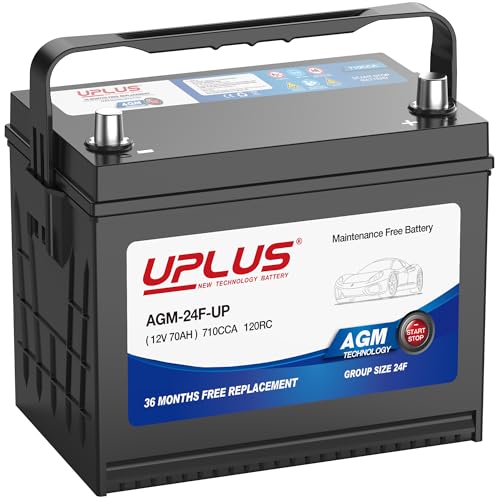
This Group 24F AGM pairs 710CCA with four-times cycle life, a strong fit for hybrids with larger electrical loads.
The UPLUS Group 24F AGM delivers 70Ah, 710 cold cranking amps, and a 120-minute reserve in a taller case, 8. 98 inches high. That extra height fits vehicles with a Group 24F tray, common in certain hybrid and start-stop models.
Like the other UPLUS AGM units, it claims four times the cycle life of conventional batteries through high-density paste and a calcium-alloy grid. For a hybrid owner, the combination of deep-cycle tolerance and strong cold-weather cranking addresses both failure modes: gradual capacity loss and hard winter starts.
The 15-times vibration resistance and vented, spill-resistant design make it durable in a hybrid engine bay. It suits vehicles with heavy accessory loads, frequent short trips, or long idle periods, all situations that stress a 12-volt battery.
The main limitation is the 24F form factor, which does not fit every hybrid. Measure your existing battery and confirm the left-negative, right-positive terminal layout before ordering.
|
7
|
UPLUS BCI Group 34/24 Car Battery, AGM-L55-UP 12V 55Ah 650CCA 120RC AGM | Maintenance Free |

Its 55Ah AGM build and four-times cycle rating fit hybrids that need a compact Group 24/34 replacement.
The UPLUS AGM-L55-UP is a Group 24 battery that replaces Group 34, with 55Ah, 650CCA, and a 120-minute reserve. It is smaller than the Group 48 and 24F options, making it the right pick for hybrids with a compact battery tray.
The AGM construction and silver-calcium alloy grid deliver the same four-times cycle-life claim as the rest of the UPLUS line, and the sealed design resists acid leakage and vibration. For a hybrid owner whose original battery was a Group 34, this is a direct-fit upgrade to a start-stop-rated AGM.
The 10. 87 x 6. 61 x 6. 89-inch case is notably shorter than the Group 24F, so height clearance is rarely an issue. It handles large electrical loads and stop-and-go driving well.
The honest limitation is capacity: at 55Ah and 650CCA, it has less reserve than the 70Ah units, so it suits smaller hybrids better than large ones. Note the terminal layout is left-positive, right-negative, which differs from most of the other batteries here.
|
8
|
UPLUS BCI Group 140R Car Battery, AGM-L50-UP 12V 50Ah 570CCA 80RC AGM H4 | LN1 Maintenance |

The 50Ah Group 140R AGM fits small hybrids and delivers the cycling durability that extends battery life.
The UPLUS AGM-L50-UP is a Group 140R (H4/LN1) battery with 50Ah, 570CCA, and an 80-minute reserve. It is the smallest UPLUS unit here, sized for compact hybrids and smaller start-stop vehicles.
The AGM design and calcium-alloy grid carry the same four-times cycle-life rating, and the sealed, maintenance-free construction resists vibration and acid leakage. For a hybrid owner with a Group 140R tray, this is a purpose-built replacement that addresses the cycling wear that shortens hybrid 12-volt battery life.
The 8. 15 x 6. 89 x 7. 48-inch case is compact, and the left-negative, right-positive terminal layout matches many small hybrids. It suits vehicles with frequent short trips or long idle periods.
The limitation is clear: 50Ah and 570CCA are modest, so this battery is not right for larger hybrids or ones with heavy accessory draw. Confirm the Group 140R fitment and terminal positions before ordering, since this is a less common size.
|
9
|
Mighty Max Battery MM-H4L Start and Stop Car BCI Group Size 140 Positive Terminal on Left |

Mighty Max’s Group 140 AGM offers 570CCA and deep-discharge recovery, matching small hybrids’ cycling demands.
The Mighty Max MM-H4L is a Group 140 AGM battery with 50Ah, 570CCA, and an 80-minute reserve, with the positive terminal on the left. It is built for start-stop vehicles and emphasizes deep-discharge recovery, which is exactly the trait that helps a hybrid 12-volt battery survive repeated partial cycling.
The sealed, spill-proof AGM design resists shock and vibration, and Mighty Max notes it is built in an ISO-certified facility meeting CE standards. For a small hybrid owner, it is a direct-fit answer to the lifespan question.
The rugged construction and wide temperature tolerance suit daily driving in varied climates. It fits compact hybrids where the original battery was a Group 140 with left-positive layout. The limitation is the modest 570CCA and 50Ah capacity, which are fine for small hybrids but not for larger ones.
Double-check the terminal orientation, since the positive-on-left configuration differs from several other batteries in this list.
Every battery above is an AGM or lithium unit rated for start-stop duty, because that construction is what actually extends hybrid 12-volt lifespan. Match the Group size and terminal layout to your car first, then pick the capacity and cycle-life rating that fits your driving.
The right battery gets you to four or five years; the wrong one can fail in two.
Making Your Replacement Last The Full Range
Recommended Products


Installing a new hybrid starting battery is only half the answer. How you treat it in the first year determines whether you get three years or six. These habits and checks keep the replacement in the upper part of its lifespan range.
- Drive at least 20 continuous minutes a few times weekly to let the DC-DC converter fully recharge the battery.
- Avoid leaving the hybrid parked for more than two weeks; use a battery maintainer if you do.
- Keep terminals clean and coated with dielectric grease to prevent corrosion and resistance.
- Test the battery annually after year two with a conductance tester, which reads state of health better than voltage.
- Park in a garage or shade when possible, since heat is the biggest long-term killer of 12-volt batteries.
- Replace with the same Group size and AGM type the car came with unless you have a specific reason to change.
One habit that surprises hybrid owners: idling in the driveway does not recharge the 12-volt battery the way it does in a gas car. In a hybrid, the engine may shut off entirely, and the DC-DC converter only charges when the hybrid system is fully on and running.
A short driveway idle can actually draw down the battery slightly. Real recharge happens during actual driving, when the hybrid system is active and the converter has time to push current into the battery.
If your hybrid sits a lot, a plug-in maintainer is the single best investment you can make to reach the top of the lifespan range.
When To Replace Instead Of Recharge
Hybrid 12-volt batteries rarely die all at once. They fade, and the fade is easy to miss because the hybrid system masks weak starts. Knowing when to stop recharging and start shopping saves you a roadside jump or a no-start morning.
Recharge Versus Replace Signals
| Symptom | Likely Cause | Action |
|---|---|---|
| One-time drain after lights left on | Accidental discharge | Recharge and retest |
| Slow boot-up after sitting overnight | Capacity loss | Test and plan replacement |
| Needs a jump more than once a month | Failing cells | Replace now |
| Battery over four years old with any symptom | Normal aging | Replace proactively |
| Swollen case or acid smell | Internal damage | Replace immediately |
| Voltage below 12.0V after a full drive | Charging or battery fault | Test both battery and DC-DC converter |
Turn the car off and wait at least an hour so the battery settles to its resting voltage.
Touch a multimeter to the terminals; a healthy rested battery reads about 12.4 to 12.7 volts.
Start the hybrid and recheck; the reading should climb toward 13.5 to 14.5 volts if charging works.
If voltage stays low while running, the DC-DC converter or battery is failing; test both.
For a true health reading, use a conductance tester, which estimates remaining capacity better than voltage alone.
The three-to-five-year average is not a deadline, but it is a useful planning window. If your hybrid is approaching year four and the car has ever needed a jump, start shopping before the battery strands you.
AGM batteries give warning signs for weeks before they fail completely, so paying attention to slow starts and dim lights buys you time to choose the right replacement rather than grabbing whatever is in stock.
A proactive replacement at year four or five is almost always cheaper and less stressful than a failure at year five and a half.
A hybrid car starting battery typically lasts three to five years, and driving habits, climate, and battery type decide where in that range you land. The single best thing you can do today is check the age of your current 12-volt battery and test its resting voltage with a multimeter.
If it reads below 12. 4 volts or the battery is past year four, start shopping for an AGM replacement sized to your car. A small investment now beats a no-start morning later.

- 10 Best Battery For Generator Ev Battery Bank Marine 2026 - October 27, 2026
- 10 Best Battery For Generator Ev Battery Bank Lto 2026 - October 27, 2026
- 10 Best Battery For Generator Ev Battery Bank Low Voltage 2026 - October 27, 2026