Dl Vs Cr Batteries: Key Differences And Best Uses Explained
A coin cell labeled CR2032 is 3 volts and 20 millimeters across, and that one spec often decides whether a battery will fit and work. The most important spec is the battery code and voltage. A common mistake is assuming DL means a different chemistry – DL is Duracell’s label. First check the 4-digit code and the listed voltage on the battery or device.
Difference between DL and CR batteries is that DL is Duracell’s brand prefix, while CR is the IEC code for lithium manganese dioxide coin cells; for example DL2032 equals CR2032, a 3V, 20 mm cell, so always match the 4-digit code and voltage.
DL vs CR at a glance
DL is a Duracell brand prefix and CR is the IEC-type code, and when the numeric code matches (for example DL2032 vs CR2032) the cells are the same size and usually interchangeable. CR indicates the standardized chemistry and size, while DL simply tells you the cell is Duracell-branded, so always match the numeric code and voltage before swapping cells.
Duracell applies the DL label across its product line to identify its versions of common cells; other manufacturers keep the CR prefix that follows IEC naming. Because DL is a brand label, capacity, packaging, and stated shelf life may differ between DL and non-DL cells that share the same CR number.
| Label | What it indicates | Typical size / examples | Nominal voltage | Chemistry (short) | Brand naming / interchange notes |
|---|---|---|---|---|---|
| DL | Duracell’s product prefix | DL2032, DL123A, DL1620 | Usually 3 V for DL/CR types with same number | Lithium (primary) on DL labelled CR equivalents | Duracell-branded equivalent of IEC CR numbers, typically interchangeable by numeric code |
| CR | IEC type code for lithium primary cells | CR2032, CR2025, CR1632, CR123A | Usually 3 V for common CR cells | Lithium manganese dioxide (primary) in many CR types | Standardized code used by many manufacturers; easiest match for device specs |
Quick pros and cons
DL pros: packaging lists Duracell specs and date codes, which helps verification, and DL cells will fit devices that accept the matching CR number. DL cons: often priced higher and the DL prefix can confuse buyers who only look for CR markings.
CR pros: CR is the standard code most manuals and devices list, making replacement straightforward and giving many brand and price choices. CR cons: quality and capacity vary by maker, and cheap CR-labeled cells can underperform or be counterfeit.
For example, if a key fob calls for CR2032 you can buy DL2032 and expect correct fit and nominal voltage, but always confirm the numeric code and the voltage printed on the package before installing.
Chemistry and voltage specs
CR cells are lithium-manganese dioxide (Li-MnO2) primary cells with a nominal voltage of 3.0 volts, and DL is a Duracell brand/model prefix, not a separate chemistry. A DL2032 is the Duracell-marked equivalent of a CR2032, so the chemistry and nominal voltage are the same when the numeric code matches.
Li-MnO2 chemistry gives coin cells high energy density and low self-discharge, which is why CR cells power watches, key fobs, CMOS clocks, and small sensors for years. Capacity varies with cell diameter and thickness, but the chemical system itself is optimized for low to moderate continuous currents rather than heavy loads.
| Label | Meaning | Typical chemistry and nominal voltage |
|---|---|---|
| CR2032 | IEC code for a 20 mm diameter, 3.2 mm thick coin cell | Li-MnO2, nominal 3.0 V |
| DL2032 | Duracell’s branded version of CR2032 | Li-MnO2, nominal 3.0 V (same chemistry) |
Voltage behavior on Li-MnO2 coin cells is predictable: the open-circuit voltage is about 3.0 V at new state, and under low steady drain the voltage declines gradually until a rapid fall near end-of-life. Under higher loads the cell voltage sags more because internal resistance is higher than larger lithium cells, which reduces usable capacity in high-drain tools.
Size codes and device fit
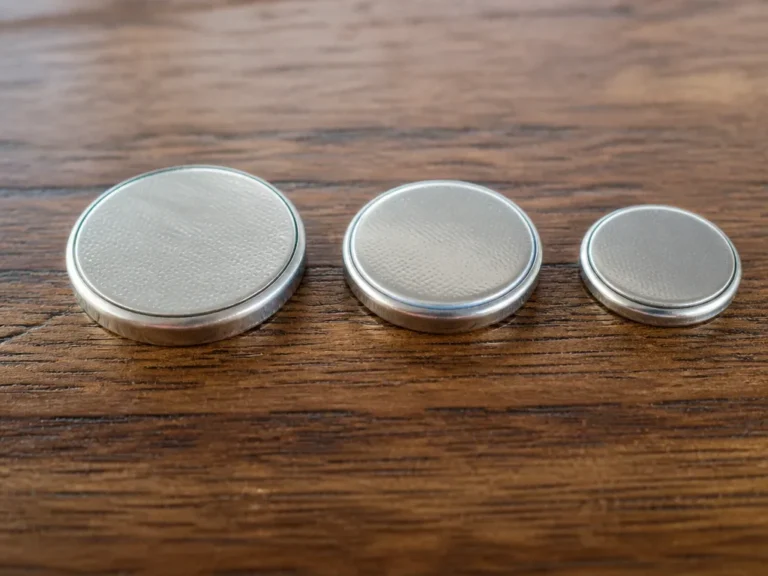
DL is Duracell’s brand prefix for coin cells that use the same numeric size codes as industry IEC “CR” numbers, and the four-digit code 2032 means 20.0 millimeters diameter by 3.2 millimeters thickness. Seeing DL2032 and CR2032 means the cells share the same physical size, but you must still verify the device’s recommended cell type before replacing cells.
Read the numeric code left to right: the first two digits give the nominal diameter in millimeters, the second two digits give the thickness in tenths of a millimeter. Three- or four-digit codes follow the same rule, so 1220 is 12.0 mm by 2.0 mm, while 1632 is 16.0 mm by 3.2 mm; always match both diameter and thickness to avoid loose fit or pressure on contacts.
For example, the common coin sizes and typical device fits below are what you will most often encounter; confirm against your device label or manual before buying replacements.
| Size code | Dimensions (mm) | Typical devices |
|---|---|---|
| 2032 | 20.0 × 3.2 | Motherboard CMOS, key fobs, fitness sensors |
| 2025 | 20.0 × 2.5 | Car remotes, small LED lights, remote controls |
| 2016 | 20.0 × 1.6 | Wrist thermometers, some calculators, small toys |
| 1632 | 16.0 × 3.2 | Hearables, glucose meters, compact sensors |
| 1220 | 12.0 × 2.0 | Hearing aid remotes, tiny remotes, medical tags |
Brand prefixes are common traps: DL (Duracell) and CR (IEC) refer to the same physical numbering system, while other prefixes like BR, LR, ML, or LIR point to different chemistries or rechargeable types. Using a different chemistry or a rechargeable cell without checking the device can cause poor performance or damage, so always match both size code and the device’s recommended cell specification. Do not force a slightly larger cell into a compartment, and never mix chemistries in battery holders.
Capacity and runtime
DL is Duracell’s product prefix while CR is the IEC size and chemistry code, and both refer to the same family of 3 volt lithium manganese dioxide coin cells; capacity changes mostly with diameter and thickness. A CR2032/DL2032 usually has on the order of two hundred milliamp-hours, while thinner coins like CR2016 have substantially less, and larger diameter, thicker coins like CR2450 hold several hundred milliamp-hours.
Typical capacity ranges by common coin size are approximate and vary by manufacturer, so always check the cell label for mAh. The table below gives practical ranges you will see on retail packaging for comparison purposes only.
| Size | Typical capacity (mAh) | Nominal voltage | Common uses |
|---|---|---|---|
| CR2016 / DL2016 | ~75 to 100 | 3 V | Thin remotes, slim key fobs |
| CR2025 / DL2025 | ~140 to 170 | 3 V | Key fobs, small sensors |
| CR2032 / DL2032 | ~180 to 240 | 3 V | Watches, motherboards, calculators |
| CR2450 / DL2450 | ~500 to 620 | 3 V | IoT sensors, larger remotes |
Load is the single biggest runtime killer for coin cells, because these cells are designed for low current draw. Under microamp to low milliamp loads a coin cell delivers close to its rated mAh, but at higher currents internal resistance causes voltage to sag and effective capacity to fall sharply, so the same CR2032 that lasts years in a watch can fail in days under several milliamps.
Temperature also changes runtime; cold reduces chemical reaction rates and effective capacity, while high temperature can increase self-discharge and shorten shelf life. For practical use, expect shorter runtimes below 0 degrees C and somewhat higher self-discharge above 40 degrees C, and verify device behavior rather than relying on ideal lab numbers.
For example, a CR2032 in a watch that draws 5 microamps average will last several years, while the same cell powering a Bluetooth tag drawing 5 to 10 milliamps during transmissions will only last months or weeks depending on duty cycle. Always verify the device’s acceptable cutoff voltage and check the manufacturer’s recommended cell codes rather than swapping different sizes under the same label.
Safety, storage, replacement
DL is Duracell’s brand label for coin lithium primary cells and CR is the IEC/industry code for the same family of lithium manganese dioxide coin cells, so DL2032 usually matches CR2032 in size and nominal voltage. Both are primary, non-rechargeable 3 volt coin cells and must be treated as single-use, hazardous small batteries for safety and disposal purposes.
For example, if a device lists CR2032 on the battery compartment, a DL2032 from Duracell is usually interchangeable because DL is the brand name and CR is the standard size/chemistry code, but always verify the exact code printed on the cell and the device recommendation before replacing.
Practical rule: replace coin cells at the first sign of device malfunction, corrosion, heat, or swelling, and send used or damaged cells to a recycling point immediately. When in doubt about safety or compatibility, remove the cell and consult the device manufacturer or a qualified technician rather than experimenting with charging or mixing cells.
Buying, testing, troubleshooting
DL is a brand prefix used by Duracell on many coin and button cells, while CR is the IEC standard code for nonrechargeable lithium manganese dioxide coin cells (for example CR2032). In practice a DL2032 and a CR2032 are the same size and nominal 3 volt chemistry, so you should buy by the IEC number, voltage, and capacity rather than by the DL/CR label alone.
Packaging and label checks
Symptom: You cannot tell if a pack contains genuine CR chemistry cells or a different type because the pack shows DL, CR, or no clear IEC number. This is common with off-brand blister packs.
Cause: Manufacturers sometimes use brand prefixes, and counterfeit sellers copy logos or omit the IEC code. A wrong code or missing voltage can mean the cell is a different chemistry or size and will damage the device or fit poorly.
Fix: Verify every pack before buying or installing. Check these items on the label and packaging:
Quick tests: multimeter and contact cleaning
Symptom: A device that used to work now fails or behaves erratically with a coin cell installed. The battery reads some voltage but the device still resets or shows low power.
Cause: Open-circuit voltage can look acceptable, but voltage under load may collapse because the cell is near end of life or contacts are corroded. Dirty springs or recessed contacts can also prevent reliable connection.
Fix: Use these quick checks and steps to isolate the issue.
Warning: Do not short coin cells or attempt to charge nonrechargeable CR/DL cells. Shorting can cause heat, leakage, or rupture.
When to replace battery vs service device
Symptom: New DL/CR cells still do not make the device work, or the device shows intermittent faults only on batteries that test OK. You may see corrosion, bent contacts, or mechanical fit issues.
Cause: If a known-good fresh coin cell fails in the device, the problem is likely the device contact, holder spring, or an internal circuit fault. If the battery fails voltage or load tests, the cell is the cause.
Fix: Follow this decision flow before ordering parts or service:
| Label | What it means | Nominal voltage | When to buy |
|---|---|---|---|
| CR | IEC standard lithium coin cell | 3 V | Match IEC number and device spec |
| DL | Duracell brand prefix, often equivalent to CR on coins | 3 V | Buy when IEC number, expiry, and seller are verified |
Quick Summary
Understanding the difference between DL and CR batteries is essential for selecting the right power source for your devices.
Frequently Asked Questions
What is the main difference between DL and CR batteries?
The primary difference is that DL batteries are often branded versions of CR batteries, typically made by specific manufacturers. Both types are lithium coin batteries, but they may have slight variations in quality and price.
Can I use a CR battery instead of a DL battery?
Yes, you can generally use a CR battery in place of a DL battery as they share the same dimensions and voltage, typically 3 volts. However, it’s best to check the device specifications to ensure compatibility.
Do DL and CR batteries have the same runtime?
The runtime can be similar, but it varies by brand and specific model. Always refer to the capacity rating, usually given in milliamp hours (mAh), to make a direct comparison.
Are there safety concerns when using DL versus CR batteries?
Both types have similar safety standards as they are manufactured to meet the same specifications. However, using a low-quality brand may increase risks such as leakage or swelling, so always opt for reputable brands.
What common mistakes should I avoid when buying DL or CR batteries?
A common mistake is to overlook the expiration date listed on the packaging, which can affect performance. Always check for the freshest batteries, as older stock may have reduced capacity.

- Top 10 Best Solar Battery Installers Qld 2026 - September 12, 2026
- Top 10 Best Solar Battery Deals Qld Reviews 2026 - September 12, 2026
- Top 10 Best Solar Battery Deals Qld Price 2026 - September 12, 2026