
Understanding The Difference Between Standard And Agm Batteries
AGM batteries are sealed and often tolerate higher charge rates, but the single spec that matters most is the required charge profile and voltage. A common mistake is using a flooded battery charger on an AGM, which shortens life. First check the battery label and your charger setting, confirm the battery is 12V and marked “AGM” or “flooded”.
STD vs AGM battery: Standard flooded lead-acid batteries are vented, need periodic distilled water top-ups, and are lower cost; AGM (Absorbent Glass Mat) batteries are sealed, maintenance-free, handle higher charge rates, and are common in 12V systems. Check charger type and voltage before connecting.
Standard vs AGM Battery Types
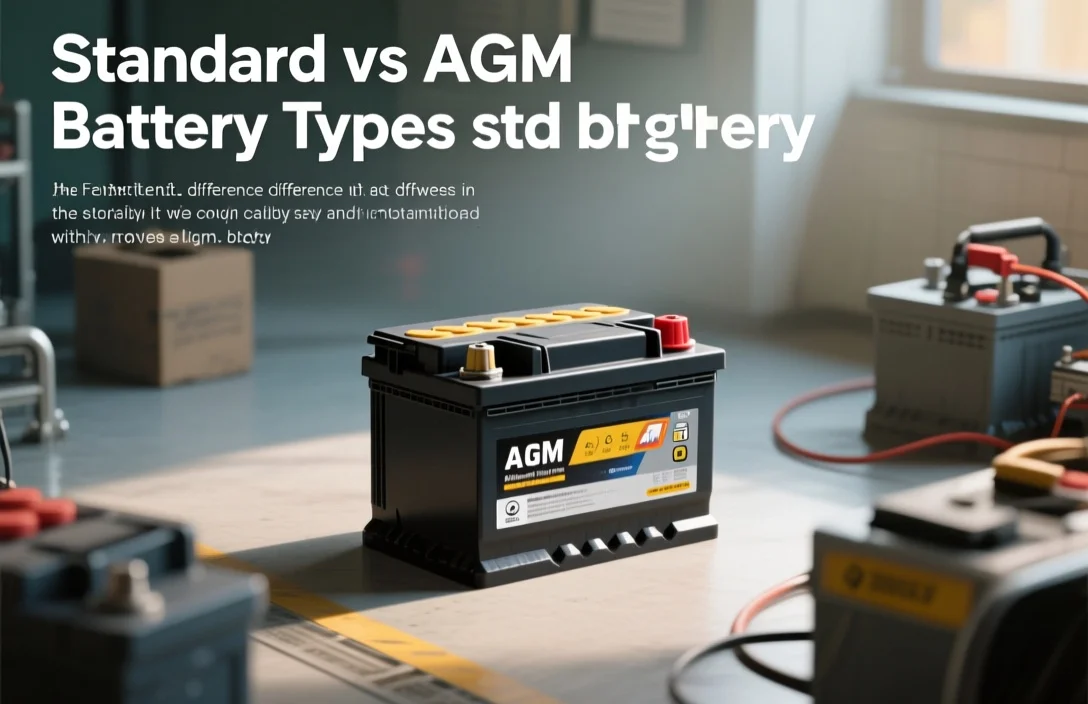
Standard flooded lead-acid batteries are wet-cell designs with free electrolyte that require periodic water topping and ventilation, while AGM batteries are sealed, valve-regulated lead-acid units that trap electrolyte in glass mats and are maintenance-free for normal use. AGM cells usually accept higher charge currents and are more vibration-resistant, but they are more sensitive to prolonged overcharge and high heat.
Construction differs clearly: flooded batteries have loose liquid sulfuric acid covering the plates, with removable caps for access. AGM batteries have a fiberglass mat between plates that soaks up the electrolyte, and they are closed except for a safety valve that vents only under abuse.
Electrical behavior and charger interactions differ too. AGM typically has lower internal resistance, which means faster charge acceptance and better performance under higher burst loads. Flooded batteries tolerate some overcharge during equalization charging, while AGM can be damaged by repeated excess voltage, so charger settings matter.
Life and maintenance tradeoffs are real choices, not marketing lines. Flooded batteries are usually cheaper per amp-hour and can last longer if you can perform watering, equalization, and keep them ventilated. AGM is safer for indoor, portable, or vibration-prone installations, and it removes the need for regular water checks, but replacement cost is higher and abuse shortens life.
| Attribute | Standard Flooded | AGM (Valve-Regulated) |
|---|---|---|
| Construction | Wet plates submerged in liquid electrolyte | Electrolyte absorbed in glass mats, sealed |
| Maintenance | Requires watering and ventilation | Maintenance-free under normal conditions |
| Mounting & Venting | Must stay upright and ventilated | Can be mounted in more orientations, limited venting |
| Charge behavior | Tolerates equalization, slower charge acceptance | Faster charge acceptance, sensitive to overvoltage |
| Common uses | Stationary power, deep-cycle, budget applications | UPS, automotive start-stop, portable power, motorcycles |
Rule of thumb: choose flooded if you can provide ventilation and maintenance for lower cost, choose AGM when you need a sealed, low-maintenance battery and are willing to pay more.
Capacity and Runtime Differences
AGM batteries generally provide a higher capacity and longer runtime compared to standard flooded lead-acid batteries. AGM batteries can achieve a discharge rate of up to 10 times their rated capacity, leading to longer operational periods under load.
Capacity metrics are crucial for understanding how long a battery can power a device before needing a recharge. Standard lead-acid batteries typically have a capacity measured in amp-hours (Ah), which indicates the amount of current a battery can deliver over a specified time. AGM batteries also use amp-hours but tend to deliver more usable energy due to their design, which minimizes sulfate buildup on the plates.
Expected runtime can vary significantly between the two types. While both batteries can provide similar Ah ratings, AGM batteries often hold their voltage better under load, translating to more reliable performance.
For example, an AGM battery rated at 100Ah can maintain higher voltages for longer, leading to extended runtimes in applications like solar power systems or uninterruptible power supplies (UPS).
| Battery Type | Typical Capacity (Ah) | Usable Capacity (%) | Runtime (for similar loads) |
|---|---|---|---|
| Standard Lead-Acid | 100 | 50-60 | 5-6 hours |
| AGM | 100 | 80-90 | 8-10 hours |
AGM batteries are often preferred in applications requiring deep cycling, such as in RVs or marine environments. Their ability to handle deeper discharges without damage contributes to their longer lifespan and efficiency. Standard batteries, while effective for less demanding applications, may struggle under similar conditions.
In summary, AGM batteries typically offer better capacity and runtime advantages, making them a more suitable choice for high-demand applications or situations where prolonged power is essential. When choosing between the two, consider your specific power needs and the operational context.
Charging Compatibility Factors
Standard (STD) batteries and Absorbent Glass Mat (AGM) batteries have different charging requirements that affect compatibility with chargers. STD batteries typically require a higher voltage for charging, while AGM batteries can be charged with lower voltages and often require special chargers to avoid overcharging.
Charger voltage requirements differ between the two types. Standard lead-acid batteries generally need a charging voltage of around 2.4 to 2.5 volts per cell (approximately 14.4 to 15 volts for a 12V battery), while AGM batteries usually charge effectively at 2.3 to 2.4 volts per cell (roughly 13.8 to 14.4 volts for a 12V configuration). Using the incorrect voltage can lead to undercharging or damaging the battery.
Port Standards
Charging port compatibility is another crucial factor. Most standard batteries use conventional ring terminals or SAE connectors, while AGM batteries often have specialized terminals that may require unique connectors or adapters. This can affect the type of charger you can use and may necessitate the purchase of additional charging accessories.
When selecting a charger for either battery type, check for compatibility features such as:
Always verify the specifications on your battery and charger to ensure safe and effective charging. Mismatches can lead to decreased performance or even battery failure.
In summary, understanding the differences in charging voltage requirements and port standards between standard and AGM batteries is essential for selecting the right charger. This ensures both safety and optimal battery performance over time.
Safety Considerations in Usage
AGM batteries are sealed and normally tolerate higher charge acceptance with less surface heat at moderate loads, while standard flooded (wet) batteries can vent, lose water, and show more visible boiling under abuse. Both types can overheat, swell, or leak if charged with the wrong voltage, exposed to sustained high ambient temperature, or physically damaged.
Heat Management
AGM cells have lower internal resistance and can accept higher charge rates, which often produces less surface heating during normal use, but they still age faster when operated at elevated temperatures. Flooded batteries can generate more surface steam and require ventilation because they vent hydrogen and oxygen when overcharged; that ventilation can hide internal hotspot formation and accelerate water loss.
Keep batteries away from enclosed hot spaces and do not place chargers or heavy loads on top of a battery. If a battery feels very hot to the touch, emits a sulfur or acid smell, or the case becomes soft or discolored, stop use immediately and move the battery to a safe ventilated area.
Swelling Risks
Swelling happens when internal gases cannot recombine or escape correctly, or when internal plates warp from heat and corrosion. AGM is sealed so gas buildup forces the case to bulge if the recombination fails or the cell is overcharged repeatedly, while flooded batteries more commonly lose electrolyte and reveal plate warpage before dramatic external bulging.
Visual checks catch most swelling early: look for raised lids, warped corners, wet stains, or white salt residue around terminals. Do not attempt to puncture, press, or recharge a visibly swollen battery; treat it as a failure and replace it with the correct chemistry and physical size.
| Issue | Standard Flooded | AGM |
|---|---|---|
| Likely external sign | Water loss, corrosion, venting | Bulging case, pressure build-up |
| Venting behavior | Open venting, hydrogen release | Sealed, pressure relief valves may activate |
| Heat tolerance | Requires ventilation, can mask hotspots | Lower surface heat under some loads, sensitive to prolonged high temperature |
| Immediate action if hot or swollen | Stop charging, vent area, replace or refill per manual | Stop charging, isolate, replace |
If you detect overheating, smell, leakage, or swelling, stop use and isolate the battery; continued charging or transport can be hazardous.
Storage and Maintenance Tips
Flooded, or standard, lead-acid batteries need periodic water top-ups and active float charging with ventilation, while AGM batteries are sealed, lose less water, and require lower-maintenance float settings but are more sensitive to permanent overcharge and deep discharge. Store both types charged, monitor state of charge, and follow the manufacturer’s recommended float or storage voltage listed on the battery label.
Optimal Storage Conditions
Store batteries in a cool, dry place away from direct heat and corrosive chemicals. Avoid freezing temperatures and prolonged high heat, because both conditions accelerate capacity loss and can damage internal plates.
Keep batteries at or near full charge for long storage periods, and check state of charge monthly. For flooded batteries, a float charger and occasional distilled water top-up are required; for AGM, use a charger with an AGM/VRLA setting and avoid charger modes that force prolonged high voltage.
Maintenance Practices
Follow a regular inspection and maintenance schedule: for flooded batteries, check electrolyte level and specific gravity if you have a hydrometer, and add distilled water only to cover plates. For AGM, do not open or add water, and inspect terminals for corrosion and tightness instead.
Use a charger that lists AGM or flooded settings and set it according to the battery label, and avoid leaving a battery at a high absorption voltage for long periods. If a battery self-discharges during storage, recharge it promptly; repeated deep discharge causes sulfation on flooded cells and permanent capacity loss on AGM cells.
| Aspect | Flooded (STD) | AGM |
|---|---|---|
| Ventilation | Requires ventilation when charging | Sealed, no regular ventilation needed |
| Water topping | Requires distilled water top-ups | No water addition, sealed |
| Charger setting | Standard lead-acid/float charger | Charger with AGM/VRLA mode recommended |
| Self-discharge | Higher self-discharge; needs more frequent charging | Lower self-discharge; holds charge longer |
Replacement Triggers Explained
Standard flooded lead-acid and AGM batteries reach end of useful life in different ways, so the replacement trigger is different for each: flooded batteries usually show low specific gravity, visible electrolyte loss, or repeated failure to accept full charge, while AGM batteries most commonly show steady capacity loss, increased voltage sag under load, or higher resting voltage with poor charge acceptance. Use the specific symptoms plus basic capacity checks and the manufacturer’s cycle rating to decide when to replace.
Signs of Wear
Look for mechanical and electrical signs that separate standard and AGM failure modes. Physical electrolyte loss, cracked or bulging cases, and a persistent low specific gravity on a hydrometer point to flooded battery failure.
AGM batteries rarely leak, so electrical symptoms matter more: higher internal resistance, inability to deliver rated cold-cranking amps, and a gradually reduced amp-hour capacity under normal use are common triggers to replace an AGM. Replace immediately if the battery is swollen, hot to the touch, or smells of strong acid or sulfation.
| Symptom | Standard flooded | AGM | Recommended action |
|---|---|---|---|
| Low capacity | Check specific gravity and recharge, consider replacing if gravity won’t recover | Perform load or capacity test, likely replace if below usable threshold | Capacity test, then replace if capacity is significantly reduced |
| Physical damage | Electrolyte loss or cracks = replace | Swelling or case deformation = replace | Immediate replacement, follow safe disposal rules |
Cycle Life Considerations
Cycle life and depth of discharge drive replacement timing more than calendar age for both chemistries. Check the manufacturer’s specified cycle rating, but treat it as a guideline because real-world conditions change life span: temperature, depth of discharge, and charge method alter how many cycles you actually get.
Practical replacement triggers include repeated drops below expected capacity, a battery that no longer accepts full charge, or when the battery has reached or exceeded the published cycle count and shows performance decline. For safety, replace any battery that is swollen, emits gas excessively, is hot after charging, or leaks.
Real-World Applications Comparison
Standard flooded lead-acid batteries are low-cost, serviceable cells good for stationary, high-capacity uses where ventilation and periodic watering are acceptable; AGM batteries are sealed, require no watering, tolerate vibration better, and accept higher charge and discharge rates for compact or mobile installations. Choose flooded when cost and bulk capacity matter, choose AGM when maintenance, space, or sensitive electronics are the priority.
Flooded batteries are common in off-grid bank setups, large standby banks where a dedicated ventilated battery room exists, and applications that can tolerate occasional maintenance. They are often used where long runtime per dollar is the main criterion and where weight and placement rules are flexible.
For example, an off-grid cabin with a separate battery bank and a fixed, vented battery box often uses flooded batteries because the owner can top up water and ventilate hydrogen safely. Conversely, an ambulance, motorcycle, or marine starting bank where vibration and space are constraints will often use AGM to reduce maintenance and avoid acid spills.
| Feature | Standard (Flooded) | AGM (Absorbent Glass Mat) |
|---|---|---|
| Maintenance | Requires watering and terminal upkeep | Maintenance-free under normal use |
| Venting | Emits hydrogen, needs ventilation | Sealed, low venting but can vent under abuse |
| Best fit | Stationary banks, cost-sensitive installs | Vehicles, UPS, small spaces, vibration-prone gear |
| Charge acceptance | Lower charge rates typical | Higher charge/discharge capability |
Choose flooded for low cost and fixed installations where ventilation and maintenance are possible; choose AGM for sealed, mobile, or vibration-prone uses, but always verify charger settings and avoid mixing types.
Quick Summary
AGM batteries are sealed, valve regulated lead acid types with different charging and installation rules than standard flooded lead acid batteries.
Frequently Asked Questions
What is the main difference between a standard battery and an AGM battery?
The main difference is that an AGM battery uses a glass mat to absorb electrolyte, making it spill-proof and more resistant to vibrations compared to standard lead-acid batteries.
Are AGM batteries more expensive than standard batteries?
Yes, AGM batteries typically cost 20-50% more than standard batteries due to their advanced technology and longer lifespan.
How does heat affect the performance of standard and AGM batteries?
AGM batteries perform better in high temperatures as they have lower internal resistance, while standard batteries can suffer from faster degradation and reduced efficiency in heat.
When should I replace my standard or AGM battery?
Replace your battery when it shows signs of diminished performance or if it is over 3-5 years old, as this is the typical lifespan for both types under normal use conditions.
What mistakes should I avoid when buying a battery?
A common mistake is not checking the compatibility with your device, including the size, type, and specifications, which can lead to performance issues or failure to operate.

- Gaming Laptops With Long Battery Life: Practical Picks For Travel Play - July 27, 2026
- Cordless 18-gauge Brad Nailer Top Pick 2026 - July 27, 2026
- Best Watch Battery Brand: Silver Oxide Choices For Reliable Quartz Power - July 27, 2026