Difference Between Agm And Lead Acid Batteries
You can mount an AGM battery on its side and use it indoors, but a flooded lead acid must stay upright and be vented. The spec that matters most is the battery voltage and the recommended charge voltage and mode, so check the battery label or manual for “12 V” and “AGM/sealed”. A common mistake is using a generic “wet” charger on sealed batteries.

Difference between AGM and lead acid batteries: AGM is a sealed lead-acid type with electrolyte absorbed in a glass mat, usually 12 V nominal, spill-proof and better at handling higher charge and discharge rates; flooded lead acid has liquid electrolyte, needs periodic water topping and ventilation.
AGM vs. Lead Acid Basics
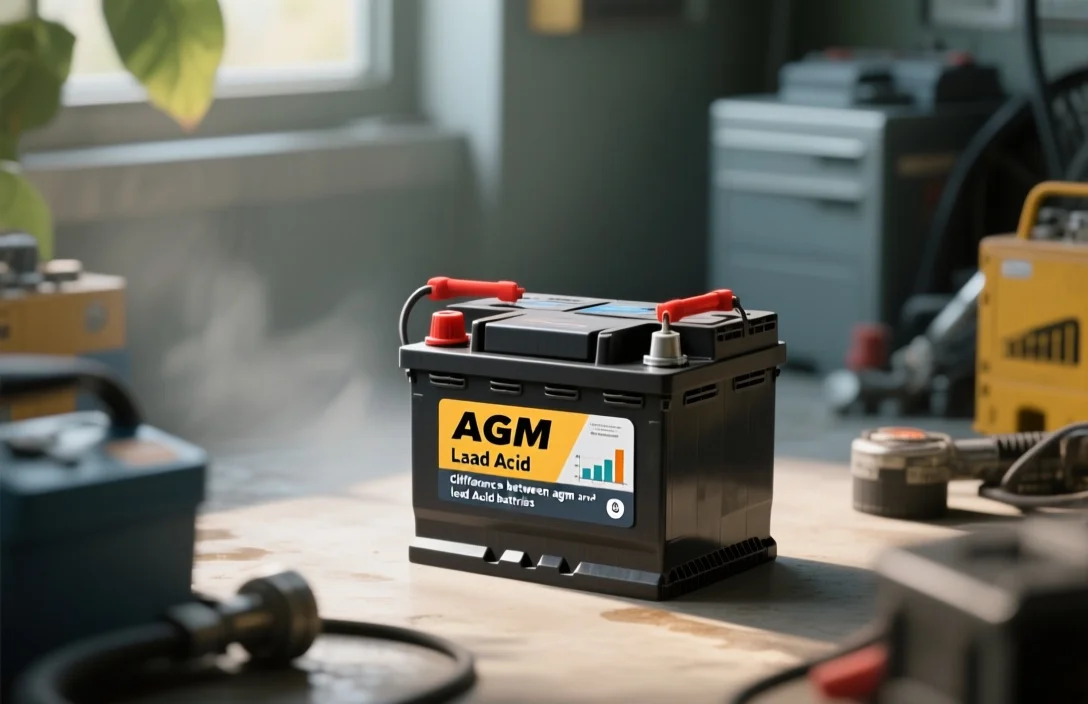
AGM (Absorbent Glass Mat) batteries are a type of sealed lead-acid battery that use a fiberglass mat to absorb the electrolyte, while traditional lead-acid batteries have liquid electrolyte solutions. AGM batteries typically provide better performance in terms of cycle life and deep discharge capabilities compared to their flooded counterparts.
Battery chemistry plays a crucial role in the performance and application of these batteries. AGM batteries are designed to handle higher discharge rates and can be mounted in any orientation without leaking, making them suitable for applications where space and positioning are limited. In contrast, flooded lead-acid batteries require regular maintenance, such as checking water levels, and should be kept upright to avoid spills.
Common Applications
AGM batteries are commonly used in applications that demand reliability and safety, such as:
Flooded lead-acid batteries, while less versatile, are often used in:
AGM batteries typically provide up to two times the cycle life of flooded lead-acid batteries, making them a better choice for deep-cycle applications.
Understanding these differences can help in selecting the right battery for your needs, as AGM batteries offer advantages in terms of maintenance, performance, and safety, while flooded batteries can be more cost-effective for certain applications.
Capacity and Runtime Differences
AGM batteries typically have a higher energy density compared to traditional lead-acid batteries, resulting in longer runtime capabilities under similar conditions. AGM batteries can achieve around 20-30% more usable capacity, making them more efficient for high-drain applications.
Energy density refers to the amount of energy stored per unit volume or weight. AGM batteries, which use absorbed glass mat technology to immobilize the electrolyte, allow for a more compact design and higher energy storage. This makes them suitable for applications such as renewable energy storage, electric vehicles, and backup power systems where space and weight are critical factors.
In contrast, traditional lead-acid batteries, while reliable and cost-effective, have lower energy density, meaning they occupy more space and weigh more for the same amount of stored energy. This can limit their use in applications where size and weight are significant factors.
| Battery Type | Energy Density (Wh/kg) | Usable Capacity (%) | Typical Usage Scenarios |
|---|---|---|---|
| AGM | 30-50 | 80-90 | Solar systems, RVs, UPS, electric vehicles |
| Lead Acid | 20-30 | 50-70 | Starting batteries, backup generators, low-drain applications |
For instance, in a solar power application, an AGM battery can store more energy efficiently, allowing for longer periods of use between charges. This can significantly enhance the performance of solar systems, especially in off-grid scenarios where every watt counts.
When considering runtime for both battery types, it’s crucial to account for the discharge rates. AGM batteries can support higher discharge rates without significant voltage drop, making them ideal for applications requiring quick bursts of power, such as inverters and power tools. Lead-acid batteries may struggle under heavy loads, leading to reduced performance and shorter runtimes.
Ultimately, choosing between AGM and lead-acid batteries will depend on your specific needs regarding capacity, weight, and application. While AGM batteries offer enhanced performance and longevity, lead-acid batteries remain a cost-effective solution for applications where weight and space are less critical.
Charging Methods and Compatibility
AGM (Absorbent Glass Mat) batteries and traditional flooded lead acid batteries require different charging methods for optimal performance. AGM batteries can be charged with standard lead acid chargers, but they often benefit from a charger specifically designed for AGM technology to avoid overcharging and extend their lifespan.
When selecting a charger, consider the following:
Charging time can vary significantly between AGM and flooded lead acid batteries due to their different internal structures:
In practice, the charging process for AGM batteries can be more efficient, but it is crucial to monitor the charging cycle.
For example, a smart charger can switch to a trickle charge mode once the battery reaches full capacity, preventing damage from overcharging.
| Battery Type | Optimal Charging Voltage | Average Charging Time |
|---|---|---|
| AGM | 14.4 – 14.7 V | 4 – 6 hours |
| Flooded Lead Acid | 14.2 – 14.6 V | 8 – 12 hours |
Properly matching the charger to the battery type is essential for maintaining battery health. Using an inappropriate charger can lead to reduced performance or damage. Always check the manufacturer’s specifications for both the battery and charger prior to use.
Safety Considerations
AGM batteries are sealed, valve-regulated lead-acid cells with electrolyte trapped in glass mats, so they usually vent and leak far less than traditional flooded (wet) lead-acid batteries. Despite that, both AGM and flooded lead-acid types can produce dangerous heat, swelling, and gas if they are overcharged, charged too fast, physically damaged, or stored/operated at high temperatures.
AGM is generally safer for indoor or enclosed installations because it reduces acid spills and continuous off-gassing, but it can still fail violently if abused. Flooded batteries require ventilation and regular maintenance to manage gases and water loss, which changes the risk profile for enclosed or poorly ventilated spaces.
For example, an AGM mounted inside a sealed equipment bay that is charged with too-high voltage can heat, bulge at the seams, and eventually vent through pressure relief valves, while a flooded battery in the same bay will vent continuously and lose water, creating corrosion and an explosion risk if the area is not ventilated. Always follow the battery label and manufacturer’s safety guidance and verify charge voltages and installation requirements before use.
Lifespan and Maintenance Needs
AGM batteries are a sealed subtype of lead-acid that usually require less routine servicing and, under light to moderate cycle use, often retain usable capacity longer than traditional flooded lead-acid. Flooded lead-acid batteries need scheduled water topping and periodic equalization charging, and their lifespan depends strongly on maintenance, depth of discharge, and charging discipline.
Cycle Life
Cycle life for both AGM and flooded lead-acid depends on how deeply the battery is discharged each cycle, the charge voltage applied, and the operating temperature. In many real-world applications, AGM cells show better tolerance of shallower, more frequent cycling and therefore deliver more usable cycles for similar duty profiles, but the difference is not guaranteed and varies by manufacturer and cell construction.
Repeated deep discharges shorten life for both chemistries. A flooded battery left deeply discharged will sulfate more quickly, while an AGM can suffer irreversible capacity loss if routinely discharged too deep or charged improperly. Always check the manufacturer’s cycle life spec and the recommended depth of discharge for the intended use.
For heavy cycling applications pick a battery marketed for cycle use rather than assuming one chemistry is enough by itself. The tradeoff is practicality: AGM often works better where low maintenance and vibration resistance matter, while well-maintained flooded batteries can provide long service in stationary setups where topping and equalization are practical.
| Characteristic | AGM (sealed) | Flooded (wet) |
|---|---|---|
| Routine maintenance | Low, no watering | Regular watering, terminal cleaning |
| Charging sensitivity | Requires correct float/absorption voltages | Tolerant of periodic equalization |
| Typical use | Cycle and vibration-prone applications | Stationary backup and deep-cycle where maintenance is feasible |
| Failure signs | Capacity loss, bulging | Low specific gravity, corrosion, plate exposure |
| Relative cycle life | Often higher for shallow cycles, varies by model | Depends on maintenance and depth of discharge |
If a battery bulges, emits unusual heat, or leaks electrolyte, stop using it and replace it; do not attempt to repair or open sealed cells.
Cost and Availability
AGM batteries usually cost more per amp-hour than conventional flooded lead-acid batteries, and they are commonly sold through UPS, marine, motorcycle, and specialty battery channels as well as many online retailers. Flooded lead-acid batteries are cheaper up front and are the most widely stocked option at auto shops and big-box stores, but shipping and disposal rules can affect final price and where you can buy them.
Exact current retail prices were not available from my sources, so the table below uses relative price and availability categories instead of dollar amounts. Use the table to compare where each type is likely to appear on store shelves and what to expect from supply and distribution.
| Battery Type | Typical Upfront Cost | Market Availability | Retail and Shipping Notes |
|---|---|---|---|
| Flooded (conventional) Lead-Acid | Lower | Widespread (auto parts stores, big-box, farm supply) | Common for vehicle starter and deep-cycle; sold locally; heavier handling limits air shipping |
| AGM (Absorbent Glass Mat) | Higher | Widely available, more in specialty/online channels (UPS, marine, RV, telecom) | Sealed, valve-regulated so easier to ship by ground; often sold as premium replacement or OEM option |
When comparing cost, factor in practical buyer details rather than sticker price alone. Check the rated amp-hours, the stated warranty length and terms, and whether the seller includes a manufacture or fill date on the label.
Safety note: buy from reputable dealers and check labels carefully, because cheap or counterfeit batteries are common and may lack proper venting, date codes, or warranty coverage.
Choosing the Right Battery
AGM is a sealed, valve-regulated lead-acid battery that uses glass-mat separators to hold electrolyte and typically has lower internal resistance and less gassing, while “flooded” lead-acid batteries are vented wet cells that require periodic water top-ups and produce gas during charge. AGM usually costs more and is maintenance-free with better performance for short high-current draws and flexible mounting, whereas flooded batteries are often cheaper and can be more tolerant of repeated deep discharges when maintained.
Use Case Considerations
Decide by duty cycle, installation constraints, and who will maintain the battery. If you need a battery for frequent engine starts, inverter loads that draw short high currents, or installations where you cannot check water levels, AGM is usually the better choice.
For example, if you are building a small off-grid solar bank and can perform regular maintenance, a flooded deep-cycle battery can give you lower upfront cost per amp-hour and may tolerate sustained deep discharges better. If the battery sits inside a cabin, a sealed AGM reduces the ventilation requirement and spill risk.
Performance Needs
AGM typically accepts charge faster and handles high discharge rates better because of lower internal resistance, which helps for cold starts and inverter surges. Flooded batteries can perform well for long, steady discharges but often need a charger with different voltage settings and may require temperature compensation to avoid over- or under-charging.
Cycle life is not a fixed label, it depends on design and depth of discharge, so compare cycle-life specs at the stated DoD rather than trusting marketing. Always set your charger to the chemistry-specific voltages shown on the battery label, and use temperature compensation when the environment varies widely.
| Attribute | AGM | Flooded Lead-Acid |
|---|---|---|
| Sealing | Sealed, low gassing | Vented, requires water top-ups |
| Maintenance | Maintenance-free | Requires periodic water addition |
| Best for | High current pulses, compact spaces, mobility | Deep-cycle banks where maintenance is possible |
| Charge sensitivity | Requires correct float/absorption voltages | More tolerant of occasional overcharge if vented |
| Cost | Higher upfront | Lower upfront |
Rule of thumb: choose AGM when you need maintenance-free installation, high pulse current, or flexible mounting; choose flooded when cost per cycle and deep discharge handling with regular maintenance matter more.
Troubleshooting Common Issues
AGM is a sealed, valve-regulated lead-acid battery with electrolyte absorbed into glass mats, while flooded lead-acid batteries have free liquid electrolyte and vents that release gas during charge. Those design differences cause different charging tolerances, failure modes, and maintenance needs, so the troubleshooting steps for one type can harm the other if applied blindly.
Charging Problems
AGM batteries need a charger with appropriate bulk, absorption, and lower float voltage settings, because they accept charge faster and are sensitive to sustained high voltage. If an AGM is repeatedly kept at too-high float voltage it will lose capacity and may vent; flooded batteries tolerate higher float voltages for short periods but require periodic water topping after gassing.
Follow this stepwise check when charging problems appear:
| Symptom | AGM Likely Cause | Flooded Likely Cause |
|---|---|---|
| Battery not reaching full charge | Charger voltage too low or sulfation | Charger set for AGM (undercharging) or sulfation |
| Bulging or swelling | Overcharge or heat, permanent damage | Severe overcharge or heat, risk of plate distortion |
| Low electrolyte level | Not applicable, sealed | Normal if gassing; top with distilled water |
Performance Issues
If capacity drops, first check for chronic undercharge, improper storage, or parasitic loads. AGMs are more prone to permanent capacity loss from being left partially charged for long periods, while flooded batteries can sometimes be recovered by controlled charging and water maintenance if plates are not severely sulfated.
Practical checks and fixes:
Safety: If a battery is hot, bulging, leaking, or producing strong sulfur odor, stop use, disconnect safely, and replace it. Do not attempt to repair a swollen or leaking battery.
Quick Summary
AGM is a sealed, maintenance-free lead acid type with faster discharge recovery and lower internal resistance than flooded lead acid batteries.
Frequently Asked Questions
Are AGM batteries compatible with the same chargers as regular lead acid batteries?
You can usually charge an AGM with a charger designed for lead acid batteries because both use the same nominal voltages, for example a 12 V (six 2 V cells) battery, but you should use the charger’s AGM or VRLA mode and follow the battery maker’s recommended charge voltage.
Do AGM batteries handle heat better than flooded lead acid batteries?
You can expect both AGM and flooded lead acid batteries to age faster at higher temperatures, so avoid storing or operating them above about 25 C when possible, and follow the manufacturer’s storage temperature guidance.
Will an AGM give me longer runtime than a flooded lead acid of the same amp-hour rating?
You can expect similar runtime from two batteries with the same amp-hour rating because runtime is based on capacity, so a 100 Ah battery roughly delivers 100 Ah at low discharge rates, though the Peukert effect and internal resistance can reduce usable runtime at high discharge currents.
Is an AGM battery safer than a flooded lead acid battery for indoor use?
You can use AGM indoors more safely because it is a sealed VRLA type and is less likely to vent under normal charging, but do not exceed the manufacturer’s recommended charge voltages to avoid gassing, commonly keeping a 12 V battery below about 14.8 V unless the maker specifies otherwise.
What common buying mistakes should I avoid when choosing between AGM and flooded lead acid?
You can avoid buyer regret by checking the battery’s required charger profile and cycle-life spec at a given depth of discharge, for example manufacturers often quote cycles at 50% DOD, rather than buying based only on price or amp-hour label.

- Home Solar Battery Backup Systems: Cost-focused Guide And Top Picks - July 29, 2026
- Rechargeable 9v Batteries With Usb-c Charging For Smoke Detectors And Tools - July 29, 2026
- Top 10 Best Solar Backup Batteries Austin 2026 - July 28, 2026