Different Between Aa And Aaa Battery
AA cells are larger and usually run a device two to three times longer than AAA cells, so size often equals runtime. That difference is simple physics, not brand trickery. Before you swap cells, check the battery compartment label or icon to confirm whether the device needs AA or AAA and which chemistry to use.
AA and AAA batteries differ mainly by size and capacity: AA is larger (about 50 mm by 14 mm) and typically stores roughly 2 to 3 times the mAh of a AAA; both are about 1.5 V for alkaline and about 1.2 V for NiMH rechargeables.
Size Comparison
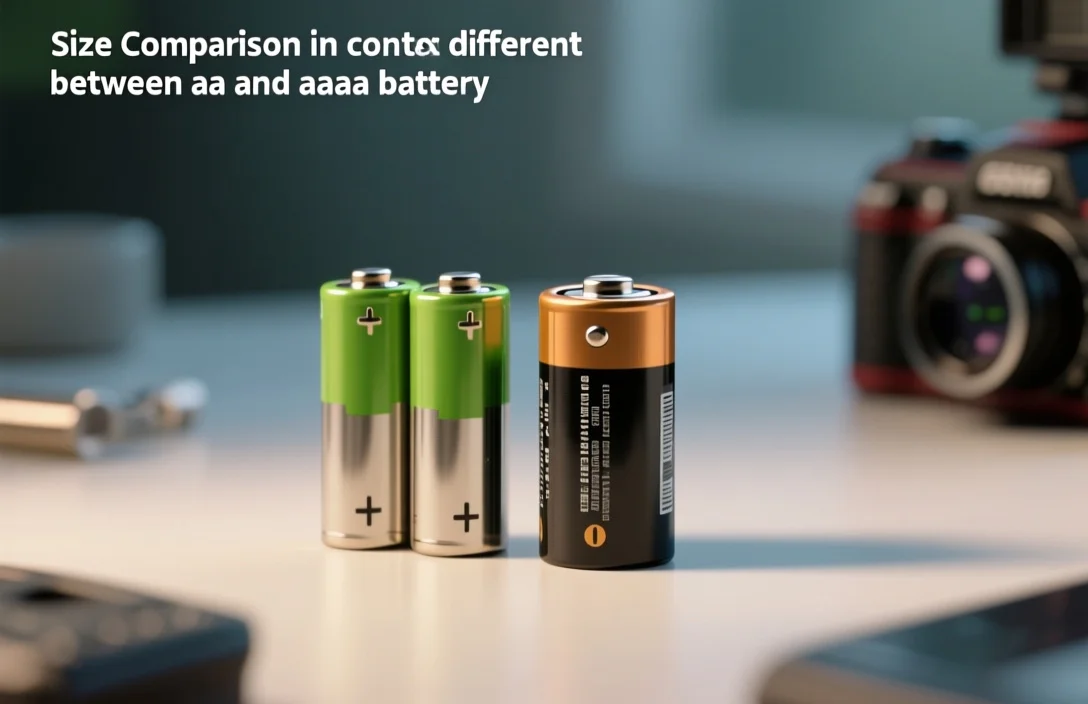
AA cells are larger and heavier than AAA cells: an AA cell is roughly 50.5 millimeters long with about a 14.5 millimeter diameter, while a AAA cell is roughly 44.5 millimeters long with about a 10.5 millimeter diameter. Those length and diameter figures are the standard nominal dimensions used for consumer cylindrical cells.
The physical size difference affects how devices are designed and which holders, springs, and contacts they use. Manufacturing tolerances mean actual parts can vary a fraction of a millimeter, so devices expect the nominal IEC sizes but allow small clearances.
Weight is chemistry dependent, but AAA batteries typically weigh around half what an AA battery does. For alkaline chemistry an AA commonly runs in the low-20 gram range while a AAA is often around 10 to 12 grams; rechargeable NiMH cells shift those numbers upward, with AA NiMH usually heavier than alkaline AA and AAA NiMH only slightly heavier than alkaline AAA.
For example, swapping a set of AAA rechargeable cells into a device that accepts AA is impossible without an adapter because the diameter is smaller and the length is shorter. Conversely, forcing an AA into an AAA slot will not fit and can damage the battery compartment or contacts.
| Cell | Nominal Diameter (mm) | Nominal Length (mm) | Typical Weight, alkaline (approx) | Typical Weight, NiMH (approx) |
|---|---|---|---|---|
| AA | 14.5 | 50.5 | ~20 to 25 g | ~25 to 30 g |
| AAA | 10.5 | 44.5 | ~8 to 12 g | ~11 to 15 g |
If you need exact dimensions or weight for a mechanical design or tight-fit device, measure the actual cells or consult the cell manufacturer’s datasheet rather than relying on rounded nominal values.
Capacity Differences
AA cells typically store roughly two to three times the charge of AAA cells when measured in milliamp hours, so an AA will run the same device noticeably longer before needing replacement. Capacity varies by chemistry and brand, but the size difference is the main reason for the higher mAh in AA cells.
Typical mAh ratings depend on both size and chemistry. The table below gives common ranges you will see on retail packs and rechargeable specs, but individual brands can sit outside these ranges, so always check the label.
| Size | Chemistry | Typical mAh Range |
|---|---|---|
| AA | Alkaline | ~1800 to 3000 mAh |
| AA | NiMH rechargeable | ~1300 to 2800 mAh |
| AAA | Alkaline | ~800 to 1200 mAh |
| AAA | NiMH rechargeable | ~600 to 1200 mAh |
Capacity directly affects runtime through a simple relationship: hours of operation equals battery mAh divided by the average device current in milliamps (mA). Use that formula to compare how long an AA and a AAA will last in the same device under the same load.
For example, with a 100 mA load, a 2000 mAh AA runs about 20 hours, while a 1000 mAh AAA runs about 10 hours, ignoring changes in voltage and device cutoff behavior.
In practice, device behavior matters. Some gadgets stop working when cell voltage drops below a threshold even if the cell still has capacity, so an AA’s higher capacity often delays that cutoff, but only if the device accepts the larger cell physically and electrically.
Trade-offs are real: choose AAA when space and weight matter, accept shorter runtime, and choose AA when you need longer runtime or higher reserve capacity. Rechargeable NiMH reduces cost per use but carries lower nominal voltage stability under load than fresh alkalines for some applications.
Voltage Specifications
AA and AAA cells of the same chemistry provide the same nominal voltage: alkaline and carbon-zinc cells are nominally 1.5 volts, while common rechargeable NiMH cells are nominally 1.2 volts. That means size alone does not change the per-cell voltage, chemistry does.
Manufacturers make both AA and AAA in the same basic chemistries, so a 1.5 volt alkaline AA and a 1.5 volt alkaline AAA will each register the same open-circuit voltage. The practical difference for a device comes from capacity and internal resistance, not nominal cell voltage.
| Chemistry | Nominal voltage (AA / AAA) | Typical device effect |
|---|---|---|
| Alkaline (disposable) | 1.5 V | Good for low to medium drain, steady voltage until near end of life |
| NiMH (rechargeable) | 1.2 V | Lower nominal voltage but can deliver higher current with less voltage sag under load |
| Lithium primary (specialty) | ~1.5 V (varies by type) | Long shelf life, performs better in extreme temperatures; check label for exact voltage |
Devices that read absolute voltage, for example battery level indicators and simple electronics, will respond to the cell chemistry more than the cell size. The smaller AAA cell usually has higher internal resistance, so under heavy load it can show greater voltage drop than an AA of the same chemistry and state of charge.
For example, a flashlight using two alkaline AA cells provides about 3.0 volts nominal, and two NiMH cells provide about 2.4 volts nominal. Some devices run fine on either combination, but high-current equipment can dim or cutoff sooner with AAA cells because of their higher internal resistance and lower capacity.
Same nominal voltage depends on chemistry, not size; AA and AAA deliver the same per-cell voltage when the chemistry matches, but expect different voltage behavior under load because capacity and internal resistance differ.
Charger Compatibility
AA and AAA batteries need chargers that match their physical size and declared chemistry; many modern chargers accept both sizes but only if the charger explicitly lists AA and AAA support. Never force a smaller cell into a larger contact or charge non-rechargeable alkaline cells.
Charger Types
Simple drop-in chargers are sized for common formats and often label which sizes they accept, but they may charge all slots at the same rate and lack per-cell monitoring. Smart multi-slot chargers can detect each cell, stop charging when a cell is full, and usually list supported chemistries and sizes on the label or in the manual.
USB-powered pocket chargers and compact chargers use an external USB supply, while universal chargers with adjustable contacts expand to odd sizes. Always check the charger label for supported sizes, listed chemistries, and per-slot control before relying on it for mixed AA and AAA packs.
| Charger Type | AA | AAA | Notes |
|---|---|---|---|
| Simple drop-in | Usually yes | Sometimes (if labeled) | May charge all slots at same current, less safe for mixed-age cells |
| Smart multi-slot | Yes | Yes | Per-slot detection, best for mixed use |
| USB-powered pocket | Often yes | Often yes | Depends on adapter and input power, check manual |
| Universal adjustable | Yes | Yes | Flexible contacts, verify spring pressure and fit |
For example, a camera user who needs multiple AA cells for a flash should use a smart multi-slot charger that lists AA support and per-slot cut-off, rather than a basic pack charger that charges all cells at the same rate. That prevents overcharging weaker cells and reduces heat build-up during long charge cycles.
USB-C Compatibility
Many modern battery chargers accept USB-C input to power their internal charging electronics, but USB-C on its own does not mean the charger can safely charge different battery sizes without proper firmware and per-slot circuitry. USB-C power delivery, if used, supplies energy to the charger, the charger then regulates current and timing for AA or AAA cells according to its design.
Do not plug cells directly into a USB-C port with improvised adapters, because USB-C provides raw power and lacks the cell-level charge control needed for safe charging. Instead, use a charger that clearly states it uses USB-C input and that lists AA and AAA as supported, along with supported chemistries and input power range.
Safety: If a charger or cable gets unusually hot, or a battery swells or leaks, stop charging immediately and follow proper disposal procedures.
Real-World Applications

AA and AAA batteries have the same nominal voltage in the common chemistries, but AA cells are physically larger and typically deliver higher capacity and greater current capability while AAA cells trade capacity for a smaller, lighter package. Choose AA when runtime or device current draw matters, and choose AAA when size and weight are the limiting factors.
AA cells are commonly used in devices that need longer runtime or higher peak currents. Examples include toys with motors, wireless game controllers, certain flashlights, cordless mice, and some radio receivers.
For example, AAA cells are standard in small, low-drain electronics where space matters. Typical AAA devices include TV remotes, small LED keychain lights, digital thermometers, some wireless keyboards, and compact portable audio accessories.
| Attribute | AA | AAA |
|---|---|---|
| Physical size | Larger diameter and length, fits bulkier compartments | Smaller diameter and shorter length, fits compact compartments |
| Typical capacity | Higher capacity, better for longer runtime | Lower capacity, needs replacing or recharging sooner |
| Peak current capability | Can supply higher currents without voltage sag | Lower peak current before voltage drops |
| Common uses | Motors, larger flashlights, gaming controllers, toys | Remotes, small electronics, compact lights, sensors |
Pick AA when you want longer runtime or the device draws bursts of current; pick AAA when the device is small and lightness or internal clearance is the priority.
Your decision is a trade-off between size and performance. If you are unsure, check the device manual or the battery compartment marking, and favor the size the manufacturer specifies to avoid fit or performance problems.
Safety Considerations
AA and AAA cells share the same nominal voltage but differ in capacity, internal resistance, and physical size, and those differences change how they behave when abused. AAA cells have less thermal mass and lower capacity, so they tend to heat and show swelling sooner under high load or improper charging, while AA cells store more energy and can release more heat or cause a larger short-circuit event.
Heat Management
Heat comes from internal resistance, heavy current draw, poor contacts, and incorrect chargers, and the smaller AAA cell usually reaches dangerous temperatures faster than an AA under the same load. Devices that pull bursts of current, like motorized toys or wireless cameras, can stress AAA cells more because each cell has less energy and surface area to dissipate heat.
Practical steps reduce risk: always use batteries sized for the device, do not mix fresh and used cells or different chemistries in one device, and avoid charging non-rechargeable cells. Use reputable chargers that match the cell chemistry and stop charging when the pack or charger reports full; charge on a non-flammable surface in a ventilated area and keep cheap, unbranded chargers out of the routine.
| Feature | AA (qualitative) | AAA (qualitative) |
|---|---|---|
| Size and thermal mass | Larger, more thermal mass | Smaller, less thermal mass |
| Typical usable capacity | Higher capacity | Lower capacity |
| Short-circuit energy | Higher energy available | Lower energy available |
| Susceptibility to overheating | Lower for same load, but still dangerous if abused | Higher for same load, reaches dangerous temperature faster |
Swelling Risks
Swelling is a sign of internal damage, usually from overheating, over-discharge, overcharge, or age-related breakdown of internal materials, and both AA and AAA can swell. Because AAA cells have less empty volume and thinner casings, visible bulging can appear sooner and may be easier to miss in tight battery compartments until it causes contact problems or case deformation.
Act immediately when you see swelling: stop using the battery, remove it if safe to do so, and store it isolated in a non-conductive container away from flammable materials. Follow these quick checks and steps:
Warning: If a cell is hot, swollen, leaking, or emits an odor, stop using it and isolate it immediately; do not try to revive it or dismantle it.
Replacement Triggers
AA and AAA batteries exhibit different performance characteristics, which can influence replacement timing. Generally, both types show signs of depletion based on their energy usage in devices, but the specific indicators and best practices for replacement can vary.
When it comes to best practices for replacement, consider the following:
By being attentive to these signs and following best practices, you can ensure that you replace AA and AAA batteries effectively, maintaining optimal device performance.
Buying Tips
AA cells are physically larger and usually hold more capacity than AAA cells, while both types use the same nominal cell voltage for a given chemistry. Choose AA when you want longer runtime for moderate to high drain devices; choose AAA when size and weight matter and the device expects lower capacity cells.
What to Look For
Check three things on the label before buying: size (AA or AAA), chemistry (alkaline, NiMH rechargeable, lithium disposable), and capacity expressed in mAh when available. Also confirm the device’s battery compartment marking and the owner’s manual; the wrong physical size will either not fit or damage contacts, and chemistry affects nominal voltage and rechargeability. For rechargeable options, prefer cells marketed with cycle life and handle older chargers carefully.
Short runtime or weak device operation – Symptom → Cause → Fix
Symptom: Device works but dies quickly or has lower power than expected. Cause: The installed cells may be low-capacity type, partially discharged, or mismatched by chemistry or age, and high-drain devices will draw down AAA cells faster than AA cells. Fix: Test cells with a simple battery tester or swap in fresh known-good AA or AAA units of the correct chemistry and observe; if runtime improves, replace with higher-capacity or rechargeable cells rated for your device’s drain.
Battery heating, leakage, or swelling – Symptom → Cause → Fix
Symptom: Cells get hot, bulge, leak, or the device shows corrosion at contacts. Cause: Overdischarge, using the wrong charger, short circuits, physical damage, or old degraded chemistry can cause heat and leakage; mixing cell types increases risk. Fix: Immediately remove affected batteries wearing gloves, clean contacts with a dry cloth and a small amount of isopropyl if needed, and dispose of damaged cells per local battery waste rules; replace with the correct size and chemistry and stop using chargers or adapters that do not match the cell type.
Quick Summary
AA batteries are larger and usually provide more capacity than AAA, but both commonly share the same nominal voltage in many chemistries.
Frequently Asked Questions
What is the main size difference between AA and AAA batteries?
The main size difference is that AA batteries are approximately 50% larger than AAA batteries in length and diameter. This size difference affects their capacity and the devices they can power.
Can AA batteries be used in devices that require AAA batteries?
No, AA and AAA batteries are not interchangeable due to their different dimensions. Using an AA battery in a AAA slot can damage the device or cause it to malfunction.
Do AA batteries last longer than AAA batteries?
Generally, AA batteries last longer because they have a higher capacity, typically around 2000-3000 mAh compared to AAA batteries, which usually range from 1000-1200 mAh. This makes AA batteries preferable for high-drain devices.
Are there safety concerns with using AA and AAA batteries?
Yes, both AA and AAA batteries can leak or swell if overcharged or improperly stored. Always check for signs of damage and follow the manufacturer’s guidelines for safe usage and storage.
What should I consider when replacing AA or AAA batteries?
When replacing batteries, consider the device’s voltage requirements and choose the correct size. Using the wrong battery can lead to poor performance or damage.

- Top 10 Best Solar Battery Deals Qld Reviews 2026 - September 12, 2026
- Top 10 Best Solar Battery Deals Qld Price 2026 - September 12, 2026
- Top 10 Best Solar Battery Quality 2026 - September 12, 2026