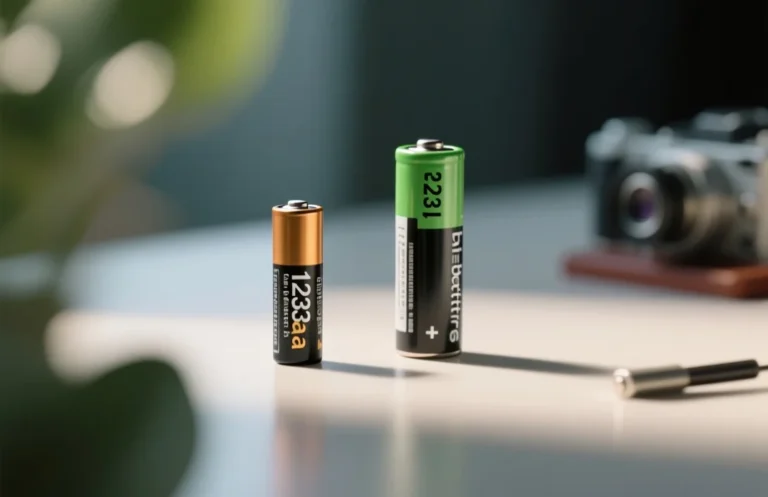
Difference Between Cr123 And 123a Batteries
Nominal voltage is the spec that matters most, because swapping a 3.7 volt rechargeable for a 3.0 volt primary battery can fry electronics or give poor performance. A common mistake is assuming 123A and CR123 are always identical. First check the device label or manual for allowed battery types – look for CR123A, RCR123, 16340, or explicit voltage limits, and follow safety warnings.

Difference between CR123 and 123A batteries is primarily chemistry and voltage: CR123 (CR123A) is a 3.0 V primary lithium cell about 34 mm long, while many 123A-labeled rechargeables (RCR123 or 16340) are 3.6-3.7 V Li-ion; primary and rechargeable types are not interchangeable without verification.
CR123 vs 123A Defined
CR123 and 123A usually refer to the same cell family, the small cylindrical 17 by 34 millimeter lithium primary battery commonly used in cameras, flashlights, and security devices. The key distinction readers must track is chemistry and voltage: CR123 or CR123A is normally a nonrechargeable 3.0 volt lithium cell, while rechargeable lookalikes appear under RCR123, 16340, or RCR123A and usually have a higher nominal voltage.
Official names and common aliases vary by label and retailer. Manufacturers and datasheets will call the nonrechargeable cell CR123, CR123A, or sometimes CR17345, while retail listings often shorten that to 123A or 123. Rechargeable options are labeled RCR123, RCR123A, or listed by the 16340 designation, and those are not the same as CR123 despite similar size.
Primary versus rechargeable is the single most important callout on a package. “CR” prefixes usually mean a lithium primary chemistry that is not meant to be recharged, and “RCR” or the numeric 16340 name indicates a lithium ion rechargeable cell with higher nominal voltage. Never assume a battery is safe to substitute because it fits physically; voltage and chemistry matter for device electronics and safety.
How manufacturers label cells can help you avoid mistakes. Good labels include the cell code (CR123A, 16340), nominal voltage, and whether the cell is rechargeable; some also print capacity and production codes. If the packaging lacks a clear chemistry or voltage, treat the cell as unknown and check the seller or device manual before installing.
For example, a security camera that lists “CR123A” in the manual expects a 3.0 volt primary cell; swapping in a 16340 rechargeable that is 3.6 to 3.7 volts can overdrive the electronics or cause the device to report errors.
| Feature | CR123 / 123A (primary) | RCR123 / 16340 (rechargeable) |
|---|---|---|
| Chemistry | Lithium primary (Li-MnO2) | Lithium ion (Li-ion) |
| Typical nominal voltage | About 3.0 V | About 3.6 – 3.7 V |
| Labeling common | CR123, CR123A, 123A, CR17345 | RCR123, RCR123A, 16340 |
| Interchangeability | Use when device specifies CR123A | Only use if device explicitly supports 16340 / rechargeable |
Safety note: Do not mix primary CR123 cells with rechargeables in the same device, and stop using any cell that is swollen, hot, or damaged.
Specs Side-by-Side Chart
CR123 and 123A cells share the same basic cylinder size and are commonly used as nominal 3.0 volt lithium primary cells, but the label can hide important differences in rechargeability, exact capacity, and manufacturer markings. Always check the cell label and the device datasheet before substituting one for the other.
Include the following specs when comparing these cells: physical dimensions, nominal voltage, stated chemistry, whether the cell is primary or rechargeable, listed capacity, and manufacturer markings or part numbers. Those items are the minimum that affect fit, voltage compatibility, runtime, and safety.
| Spec | CR123 (common labeling) | 123A (labeling/alternate) | Notes |
|---|---|---|---|
| Alternate names | Often shown as CR123 or CR123A | Shown as 123A, 123 | Names are often used interchangeably by sellers, which causes confusion. |
| Dimensions | About 34 mm length, 17 mm diameter | About 34 mm length, 17 mm diameter | Physical size is usually identical; still measure if tight fit is critical. |
| Nominal voltage | Typically listed as 3.0 V (primary) | Typically listed as 3.0 V (primary) | Rechargeable variants have higher nominal voltage, see notes below. |
| Chemistry | Commonly lithium manganese dioxide (primary) | Commonly same chemistry when labeled as primary | Rechargeable types use different chemistries and markings (RCR123, 16340). |
| Rechargeability | Usually non-rechargeable (primary) | Label may hide rechargeable versions; check marking | Do not attempt to charge cells marked CR123 unless explicitly marked rechargeable. |
| Typical capacity (manufacturer varies) | Manufacturer ratings vary; capacity is device and load dependent | Same as CR123 when primary; rechargeable models list different mAh | Expect variation between brands and big drops at high drain; check datasheets for exact mAh. |
| Typical markings | “CR123A”, manufacturer name, voltage | “123A”, part number, voltage | Rechargeables use different codes such as RCR123 or 16340; read labels carefully. |
How to read a manufacturer datasheet: verify the exact part number, look for the chemistry line, confirm nominal voltage and recommended charge method if rechargeable, and check the specified capacity with the discharge conditions listed. Pay attention to rated continuous and pulse discharge currents, and the recommended storage and operating temperature ranges.
Typical ranges vary by brand and by whether the cell is primary or rechargeable; capacity ratings are often given at a specific discharge rate so real-world runtime will differ.
For example, a high-drain flashlight will reduce useful capacity compared with the datasheet number, so always confirm the test conditions on the sheet.
Device Compatibility and Fit
CR123 and 123A cells often share the same physical size and can fit the same battery wells, but that fit does not guarantee electrical compatibility. Many devices expect a specific chemistry and nominal voltage (for example, primary 3.0 volt lithium), so swapping in a different 3×4 mm cell can damage electronics or cause unsafe operation.
Common devices that accept CR123/123A sized cells include:
For example, a popular camera flash that requires a CR123A primary lithium cell may physically accept a rechargeable RCR123/16340, but the higher nominal voltage of many rechargeables can cause misfires or damage the flash capacitor charge circuit. Conversely, some flashlights will accept the rechargeable type with no immediate issue, but runtime and heat behavior will change.
| Cell label | Typical nominal voltage | Fit and compatibility note |
|---|---|---|
| CR123, CR123A | ~3.0 V (primary lithium) | Physical fit for devices specifying CR123A; safest when device calls for CR123A. |
| RCR123, 16340 (rechargeable) | ~3.6 – 3.7 V (rechargeable Li-ion) | Same size often, higher voltage can damage devices that require 3.0 V; check device specs. |
| Label “123A” | Varies, check label | Some listings use 123A as shorthand for CR123A; confirm chemistry and voltage before use. |
Safety warning: Never assume a cell is safe because it fits. Check the battery label for chemistry and nominal voltage and check the device manual for acceptable replacements. Swollen, hot, or leaking cells must be removed and replaced immediately.
When in doubt, match the exact cell type shown on the device label or manual. Convenience adapters that only change mechanical fit do not correct electrical differences.
Capacity, Voltage, Runtime
CR123 cells are typically higher-voltage lithium primary batteries with higher usable capacity and lower internal resistance than cells sold as 123A, so CR123s usually give longer runtime in high-drain devices and retain charge on the shelf longer. A lower-voltage or higher-resistance 123A-style cell will show faster voltage sag and shorter usable runtime under load, and in devices that require about 3 volts it can fail to operate correctly.
Capacity is measured in milliamp-hours, but the label number is only a starting point, because the actual delivered capacity depends on discharge current and internal resistance. Under light loads, some lower-capacity chemistries look nearly as good as higher-capacity lithium, but under high loads the effective capacity of alkaline or high-resistance cells falls sharply.
Voltage matters both at open-circuit and under load: a lithium CR123 holds its nominal voltage longer as it discharges, while other 123A-marked cells can drop below device thresholds sooner. Devices with electronics that accept a voltage range will run longer on a CR123 because less sag means the device stays above its cutoff longer.
| Attribute | CR123 (common lithium) | 123A (other types) |
|---|---|---|
| Chemistry | Primary lithium, low internal resistance | May be alkaline or other primaries, higher resistance |
| Nominal voltage | Higher and stable under load | Lower open-circuit or drops faster under load |
| Runtime behavior | Better for high-drain, long shelf life | OK for light loads, poor for repeated high-drain use |
In practice, choose CR123-style lithiums when you need dependable runtime, especially for high-drain or temperature-sensitive gear; consider 123A-style alternatives only for low-drain, inexpensive, or non-critical uses after verifying the device accepts that voltage and chemistry. When in doubt, test under load or consult the device manual before substituting.
Rechargeable Substitutions Risk
Substituting a rechargeable RCR123 / 16340 cell into a device designed for a CR123 or 123A can create higher terminal voltage, missing protection, and fit issues that lead to device damage, overheating, or fire. Never assume physical similarity means electrical compatibility.
CR123 and 123A are labels commonly used for the same nonrechargeable primary lithium cell, while RCR123 and 16340 names refer to rechargeable lithium-ion cells that look similar but are not identical electrically. The rechargeable cells often have different voltage behavior, and some lack the protection circuitry many devices expect when using primary cells or protected rechargeable variants.
| Feature | CR123 / 123A | RCR123 / 16340 |
|---|---|---|
| Chemistry | Primary lithium, nonrechargeable | Rechargeable lithium-ion |
| Rechargeable? | No, do not recharge | Yes, but only with appropriate charger |
| Protection considerations | Device may expect lower voltage and no BMS | May need external charger or built-in protection |
| Physical fit | Standard for devices labeled CR123 | Often similar, sometimes slightly different |
Never attempt to recharge a CR123 / 123A primary cell. Charging primary lithium cells can cause rupture, leakage, or fire.
For example, camera flashes and tactical lights often list CR123A in their manuals; installing a higher-voltage rechargeable cell into these can change trigger circuits or stress voltage regulators. When replacement choice is between convenience and safety, choose the chemistry the manufacturer specifies.
Safety, Storage, Troubleshooting
CR123 and 123A labels often refer to the same physical cell size, but they can have different chemistries and voltages, so using the wrong one can damage a device or create a safety hazard. Verify the battery label and the device manual: many CR123/CR123A are nonrechargeable lithium primaries, while similarly sized rechargeable cells (RCR123, 16340) have higher nominal voltage and must not be swapped without confirmation.
Signs you must stop using a cell:
Storage and transport rules:
Disposal, recycling, and emergency steps:
Buying Checks and Recommendations
CR123 and 123A batteries are often used interchangeably, but it is crucial to check specifications to ensure compatibility with your devices. Both types generally share the same dimensions and voltage, but they can vary in chemistry and performance characteristics.
Ensuring you select the right battery for your device can enhance performance and safety. Always refer to device specifications when in doubt, and prioritize purchasing from trusted suppliers to avoid counterfeit products.
Quick Summary
The CR123 and 123A batteries are physically identical, but their labeling can lead to confusion regarding compatibility and specifications.
Frequently Asked Questions
What is the difference in voltage between CR123 and 123A batteries?
Both CR123 and 123A batteries typically have a voltage of 3 volts. They are often interchangeable in devices that require this voltage.
Are CR123 and 123A batteries interchangeable in devices?
Yes, CR123 and 123A batteries are generally interchangeable, but you should check your device’s manual to confirm compatibility. Some devices may have specific designations that could affect performance.
How do CR123 and 123A batteries perform in terms of runtime?
The runtime of CR123 and 123A batteries can vary based on the device and usage, but both typically provide around 1500 mAh of capacity. This means they can last for several hours in devices like cameras or flashlights.
Are there any safety concerns when using CR123 versus 123A batteries?
While both batteries are safe to use, it is crucial to avoid mixing brands or battery types to prevent leakage or damage. Always follow the manufacturer’s recommendations for your devices.
When should I replace CR123 or 123A batteries?
You should replace CR123 or 123A batteries when you notice a decrease in device performance, such as dimming lights or reduced functionality. Regularly checking battery levels can help you avoid unexpected failures.

- Home Solar Battery Backup Systems: Cost-focused Guide And Top Picks - July 29, 2026
- Rechargeable 9v Batteries With Usb-c Charging For Smoke Detectors And Tools - July 29, 2026
- Top 10 Best Solar Backup Batteries Austin 2026 - July 28, 2026