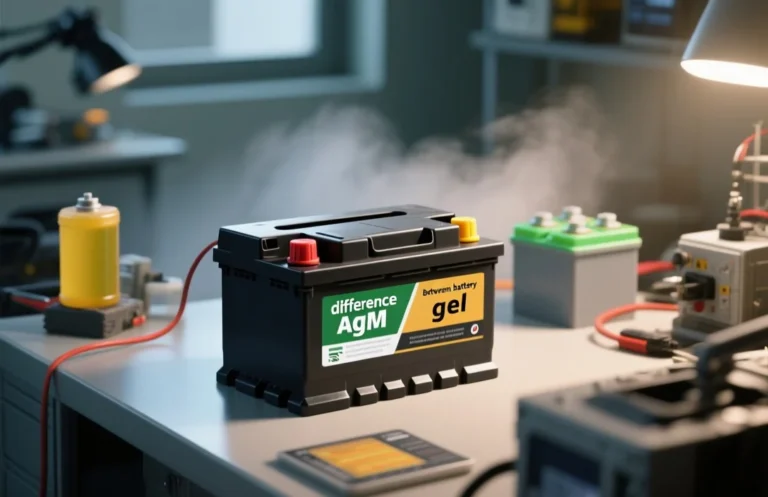
Difference Between Agm Battery And Standard
One label on the battery usually decides the rest: the chemistry or charge profile. Check that first, because using a flooded-battery charger on an AGM is the common mistake that shortens life. The spec that matters most is the battery type – AGM or flooded – and the first thing to check is the battery label and your charger mode.

Difference between AGM battery and standard lead-acid battery: an AGM is a sealed 12V lead-acid with glass-mat separators and no regular water top-up, while a standard flooded cell has liquid electrolyte, needs periodic distilled-water maintenance, and typically requires a different charger profile to avoid over- or under-charging.
AGM vs Standard Defined
AGM batteries are sealed, valve-regulated lead-acid cells that use an absorbent mat to hold electrolyte, making them maintenance-free and better at handling higher charge and discharge rates than wet flooded batteries. Standard here means flooded, wet-cell lead-acid batteries that contain free liquid electrolyte, require periodic water top-ups, and generally cost less up-front but need more maintenance.
Other sealed types exist, such as gel and other VRLA variants, but when people say “standard” they most often mean flooded wet-cell units used in cars and deep-cycle applications. Gel and other sealed batteries behave differently from AGM and from flooded batteries, so verify the exact chemistry printed on the label before replacing or paralleling batteries.
| Feature | AGM | Flooded (Standard) |
|---|---|---|
| Seal | Sealed, valve-regulated, no regular water topping | Open/wet cells, requires periodic water addition |
| Maintenance | Low to none, visual checks only | Requires checking electrolyte level and specific gravity |
| Typical lifespan | Often longer under shallow cycling, but varies by model | Can last long with proper maintenance and correct charging |
| Cost | Higher upfront price | Lower upfront cost |
| Charge acceptance | Handles faster charging and higher discharge rates better | Slower charge acceptance, more sensitive to overcharge |
| Vibration & orientation | Better vibration resistance, can be mounted in various positions | Must remain upright and is more sensitive to vibration |
| Gassing/venting | Minimal under normal conditions, vents if overcharged | Gasses during charge, hydrogen/oxygen release requires ventilation |
| Common uses | UPS, motorcycles, marine cranking, some deep-cycle, portable power | Automotive starter, stationary deep-cycle, solar battery banks |
Decide by trade-offs: choose AGM when you need low maintenance, better vibration tolerance, or faster charge/discharge capability and you can pay more up-front. Choose flooded when you need lower initial cost and are prepared to maintain water levels and provide ventilation.
Construction and Chemistry
AGM batteries hold the sulfuric acid electrolyte inside a fiberglass mat that soaks and immobilizes the liquid, while standard flooded lead-acid batteries have free liquid electrolyte that sits around the plates and vents to atmosphere. That single construction difference changes how they gas, how the plates wear, how they can be mounted, and how they fail under abuse.
For example, a cutaway diagram of each cell should label positive and negative plates, separator, electrolyte, vent or relief valve, and case. The diagram should also highlight common failure locations: the mat drying and case bulge on AGMs, and plate shedding, sediment collection, and cap seal leaks on flooded cells.
Performance and Capacity Metrics
AGM batteries usually deliver more usable energy under high loads and in cold conditions than standard flooded lead-acid batteries, while flooded batteries often have a lower upfront cost for the same nominal amp-hour rating. That means an AGM and a standard battery with the same Ah label can give different real-world runtimes depending on discharge rate, depth of discharge, and temperature.
Convert capacity into watt-hours with Wh = Ah × nominal voltage, and use Wh to estimate runtime by dividing by the device wattage, then adjusting for usable depth of discharge and inverter or conversion losses. Remember that quoted Ah is a nominal capacity under a specific discharge profile, so the real usable Wh depends on how hard and how long you discharge the battery.
For example, a 100 Ah battery at 12 volts equals 1200 Wh. If you plan to draw 300 watts from an inverter, divide 1200 Wh by 300 W to get 4 hours at full theoretical capacity, then reduce that by your chosen depth of discharge and inverter efficiency to estimate practical runtime.
| Metric | AGM (typical) | Standard Flooded (typical) | What to check on the label |
|---|---|---|---|
| Nominal capacity (Ah) | Same nominal Ah as flooded for many models | Same nominal Ah as AGM at same size | Rated Ah and nominal voltage, test conditions (eg 20 hr rate) |
| Usable capacity at high discharge | Higher usable fraction at higher C-rate | Usable capacity falls more with high C-rate | Discharge rate or C-rate reference |
| Depth Of Discharge (recommended) | Often allows deeper usable DOD for short periods | Recommended shallower DOD for longevity | Manufacturer DOD guidance, cycle life table |
| Cycle life | Typically better at shallow, repeated cycles | Can be comparable or worse if deeply cycled | Cycle rating at specific DOD (eg cycles to 80% capacity) |
| Temperature sensitivity | Better low-temperature performance | More capacity loss in cold, needs more ventilation when hot | Operating temp range and charge temp limits |
| Cranking / reserve | Good reserve and low internal resistance | Often higher water maintenance and stratification risk | CCA, Reserve Capacity (minutes) for cranking apps |
Cycle life depends strongly on depth of discharge and charge regime, not just chemistry. Expect cycle counts to drop quickly when you routinely exceed recommended DOD, and check the manufacturer’s cycle-life table that ties cycles to percent DOD rather than trusting a single nominal number.
A useful chart to create for decision making plots remaining capacity on the vertical axis against discharge rate and separate lines for ambient temperatures. The chart will show AGM holding more percent capacity at higher C-rates and lower temps, while flooded curves will slope down faster as load and cold increase.
Charging, Compatibility, Safety
AGM is a sealed, valve regulated lead acid battery that recombines most gasses internally, so it can accept higher charge rates and needs no watering, while standard flooded lead acid vents hydrogen and requires periodic topping with distilled water and occasional equalization. Both types use the same three-stage charge idea, but their recommended absorption, float, and equalization behavior and limits differ, so verify the battery label and charger settings before charging.
| Charge stage | Typical 12 V flooded | Typical 12 V AGM |
|---|---|---|
| Bulk / fast charge | Manufacturer range; higher current allowed but heats faster | Often higher allowable current than flooded; watch heat |
| Absorption | Manufacturer value (verify); used to finish charge | Often similar or slightly lower than flooded, check label |
| Float | Lower voltage to maintain full charge | Float slightly lower or similar; temp compensation important |
| Equalization | Used periodically to mix electrolyte and reverse sulfation | Not recommended for AGM, can cause damage and gassing |
Charger compatibility checklist:
Fast charging tradeoffs: pushing high current shortens life when it raises cell temperature, and can cause electrolyte loss in flooded cells and pressure build-up in AGM. For AGM, higher charge currents are possible but heat and swelling risks increase if the battery is already warm or aged.
For example, using a high-current charger without temperature compensation can make a flooded battery off-gas heavily during absorption and an AGM pack swell and vent valves, both reducing capacity and safety.
Safety warning: hydrogen off-gassing occurs when overcharging flooded cells and during equalization, so charge in a well ventilated area; AGMs recombine gas but will vent under abuse. Do not transport damaged or swollen batteries, and check airline or hazardous materials rules before travel.
Buying, Cost, Use Cases
AGM batteries are typically higher in upfront cost but lower in routine maintenance and better for vibration, mounting flexibility, and sealed installations; flooded “standard” lead-acid batteries are cheaper to buy but require watering, venting, and more careful mounting. Choose AGM when you need a sealed, low-maintenance battery for UPS, mobility, or cramped engine bays; choose flooded when lowest purchase price and simple replacement are the priority for stationary or low-vibration systems.
| Feature | AGM | Flooded (standard) |
|---|---|---|
| Upfront price | Higher per Ah on the market, varies by brand and capacity | Lower per Ah, cheapest option for bulk capacity |
| Maintenance | Sealed, no watering, low maintenance | Requires periodic water top ups and terminal care |
| Mounting and orientation | Can be mounted in more orientations, better for cramped installs | Must be upright to avoid spilling, needs venting space |
| Vibration and shock | Better resistance to vibration | More sensitive to vibration, plates can degrade faster |
| Charge acceptance | Generally accepts charge faster at moderate rates | Can accept high bulk charge but needs proper charging profile |
| Self-discharge | Lower self-discharge, better for standby | Higher self-discharge, needs periodic charging |
| Venting and safety | Sealed, minimal gassing under normal use | Emits hydrogen during charge, requires ventilation |
| Best fits | UPS, RV/boat, starter+deep hybrid, mobile rigs, cramped spaces | Stationary solar banks, budget deep-cycle, backup where ventilation is available |
To estimate cost per usable cycle, use a simple formula: divide the purchase price by the expected cycle life at the DoD you plan to use. Check the spec sheet for “cycle life at X% DoD” and use that manufacturer number as your baseline, then add expected maintenance costs, replacement parts, and energy lost to inefficiency.
For example, if a battery spec lists cycle life at 50 percent DoD, use that cycle count and the real price you would pay after tax and shipping. If you plan deeper discharges or higher temperatures, reduce expected cycle life before dividing to get a conservative cost per cycle estimate.
Decision rule: Pick AGM when sealed, low-maintenance, or vibration-resistant installation is required; pick flooded when upfront cost per Ah matters and you can provide ventilation and maintenance.
Shopping checklist:
Sizing checklist, step by step:
Maintenance, Troubleshooting, Replacement
AGM batteries require less maintenance than standard flooded lead-acid batteries, primarily due to their sealed design. However, both types have specific maintenance needs, troubleshooting methods, and replacement indicators that must be followed to ensure longevity and performance.
Routine Maintenance
For standard flooded lead-acid batteries, regular maintenance involves checking the electrolyte levels and ensuring terminals are clean and tight. AGM batteries, being sealed, do not require water topping but should still have their terminals cleaned and connections secured.
Troubleshooting Steps
When issues arise, specific troubleshooting steps can help identify problems with both battery types.
Replacement Triggers
Knowing when to replace a battery is crucial for safety and performance.
Safe Handling and Recycling
Both AGM and standard lead-acid batteries must be disposed of properly to avoid environmental harm. Always follow local regulations when recycling.
Quick Summary
The main difference between AGM batteries and standard lead-acid batteries lies in their construction and performance characteristics.
Frequently Asked Questions
What is the main difference between AGM batteries and standard lead-acid batteries?
The main difference is that AGM batteries have absorbed glass mat technology, allowing them to be spill-proof and more resistant to vibration, while standard lead-acid batteries are typically liquid-filled and can leak.
Are AGM batteries more expensive than standard batteries?
Yes, AGM batteries generally cost 20% to 50% more than standard batteries, reflecting their advanced technology and longer lifespan.
How do AGM batteries perform in extreme temperatures compared to standard batteries?
AGM batteries tend to perform better in extreme temperatures, maintaining a stable output down to -20 degrees Celsius, while standard batteries may struggle at lower temperatures.
What is the lifespan difference between AGM and standard batteries?
AGM batteries usually last longer, with a cycle life of around 3 to 5 years compared to standard batteries which might only last 1 to 3 years under similar usage conditions.
Can I replace a standard battery with an AGM battery in my device?
While you can replace a standard battery with an AGM battery, it is crucial to check compatibility with the charging system of your device, as AGM batteries require different charging voltages than standard batteries.

- Home Solar Battery Backup Systems: Cost-focused Guide And Top Picks - July 29, 2026
- Rechargeable 9v Batteries With Usb-c Charging For Smoke Detectors And Tools - July 29, 2026
- Top 10 Best Solar Backup Batteries Austin 2026 - July 28, 2026