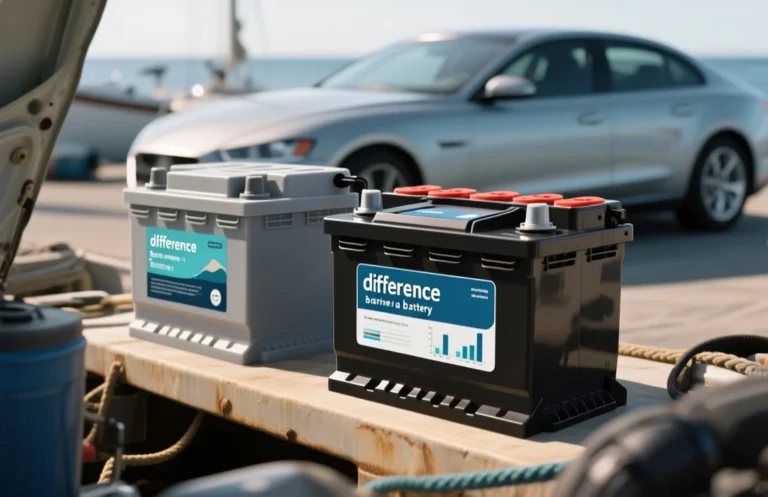
Difference Between A Marine Battery And Car Battery
Most small boats and cars use 12 V lead-acid batteries, but they are built for different jobs. The single most important spec to check is the duty rating – Cold Cranking Amps for starting versus Reserve Capacity or depth-of-discharge percent for marine/deep-cycle use. A common mistake is using a car starter battery for hours-long trolling or cabin power; check the label now.
Difference between a marine battery and car battery: marine batteries are made for sustained discharge and higher reserve capacity, often allowing repeated 50% depth-of-discharge cycles, while car batteries deliver short, high-current bursts measured in Cold Cranking Amps to start a 12 V engine.
Marine vs Car Battery Types
Car batteries are optimized for delivering a very large burst of current to crank an engine and then recharge quickly, while marine batteries are sized and built to supply sustained or repeated loads for electronics and trolling motors, or to combine both functions in one unit. Marine batteries are often designed to tolerate vibration, moisture, and repeated partial discharge cycles that would shorten a typical car starter battery’s life.
Starting batteries, sometimes called cranking batteries, are low-capacity, low-cycle units that give high cold-cranking amps for seconds at a time. Deep-cycle batteries are built to deliver a steady current over hours and to survive many partial discharge and recharge cycles. Dual-purpose batteries try to balance both roles, giving more reserve capacity than a pure starting battery while retaining decent cranking ability, but they trade off maximum performance in each role.
Common chemistries you will see are flooded lead-acid, AGM, gel, and lithium iron phosphate (LiFePO4). Flooded cells are the traditional, refillable type that require the most maintenance. AGM and gel are sealed lead-acid types that reduce maintenance and handle vibration better, with AGM usually better for high-rate starting and gel sometimes better for long discharge at low currents. LiFePO4 has higher usable capacity, lighter weight, and longer cycle life, but it requires compatible charging and a battery management system.
Physical size and terminal type matter when swapping batteries for cars or boats, because group size, post style, and hold-down points affect fit and wiring. Marine batteries are often available in the same group sizes as automotive options, but they may use side terminals, larger case footprints, or added handles and strap points for installation on a boat. Corrosion-resistant terminals and sealed cases are common on marine models to resist spray and humidity.
| Battery Type | Typical Role | Cycle Resilience | Maintenance | Vibration / Marine Suitability | Charge Sensitivity | Common Terminals |
|---|---|---|---|---|---|---|
| Flooded Lead-Acid | Starting or house with multiple cells | Low to medium | High (water topping, equalization) | Moderate, needs secure mounting | Moderate | Top posts |
| AGM | Starting, dual-purpose, or small deep-cycle | Medium | Low (sealed) | Good, resists vibration | Reasonable, handles higher charge rates | Top posts, sometimes side |
| Gel | Deep-cycle, sensitive installations | Medium | Low (sealed) | Good, but sensitive to fast charging | High sensitivity to overcharge | Top posts |
| LiFePO4 | Deep-cycle, lightweight dual-purpose | High | Low, but BMS required | Excellent, light and compact | Requires compatible charging profile | Varies: M8 studs, bolt terminals |
For example, if you only need to start a car and rarely power accessories, a dedicated starter battery is the cheapest practical choice. For a weekend boat that runs a trolling motor and house loads, choose a deep-cycle or dual-purpose battery, and consider LiFePO4 if weight and cycle life justify the higher upfront cost.
Safety note: do not mix different chemistries in parallel, avoid chargers that lack correct profiles for LiFePO4 or gel, and replace any battery that is swollen, overheating, or leaking.
Construction and Design Differences
Marine batteries are built with thicker plates, heavier cases, and stronger seals than ordinary automotive starting batteries, because boats need durability under repeated deep or partial discharges, constant vibration, and a corrosive environment. Automotive batteries are optimized for high, short bursts of current and light weight, so their plates and cases are made to favor cranking performance over long-term cycling and rugged sealing.
Plate thickness and layout are the main internal clues. Marine and dual-purpose batteries have thicker positive plates and denser active material to resist shedding during repeated cycles, which increases cycle life but raises internal resistance and weight. Car starting batteries use many thin plates to maximize surface area for very high cold cranking amps over short durations, so they deliver big bursts but lose capacity faster under deep discharge.
Cases, seals, and venting differ because of environment and service pattern. Marine batteries often have thicker, more chemically resistant polypropylene cases and stronger gasketed seals, plus options for sealed absorbed glass mat construction to limit electrolyte loss. Automotive batteries commonly use lighter thin-wall cases and simpler vent paths because frequent topping up and cabin mounting is expected, and weight is a design priority.
Quick buying checks:
| Feature | Marine/Dual-purpose | Automotive/Starting |
|---|---|---|
| Plate thickness | Thicker, denser active material | Thinner, many plates for surface area |
| Case and seals | Heavier case, better seals, often AGM option | Lighter case, simpler vents |
| Vibration protection | Reinforced straps, plated terminals | Basic mounting, less reinforcement |
Trade-off: choose marine construction when you need durability under cycle and vibration; choose automotive starting construction when weight and peak cranking are the priority.
Performance Metrics Compared
Marine batteries are tuned for sustained, repeated discharges and higher reserve capacity, while car batteries are tuned for very high short bursts of current for starting, which shows up as higher Cold Cranking Amps on their labels. Expect marine batteries to list higher amp‑hour availability under moderate loads and longer cycle life figures, and car batteries to show higher CCA but lower cycle durability.
Capacity on labels is usually given in amp‑hours, and you can convert to watt‑hours by multiplying by the nominal voltage, which is useful for runtime estimates. Runtime equals battery watt‑hours divided by the continuous load in watts, then adjust for inverter losses or Peukert effects when discharge rates are high.
| Metric | Marine Battery | Car Battery |
|---|---|---|
| Cold Cranking Amps (CCA) | Moderate to high, but often lower than starter batteries for the same size | High, optimized to deliver very large current for a few seconds |
| Amp‑hours (Ah) / Reserve Capacity | Higher Ah and reserve capacity for sustained loads like trolling motors or accessories | Lower Ah for deep discharge, reserve capacity is limited and short |
| Cycle Life | Higher cycle life, built for repeated partial and deep cycles | Lower cycle life, designed for infrequent deep discharge |
| Peukert Effect | Less severe at typical boat loads, but still relevant for high-current draws | More severe when used outside brief starting duty; capacity falls quickly at high rates |
Watt‑hours = Amp‑hours × Voltage; Runtime (hours) ≈ Watt‑hours ÷ Load (W), adjusted for Peukert and conversion losses.
Safety check: never mix battery types or use a starter battery in continuous deep‑cycle service; that shortens life and increases failure risk. If label data is missing or ambiguous, contact the manufacturer before using the battery in a different role.
Charging Compatibility and Chargers
A marine battery is usually designed for deeper, slower discharges and needs a different charging profile than a car starting battery, and vehicle alternators and shore or inverter chargers behave differently enough that using the wrong charger can shorten life or trigger safety circuits. Always match the charger profile and control method to the battery chemistry and intended use, or add a DC-DC or battery-to-battery regulator when tying different systems together.
Alternator versus shore power and onboard chargers
Car alternators are built to recover a starting battery quickly while the engine runs, they deliver high current and a voltage regulated for typical lead-acid starter batteries, which can be harsh on deep-cycle or lithium banks if left uncontrolled. Boats often have multiple battery banks and need either multi-stage alternator regulators or DC-DC chargers to provide proper bulk, absorption, and float phases to a house battery, especially when the alternator wiring has voltage drop or long runs.
For example, if you try to charge a deep-cycle AGM or LiFePO4 house bank directly from a standard alternator with a simple voltage regulator, the bank may never reach proper absorption, or the alternator may overheat trying to maintain current. Adding a dedicated multi-stage charger or a smart alternator regulator gives the right voltages and can isolate banks so the starter battery and house bank are charged correctly without overtaxing the alternator.
Charger profiles by chemistry
Flooded lead-acid, AGM, and LiFePO4 each need different voltage steps and timing: flooded cells tolerate higher absorption voltages and occasional equalization, AGM wants controlled absorption and limited equalization, and LiFePO4 needs a charger set for the manufacturer recommended bulk/absorption voltage and a BMS-compatible cutoff. Using the wrong preset on a charger risks watering loss in flooded cells, permanent capacity loss in AGM, or BMS lockout and heat issues with lithium packs.
Solar and inverter charging
Solar charge controllers and inverter-chargers must be configured to the same profile as the battery chemistry; MPPT controllers usually offer selectable battery types or custom voltage settings that let you match flooded, AGM, or LiFePO4. An inverter-charger provides AC shore charging and can run a multi-stage algorithm, but you must set its charge voltages and maximum current to suit the battery bank and avoid paralleling incompatible charge sources without coordination.
In practice, a good setup on a boat uses an MPPT solar controller set to the battery type, an inverter-charger configured for the same profile, and a smart device or battery monitor to prevent simultaneous conflicting charge stages. If charging LiFePO4 from an alternator or inverter, add a DC-DC charger or BMS-aware charger so the Li pack sees the correct voltages and current limits.
Use Cases and Real Fits
Marine batteries are built to handle repeated shallow or deep discharges and a wet, vibrating environment, while car batteries are optimized to deliver very high short bursts of current for starting and tolerate little repeated deep discharge. Choose by the load pattern: if you need sustained amp-hours and repeated cycles, pick a deep-cycle marine or marine house bank; if you need reliable cranking every cold morning, stick with an automotive starting battery.
For example, a 14-foot skiff with a small outboard and occasional two-hour trolling runs gets better runtime and battery life from a dedicated deep-cycle or lithium house battery; a dual-purpose battery can work if you rarely run the trolling motor more than an hour and need a single-battery setup for simplicity.
Warning: Never mix different chemistries or old and new batteries in the same bank, and avoid using a starting battery where you will routinely deeply discharge it, because that will quickly reduce capacity and can strand you. Always check labels and the boat or vehicle manual for the design intent and recommended battery arrangement before making changes.
Maintenance, Safety, Storage
Marine batteries require specific care to handle the unique demands of marine environments, while car batteries need maintenance suited for automotive applications. Understanding the differences in maintenance routines, safety considerations, and storage practices is vital for prolonging the life of each type of battery.
Proper storage practices also differ significantly between marine and car batteries.
For instance, car batteries can remain in a vehicle during winter, but marine batteries should be removed and stored indoors when not in use, especially in colder climates.
Replacement triggers differ as well; a car battery typically needs replacing every 3-5 years based on usage and climate, while marine batteries might require more frequent replacement depending on discharge cycles and maintenance. Regularly inspect both types for corrosion at terminals and physical damage to ensure safe operation.
Buying Checklist and Troubleshooting
Marine batteries are designed for deep discharge and high cycle life, while car batteries provide quick bursts of power for starting engines. When choosing between them, verify specifications, conduct tests, and understand the environment where the battery will be used.
When considering repair or replacement, evaluate the age and performance of the battery. Car batteries typically last 3-5 years, while marine batteries can last longer depending on usage. If performance is declining or if the battery shows signs of swelling or leakage, replacement is advisable.
Quick Summary
Marine batteries and car batteries serve different purposes, making their specifications and designs distinct.
Frequently Asked Questions
Can I swap a car battery for a marine battery, or what are the compatibility differences between a marine battery and a car battery?
You can physically swap if both batteries are the same voltage and the group size fits, most common batteries are 12 V. Marine batteries are made for deeper, repeated discharges while car batteries are made to deliver large current bursts for starting, so verify BCI group size, terminal layout, and charger compatibility before swapping.
Will a marine battery overheat in a car, or how does temperature tolerance differ between marine and car batteries?
You can expect temperature limits to vary by manufacturer, so check the datasheet, and if no label is present use caution around high heat because many charging guidelines flag temperatures above 50 degrees C as a stopping point; exact limits differ by model. Do not assume a marine battery tolerates higher ambient heat than a car battery without checking the spec sheet.
Which lasts longer powering accessories, a marine battery or a car battery, and how do I estimate runtime?
You can estimate runtime from the amp-hour rating, for example a 100 Ah battery can theoretically supply 100 A for 1 hour or 1 A for 100 hours under ideal conditions, and marine deep-cycle batteries are optimized to give more usable Ah for accessories than a starting-only car battery of the same size. Always use the Ah rating and expected depth of discharge to calculate realistic runtime for your loads.
Are marine batteries safer than car batteries around water, and what safety differences should I know?
You can pick sealed options for wet environments because sealed cells reduce spill risk, look for sealed (AGM or gel) if you need spill-proof operation; however sealed does not remove the need for correct mounting, ventilation while charging, and corrosion checks. Also confirm the battery is the correct voltage for your system, typically 12 V, before installation.
What is a common buying mistake when choosing between a marine battery and a car battery?
You can avoid the common mistake of buying on price alone by checking the battery type and specs, especially the Ah rating, BCI group size, and that it is 12 V, so your charger, alternator, and tray match the battery. Also verify whether you need a starting, deep-cycle, or dual-purpose battery for your actual use case to prevent premature failure.

- Top 10 Best Solar Battery Installers Qld 2026 - September 12, 2026
- Top 10 Best Solar Battery Deals Qld Reviews 2026 - September 12, 2026
- Top 10 Best Solar Battery Deals Qld Price 2026 - September 12, 2026