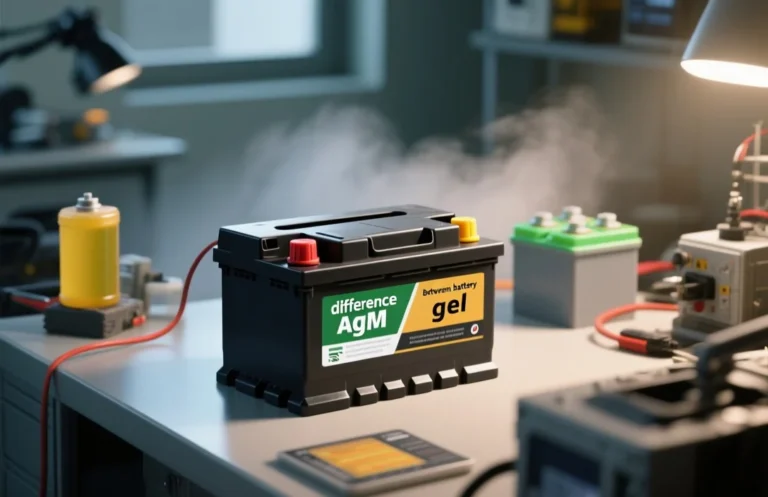
Difference Between Agm And Gel Cell Batteries
Battery voltage and charger setting matter most when choosing between AGM and Gel cells; nearly every sealed lead-acid battery you buy will be labeled 12V. A common mistake is charging Gel with an AGM or generic charger, which can shorten life and void warranties. First check the battery label for chemistry and the charger for a Gel or AGM setting before installation. Safety note: proper charger mode prevents overheating and long-term damage.

Difference between AGM and Gel cell batteries for common 12V systems is the electrolyte form: AGM traps electrolyte in a glass mat for higher pulse current and faster recharge, Gel immobilizes electrolyte in silica for steadier float performance and vibration resistance, and gel usually needs gentler charging.
AGM vs Gel Basics
AGM and gel are both valve regulated lead acid, VRLA, batteries that are sealed so the electrolyte is not free-flowing and hydrogen and oxygen recombine inside the cell. The core difference is physical: AGM traps electrolyte in fiberglass mat between the plates, while gel immobilizes electrolyte by mixing it with silica to form a thickened gel.
VRLA traits they share include a sealed case with a pressure relief valve, no regular watering, and reduced electrolyte leakage risks compared with flooded lead-acid cells. Both types allow safer mounting inside equipment, but they still need the correct charger profile and are sensitive to sustained overvoltage and heat.
AGM construction uses compressed glass-mat separators that sit against the positive and negative plates, holding electrolyte in the mat fibers by capillary action. The plates are tightly packed, which reduces internal resistance and improves vibration resistance. Because gas recombines on the plates and in the mat, AGM tolerates higher charge acceptance and short bursts of high current better than gel in many cases.
Gel cells are made by adding silica to the sulfuric acid so the electrolyte forms a putty-like gel that surrounds the plates and fills the cell. The gel prevents stratification and immobilizes acid, which reduces leakage and allows safe installation in many orientations, though the valve still controls pressure release. Gel cells accept charge more slowly and are sensitive to excessive charging voltage, which can cause voids in the gel and permanent capacity loss.
| Characteristic | AGM | Gel |
|---|---|---|
| Electrolyte form | Absorbed in glass mat | Thickened into silica gel |
| Orientation limits | Can be mounted in several orientations, check manufacturer | More tolerant of orientation but follow valve specs |
| Charge acceptance | Higher, faster charging | Lower, slower charging preferred |
| Vibration resistance | Good | Good |
| Sensitivity to overcharge | Moderate | High |
| Typical cost | Usually lower per Ah | Usually higher per Ah |
Overcharging either type can cause permanent damage; with gel cells, excessive charge voltage or heat can create gas pockets inside the gel that reduce capacity and are not repairable.
Practical implication: choose AGM when you need higher charge acceptance, better cold-start current, or lower cost, and choose gel when leakage resistance and long float life under correct charge settings matter more than fast recharge. Always confirm the manufacturer’s recommended charge and float voltage on the label or datasheet to avoid irreversible damage.
Performance: Capacity & Runtime
AGM and gel VRLA batteries often list the same nominal amp-hour capacity, but usable capacity and runtime diverge under real loads: AGM typically delivers more usable energy at higher discharge rates with less voltage sag, while gel often gives steadier voltage at low, long-duration discharge and can have slightly lower self-discharge in storage. Internal resistance, discharge rate, and temperature determine which type will run your device longer, so compare manufacturer usable-capacity curves rather than only the Ah label.
| Property | AGM | Gel |
|---|---|---|
| Usable capacity vs rated | Closer to rated Ah at moderate to high discharge rates, but capacity falls with deep cycles | Rated Ah can be optimistic at high currents; performs better at low, steady draws |
| Discharge rate behavior | Lower internal resistance, better for higher C-rate loads and short bursts | Higher internal resistance, more voltage sag under heavy loads, better for slow drains |
| Self-discharge / standby | Low self-discharge, reliable for standby if charged correctly | Often slightly lower self-discharge; can hold charge well in long storage at correct float voltage |
| Temperature sensitivity | Performance drops in cold, heat accelerates capacity loss; tolerates higher charge currents | Also loses capacity in cold, can be more sensitive to high-temperature overcharge |
For practical runtime estimates, do not use nameplate Ah alone. Manufacturers publish capacity vs discharge rate curves and Peukert-style numbers; these show usable watt-hours at given loads and temperatures, and gel and AGM curves will diverge as current increases.
Charging and Compatibility
AGM and gel are both sealed VRLA lead-acid batteries, but they charge differently: gel cells usually require lower absorption and float voltages and cannot tolerate high charge currents, while AGM cells accept higher charge voltages and recharge faster with moderate current. Using the wrong charger profile shortens life, with gel more likely to suffer irreversible drying and AGM more likely to be overheated by sustained overvoltage.
When checking a charger or inverter-charger, read the label and spec sheet for three things: the battery chemistry profiles offered, the voltage range and selectable absorption/float values, and whether the unit supports temperature compensation. Also check the maximum charge current, and whether the charger allows a custom profile when the preset profiles do not match the battery manual.
Solar charge controllers, especially MPPT models, usually offer selectable battery types or custom setpoints. If the controller does not list gel separately, program the absorption and float voltages from the battery manufacturer and enable temperature compensation where possible to avoid overcharge at high ambient temperatures.
For example, if an MPPT is set to an AGM profile but your battery is gel, the higher absorption voltage and longer absorption time can dry out the gel and permanently reduce capacity. Conversely, programming a gel profile on an AGM can undercharge it and shorten usable capacity if absorption time is too short.
| Characteristic | AGM | Gel |
|---|---|---|
| Typical charge voltage tolerance | Higher | Lower |
| Fast-charge tolerance | Better, moderate | Poor, avoid high current |
| Equalization | Sometimes allowed if specified | Usually not allowed |
| Common uses | Start/stop, inverter banks, hybrid systems | Deep discharge cycles with vibration resistance |
Always match charger profile to the battery label or manual; if you cannot find exact settings, choose lower voltage and longer charge times rather than higher voltage quick charges.
Smart chargers and inverter-chargers can simplify this if they explicitly support the battery chemistry and include temp compensation and current limiting. Before enabling fast-charge modes, confirm the battery maker’s recommended maximum charge current (C-rate). If the manual is missing, use conservative current and consult the vendor.
Safety warning: wrong profiles, disabled temperature compensation, or enabling equalization on gel cells can cause permanent capacity loss or overheating. When in doubt, stop and check the battery datasheet or ask the manufacturer for recommended charge setpoints.
Safety, Heat and Storage
AGM and gel batteries are both sealed lead acid types, but they behave differently when overheated, overcharged, or stored. AGM is more likely to vent and lose capacity from repeated overcharge, while gel resists free gassing but can suffer irreversible internal damage if exposed to sustained overcharge or high temperature.
Watch for obvious thermal and mechanical signs, because early detection prevents fires and permanent loss of capacity. Hot cases, a rotten-egg smell, bulging plastic, or white crystalline deposits on terminals mean stop and isolate the battery immediately.
| AGM | Gel | |
|---|---|---|
| Storage state of charge | Store partially charged, roughly 40 to 60 percent, and recharge periodically to avoid sulfation | Same partial storage recommended; avoid long-term full charge which increases risk of gel degradation |
| Temperature sensitivity | Tolerates higher charge rates but heats faster under abuse; keep cool and shaded | Less gassing at low abuse, but more sensitive to prolonged high temperature which can soften or harden the gel |
| Transport notes | Often classed as non-spillable when tested, check label and paperwork before shipping | Often classed as non-spillable when tested, check label and paperwork before shipping |
When storing either type long term, keep them in a cool, dry place, check voltage or specific gravity per manufacturer intervals, and never store on a charger. For transport or disposal, always verify the battery label and local regulations, because sealed does not automatically equal exempt from hazardous-material rules.
Maintenance, Troubleshooting & Buying Checks
AGM and gel are both sealed valve-regulated lead-acid batteries, but they differ in how the electrolyte is held: AGM traps electrolyte in glass-fiber mats, while gel suspends it in a silica gel. That construction difference changes charge tolerance, recommended charger profiles, and how each fails under misuse, so always confirm the chemistry marking and the manufacturer’s charge voltages before purchase or service.
Routine inspection should be monthly for installed batteries and before seasonal storage. Check terminals for tightness and corrosion, feel the case for warmth after charging, and look for slow voltage drift that could indicate self-discharge or internal shorts.
| Property | AGM | Gel |
|---|---|---|
| Electrolyte form | Absorbed in glass-fiber mats | Electrolyte thickened into silica gel |
| Charge sensitivity | Tolerates higher charge currents, sensitive to overvoltage | More sensitive to overvoltage and fast charging |
| Typical use | Starting, high-discharge cycles, UPS | Deep-cycle, long float where spill-proof and vibration resistance are needed |
| Maintenance | Visual checks, correct charger profile, conductance tests | Same checks, avoid equalization unless allowed by maker |
Replace the battery when it repeatedly fails to hold charge, shows high internal resistance on conductance/load tests, bulges, leaks, or if warranty/age limits are reached. For safety, stop using any battery that swells, gets hot during normal charging, emits a strong odor, or cannot reach and hold its proper float voltage despite correct charging, and arrange proper disposal.
Cost and Warranty Considerations
AGM batteries typically have a lower upfront price than gel cell batteries, but that advantage can disappear if the application stresses the battery or if charging is not matched to the chemistry. Warranties for both types vary widely, and many manufacturers tie full coverage to specific charge voltages, installation conditions, and proof of proper use.
Upfront price versus expected cycle life is a trade-off readers must budget for. AGM often wins on initial cost and on applications with higher peak currents, while gel can cost more up front and may promise longer float life in certain conditions, but only if charged and used within the maker’s specified limits.
Safety note: charging at the wrong voltage can void warranty and damage the battery, so verify recommended float and bulk voltages before purchase and make that part of any warranty discussion.
| Item | AGM | Gel |
|---|---|---|
| Upfront cost | Generally lower | Generally higher |
| Warranty style | Varies, often shorter full-replacement window | Often similar length, may require stricter charging |
| Common exclusions | Deep discharge, overcharge, physical damage | Same as AGM, plus stricter charge-voltage requirements |
| What to verify | Cycle test conditions and claim logistics | Charge profile requirements and pro-rata terms |
Best Use Cases
AGM batteries are the practical choice when you need higher charge acceptance, strong surge current, and good vibration resistance; Gel batteries are the practical choice when you need slow, low-rate deep cycling with long float life and you can enforce a gel-specific charging profile. Both are sealed VRLA types, but their charging limits and abuse tolerance differ enough that application choice matters.
AGM uses glass mats to hold electrolyte, which gives lower internal resistance and faster charge/discharge. Gel traps electrolyte in silica, which limits high-rate discharge and makes the battery sensitive to overvoltage during charging, but it reduces electrolyte movement and can be useful where leakage must be avoided.
| Feature | AGM | Gel |
|---|---|---|
| Charge acceptance | Higher, faster | Lower, slower |
| Surge/cranking | Good | Poor |
| Overcharge sensitivity | Moderate | High |
| Vibration/tilt | Good | Good |
| Maintenance | Low | Low |
| Typical use | UPS, starters, inverters, solar | Deep float, specialty off-grid, sealed locations |
Deep-cycle solar and off-grid setups: choose AGM when your system needs higher inverter bursts, faster recharge from panels, or you expect shallow, frequent cycles. Choose Gel when your regulator can be set to gel voltages and you expect long, low-rate float with infrequent recharge.
Marine, RV, and mobility applications: AGM is the common, flexible pick for combined starting and house loads because it tolerates engine vibration and high starting currents. Gel is suitable in niche sealed installations where very low gas release and absolute leak prevention are required, but you must control charger voltage precisely.
UPS, telecom, and standby backup roles favor AGM for its rapid recharge and ability to supply high fault currents. Gel can work for long float backup when chargers are set to gel float voltages and loads are light.
Starter and mixed-use scenarios: AGM is usually the safe option for combined cranking and cycle duty. Gel will fail faster if used for repeated high-current starts.
For example, replacing a boat’s old flooded house bank with AGM will usually improve inverter run time and reduce maintenance, while replacing a sealed instrument enclosure battery with gel may be chosen to avoid any chance of free liquid in a tilted position.
Safety warning: Do not use a charger set for AGM on a gel battery without confirming voltages, and do not mix AGM and gel in the same bank, because overvoltage can cause permanent gel damage and swelling.
Quick Summary
The main difference between AGM and gel cell batteries lies in their construction and applications.
Frequently Asked Questions
What is the main difference in cost between AGM and gel cell batteries?
Generally, gel cell batteries tend to be more expensive than AGM batteries, often due to their more complex manufacturing process. Expect to pay around 10-20% more for a gel battery compared to an AGM of similar capacity.
How do AGM and gel cell batteries compare in terms of heat tolerance?
AGM batteries can handle higher temperatures better, often rated for up to 60°C, while gel batteries may begin to lose efficiency at temperatures above 45°C. So, for hotter environments, AGM might be a safer choice.
Which type of battery has a longer runtime in deep cycle applications?
Gel cell batteries generally offer longer runtimes in deep cycle applications, making them suitable for extended use. They can handle deeper discharges without damage better than AGM batteries, which typically last longer in shallow cycling.
Are there safety concerns when using AGM versus gel cell batteries?
Yes, gel batteries are less prone to leaking and are less hazardous because they are sealed and do not emit gases during charging, unlike AGM batteries which can release gases if overcharged. This makes gel batteries a safer choice in sensitive environments.
When should I replace my AGM or gel cell battery?
Typically, you should consider replacing these batteries every 3 to 5 years, depending on usage and maintenance. Regularly check for signs of swelling, corrosion, or diminished capacity to determine if replacement is necessary.

- Home Solar Battery Backup Systems: Cost-focused Guide And Top Picks - July 29, 2026
- Rechargeable 9v Batteries With Usb-c Charging For Smoke Detectors And Tools - July 29, 2026
- Top 10 Best Solar Backup Batteries Austin 2026 - July 28, 2026