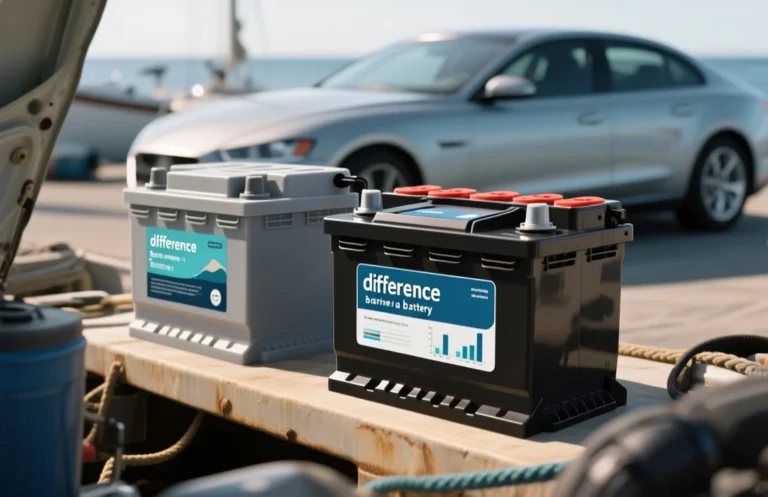
Difference Between Agm And Lead Acid Battery
AGM batteries are a sealed form of lead-acid that trap electrolyte in glass mats, while flooded lead-acid keeps free liquid you must top up. The single most important spec is the required charging profile and voltage, because the common mistake is using the wrong charger. First check the battery and charger labels for “AGM” or “SLA/Sealed”.

Difference between AGM and lead acid battery: AGM is a sealed, absorbed glass mat type that generally needs no water top-ups, while flooded lead-acid holds free electrolyte and requires periodic water checks, often every 1-3 months; always verify the charger has an AGM or sealed lead-acid profile.
AGM vs Flooded Lead Acid
AGM batteries have glass-mat separators that hold the electrolyte against the plates in a sealed, valve-regulated case, while flooded lead acid batteries contain free liquid electrolyte in vented cells and require periodic water top-ups and ventilation. The construction difference drives most practical trade-offs: maintenance, mounting, off-gassing, and sensitivity to overcharge.
AGM means Absorbent Glass Mat, which is a fine fiberglass mat pressed between the positive and negative plates so the sulfuric acid is absorbed into the mat. AGM cells are typically sealed with a pressure relief valve and are usually labeled VRLA, for valve regulated lead acid. Because the electrolyte is immobilized, AGMs are more tolerant of vibration and can be mounted on their side in many cases.
Flooded, or wet, lead acid batteries have lead plates immersed in free liquid electrolyte inside individual cells with removable caps or permanent vents. During charging, flooded cells vent hydrogen and oxygen gas, so they need ventilation and occasional distilled water top-ups to replace lost water. Flooded batteries are common for stationary battery banks, automotive starting, and applications where low cost and easy capacity checks matter.
| Component or Trait | AGM | Flooded (Wet) |
|---|---|---|
| Separator | Glass-mat between plates | Porous separators or none, plates immersed |
| Electrolyte | Absorbed into mat | Free liquid, covers plates |
| Venting | Sealed, valve-regulated | Open/vented caps, continuous venting during charge |
| Maintenance | Low, no watering | Requires periodic water top-ups and inspection |
| Mounting | Flexible orientation | Must stay upright to avoid spills |
| Typical uses | UPS, mobility, small solar systems, vehicles with vibration | Large stationary banks, deep cycle in controlled environments, starter batteries |
Safety note: Flooded batteries release hydrogen when charging, so charge them in a well ventilated area and never smoke near the cells; AGM batteries vent rarely but will release gas if overpressurized, so use a proper charger and monitor temperature and voltage.
Trade-offs are clear: AGM costs more up front and requires less maintenance, while flooded batteries cost less and allow simple capacity checks and cell equalization. Choose AGM where space, orientation, low maintenance, or vibration resistance matter; choose flooded where cost control and easy long-term servicing matter.
Side‑by‑Side Comparison
AGM is a sealed, valve-regulated lead-acid battery that traps electrolyte in glass-mat separators, while “lead acid” in common use usually means flooded, wet-cell batteries with free liquid electrolyte. AGM has lower routine maintenance, tighter mounting orientation, and generally faster charge acceptance; flooded cells are less expensive per amp-hour and can be serviced by adding water.
| Specification / Behavior | AGM | Flooded (wet) Lead Acid |
|---|---|---|
| Construction | Sealed VRLA, glass-mat separators hold electrolyte | Open cells, liquid electrolyte, removable caps or vent |
| Electrolyte containment | Immobilized, minimal gassing under normal charge | Free liquid, gases during charge, requires ventilation |
| Weight per Ah | Normally heavier per Ah than advanced chemistries but compact | Often similar or slightly lighter per Ah depending on design |
| Energy density | Lower energy density than lithium, comparable to flooded lead acid | Comparable to AGM, varies by plate design |
| Maintenance | Low, sealed, no watering | Requires periodic water top-up and cell checks |
| Charge acceptance | Better at higher charge rates and recovers faster after discharge | Good, but slower recovery and more prone to stratification |
| Install orientation | Can be mounted in various orientations (within limits) | Must remain upright to avoid spills |
| Typical use cases | UPS, telecom, mobility scooters, small solar systems, backup | Automotive starters, deep-cycle renewable arrays, industrial cells |
| Cost | Higher upfront cost per Ah | Lower upfront cost per Ah |
| Safety / Venting | Sealed, lower hydrogen emission when charged properly | Vents hydrogen and oxygen; needs ventilation during charging |
Quick pros and cons
AGM pros and cons are concise and decision-focused.
For example, an RV owner who wants low upkeep and flexible mounting may pick AGM, while a workshop that routinely deep-cycles and can maintain cells might choose flooded for lower capital cost.
Which specs to verify on the datasheet
Safety note: Never mix sealed AGM and flooded cells in the same bank; verify ventilation needs, watch for swelling or heat, and use a charger with the correct voltage profile for the battery type.
Performance and Runtime
AGM batteries generally deliver higher usable power under heavy loads because they have lower internal resistance and less voltage sag than traditional flooded lead acid cells, so an AGM will keep voltage higher during short, high-current draws. Flooded lead acid batteries often show larger capacity loss at high discharge rates and therefore shorter usable runtime for the same rated ampere-hour capacity.
Rated capacity (Ah) is only the starting point when predicting runtime; actual delivered energy depends on discharge rate, temperature, and how deeply you draw the battery. At higher C-rates the effective capacity falls, an effect often called the Peukert effect, and that loss tends to be larger for flooded cells than for AGM because flooded plates and electrolyte movement increase internal resistance under load.
Depth of discharge, DOD, is the main driver of cycle life for both chemistries, but the trade-offs differ. Flooded batteries typically require shallower cycling to reach long life, while AGM can tolerate deeper cycles more often without immediate failure, though AGM cycle life still falls as average DOD increases. Manufacturer cycle-life curves are the only reliable guide for exact numbers, so check the spec sheet before planning regular deep discharges.
For example, using a battery to run an inverter shows these effects clearly: two batteries with the same Ah rating can give different runtimes if one is AGM and the other is flooded, because the AGM will maintain voltage under the inverter’s surge and deliver more usable Wh at higher currents. Cold temperatures reduce capacity for both types, and starting or cranking performance will fall if the battery is cold or partially discharged.
| Characteristic | AGM | Flooded Lead Acid |
|---|---|---|
| High-current discharge | Lower internal resistance, better at surges | More voltage sag under heavy loads |
| Usable capacity under load | Higher usable Wh at high C-rates | Lower usable Wh when discharge rate is high |
| Cycle life vs DOD | Tolerates deeper cycles better, still degrades faster with deeper DOD | Longer life if cycled shallowly, sensitive to deep discharge |
| Cold cranking | Usually stronger cranking performance | Weaker cranking unless oversized |
| Maintenance | Sealed, low maintenance | Requires water topping and ventilation |
Safety reminder: stop using batteries that swell, overheat, or leak, do not mix battery types or ages in a bank, and verify charger and application specs before deep cycling to protect runtime and extend service life.
Charger Compatibility
AGM batteries are a sealed variant of lead acid that usually require a charger with a sealed/AGM or SLA profile because their recommended float voltage is slightly lower and they do not tolerate routine high-voltage equalization the way flooded batteries do. Flooded (wet) lead acid needs multi-stage charging with periodic equalization and watering, so a charger that can be set to “Flooded” or “Wet” and that supports adjustable bulk, absorption, and float stages is preferred.
Smart multi-stage chargers matter here, because they move through bulk, absorption, and float stages and can limit voltage and current for the battery chemistry you select. A charger with an explicit AGM/SLA setting, temperature compensation, and selectable absorption time will keep an AGM battery healthier than a basic single-stage charger.
Equalization is a high-voltage, extended absorption step that deliberately causes gassing to mix electrolyte and correct cell imbalance. For flooded cells, occasional equalization is beneficial. For AGM, equalization can force gas out of the mat, reduce capacity, and may damage the battery unless the manufacturer explicitly permits it.
| Property | Flooded (wet) Lead Acid | AGM (sealed) Lead Acid |
|---|---|---|
| Construction | Free electrolyte, removable caps | Electrolyte absorbed in glass mat, sealed valves |
| Venting & Maintenance | Gasses during charge, needs water topping | Minimal venting, no routine watering |
| Charge profile recommended | Multi-stage with periodic equalization | Multi-stage with lower float and no routine equalization |
| Float voltage (relative) | Typically slightly higher | Typically slightly lower |
| Equalization | Used periodically to restore balance | Avoid unless manufacturer allows |
| Applications | Stationary banks, industrial, cheaper deep-cycle | RV, UPS, portable power, space-limited installs |
| Cost & upkeep | Lower initial cost, higher maintenance | Higher upfront cost, lower routine maintenance |
Checklist, what to verify on your charger:
Steps to confirm compatibility:
Warning: Do not perform equalization on AGM batteries unless the manufacturer explicitly authorizes it; higher voltages can force gas out, damage the glass mat, and reduce battery life.
Safety and Failure Modes
AGM batteries are valve regulated, with electrolyte trapped in glass mats, so they normally emit far less hydrogen and liquid acid than flooded lead acid cells, but they still can vent or fail under overcharge and high heat. Flooded lead acid batteries are openly vented, produce hydrogen during charge, need water top-up, and are more likely to lose capacity due to electrolyte stratification and plate corrosion.
Venting and hydrogen risk differ in quality and timing between the two types. Flooded cells will release gas during normal charging and after overcharge, creating a continuous hydrogen risk in enclosed spaces. AGM batteries recombine most gasses internally, but the pressure relief valves can open if the battery is abused, which releases gas and causes permanent capacity loss.
Heat, swelling, and overcharge present different symptoms. Flooded batteries lose water, which exposes plates and speeds warping; this is fixable only by refilling distilled water in normal service. AGM cells can heat quickly and the case can bulge, which indicates internal gas build up or an internal short and is often irreversible.
| Failure Mode | Flooded Lead Acid | AGM |
|---|---|---|
| Venting / Hydrogen | Regular venting, continuous hydrogen risk during charge | Minimal under normal use, valves open under abuse |
| Sulfation | Common after long discharge or storage, sometimes partially reversible | Also occurs, often more damaging because active material is thinner |
| Stratification | Common in flooded cells left at partial charge | Rare due to immobilized electrolyte |
| Plate corrosion / failure | Accelerated by deep cycling and low electrolyte | Occurs with age and deep cycling, often shows as high internal resistance |
For example, a marine starter battery left discharged and unfilled can stratify and sulfate; replacing water and equalizing charges can help flooded cells but will not rescue a heavily sulfated battery. An AGM used on an overvoltage charger can overheat, swell, and permanently lose capacity with little warning.
Sealed does not mean risk-free; treat both AGM and flooded lead acid batteries as sources of hydrogen, acid, and heat and follow ventilation and disposal rules.
Maintenance and Troubleshooting
AGM batteries need no watering and lower day-to-day maintenance, while flooded lead-acid batteries require regular electrolyte top-ups and cell-specific gravity checks. Both types must be tested with voltage, load, and connection checks to diagnose capacity loss or charging faults.
| Task | AGM | Flooded (wet) |
|---|---|---|
| Watering | Not required | Top up distilled water to specified level regularly |
| Corrosion/terminals | Clean and torque terminals, check for acid residue | Same, plus inspect vent caps and hold-downs |
| Specific gravity | Not applicable | Use hydrometer to check each cell |
| Charger profile | Use AGM/VRLA charging profile | Use flooded/vented profile, occasional equalization per manual |
For example, if an AGM bank reads low resting voltage but passes a short load test, check the charger profile and connections first; incorrect float or sulfation from undercharging is common. If a single flooded cell shows much lower specific gravity than the others, plan to replace the battery rather than chasing intermittent fixes.
Applications and Real Uses
AGM batteries are sealed lead acid batteries that trap electrolyte in glass mats, which makes them low-maintenance, vibration resistant, and suitable for enclosed or tilted installations. Flooded, or wet, lead acid batteries use free liquid electrolyte, need ventilation and periodic watering, and are typically cheaper per amp-hour for large deep-cycle banks.
AGM is the better choice when you need a sealed, compact battery that can handle higher discharge rates and repeated short bursts, for example in UPS systems, marine cranking and electronics, and small sealed cabinets where venting is impossible. AGM’s lower internal resistance also helps with inverter start-up loads and rapid charge acceptance from alternators or DC chargers.
For example, a powerboat with lots of vibration and limited locker ventilation benefits from AGM for electronics and engine starting, because it reduces acid leaks and requires no watering. However, AGM can be heavier and cost more per stored watt-hour than flooded options, and it still needs the correct charging profile to avoid loss of capacity.
Flooded lead acid is the better fit for large deep-cycle solar banks, off-grid battery banks, and situations where cost per amp-hour and ease of equalizing charge matter. Flooded cells tolerate overcharging during equalization better because you can add water, and they can be scaled cheaply for high total capacity when space and ventilation are available.
For instance, an off-grid cabin that has room for a battery shed and regular maintenance often uses flooded batteries to keep upfront costs low and to let the owner perform periodic equalization and watering. That choice trades more maintenance and the need for venting for lower cost per usable capacity.
| Spec to check | Symbol/unit | Why it matters |
|---|---|---|
| Voltage | V | Matches system and inverter input |
| Amp-hour rating | Ah | How many amps the battery can deliver for an hour |
| Watt-hours | Wh = V × Ah | Real usable energy for runtime calculations |
| C-rate / max discharge | ×Ah or A | Affects inverter start and short bursts |
Caution: Using the wrong charger profile or failing to vent flooded batteries can cause overheating, acid loss, and fire risk. Verify charger settings and battery labels before connecting.
Cost, Lifespan, Warranty
AGM batteries typically cost more than traditional lead acid batteries due to their advanced technology and construction. The lifespan of AGM batteries is generally longer, often rated for more cycles, which can lead to better long-term value despite the higher initial investment.
AGM batteries can range from 20% to 50% more expensive than conventional lead acid batteries, depending on brand and specifications. Dealer pricing, local demand, and availability also impact costs. Always compare prices from reputable dealers to ensure you get fair value.
When considering lifespan, AGM batteries usually deliver 4 to 7 years of performance, while standard lead acid batteries last about 3 to 5 years. The actual lifespan can vary based on usage, charging habits, and environmental conditions.
For example, deep cycling can reduce the lifespan of lead acid batteries significantly more than AGM batteries.
| Battery Type | Typical Cost Range | Cycle Life | Warranty Period |
|---|---|---|---|
| AGM | $150 – $300 | 500 – 1000 cycles | 3 – 5 years |
| Lead Acid | $100 – $200 | 300 – 500 cycles | 1 – 3 years |
Warranty terms are crucial when selecting a battery. AGM batteries often come with longer warranties, reflecting their durability. Check for specific terms and conditions, such as coverage for defects, performance guarantees, and what actions might void the warranty.
Understanding when to replace your battery is essential for maintaining performance. Signs like reduced capacity, swelling, or leakage indicate that a battery may need replacement. Always ask sellers about the expected lifespan, warranty details, and any specific usage recommendations to maximize your investment.
Quick Summary
The main difference between AGM and lead acid batteries lies in their construction and performance characteristics.
Frequently Asked Questions
What is the main difference in cost between AGM and lead acid batteries?
The cost of AGM batteries is typically 20% to 50% higher than standard lead acid batteries, reflecting their advanced technology and benefits like lower maintenance.
How does heat affect AGM versus lead acid battery performance?
AGM batteries can tolerate higher temperatures up to 140°F without significant damage, while traditional lead acid batteries may start degrading around 120°F, affecting their lifespan.
What is the runtime difference between AGM and lead acid batteries?
AGM batteries generally offer 20% to 30% more runtime compared to equivalent lead acid batteries due to their ability to discharge more efficiently without damaging the cells.
Are AGM batteries safer than traditional lead acid batteries?
Yes, AGM batteries are considered safer because they are sealed and spill-proof, reducing the risk of leaks and gas emissions that can occur with traditional lead acid batteries.
When should I replace my AGM or lead acid battery?
Replace your battery if it shows signs of reduced capacity or fails to hold a charge after a few cycles, which usually happens every 3 to 5 years for both battery types, depending on usage and maintenance.

- Rechargeable 9v Batteries With Usb-c Charging For Smoke Detectors And Tools - July 29, 2026
- Top 10 Best Solar Backup Batteries Austin 2026 - July 28, 2026
- Top 10 Best Solar Battery Charger For Rv 2026 - July 28, 2026