Difference Between Deep Cycle And Starting Battery
The single spec that decides most purchases is whether you need short-term high current or long-term usable amp-hours. Many people make the mistake of using a starting battery as a house bank and killing it by deep discharge. First check the label for CCA, Ah and the chemistry or recommended charge voltage before you buy or change charger settings.
Difference between deep cycle and starting battery is that a starting (SLI) battery is built for short, high-current bursts and rated by CCA, typically 300 to 800 CCA, while a deep-cycle battery is built for sustained discharge, rated in Ah and cycle life, and designed for regular 20 to 80 percent depth of discharge.
Key Definitions
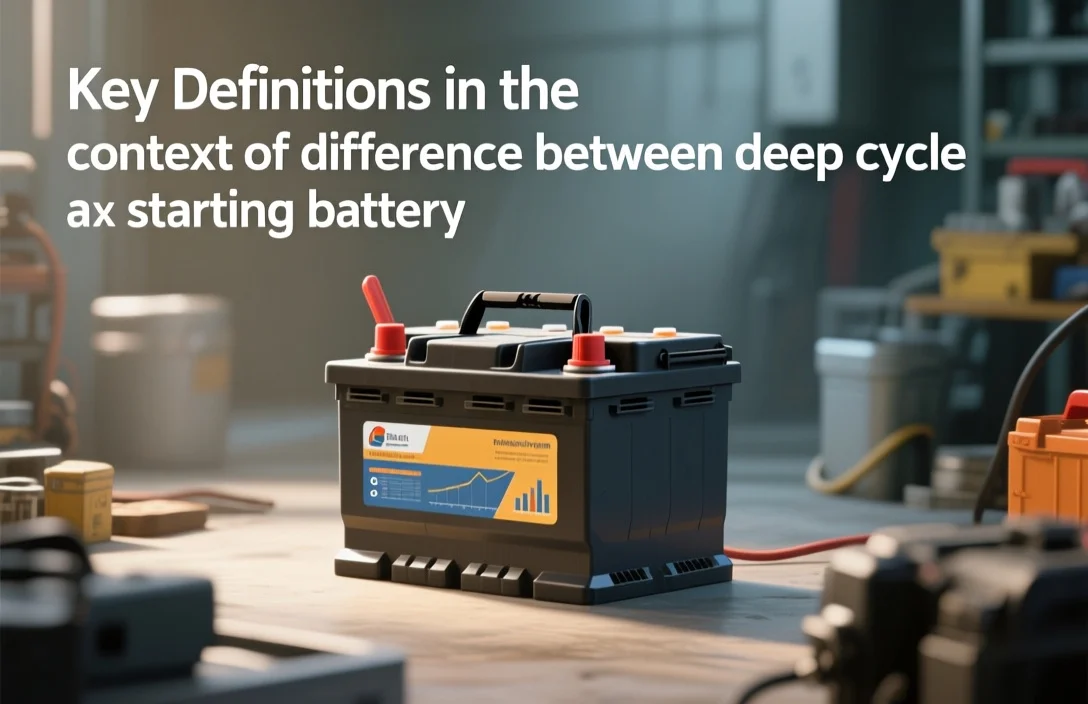
Starting (SLI) batteries supply a short, very high current to crank an engine and run vehicle electronics during start. Deep-cycle batteries deliver lower current for many hours and are built to tolerate repeated partial or full discharges. Dual-purpose or marine batteries try to balance both roles, offering moderate cranking and usable capacity for light house loads.
Starting / SLI battery: An SLI battery is designed to provide a large burst of current for a few seconds to turn an engine over, then be recharged quickly by the alternator. Typical uses are cars, trucks, motorcycles, and small engine starting where repeated deep discharge is not expected. On the label you will usually see Cold Cranking Amps (CCA) or MCA and sometimes reserve capacity, which tell you starting capability and how long it can support accessory loads briefly.
Deep-cycle battery: A deep-cycle battery is made to supply steady current over many hours and to survive many discharge/charge cycles. Typical uses include RV house banks, off-grid solar storage, trolling motors, and electric golf carts. Look for amp-hour (Ah) ratings, advertised cycle life, and recommended depth-of-discharge (DoD) when comparing these batteries.
Dual-purpose / marine battery: A dual-purpose battery is a compromise that gives moderate cranking current plus usable capacity for bilge pumps, radios, lighting, and short anchor runs. It is common in small boats and some light RV setups where space or weight prevents two separate batteries. Expect shorter deep-cycle life than a true deep-cycle battery and lower cranking ability than a dedicated SLI battery.
| Battery Type | Primary Role | Typical Uses | What to check on the label | Trade-off |
|---|---|---|---|---|
| Starting (SLI) | High short-term current to start engines | Cars, motorcycles, trucks | CCA or MCA, reserve capacity | Excellent cranking, poor tolerance for deep discharges |
| Deep-cycle | Long, steady discharge and many cycles | RV house bank, trolling motor, solar storage | Ah rating, cycle life, recommended DoD | Good run-time and cycle life, lower cranking power |
| Dual-purpose / Marine | Moderate cranking and usable capacity | Small boats, mixed-use RVs | Both CCA and Ah, reserve capacity | Convenient compromise, shorter lifespan than dedicated types |
Construction Differences
Starting batteries have thin, highly porous plates and a lot of active surface area so they can deliver a very large current for a few seconds, while deep-cycle batteries have thick, dense plates and more active material to withstand repeated long discharges and recharges. Those physical differences in plates, separators, grid alloy, and electrolyte behavior are why a starter excels at high-crank current and a deep-cycle holds usable capacity over many cycles.
Plate thickness and active material determine the mechanical and chemical life of the battery. Thin plates in starting batteries expose more lead oxide surface for rapid chemical reaction, which gives high cold-cranking amps, but thin plates shear and corrode faster under deep discharge. Thick plates in deep-cycle cells use denser active material that resists shedding during long discharge and recharge, which increases cycle life but lowers instantaneous current capability.
Separators, grid design, and electrolyte behavior are tuned differently between the two types. Starting batteries use lighter separators and finer grid patterns to minimize internal resistance and allow rapid ion flow, while deep-cycle batteries use thicker separators and stronger grids to support heavier plates and prevent shorting from active material shedding. Electrolyte circulation and recombination are also different: deep-cycle cells tolerate sustained acid stratification and need equalization or mixing more often, while starter cells are optimized for short bursts and frequent surface charge recovery.
| Feature | Starting Battery | Deep-Cycle Battery |
|---|---|---|
| Plate thickness | Thin | Thick |
| Active material | Porous, high surface area | Denser, mechanically bonded |
| Design goal | High short-term current | Long discharge, many cycles |
Specs & Metrics
 Deep cycle batteries are designed for prolonged energy discharge, while starting batteries are optimized for delivering short bursts of power. The specifications that differentiate these two types of batteries include Cold Cranking Amps (CCA), Amp-hours (Ah), Reserve Capacity (RC), depth-of-discharge (DoD), and cycle life.
| Specification | Starting Battery | Deep Cycle Battery |
|---|---|---|
| Cold Cranking Amps (CCA) | 300 – 800 | Less than 200 |
| Amp-hours (Ah) | 30 – 100 | 50 – 300 |
| Reserve Capacity (RC) | 30 – 100 minutes | 100 – 200 minutes |
| Depth-of-Discharge (DoD) | 20% | 50% – 80% |
| Cycle Life | 200 – 300 cycles | 500 – 2000 cycles |
When selecting between a deep cycle and a starting battery, understanding these specifications is crucial for matching the battery to its intended application.
Choosing by Application
Starting batteries are built for high, short bursts of current to crank engines, while deep-cycle batteries are built to deliver steady current over long periods and tolerate repeated deep discharge. Mixing their uses shortens life: a starter used as a house bank will die early, and a deep-cycle used for repeated starts will give weak cranking and poor reserve.
For a vehicle that only needs to start the engine and run accessories briefly, choose a starting battery rated for cold cranking amps and reserve capacity. For a boat with separate engine start and house loads, keep a dedicated starting battery and use a separate deep-cycle house bank sized for lights, pumps, and electronics.
For RV house banks, pick true deep-cycle batteries, or LiFePO4 if weight, usable capacity, and cycle life matter and budget allows. For trolling motors, prefer deep-cycle or lithium designed for repeated discharge; a starting battery will lose capacity quickly when used for trolling. For a small off-grid system that runs loads for hours daily, LiFePO4 gives the best usable energy and cycle life if the charging system supports it, but flooded or AGM can work if budget limits you.
| Chemistry | Best for | Pros | Cons | Cost vs Lifetime |
|---|---|---|---|---|
| Flooded lead-acid | Budget house banks, large banks, equalization capable systems | Lowest upfront cost, tolerant of overcharge with watering | Requires maintenance, ventilation, heavier, shorter usable cycles | Low cost, shorter life if deeply cycled frequently |
| AGM | Starter applications, maintenance-free house banks, boats | Sealed, better vibration resistance, lower internal resistance | Higher cost than flooded, sensitive to high-voltage overcharge | Mid cost, longer life than flooded under shallow cycles |
| Gel | Sensitive electronics, deep discharges where AGM heat is a concern | Low gassing, vibration tolerant, sealed | Must use correct charging profile, slower to accept charge | Similar to AGM, potentially shorter life if charged incorrectly |
| LiFePO4 | Lightweight RV banks, repeated deep cycles, long service life | High usable DoD, light, long cycle life, fast recharge | Higher upfront cost, needs proper BMS and charger compatibility | High cost, lowest lifetime cost per cycle when used heavily |
Top 5 takeaways: Use starting batteries for engine cranking only; use deep-cycle for house loads and trolling; choose LiFePO4 for heavy daily cycling despite higher cost; pick AGM or flooded when budget or installation limits lithium; never substitute one type for the other without understanding the tradeoffs.
Charging, Sizing & Wiring
Deep cycle batteries and starting batteries have different charging requirements and characteristics that affect their performance and lifespan. Deep cycle batteries are designed to be regularly discharged and recharged, while starting batteries provide short bursts of high current for engine starting. Understanding these differences is crucial for determining suitable charging practices and setup.
Maintaining proper charging conditions and understanding the differences between battery types will enhance performance and lifespan. Regularly check all connections and charging equipment to ensure safety and efficiency.
Maintenance, Troubleshooting & Safety
Deep cycle batteries and starting batteries require different maintenance approaches due to their distinct designs and uses. Deep cycle batteries, designed for sustained energy output, often need regular watering and equalization to maintain performance, while starting batteries, built for short bursts of high current, typically require less maintenance but can show signs of failure differently.
Choosing and maintaining the right battery type for your application is crucial for safety and performance. Regular maintenance and monitoring will extend the lifespan of both deep cycle and starting batteries, ensuring reliable operation in vehicles, boats, and other applications.
Quick Summary
Deep-cycle batteries are built for repeated deep discharges and sustained output, while starting batteries deliver short, high-current bursts for engine cranking.
Frequently Asked Questions
Can I use a deep cycle battery instead of a starting battery in my car?
You can physically install a deep-cycle battery in place of a starting battery, but it may not deliver the short high current needed to crank an engine reliably. Starting batteries supply high short-term current measured as CCA, while deep-cycle batteries are rated in amp-hours for sustained discharge.
How does heat affect the difference between deep cycle and starting batteries?
You can expect both types to age faster in heat, so avoid storing or operating batteries at high temperatures; keeping them below about 30 C (86 F) helps limit accelerated degradation. Deep-cycle batteries are slightly more tolerant of repeated charge cycles, but both lose capacity faster above 30 C.
Which will run my accessories longer, a deep cycle or a starting battery?
You can rely on a deep-cycle battery for longer accessory runtime because it is sized in amp-hours; for example, a 100 Ah deep-cycle battery with 50% usable depth gives about 50 Ah usable, so a 5 A load runs roughly 10 hours.
Is it safe to regularly deep-discharge a starting battery or use a deep-cycle for engine starting?
You can do it occasionally, but regular deep discharges will shorten a starting battery’s life and a deep-cycle may not start the engine reliably if it lacks enough CCA. Avoid discharging a starting battery more than about 20% regularly, and verify a deep-cycle’s CCA before using it for repeated starts.
When should I replace a deep-cycle vs a starting battery, and what buying mistakes should I avoid?
You can time replacement by performance: replace when capacity or CCA falls well below original spec or when a load test fails, commonly when capacity is under about 80% of rated and performance is inconsistent. Avoid buying on price alone – check group size, Ah, required CCA, chemistry, and warranty length before you buy.

- Top 10 Best Solar Battery Deals Qld Reviews 2026 - September 12, 2026
- Top 10 Best Solar Battery Deals Qld Price 2026 - September 12, 2026
- Top 10 Best Solar Battery Quality 2026 - September 12, 2026