Do I Need A New Battery After Jump Start?
One jump start will often get an engine running, but it does not prove the battery is healthy. The single spec to check first is resting voltage, and the common mistake is assuming a successful crank means the battery holds charge. Look at the battery’s CCA label, then measure resting voltage and cranking performance before buying a replacement.
Do I need a new battery after jump start? Not always; replace if resting voltage stays below 12.0 V after charging, the battery fails a load test (stays under 9.6 V at 70% CCA for 15 seconds), or the battery is older than about 4 to 5 years; otherwise recharge and recheck the alternator at 13.7 to 14.7 V.
Quick Verdict
If your battery is older than 3 – 5 years and shows signs of repeated jump starts, it likely needs replacement. Additionally, if the resting voltage is below 12.0V after a recharge, it may indicate a failing battery. Immediate actions include running the engine for at least 20 – 30 minutes after a jump to recharge and checking the alternator output.
In practice, after jump starting, drive for at least 20 – 30 minutes to allow the alternator to charge the battery. If the battery doesn’t hold charge or shows low voltage again soon, consider replacing it. You might also want to have a professional check for parasitic drains or charging system issues if problems persist.
Safety Note: If you suspect battery damage or if the battery is swollen, avoid using it further and seek professional assistance immediately.
Replacement costs can vary, typically ranging from $100 to $200, depending on the battery type and vehicle. Check for warranty information, as many batteries come with limited warranties that could cover replacement if they fail prematurely.
Post‑Jump Immediate Steps
You do not automatically need a new battery after a jump start. Replace is required when the battery will not hold voltage after being charged, fails again within a day or two, or shows physical damage such as swelling or leaking; otherwise a proper recharge and short monitoring period will usually suffice.
Safety checklist:
Replacement and warranty note: battery cost and warranty terms vary by type, vehicle, and seller; many consumer car batteries fall in a roughly low to mid price range, and manufacturers often offer pro-rated warranties. If your battery is within warranty, have the seller or installer check the date code before buying a replacement.
DIY Tests & Thresholds
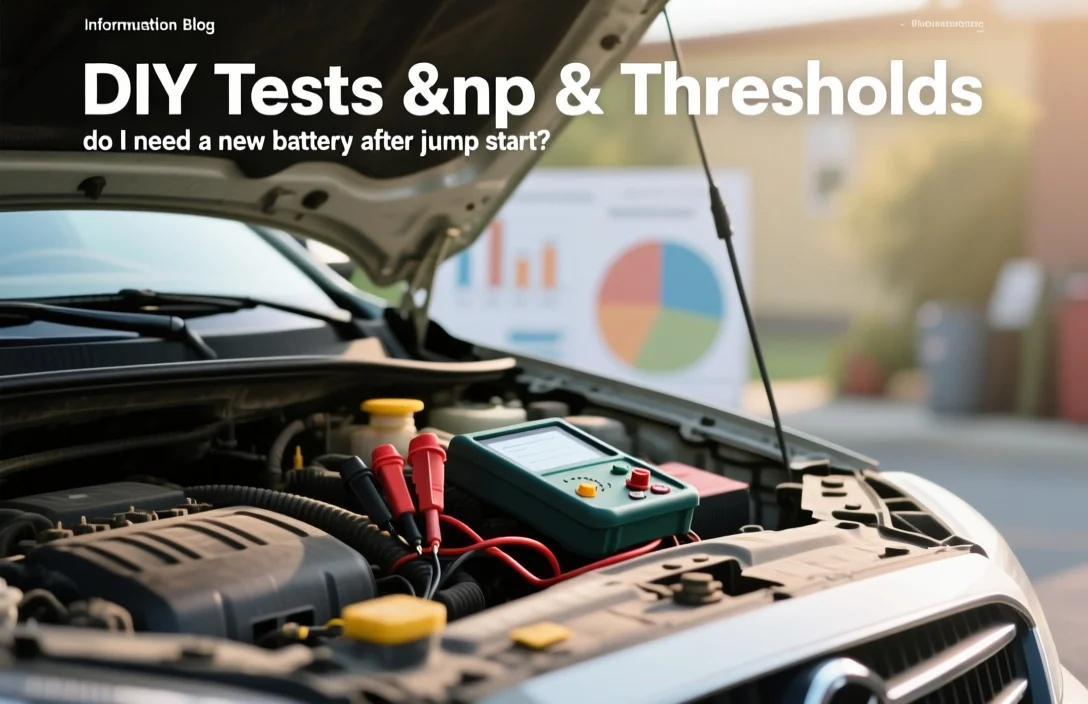
Short verdict: you must replace the battery if it fails simple voltage and load checks after a jump, otherwise a full recharge and monitoring can be enough. Replace likely if resting voltage stays below 12.0 volts after 15 to 30 minutes off, any cell reads weak on a hydrometer, or the battery fails the load test (see pass/fail rule below).
Start with the resting voltage test, then check cranking voltage, then perform a controlled load test if possible. Use a digital multimeter, the battery’s CCA label, and a proper load tester or take the battery to a shop if you lack gear.
| Resting Voltage | Approx State of Charge | Quick Interpretation |
|---|---|---|
| >=12.6 V | 100% | Good, no immediate replacement |
| 12.4 V | ~75% | Recharge and retest if recent jump |
| 12.2 V | ~50% | Recharge, check age and repeats |
| 12.0 V | ~25% | Weak, consider full charge then retest |
| <11.9 V | Deep | Likely failing, test further or replace |
Load-test pass/fail rule: sustain >=9.6 volts at roughly 70% of the battery’s CCA for 10 to 15 seconds to pass.
Flooded-cell check with a hydrometer: full specific gravity is typically about 1.26. If any cell reads below about 1.20, that cell is weak and the battery is likely failing, even after recharge. Record all cell readings; a single low cell usually means replacement is needed.
AGM testing notes: you cannot use a hydrometer on AGM cells, and surface charge can make a recently charged AGM read higher. For AGMs, rely on a true rested voltage (15 to 30 minutes after rest), the cranking check, and the 70 percent CCA load test. If an AGM fails those, replace it.
Charging System & Drains
If your car started after a jump but the battery will not hold a charge after a proper recharge or it fails a load test, you need a new battery. If the battery recharges and holds voltage, or the alternator is failing or a parasitic drain exists, replacement may not be necessary until you fix the charging system or the drain.
After a jump, run the engine 20 to 30 minutes to restore a partial charge, but expect a full recharge only from a dedicated charger, typically 4 to 8 hours depending on charger rate and battery state. If the battery is slow to recover or drops below thresholds below, stop driving and do the tests below.
| Resting V | Interpretation | Action |
|---|---|---|
| >=12.6 V | Charged | Recharge if needed, retest under load |
| 12.4 – 12.6 V | Partial charge | Charge and recheck, consider age |
| 12.0 – 12.4 V | Weak | Charge fully, then load test |
| <12.0 V | Very weak | Likely replace, especially if >3 years old |
If alternator tests fail, or parasitic draw remains high after isolating circuits, fix the charging system or the drain before buying a new battery. For any ambiguous test, a shop or mobile technician can run a professional CCA and alternator test, verify warranty coverage, and perform safe replacement if required.
Age, Type, & Triggers

You do not always need a new battery after a jump start, but you must replace it if it is old, physically damaged, or fails simple voltage and load tests. If the battery is over 3 to 5 years old, has visible damage, or shows resting voltage under 12.0 volts after charging, replacement is likely required rather than another jump.
Physical replacement triggers:
AGM versus flooded differences matter: AGM holds higher resting voltages, accepts charge faster, and cannot be tested with a hydrometer, so rely more on voltage and load tests for AGMs. AGMs are more sensitive to overvoltage from an incorrect charger, so if charging behavior is unusual get a shop to verify the battery and charger settings.
If you must decide quickly, weigh age and test results. Typical replacement costs often vary by region, battery group size, and whether you choose AGM or standard flooded cells, so check local prices and the original warranty period before buying; keep the battery label with CCA and manufacture date when comparing replacements.
Troubleshooting Chart
If your car needed a jump, you do not always need a new battery immediately, but you must verify if the battery holds charge and the charging system is working. Replace is likely when the battery cannot hold resting voltage, fails a load test, or is old and weak; repair or recharge will do when terminals, cables, or the alternator are the cause.
Immediate actions after a jump: run the engine at moderate RPM for 20 to 30 minutes to recover a partial charge, then use a proper battery charger for 4 to 8 hours for a full recharge if possible. If the battery is hot, swollen, leaking, or has physical damage, stop and replace it now, do not attempt to recharge.
For example, if resting voltage is below 12.0V after a full charge attempt and the battery is older than about 3 years, replacement is likely; if resting voltage is good but alternator shows 12.5V while running, fix the charging system instead of buying a battery.
| Problem | Probable cause | What to try first | Recommended fix / Replace? |
|---|---|---|---|
| Dead after jump | Battery didn’t hold charge, sulfation, or loose/dirty terminals | Clean and tighten terminals, measure resting voltage after 30 min, charge on a smart charger 4-8 hours | If resting voltage stays <12.0V or fails load test, replace. Free shop test can confirm. |
| Dies while driving | Alternator or belt failure, high resistance at connections | Measure run voltage at battery, inspect belt and alternator wiring | If run volts <13.7V, fix alternator or belt. Replace battery only if it failed to recover after charging. |
| Slow crank | Weak battery or poor ground/positive connections | Clean grounds, tighten cables, measure cranking voltage (should stay ≥9.6V) | If cranking voltage falls below ~9.6V after cleaning, battery likely needs replacement. |
| Repeat drain | Accessory draw, parasitic leak, or faulty module | Measure parasitic current with doors/keys off; >50 mA is suspicious, isolate circuits | Repair parasitic draw. If battery has been deeply cycled repeatedly and capacity low, replace. |
Professional Testing & Warranty
You do not always need a new battery after a jump start. Replace the battery if, after recharging and testing, it shows low resting voltage, poor CCA relative to its rating, high internal resistance, visible damage, or it is old (commonly more than three to four years), otherwise a full recharge and follow-up test is reasonable.
Immediate actions after a jump start: run the engine for 20 to 30 minutes to top a partial charge, but plan a full recharge on a smart charger for 4 to 8 hours to restore capacity. If the battery fails the tests after a full recharge, you must replace it.
Shop test types explained: stores typically offer free voltage and conductance (CCA) tests, often with a printed report. Professional shops can also do a true load test and alternator output check, while battery shops or dealers may test specific gravity for flooded cells.
| Test | Good | Replace |
|---|---|---|
| Resting voltage | >12.4V | <12.0V after recharge |
| Cranking voltage | >9.6V | <9.0V |
| Alternator output | 13.7 – 14.7V running | <13.0V or >15.0V |
| Capacity/CCA | Near rated CCA | Significantly below rated CCA |
Example shop report lines: “Resting voltage 12.05V after 1 hour, CCA at 58% of rating, internal resistance elevated; recommend replacement under warranty or replace now if >36 months old.”
Safety note: If the battery is swollen, leaking, hot to the touch, or vents excessively, do not try to recharge it; have it replaced immediately. If you see repeat failures despite a healthy alternator, choose replacement and verify warranty terms before purchase.
Quick Summary
Usually you do not need a new battery immediately after a successful jump start, but test and monitor the battery before deciding.
Frequently Asked Questions
Do I need a new battery after a jump start if my car starts but dies soon after?
If the engine dies soon after the jump, the battery may not be holding charge or the alternator may not be charging correctly. You can measure the resting voltage after 1 to 2 hours; a healthy, full battery is about 12.6 V, and a voltage under 12.4 V after charging suggests you need further testing or replacement.
How can I test whether I need a new battery after a jump start?
You can use a multimeter and a shop load tester: check resting voltage after a full charge and measure charging voltage with the engine running; the alternator should show about 13.7 to 14.7 V while charging. If the battery fails a load test or cannot reach about 12.6 V after a full charge, you should replace it.
Can I damage my car or battery by jump starting repeatedly, do I need a new battery?
Yes, repeated jump starts stress the battery, starter, and alternator, and they reduce battery life; if you need more than 2 to 3 jump starts in a month, get the battery and charging system tested and plan for replacement if tests fail.
How long should I drive after a jump start before deciding if I need a new battery?
You should drive at least 20 to 30 minutes at road speed or use a smart charger to bring the battery to a full charge; if the battery does not recover to about 12.6 V after a full charge, consider replacing it.
What common mistakes lead people to buy a new battery unnecessarily after a jump start?
Common mistakes are not checking alternator output, not fully charging the battery before testing, and assuming a single successful start proves battery health; verify alternator voltage of about 13.7 to 14.7 V and perform a full charge and load test before buying a new battery.