How Long Do Marine Batteries Last?
Marine batteries can last 3 to 5 years or 8 to 12 years, and the biggest swing usually comes down to one spec: how deep you regularly discharge them. If you are troubleshooting a bank that seems to “die early” or comparing AGM versus LiFePO4, lifespan is only part of the story. You will get chemistry-specific expectations, the charging settings to check first, and a practical plan to estimate replacement timing for your boat.
Marine battery life depends mostly on chemistry and average depth of discharge (DoD). Typical deep-cycle AGM often lasts about 3 to 5 years, while LiFePO4 commonly reaches around 8 to 12 years when kept properly charged. Repeated full discharges and heat shorten life quickly, while staying near 50% DoD for lead-acid or 80 to 90% DoD for LiFePO4 helps.
How Long Do Marine Batteries Last?
Recommended Products


Marine battery life is usually limited by two different aging processes: time-related calendar aging and use-related cycle wear. A battery can look “fine” while its capacity quietly drops, which is why replacement planning needs more than just the purchase date.
Calendar aging is driven by chemistry sitting at high state of charge (SOC), time at elevated temperature, and poor charge regulation. Cycle wear is driven by how much capacity you remove each discharge (depth of discharge, DoD), how often you cycle, and how well you return the battery to the right charge voltage profile for its chemistry.
Lifespan Vs Cycle Life (Why They Don’t Match)
Cycle life is often specified as a number of cycles to a defined end point (commonly when usable capacity reaches a stated percentage). Calendar life is measured in years under storage and typical float or resting conditions, and it can be shorter for chemistries that sit near full charge for months. Two boats using the “same size” battery can see very different results because one boat runs heavy loads daily (more cycles) while the other battery spends long periods at high SOC (more calendar aging).
DoD is the big lever. Shallow cycling tends to extend cycle life because less active material is stressed each time; deep cycling stresses it more and accelerates capacity loss. Temperature is the second lever: heat speeds many degradation reactions, so a battery in a hot compartment can age faster even with fewer cycles.
| Life limiter | What it looks like | What to measure | Main driver |
|---|---|---|---|
| Calendar aging | Capacity drops while usage stays moderate | Age in years, average SOC, charge/float settings | High SOC + heat + time |
| Cycle wear | Capacity drops after repeated discharges | Cycle count, average DoD, discharge behavior | DoD + number of cycles + recharge quality |
| Charging issues | Chronic undercharge or chronic overvoltage | Charger model, voltage readings, battery temperature | Wrong charge profile or poor regulation |
Replacement timing usually comes down to your combination of chemistry, DoD habits, temperature, and charger correctness. A quick plan is to estimate usable life from cycle wear first (your average DoD and how often you cycle), then check calendar aging risk (how hot it gets and how long it sits near full).
In practice, use a back-of-napkin estimate like this. First, pick an average DoD you actually see (for example, “we usually discharge to about half capacity” is different from “we routinely go near empty”). Second, estimate cycles per year by counting how many days you truly cycle the bank deeply enough to matter, then apply the chemistry’s published cycle-life rating as a guide to a “likely” end-of-use window, and finally adjust earlier if your batteries run hot or spend weeks at high SOC on float.
Common aging signs can lag the real capacity loss. Watch for frequent voltage sag under load, reduced runtime at the same loads, charger “hunting” behavior, and any swelling, cracking, or strong heat at the case after charging. Swollen or overheated batteries are stop-use signals, especially for sealed designs, because continued charging can worsen internal damage.
Chemistry And Expected Service Years
Battery life varies more by how the battery is charged and stored than by the brand. The most common marine options are flooded lead-acid (FLA), AGM, GEL, and LiFePO4, and each chemistry has a different balance of cycle life, calendar life, and charging sensitivity.
When you compare service years, check the spec sheet for the benchmark that matches your use. Cycle life claims often assume a specific depth of discharge (DoD), temperature, and end-of-life voltage or capacity threshold. If the manufacturer only states “expected lifespan” with no DoD or test conditions, treat it as marketing.
Flooded Lead-acid (Deep-cycle): Years Depend On Maintenance And Water Loss
Flooded deep-cycle batteries can last many years with proper watering, correct absorption voltage, and routine equalization when the manufacturer approves it. Life drivers are plate corrosion from being chronically undercharged, plus loss of electrolyte water from overcharging or excessive gassing.
Practical yardstick: many failures are “charge handling” failures, for example a charger that is too low keeps the bank sulfated, and a charger that is too high drives off water and warps plates.
Agm Deep-cycle: Strong Cycle Behavior, But Charging Still Has Rules
AGM typically tolerates higher charge acceptance than flooded cells and can handle vibration well, so it is common for boats where charging happens on the road or in shorter sessions. AGM still ages fast if you keep it undercharged, or if the regulator repeatedly drives excessive voltage that vents gas and dries internal surfaces.
Gel Deep-cycle: Charging Sensitivity Is The Trade-off
GEL batteries are more sensitive to charger voltage and to how quickly charge current tapers. Gel charging missteps can permanently reduce capacity, so you need a charger that explicitly supports GEL voltage settings and limits.
Lifepo4: Long Cycle Life, But Calendar Aging Still Limits Total Years
LiFePO4 can deliver long cycle life when operated within recommended charge limits and with a working battery management system (BMS). Even with excellent cycle life, time and temperature still reduce capacity, so “years” depends heavily on storage state of charge and how hot the battery runs.
LiFePO4 life claims should include charge temperature and end-of-life capacity criteria. Cycle life numbers are often presented at an 80 percent DoD style benchmark, while real boats may see partial cycling plus long storage at high voltage, which shortens usable capacity.
| Chemistry | What most often limits life | Buyer checks to verify in specs |
|---|---|---|
| Flooded lead-acid (deep-cycle) | Undercharging sulfation, overcharging water loss | Flooded charging profile, equalization guidance, warranty conditions |
| AGM deep-cycle | Repeated overvoltage heat, chronic low charge | AGM mode voltage, cycle-life DoD and temperature, end-of-life definition |
| GEL deep-cycle | Overvoltage or wrong charger profile | Explicit GEL charging profile, charge current limits, test conditions |
| LiFePO4 | Calendar aging from heat and high state of charge | Cycle life at a stated DoD, calendar life conditions, BMS charge limits |
Marine labeling is not a chemistry spec, it is a use-case label. Many “marine” batteries are standard lead-acid types sold for boats, so the life you get depends on the actual chemistry, the charger profile your system uses, and the battery’s rated cycle and warranty conditions.
Replacement planning rule: treat warranty time as a minimum, cycle-life claims as condition-dependent, and your own charging accuracy as the biggest lever for how many service years you actually get.
Dod Targets For Longevity
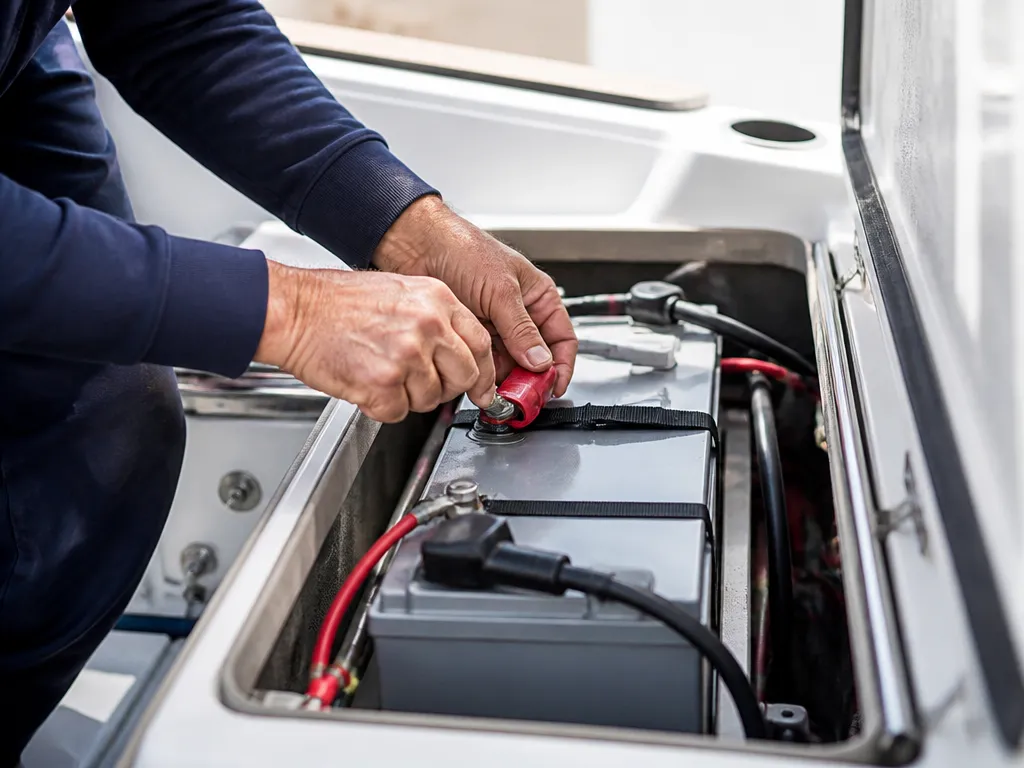
Depth of discharge (DoD) is the biggest knob you control for cycle life: deeper discharges force more wear each cycle. For most battery types, keeping DoD shallower improves years of service more than chasing small charger upgrades.
Manufacturers publish cycle life under specific test conditions, so two batteries with the same chemistry can show different numbers. DoD maps to cycle count through the cell’s usable voltage window, the charge termination method, temperature during cycling, and whether the test includes rest periods between cycles.
Why The Charts Disagree
One maker’s “end of life” is often a capacity drop target (like reaching 80% of original capacity), while another uses a voltage threshold under load. Different charge profiles also change what “one cycle” means, for example a full charge from a deeper discharge versus a partial top-off routine.
Battery condition matters too. A battery that sits partially charged after use can lose performance from sulfation (lead chemistries) or from lithium cell imbalance and elevated stress (LiFePO4), even if the number of cycles looks acceptable.
Long-life Dod Guidance By Chemistry
Lead-acid (flooded) tolerates use patterns better than many people expect, but it ages quickly when regularly pushed deep and left discharged. AGM and GEL typically last longer than flooded lead when used hard, yet they still benefit from shallower cycling and staying fully charged.
LiFePO4 is the most forgiving option for repeated shallow use, and it is also where DoD targets are most commonly used for planning. Many system designers aim around 80% DoD for long service life, meaning you plan to use only 80% of rated capacity before recharging.
Use these starting targets when planning, then verify against the exact spec sheet for your model:
Example for a house bank: a 100 Ah LiFePO4 battery that you cycle to about 80% DoD uses about 80 Ah per cycle before you recharge. If the manufacturer specifies cycle life at 80% DoD (and at a stated temperature and charge method), you can translate that into an approximate service-life expectation for your duty pattern.
Starter versus house use has different end-of-life definitions. A starter battery may be judged by how well it cranks for short bursts, while a house bank is judged by capacity retention under repeated cycling, so the same chemistry can appear to “last longer” in one role than the other.
Safety and aging signs that can override cycle-life planning: swollen cases, hot battery tops, persistent charging issues, abnormal voltage sag during load tests, and repeated formation of corrosion at terminals. If you see any of those, stop cycling and troubleshoot before running the battery harder.
| Chemistry | Longevity-focused DoD target | Common “end of life” definition to look for |
|---|---|---|
| Flooded lead-acid | ~30% to 50% | Capacity reduced to a stated % or inability to meet voltage under load |
| AGM | ~50% | Capacity reduced to a stated % or failure to meet voltage criteria |
| GEL | ~50% | Capacity reduced to a stated % or failure to meet voltage criteria |
| LiFePO4 | ~80% | Capacity reduced to a stated % or BMS/cell limits reached sooner than expected |
Replacement planning approach: build a target DoD in your boat’s routine, then use the manufacturer’s cycle-life test conditions as the ceiling, not as a guarantee. When your real-world charging is less controlled, assume fewer cycles than the catalog number and schedule replacement earlier rather than later.
Charging Regimes That Extend Life
Marine battery life is driven heavily by how close your charging voltage, current limit, and end-of-charge behavior match the battery chemistry. Overvoltage cooks lead-acid and can permanently damage capacity, while poor charging and thermal control is a common way LiFePO4 loses long-term capacity. Treat the charger settings as a lifespan component, not a convenience setting.
Correct charge profiles follow a pattern: a bulk stage that raises state of charge, an absorption stage that holds a specific voltage to complete saturation, and then a final step that prevents constant stress. Charge systems that never stop charging, or that keep pushing the battery at absorption voltage for hours, shorten life across most marine types.
Absorb/float, And When To Stop
Flooded lead-acid and AGM usually tolerate a controlled float stage, which is typically a lower voltage that maintains full charge. Gel lead-acid generally dislikes aggressive float and overvoltage, so Gel-specific voltage targets and charger settings are critical.
In practice, longevity comes from matching the charger to the “rest of the battery” requirements. A smart charger that drops from absorption to float, or stops when current tapers, reduces time spent at damaging high voltage.
Temperature Compensation: The Silent Lifespan Killer
Battery labels and charger manuals often include a temperature coefficient or “temperature compensated” requirement because charging voltage changes with temperature. Cold batteries need higher voltage to reach full charge, hot batteries need lower voltage to avoid gassing and plate damage.
When a charger lacks temperature sensing, it usually charges “fixed voltage,” which increases stress in summer or freezing winters. Install the temperature probe if the charger supports it, and verify it is strapped to the battery case where the manufacturer expects.
| Battery type | What to verify on the charger | Lifespan risk when wrong |
|---|---|---|
| Flooded lead-acid | Correct flooded/”wet” profile and temperature compensation | Overvoltage drives gassing, water loss, and plate warping |
| AGM | AGM profile (higher sensitivity to voltage errors than flooded) | Overvoltage reduces capacity and increases dry-out risk over time |
| Gel | Gel profile and conservative voltage behavior | Overvoltage damages the gel matrix and cuts usable capacity |
| LiFePO4 | LiFePO4 charging profile and a compatible BMS-friendly charger | Poor profile or thermal mismatch increases BMS cycling and capacity fade |
Charge Rate Limits, Absorption Time, And Equalization
Charge rate is a cycle-life issue because higher current heats cells and can push voltage into the absorption region sooner. Look for the battery spec that lists a maximum recommended charge current, or charger documentation that names the allowable “max amps” for that battery size.
Equalization is a special case for flooded lead-acid: it can help recover cells that have drifted apart, but it is not a routine maintenance step for every battery. Using equalization on AGM or Gel is a common way to shorten life or damage the battery.
Alternator Charging: Smart Regulators Beat Set-and-forget
Engine charging depends on what your alternator regulator does with battery voltage. A “set-and-forget” approach that simply runs a high fixed voltage increases time spent at damaging levels, especially during long runs at partial state of charge.
Smart alternator regulators and multi-stage battery chargers help because they can match absorption and taper behavior to battery needs. When alternator charging is the main method, verify that your system wiring includes correct sensing and that the regulator is configured for the specific battery chemistry.
Safety check: If a battery case is hot to the touch, bulging, releasing strong venting odors, or the electrolyte level drops unusually fast on flooded types, stop charging and inspect. Damaged cables, loose connections, and wrong charger mode settings are common causes of heat and venting.
Temperature, Heat, And Aging Signs
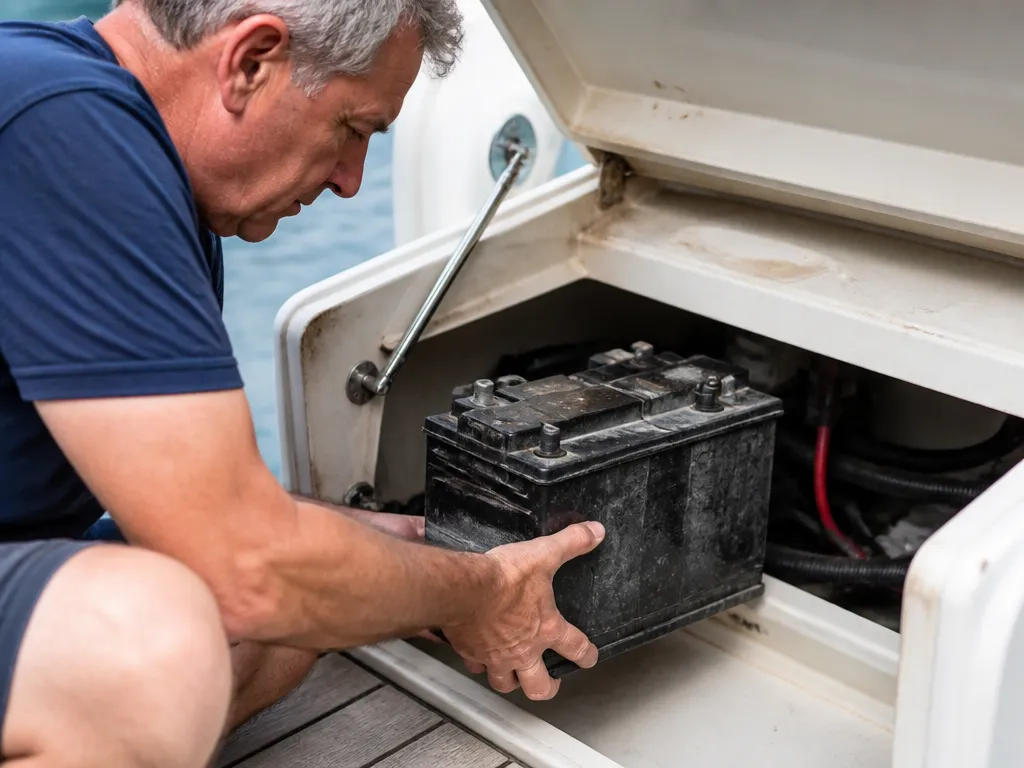
Heat is the fastest way to shorten marine battery life because it increases chemical reaction rates and speeds up electrolyte loss, corrosion, and plate damage. A practical rule is that every roughly 10°C rise above ideal storage or charging temperature can cut usable life meaningfully, so a hot bilge can turn “years” into “months.”
Confirm your situation by estimating battery temperature, not just air temperature. Place a cheap contact thermometer on the case (or near the vent for flooded batteries) after charging and after running loads for 1 to 2 hours, then record the peak you see. Ideal for long life depends on chemistry, but the direction is consistent: staying cool helps, while repeating high-heat events accelerates aging.
AGM and flooded lead-acid batteries show heat-driven damage through faster grid corrosion and higher gassing during overcharge. Lithium iron phosphate (LiFePO4) tolerates heat better than some lithium types, but it still ages faster when repeatedly warm, and it can swell if it is forced into the wrong charge profile or overheats. If a battery case is hot enough to feel uncomfortable to hold, stop and investigate charging and ventilation.
Common Aging Signs By What You Can Measure
Voltage behavior is often the first clue. A sulfated lead-acid battery may hold a “resting” voltage for a while, then collapse quickly under load, and it may accept charge poorly (charger runs longer and current tapers early).
Capacity fade shows up as usable run time shrinking even though the battery still “starts” or reads near nominal voltage. For lead-acid, this can look like higher voltage drop at the same discharge current, and for LiFePO4 it can look like a shorter time before the battery hits its internal cutoff sooner than expected for the same drain.
Swelling and corrosion give immediate safety signals. Swelling can occur from internal gas buildup (often lead-acid) or from thermal stress (sometimes lithium), and it can increase the risk of venting or internal damage.
On-boat Diagnostics That Estimate Replacement Timing
Use simple tests that separate “can it deliver power today” from “how much life is left.” Start with measurements at rest (after the battery sits 2 to 6 hours without charging or heavy loads) and then under a controlled load, and compare results over time.
For best safety and decision-making, replace the battery when multiple signs agree: poor load performance plus accelerating voltage sag, repeated charging problems, and physical heat or corrosion evidence. If only one symptom appears, verify the charger settings, wiring resistance, and ventilation before condemning the battery.
| Observed sign | Likely cause | Action |
|---|---|---|
| Voltage drops hard under load | Capacity fade, sulfation, internal resistance rise | Run a load test and compare to prior readings |
| Charger current tapers too quickly | Sulfation or incorrect charging profile | Verify charge settings and retest |
| Battery case unusually hot after charging | Overcharge, poor ventilation, high resistance connections | Stop charging, inspect cables and regulator |
| Swelling or venting residue | Internal gas buildup or thermal stress | Disconnect and stop use, then replace |
Maintenance And Storage Rules
Battery life is mostly controlled by charge discipline, temperature, and connection resistance, so maintenance is how you keep those three under control. Storage changes the same variables, so “off-season” habits matter just as much as how you charge day to day. Follow the chemistry-specific rules below to avoid premature capacity loss and unsafe faults.
Flooded Lead-acid, Agm, Gel, Lifepo4: What To Do (And What To Avoid)
Flooded lead-acid batteries need periodic water top-ups and clean ventilation paths so plates stay covered and gases can escape. Corrosion around terminals and vents is a silent killer, because it adds resistance and drives heat. AGM and GEL are sealed, so the main rule is to never open cells, never add water, and never run “fix it” equalization routines unless the manufacturer explicitly permits it.
Battery Wiring, Connections, And Heat: Where Maintenance Pays Off
Voltage drop from loose or corroded connections is a common reason marine batteries “age” faster, because the starter and charging paths run hotter than they should. Heat accelerates corrosion, increases resistance, and can cause intermittent faults that look like battery failure. Use tightening and cleaning as a regular inspection item, not a one-time cleanup.
Safety warning: Stop maintenance work immediately if you see swelling, leaking, strong sulfur odor, excessive heat at the case, or smoking at terminals. Swollen or overheated packs can be in thermal runaway conditions for lithium chemistries, and flooded batteries with active venting can produce explosive gas mixtures around spark sources. Disconnect power sources and follow your battery manufacturer’s emergency guidance before continuing.
For a practical storage plan, create a simple log with date, resting voltage or charge indicator reading, water level notes (flooded), and charger model settings used. That log helps you spot patterns like “needs recharge every X weeks” in your climate, so you can schedule the next maintenance charge before the battery drifts into harmful conditions. The goal is consistent charge management plus low-resistance wiring, because those two items most directly protect usable capacity over years.
Testing, Replacement Triggers, And Cost
Marine battery replacement decisions should be driven by measurable capacity loss and charging behavior, not guesswork from age alone. Voltage, specific gravity, and load tests each catch different failure modes, so combine them to avoid replacing a battery that still has usable life.
Capacity Testing Vs Voltage Checks (What Each Tells You)
Voltage checks are quick, but they are a “snapshot,” they do not measure how much usable energy the battery still stores. A rested battery can show a normal voltage while cells are sulfated or internally resistive, which creates voltage sag under load and during charging.
Capacity testing measures how many amp-hours (Ah) the battery can deliver to a defined cutoff under a defined load and temperature. Capacity results are better for predicting remaining service life, but they take equipment and time and are most reliable when you follow the test procedure from the battery manufacturer.
Flooded (Specific-gravity) Vs Sealed (Agm/gel) Health Checks
Flooded lead-acid batteries can be checked with a hydrometer by measuring specific gravity in each cell. Specific gravity tells you how much active material remains and how balanced the cells are, which voltage alone often hides.
AGM and GEL are sealed, so you cannot safely take cell-by-cell specific gravity readings. For sealed units, you rely on charge acceptance behavior, resting voltage trends after a controlled charge, and load performance (and sometimes temperature-compensated diagnostics from the manufacturer).
Load Test Interpretation For Starting Vs House Banks
Starting batteries are judged by voltage stability and the ability to deliver high current for short bursts. A load test can reveal internal resistance even when the resting voltage appears normal.
House banks are judged by usable amp-hours over your discharge depth (DoD), and by whether the bank consistently recharges to the same level after similar cycles. A battery that sags early on discharge or shows poor charge acceptance after moderate use is often near end-of-life for the way you run your boat.
Replacement Triggers You Can Act On
Replacement is warranted when performance stops matching your boat’s needs consistently, even after correct charging. The most actionable triggers are inability to reach full charge reliably, persistent voltage sag under load, and recurring charge-acceptance failures.
Lifecycle Cost Method (Warranty Plus Verified Use)
Lifecycle cost is easiest to defend when you base it on warranty terms and realistic depth-of-discharge (DoD) from your operating pattern. The practical method is to estimate how many cycles you will actually run and multiply by your local replacement interval, then compare against the battery price you paid or plan to pay.
Battery makers often publish cycle-life curves under specific test conditions, and the conditions matter a lot (DoD, charge voltage profile, temperature, and rest time). When you cannot confirm your exact conditions match, treat published cycle life as an upper bound and use your test results to calibrate.
| Cost inputs you should gather | How to use it |
|---|---|
| Warranty coverage (years and any limits) | Use the warranty duration as the “best case,” then adjust based on your observed cycle performance. |
| Battery capacity baseline (Ah) when new or when known-good | Track what fraction of that capacity you get at your normal cutoff. |
| Expected DoD per outing (from your discharge history) | Use your measured DoD, since deeper discharges usually shorten cycle life. |
| Charger profile correctness (chemistry match and absorption behavior) | Assume correct charging as your “control,” then change only one variable at a time when troubleshooting. |
Safety note: If the battery case is hot, the venting looks abnormal, the terminals are damaged, or the battery shows swelling, stop charging and stop use. A failing battery can vent aggressively, and flooded cells can leak corrosive electrolyte.
Charger Compatibility Checks
Correct charging profile match is one of the fastest ways to protect your marine battery life. Wrong settings can overcharge AGM or flooded cells, or push LiFePO4 beyond safe limits and trigger permanent capacity loss. Charger compatibility also includes wiring and sensor use, because a charger that reads the wrong voltage or temperature can still be “the right model” and still charge poorly.
Start with the chemistry and the exact label the charger uses. Marine battery makers commonly charge flooded lead-acid, AGM, GEL, and LiFePO4 with different voltage targets and absorption behaviors, so a generic “12V” setting is not enough.
Alternator And Onboard Charging Sources
Alternators can charge safely when the regulator and battery are a good match, but mismatches shorten life. A common failure mode is a regulator that holds high voltage long enough to overcook lead-acid batteries, or undercharge a deeply depleted bank because the alternator never reaches the right conditions at your typical RPM and load.
For LiFePO4 house banks, you often need a charger that is explicitly designed and programmed for LiFePO4 charging limits. Some alternator setups charge LiFePO4 acceptably only when paired with an appropriate DC-DC charger and correct wiring for voltage sensing.
| Charger setting | Battery chemistry it fits | Main life risk if mismatched |
|---|---|---|
| Flooded (wet) | Flooded lead-acid | AGM can overheat and lose capacity if overcharged |
| AGM | Absorbed glass mat lead-acid | GEL/flooded can be under or overcharged depending on target profile |
| GEL | Gel lead-acid | Overvoltage can permanently damage gel cells |
| LiFePO4 / LFP | LiFePO4 lithium | Lead-acid voltages and behaviors can overstress lithium packs |
Port Standards And Why “Usb-c Power” Is Not Battery Charging
USB-C power (USB Power Delivery, or USB-C PD) uses volts and current negotiated by the device and cable, but it is designed for small electronics, not marine battery charge algorithms. A power bank or USB-C charger may provide convenient DC power, yet it generally lacks the correct multi-stage charge profile, bulk/absorb control, and temperature monitoring required for long battery life.
Onboard takeaway: Use USB-C PD to run accessories or charge the accessory battery, then route battery charging through your marine battery charger, alternator system, or DC-DC charger configured for your bank chemistry.
Bulk/absorb Checks Before You Connect
Before connecting a charger to a boat bank, verify three things: voltage targets, current limits, and temperature sensing. Bulk and absorb stages should have chemistry-specific limits, and a charger that never sees the battery temperature sensor (when your system uses one) can drift into overcharge in hot engine-bay or sun-baked storage conditions.
Safety warning: Stop and investigate if you see swelling, strong heat, damaged cables, cracked battery cases, or a charger that repeatedly trips. For lithium packs, a faulty BMS response can look like charging errors, and continuing to force charge can be dangerous.
Quick Summary
Marine battery life is usually limited by chemistry and your average depth of discharge, with typical lifespans ranging from about 3 to 5 years up to 8 to 12 years. Deep-cycle AGM is often around 3 to 5 years, while LiFePO4 commonly reaches roughly 8 to 12 years when kept properly charged. Repeated full discharges and heat shorten life quickly, and dropping below 50 percent DoD for lead-acid or regularly going beyond 80 to 90 percent DoD for LiFePO4 accelerates aging.
You can think of aging as both calendar aging, driven by high state of charge, time at elevated temperature, and poor charge regulation, and cycle wear, driven by how much capacity you remove each discharge and how well you recharge to the right voltage profile. Temperature matters, with the article describing roughly half the life for every 10 C of sustained high heat. For best next action, verify the charger settings and then plan replacement using capacity and load testing, while treating voltage sag, slow recovery, or swelling as stop-using alarms.
Frequently Asked Questions
How Long Do Marine Batteries Typically Last In A Boat?
Most marine batteries last a few years, but the exact lifespan depends heavily on battery type (starting vs deep cycle), how often you discharge, and your charging setup. If you regularly run a deep-cycle battery down and then recharge correctly, it can go longer than a battery used for light duty. If it is years old and you notice slower starts or frequent low-charge behavior, plan for replacement testing soon.
Will A Car Battery Charger Work With My Marine Battery, Or Do I Need A Marine Charger?
It can work, but only if the charger matches the battery type and voltage (commonly 12 V) and has the right charging profile. Many marine batteries are deep-cycle lead-acid (flooded or AGM), which means a basic charger with incorrect stages can reduce life. Check for an output voltage that matches your battery and, if possible, use a charger that supports the battery chemistry you have.
Why Does My Marine Battery Get Warm When Charging, And Is That Normal?
Some warmth can be normal during charging, but noticeably hot cases, strong odor, or gassing are not. If the battery is very hot to the touch, that can point to an overcharge condition, a charger mismatch, or a failing battery. Stop charging and verify the charger settings and ventilation before continuing.
How Long Should My Marine Battery Power My Trolling Motor Or Electronics Per Charge?
Runtime is usually less about “marine battery years” and more about battery capacity (Ah or kWh), voltage, and your load watts. As a rule of thumb, higher motor power draws can drain a battery fast, especially with repeated deep discharges. To estimate, look up the battery’s capacity and compare it to the electronics or motor’s rated power draw, then allow for real-world efficiency losses.
When Is The Right Time To Replace A Marine Battery, And What’s A Common Buying Mistake?
Replace when performance drops, you see repeated low voltage, or the battery struggles to start reliably, because waiting for total failure can leave you stranded. A common mistake is buying the wrong style for the job, like using a starting battery for deep discharge, which shortens life. Also confirm the physical fit and terminal layout, since an incorrect size or connection requirement can force unsafe adapters or poor connections.

- 10 Best Battery For Generator Battery Retrofit System 2026 - October 12, 2026
- 10 Best Battery For Generator Battery Retrofit Service 2026 - October 12, 2026
- 10 Best Battery For Generator Battery Retrofit 2026 - October 12, 2026