How Often Do You Need A New Car Battery?
How often should you replace a car battery? For many drivers, the practical answer is every three to five years, although climate, driving patterns, and battery design can shift that window.
Short trips and extreme heat or cold tend to be hard on batteries, while AGM models may better tolerate frequent cycling in vehicles with start-stop systems. Knowing the warning signs gives you a chance to replace the battery before it leaves you stuck.
What Drains Your Car Battery Faster
Battery age is only part of the story. Heat can speed up wear, short trips may not give the alternator enough time to restore the charge, and stop-and-go traffic adds more cycling than steady highway driving. Start-stop vehicles place another demand on the battery because the engine restarts repeatedly.
These are the main conditions I would consider when estimating replacement timing.
Hot Climates Age Batteries Faster
High under-hood temperatures can accelerate chemical breakdown in conventional lead-acid batteries. In a hot climate, a battery may reach the end of its useful life in two to three years rather than five.
Heat promotes electrolyte loss and plate corrosion, while cold weather makes a weak battery work harder when starting.
Cold Weather Reveals Weak Batteries
Winter usually reveals a battery that was already aging rather than causing the problem by itself. Starting in cold weather requires more power, so a battery that managed through summer may fail when temperatures drop. That is why battery problems often become noticeable during the coldest part of the year.
Battery Types and Expected Lifespans
| Battery Type | Average Lifespan | Best For |
|---|---|---|
| Flooded Lead-Acid | 3-5 years | Standard daily driving |
| AGM | 4-7 years | Start-stop vehicles |
| Lithium-Ion (rare) | 5-10 years | High-performance use |
Picks To Answer Your Battery Replacement Timeline
The products below cover several different replacement scenarios, from start-stop vehicles to ride-on toys and backup equipment. My read is that the right chemistry, size, and application matter more than a general promise of long life.
Each pick is tied to the replacement question in a slightly different way, so fitment and intended use should come before any longevity claim.
|
1
|
ExpertPower EXP1270, 12V 7Ah Battery SLA Rechargeable with F1 Terminals | 12 Volt sealed l |

This 12V 7Ah SLA battery is aimed at lower-demand equipment where dependable output and straightforward replacement matter more than automotive starting power.
The ExpertPower EXP1270 is a 12-volt, 7Ah sealed lead-acid battery with F1 terminals. It replaces several common 1270 and UB1270-style batteries used in alarm systems, security equipment, UPS units, and ride-on toys.
Its maintenance-free format makes it practical for applications that see regular discharge and recharge cycles, rather than for starting a car engine.
I would shortlist it for stationary backup equipment or a compatible kids’ ride-on car, not for high-cranking automotive use. The battery measures 5.94 by 2.56 by 3.70 inches, with the height reaching 3.94 inches including the terminals. Confirming the connector and compartment dimensions is important before ordering.
|
2
|
HQST 12V 60Ah AGM Car Battery, Group 47 H5, 680CCA, 100RC, Start-Stop | 3× Longer Cycle Li |

Its AGM design and start-stop compatibility make this a relevant option for vehicles that put extra cycling demands on their battery.
The HQST 12V 60Ah AGM battery is built for Group 47 H5 applications and is rated at 680 cold cranking amps. The listing describes operation down to 0 degrees Fahrenheit, along with higher charge acceptance and faster energy recovery for start-stop vehicles.
That combination speaks directly to the kind of repeated restarting that can affect replacement timing.
Its AGM construction is intended to handle frequent engine restarts, and the standard SAE top posts simplify comparison with the existing battery. The listed dimensions are about 9. 5 by 6. 9 by 7. 6 inches.
I would verify the group size, terminal arrangement, and vehicle requirements before purchase; this is not presented as a deep-cycle marine or solar battery.
|
3
|
ACDelco Gold Automotive Battery 94RAGM | PN 88864542 | 12V Car Battery AGM Group 94R/H7 Ba |

This GM-backed 94R AGM battery is suited to drivers who want application-specific construction and a stated 36-month warranty behind their replacement choice.
The ACDelco Gold 94RAGM is a 12-volt AGM battery in Group 94R, also known as H7, for vehicles that require that specification. The listing points to GM-backed engineering, a 36-month warranty, high-density plate construction, and a pressurized valve system.
Those details make it a candidate for vehicles with heavier electrical demands, provided the fit is correct.
The envelope separators and leak-resistant design are intended to support consistent service over time. This is one of the products where exact vehicle compatibility matters more than a broad battery-life estimate, so I would check the vehicle-specific fitment information before ordering. The listing names select Audi, BMW, and Chevrolet applications.
|
4
|
Daakmax Platinum AGM Car Battery Group Size 47 H5, 12V 60Ah, 680 CCA, 100 RC, Rechargeable |
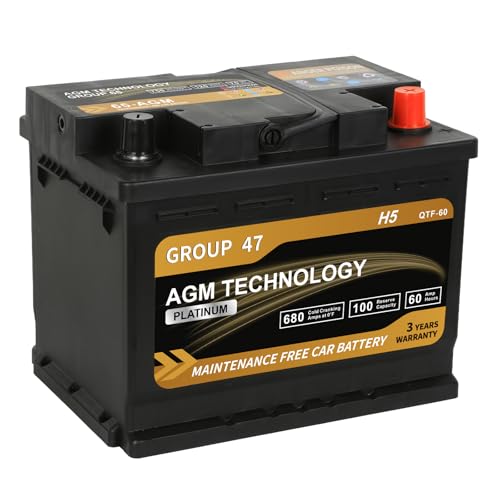
With 680 CCA, AGM construction, and a claimed cycle-life advantage, this battery is aimed at drivers who want more margin in a start-stop application.
The Daakmax Platinum AGM battery uses Group Size 47 H5 dimensions and is rated at 680 CCA with 100 minutes of reserve capacity. It is designed for start-stop vehicles and is listed for temperatures from -22 to 158 degrees Fahrenheit.
Its high-density negative paste is intended to support conductivity, recharge speed, and repeated cycling.
The maintenance-free, non-spillable design is useful for ordinary automotive installation, while the stated AGM construction is aimed at durability under vibration and frequent restarting. I would compare the 9. 52 by 6. 89 by 7. 48-inch size, terminal position, and CCA with the original battery before buying.
It is not intended for deep-cycle solar or marine use.
|
5
|
ACDelco Gold Automotive Battery 51RAGM | PN 88866315 | 12V Car Battery AGM Group 51R Batte |

This 51R AGM battery addresses replacement timing through a vehicle-specific fit for 2019-2022 Honda Insight models.
The ACDelco Gold 51RAGM is a 12-volt AGM battery sized Group 51R and is described for 2019-2022 Honda Insight hybrid models. Its pressurized valve system, envelope separators, and high-density plates are intended to support dependable service in an application with regular electrical demands.
The 36-month warranty provides a defined coverage period for the replacement.
I would treat exact fitment as the first check here. The 51R size and the vehicle application need to match, even if the battery’s general specifications look suitable. Buyers should confirm compatibility through the vehicle information or a Honda parts source before ordering.
|
6
|
UNIKARO 12V 7Ah Li-ion Battery Pack for Kids Ride-On Cars, Replacement Battery with Adapte |

This lightweight lithium-ion pack is intended for ride-on toys, where runtime between charges and ease of replacement matter more than automotive starting performance.
The UNIKARO 12V 7Ah lithium-ion battery pack is made for 12-volt kids’ ride-on cars and tractors. It includes an adapter and connector for installation, measures 10 by 5 by 5 inches, and weighs 4.5 pounds. The lower weight may be useful when handling or replacing a toy battery.
The pack is a direct fit only for compatible 12-volt ride-on equipment, so I would compare the connector and available space before ordering. Its lithium-ion format does not require the acid checks associated with lead-acid batteries.
The listing positions it as a replacement for toy use, not as a car battery.
|
7
|
Mighty Max Battery Drop in Replacement for 12v Ride on Vehicle with 5ah Battery kit and Ha |

This kit focuses on making a compatible ride-on battery replacement straightforward when the existing toy uses the listed connector.
The Mighty Max 12V 5Ah SLA kit includes an ML5-12 battery, wire harness, and 2-pin connector for 12-volt ride-on vehicles. It measures 3. 58 by 2. 76 by 4. 21 inches, giving it a compact form for toy battery compartments.
The included wiring is the main convenience here, since it can reduce the need to source connectors separately.
The kit also includes a 40-amp fuse, but compatibility still depends on the toy’s voltage, connector, and available space. I would compare the existing plug with the pictured 2-pin connector before purchase. It is intended as a replacement for compatible ride-on cars, not for full-size automotive starting systems.
|
8
|
AJC Battery Compatible with URideon Bumper car for Kids 6V 5Ah Ride-On Toy Battery |

This 6V 5Ah battery is a direct replacement option for compatible URideon bumper cars when preserving the original voltage and terminal setup is the priority.
The AJC Battery is rated at 6 volts and 5Ah and uses F1 terminals. It is described as a direct replacement for URideon bumper cars and other compatible indoor commercial ride-on equipment. Keeping the original voltage and terminal format can make replacement simpler than adapting a different battery type.
Its compact form is intended to preserve the equipment’s original fit and weight distribution, with no additional wiring modifications described. I would confirm that the system is designed for 6 volts before ordering, since this battery is not interchangeable with 12-volt ride-on models or automotive batteries.
|
9
|
Mighty Max Battery MM-H4L Start and Stop Car BCI Group Size 140 Positive Terminal on Left |

Its AGM construction, 570 CCA, and 80-minute reserve capacity make this a candidate for vehicles facing regular starting demands and harsher operating conditions.
The Mighty Max MM-H4L is a 12V 50Ah AGM battery in BCI Group Size H4, with the positive terminal on the left side. It is rated at 570 cold cranking amps and 80 minutes of reserve capacity.
Those specifications are useful starting points when comparing it with the battery already installed in a vehicle.
The sealed, spill-proof design and stated resistance to shock and vibration suit demanding automotive environments. I would verify the H4 size, terminal orientation, and vehicle fit before purchase, since those details can prevent an otherwise suitable battery from installing correctly.
Its automotive specification does not make it a substitute for a deep-cycle battery.
These examples show why replacement frequency cannot be reduced to one number. Conventional automotive batteries often last around three to five years, while AGM models can be a better match for vehicles with start-stop demands and heavier cycling.
Lithium-ion and SLA packs serve different equipment, such as ride-on toys, alarms, and backup systems. I would match the chemistry, dimensions, terminals, and intended use first, then consider the brand and warranty.
Signs Your Battery Needs Early Replacement
A battery rarely gives a precise countdown to failure, but it often shows signs that its reserve is shrinking. Slow cranking, dimming lights, repeated jump-starts, or a battery that is already several years old deserve attention. Checking early can turn an inconvenient replacement into a planned one.
- Dimming headlights when accelerating indicate voltage drop
- Swollen battery case means internal damage has occurred
- Slow engine cranking suggests reduced cold cranking amps
- Corroded terminals require cleaning or replacement
- Frequent jump-starts point to charging system issues
- Old age over three years means replacement soon
A multimeter set to DC voltage can provide a quick resting-voltage check. A fully charged battery commonly reads about 12. 6 volts, while a reading below 12. 4 volts suggests it is partially discharged. A load test is more informative because it evaluates the battery under simulated starting demand.
Many auto parts stores provide battery testing, which is useful when voltage readings alone do not explain a starting problem.
Extending Battery Life Through Maintenance
A few routine habits can help a battery reach the longer end of its expected service window. Longer drives give the charging system more time to replenish energy, and clean, secure terminals help maintain a good connection.
These steps cannot overcome an old or damaged battery, but they can reduce avoidable strain.
Inspect terminals monthly for white corrosion or looseness
Drive for at least 20 minutes weekly to maintain full charge
Keep battery securely fastened to prevent vibration damage
Clean spills immediately using baking soda and water solution
Turn off lights and accessories when engine is off
Schedule professional inspection annually after three years
Maintenance Actions and Their Impact
| Action | Impact on Lifespan | Frequency |
|---|---|---|
| Terminal cleaning | Prevents connection loss | Monthly |
| Long drives | Full recharge cycle | Weekly |
| Secure mounting | Reduces vibration wear | Check quarterly |
| Corrosion protection | Slows terminal degradation | Semi-annual |
For many vehicles, three to five years is a reasonable replacement estimate, but heat, cold, short trips, start-stop use, and battery type can move that timeline. Pay attention to slow cranking and dimming lights instead of waiting for a complete failure.
I would check the battery’s age and resting voltage now, then arrange a proper test if it is more than three years old or the readings are low.

- Marine Chargers and Backup Batteries: 9 Options Compared (2026) - October 27, 2026
- LTO Cells vs. SLA Generator Batteries: 5 Options Compared (2026) - October 27, 2026
- 12V/24V Backup Batteries and the EcoFlow DELTA Pro 3 (2026) - October 27, 2026