What Causes Battery Terminals To Corrode?
That crusty blue-white fuzz on your battery posts is not just ugly; it is a sign that acid fumes are escaping and attacking the metal. You may have noticed the buildup after a few months, or your car may be cranking slower than usual.
The real question is why it keeps coming back. The answer involves chemistry, heat, and the way your charging system works. Below, I will explain what causes battery terminals to corrode and show you the tools that fix and prevent it.
Why Battery Terminals Corrode In The First Place
Corrosion on battery terminals is not random. It happens because of a predictable chemical reaction between acid vapor, metal, and the air around your engine bay. Understanding that reaction helps you stop it from returning.
A car battery vents hydrogen gas and sulfuric acid vapor as it charges and discharges. Those fumes escape around the posts and settle on the lead terminals. When the acid vapor meets oxygen and moisture, it forms lead sulfate and copper sulfate crystals.
That is the blue-green or white powder you see. Heat speeds up the reaction, which is why corrosion is worse in summer or after long drives. Loose connections make it worse too, because arcing creates more heat and more vapor.
Even a small leak around the post seal can let acid creep up and eat the terminal from the inside out.
Acid Vapor Escapes During Charging
Every time your alternator pushes current into the battery, a small amount of electrolyte vapor escapes through the vents. That vapor is acidic and slightly conductive. It lands on the terminal posts, the cable clamps, and the battery tray.
Over time, the acid reacts with the lead and copper in those parts. The result is a fuzzy deposit that looks like salt but is actually a mix of sulfates.
If you see it on the tray or hold-down, that is a sign the vapor has been spreading for a while.
Moisture And Humidity Accelerate The Damage
Humidity in the air gives the acid vapor something to dissolve into. That creates a weak acid solution that clings to the metal. In coastal areas or rainy climates, corrosion appears faster. Winter road salt can also stick to the terminals and pull moisture from the air.
Even a tiny amount of condensation overnight is enough to keep the reaction going. That is why a battery that looks clean in dry weather can develop a thick crust after a few damp weeks.
- Overcharging from a faulty voltage regulator boils the electrolyte and vents more acid vapor.
- Loose terminal clamps create resistance, heat, and tiny arcs that release more fumes.
- A cracked battery case or worn post seal lets acid seep directly onto the terminal.
- Dirty or wet battery tops trap acid and moisture against the posts.
- Cheap replacement cables with thin plating corrode faster than OEM copper or lead.
How To Tell Corrosion From A Leaking Battery
Not every white or blue deposit means the same thing. Sometimes it is surface corrosion from normal venting. Other times it is a sign that the battery itself is leaking or failing. Knowing the difference saves you from replacing a battery you do not need to replace.
Corrosion Versus Leak: What You Are Looking At
| Sign | Likely Cause | What To Do |
|---|---|---|
| Light white powder on posts | Normal acid vapor | Clean and protect terminals |
| Thick blue-green crust | Heavy venting or overcharge | Test charging system |
| Wet or sticky residue | Acid leak from case or seal | Replace battery |
| Corrosion on tray only | Vapor spread over time | Clean tray and check hold-down |
| Corrosion returns in weeks | Loose connection or bad seal | Tighten clamps, inspect posts |
Put on safety glasses and gloves, then look at the battery top for wet spots or cracks.
Check the terminal clamps for tightness by trying to twist them gently by hand.
Note the color of any deposit: white is normal, blue-green suggests overcharging, wet means leaking.
Smell near the battery for a rotten-egg odor, which points to overcharging and venting.
If you see wet acid or a cracked case, stop driving and have the battery tested.
Tools That Stop Terminal Corrosion And Keep It Away
Once you know what causes the corrosion, the next step is removing it safely and keeping it from coming back. The products below are the cleaners, protectors, and brushes that do that job. Some neutralize acid on contact, some seal the metal, and some give you a complete kit.
Pick based on how bad your terminals look and how much prevention you want.
|
1
|
CRC Tech Grade Battery Cleaner w/Acid Indicator – 11 oz | Battery Acid Cleaner, Terminal a |

CRC Tech Grade Battery Cleaner neutralizes acid and shows a color change so you know corrosion was there.
CRC Tech Grade Battery Cleaner comes in an 11-ounce aerosol can with an acid indicator built into the formula. You spray it on the terminal and wait for a color change that confirms acid is present. That indicator takes the guesswork out of whether your cleaning actually did anything.
The cleaner dissolves the sulfate crust and neutralizes the acid residue so it can be rinsed away. It is made in the United States and sold for fleet and vehicle maintenance, so it is built for repeated use.
This cleaner works best on terminals that already show visible powder or crust. The acid indicator is a real advantage if you are diagnosing a slow crank and want to know if corrosion is the culprit.
One limitation is that it does not leave a protective coating behind, so you still need a separate protector spray or washers. It is also an aerosol, so you need ventilation when you use it in a garage.
|
2
|
NOCO E404 12.25 Oz Battery Terminal Cleaner Spray and Corrosion Cleaner with Acid Detector |
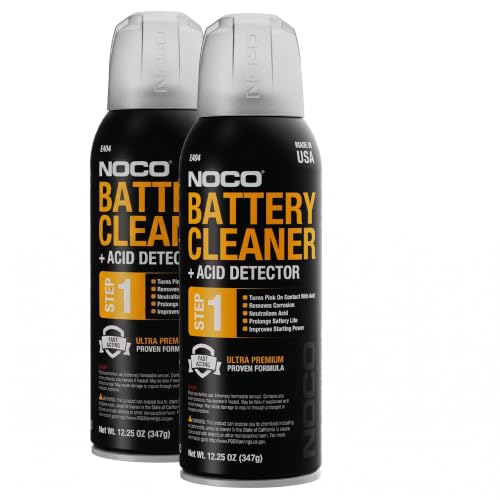
NOCO E404 foams on contact, dissolves corrosion fast, and includes an acid detector in a two-pack.
The NOCO E404 is a 12. 25-ounce battery terminal cleaner spray that comes in a pack of two. It uses a foaming action to break down corrosion within seconds, and it changes color pink when it touches acid.
That pink indicator tells you exactly where the acid has spread, which is helpful if you suspect a leak around the post. The formula neutralizes, dissolves, and removes corrosion so your connections can carry full current again. You spray it on and rinse it off, which keeps the job simple.
Two cans are handy if you maintain more than one vehicle or want a spare for the garage. The foaming action clings to vertical surfaces better than a thin spray, so it works well on side-post batteries.
The main drawback is that the pink dye can stain light-colored battery tops or concrete if you do not rinse thoroughly. It also does not protect against future corrosion, so pair it with a protector or fiber washers.
|
3
|
CRC Battery Terminal Protector Spray – Anti-Corrosion Coating – 7.5 oz | Battery Terminal |

CRC Battery Terminal Protector Spray coats terminals in a soft film that blocks acid fumes from returning.
CRC Battery Terminal Protector Spray is a 7. 5-ounce aerosol designed to go on after you clean. It leaves a lead-free soft coating over the terminals, cables, and bulkhead connectors. That coating acts as a barrier against the acid vapor that causes corrosion in the first place.
The manufacturer notes that corrosion is a leading cause of hard starting and battery failure, and this product is meant to stop that cycle. It also claims to prolong battery life and make starting easier by keeping connections clean.
This is a prevention product, not a cleaner, so you need to remove the existing crust before you spray it. It works well on daily drivers, farm equipment, and marine batteries that sit in humid conditions.
The soft coating can collect dust over time, and it may need reapplication every few months in harsh environments. If you want a one-step product, this is not it, but as a second step after cleaning it is very effective.
|
4
|
CRC 05023-12PK Battery Cleaner (Acid Indicator 12/11Oz) |

CRC 05023-12PK gives you twelve cans of acid-indicating cleaner for shops or fleets.
The CRC 05023-12PK is a case of twelve 11-ounce cans of the same acid-indicator battery cleaner. Each can neutralizes acid, removes corrosion, and alerts you to leaks with a color change. Buying by the case lowers the cost per can and ensures you always have a cleaner on the shelf.
It is aimed at shops, fleet managers, and anyone who services many batteries in a year. The formula is user-friendly and designed for quick spray-on, rinse-off use.
This bulk pack makes sense if you run a garage, marina, or farm with several batteries. The acid indicator helps technicians document whether a battery is leaking or just venting normally. The obvious limitation is that twelve cans take up shelf space and may dry out if stored for years.
For a single car owner, this is far more than you need. For a professional, it is a practical way to keep the bay stocked.
|
5
|
NOCO NCP2 M401 Battery Terminal Cleaner and Protector Kit with Brush | Clean and protect c |

The NOCO NCP2 M401 kit cleans, scrubs, and seals terminals so corrosion cannot return.
The NOCO NCP2 M401 is an all-in-one kit that includes a battery terminal cleaner, a protector, and a brush. You spray the cleaner to dissolve corrosion, scrub the posts with the brush, then apply the protector to seal the metal.
The protector is designed to make surfaces impenetrable to corrosion-causing acid fumes for the life of the battery. The formula is described as the original corrosion preventative since 1914, used by professionals. It is made in the USA and sold for cars, trucks, boats, and RVs.
This kit is the most complete single purchase if you want to fix corrosion and prevent it in one session. The brush helps remove stubborn buildup that spray alone cannot lift, especially on older terminals.
One limitation is that the kit costs more than a single can of cleaner, so it is overkill if your terminals are only lightly dusty. The protector also needs time to dry before you reconnect the cables, so plan for a short wait.
|
6
|
NOCO Remove E403S 14 Oz Battery Terminal Cleaner Spray |

NOCO Remove E403S neutralizes acid and restores current flow with a simple spray-and-rinse step.
The NOCO Remove E403S is a 14-ounce battery terminal cleaner spray that instantly neutralizes, dissolves, and removes corrosion. It is formulated to restore maximum current flow and reduce the battery’s potential for voltage leakage.
That matters because corrosion creates resistance, which makes your alternator work harder and your starter crank slower. The spray works on terminals, cables, hold-downs, and trays. You simply spray it on and rinse it off, with no scrubbing required for light to moderate buildup.
This is a good choice if you want a single can that handles the cleaning step without extra tools. It is strong enough for marine and RV batteries that see more moisture than a typical car.
The limitation is that it does not include a protector, so you will need to add one if you want long-term prevention. It also works best on visible corrosion; heavily caked terminals may still need a wire brush first.
|
7
|
Battery Terminal Cleaner Tool Kit, 2-Pack Battery Post Wire Brush with Metal Case and 10 A |

This 2-pack brush kit includes fiber washers that block acid mist from reaching the terminals.
This battery terminal cleaner tool kit includes two metal-case wire brushes and ten anti-corrosion fiber washers, five red and five green. The dual-ended brush has steel bristles that scrub stubborn corrosion and oxides off posts and clamps.
The fiber washers sit under the terminal clamps and block acid mist and moisture from reaching the metal. Red washers mark the positive terminal and green marks the negative, which helps you avoid mixing them up. The kit fits 6V and 12V top-post and side-post batteries.
This is the most mechanical option here, and it is ideal if your terminals have thick, hardened crust that sprays cannot dissolve. The washers add a layer of prevention that works even if you do not apply a spray protector.
One limitation is that the brushes require manual scrubbing, which takes a few minutes per terminal. The washers also need to be sized correctly; the inner ring is removable for larger posts, but always check the fit before tightening.
|
8
|
Permatex 80369 Battery Cleaner, 5.75 oz. net Aerosol Can |

Permatex 80369 penetrates and neutralizes acid in three minutes, then washes away the residue.
Permatex 80369 Battery Cleaner comes in a 5. 75-ounce aerosol can and works in about three minutes. You spray it on, and it penetrates and removes corrosion, dirt, and grime while neutralizing harmful acid.
The formula is designed for automotive, marine, farm machinery, and motorcycle batteries, plus cables and terminal connections. It also works on storage batteries in emergency power systems. The small can is easy to store in a toolbox or garage cabinet.
This is a convenient size for occasional use or for keeping in a vehicle emergency kit. The three-minute working time is faster than many foaming cleaners, which helps if you are in a hurry.
The main limitation is the small can size, which may not be enough for a heavily corroded battery or multiple vehicles. It also does not leave a protective coating, so you should follow with a protector spray or washers.
|
9
|
East Penn 00321 Battery Cleaner Spray – 15 oz. |

East Penn 00321 is a 15-ounce spray that neutralizes acid on automotive and marine batteries.
East Penn 00321 Battery Cleaner Spray is a 15-ounce can made in the United States. It is formulated to remove corrosion and neutralize acid on battery terminals and cables.
The flash point is listed at minus 18 degrees Celsius, which means it is flammable and should be used away from sparks or open flames. The package dimensions are compact, so it stores easily on a shelf. It is a straightforward spray-and-rinse cleaner for automotive and marine use.
This cleaner is a solid choice if you want a larger can than the small Permatex option but do not need a full case. It works well on standard car and truck batteries, and the 15-ounce size gives you enough for several cleanings.
The flammable flash point is the main caution; you must let the terminals dry completely before reconnecting. It also lacks an acid indicator, so you will not get a color change to confirm acid presence.
|
10
|
Corrosion Gone Battery Spring and Contact Cleaner |

Corrosion Gone cleans leakage from alkaline and rechargeable batteries in electronics, not just cars.
Corrosion Gone Battery Spring and Contact Cleaner is a specialty product for electronics rather than car batteries. It cleans leakage from alkaline, nicad, nickel metal hydride, and zinc carbon cells. That makes it useful for music equipment, effects pedals, tuners, headphone amps, and computer keyboards damaged by leaking backup batteries.
It can also revitalize circuit boards harmed by leaking electrolytic capacitors. If your corrosion problem is inside a remote control or a toy, this is the right formula.
This is the pick for anyone dealing with white crust inside a battery compartment rather than on a car post. It is gentle enough for springs and contacts in small devices, where a harsh automotive cleaner could damage plastic.
The limitation is that it is not designed for the large lead terminals on a car, truck, or marine battery. For those, choose one of the automotive sprays above. For a leaking AA in a guitar pedal, this is the answer.
The right tool depends on where the corrosion is and how far it has gone. For car and truck terminals, an acid-indicating spray like CRC or NOCO plus a protector or fiber washers covers both cleaning and prevention.
For heavy crust, the brush kit gives you the mechanical power that sprays cannot match. And for small electronics, Corrosion Gone handles the delicate contacts. Match the product to the surface, and the corrosion problem becomes a once-a-year chore instead of a monthly one.
How To Clean Terminals Without Damaging The Battery
Cleaning corrosion is not complicated, but doing it in the wrong order can spread acid onto paint or push debris into the battery vents. These steps keep the job safe and effective.
Turn off the engine and remove the negative cable first, then the positive, to avoid shorting.
Wear safety glasses and gloves, and work in a ventilated area away from sparks or flames.
Spray the cleaner on the terminals and let it sit for the time listed on the can.
Scrub stubborn crust with a wire brush, then rinse with water and dry the terminals completely.
Apply a protector spray or install fiber washers before reconnecting the cables.
- Do not pour baking soda directly on the battery; it can enter the cells and neutralize the electrolyte.
- Never reconnect the positive cable first; a stray wrench touch can cause a dangerous short.
- Avoid using a wire brush on the battery case itself, which can scratch plastic and create leaks.
- Do not skip rinsing; leftover cleaner residue can attract moisture and restart corrosion.
- Never tighten terminal clamps with pliers; use a proper wrench to avoid cracking the post.
Keeping Corrosion From Coming Back
Cleaning is only half the answer. If you do not address the conditions that cause corrosion, the white fuzz will return within weeks. These habits make the fix last.
The most effective prevention is keeping the battery top clean and dry. Acid vapor settles on dust and grime, so a wiped-down battery corrodes more slowly. Check your charging voltage once a year; anything above 14. 8 volts means the alternator is overcharging and boiling the electrolyte.
Make sure the terminal clamps are snug but not overtightened, because loose clamps arc and create heat. If your battery has removable caps, check the water level and top it off with distilled water only.
Finally, apply a protector spray or fiber washers every time you clean, and reapply the protector every few months in humid climates.
Prevention Schedule By Climate
| Climate | Check Interval | Protector Reapplication |
|---|---|---|
| Dry and mild | Every 6 months | Once a year |
| Humid or coastal | Every 3 months | Every 4 to 6 months |
| Winter road-salt areas | Every 3 months | Before and after winter |
| Desert heat | Every 4 months | Every 6 months |
| Marine environment | Every 2 months | Every 3 months |
When Corrosion Means The Battery Is Failing
Sometimes corrosion is a symptom, not the problem. If the buildup keeps returning or you see wet acid, the battery itself may be at the end of its life. Here is how to tell.
A healthy battery with a clean top should not produce heavy corrosion every few weeks. If it does, the likely cause is overcharging or an internal short that vents more acid than normal. A load test at an auto parts store can tell you the battery’s true condition.
If the case is swollen, cracked, or leaking, replace it immediately; no cleaner will fix a physical leak. Also check the alternator output with a multimeter. A failing diode can send AC ripple into the battery and cause it to overheat.
Replacing the battery without fixing the charging system means the new one will corrode too.
- The case is cracked, swollen, or has wet acid on the outside.
- Corrosion returns within two weeks of a thorough cleaning.
- The battery fails a load test or will not hold a charge overnight.
- You smell a strong rotten-egg odor near the battery while charging.
- The battery is more than four or five years old and cranks slowly.
Battery terminals corrode because acid vapor escapes, mixes with moisture and oxygen, and reacts with the lead and copper in your connections. Heat, loose clamps, and overcharging make it worse.
The fix is to clean the terminals with an acid-neutralizing spray, then seal them with a protector or fiber washers so the vapor cannot reach the metal. Today, take two minutes to look at your battery posts.
If you see white or blue powder, grab a cleaner and a protector, and you will stop the corrosion cycle before it leaves you stranded.

- 10 Best Battery For Generator Ev Battery Bank Marine 2026 - October 27, 2026
- 10 Best Battery For Generator Ev Battery Bank Lto 2026 - October 27, 2026
- 10 Best Battery For Generator Ev Battery Bank Low Voltage 2026 - October 27, 2026