Battery Reserve Capacity Tests: RC Ratings, Discharge Loads and Comparisons
You’re staring at a battery label and one spec jumps out: reserve capacity. It’s not the same as cold cranking amps, and it doesn’t tell you how long the battery will last forever. It tells you how long the battery can keep a car running if the alternator quits.
That number matters when you’re stuck in traffic with your lights on. This article explains what reserve capacity actually measures, why it matters, and which batteries deliver the most minutes.
What Reserve Capacity Actually Measures
Reserve capacity is one of the most misunderstood numbers on a battery. It doesn’t measure starting power or total lifespan. It measures time under a specific load. Here’s the plain-English definition and why it matters when your charging system fails.
Reserve capacity (RC) is the number of minutes a fully charged 12-volt battery can deliver 25 amps at 80°F before voltage drops below 10. 5 volts. That’s the industry standard test.
In real terms, 25 amps is roughly what your car draws at night with headlights, wipers, and the radio on. If your alternator dies, the battery becomes the only power source.
A battery with 120 minutes of reserve capacity can keep the engine and essential electronics running for about two hours under that load. A battery with 60 minutes gives you half that time. RC is your buffer against a charging system failure.
It’s also a rough indicator of how much active material is packed into the plates. More lead means more minutes, which usually means a heavier, longer-lasting battery.
Reserve Capacity vs. Other Battery Specs
| Spec | What It Measures | Typical Range |
|---|---|---|
| Reserve Capacity (RC) | Minutes at 25 amps before 10.5V | 60-190 minutes |
| Cold Cranking Amps (CCA) | Starting power at 0°F for 30 seconds | 500-1000 CCA |
| Amp-Hour (Ah) | Total energy capacity at 20-hour rate | 40-100 Ah |
| Voltage | Electrical pressure | 12V nominal |
- You drive an older vehicle with a weak or failing alternator.
- You run accessories with the engine off, like a winch or inverter.
- You live in a climate with extreme heat that shortens battery life.
- You want a buffer for unexpected electrical faults on the road.
- You tow a trailer or camper that draws extra power from the tow vehicle.
- You simply want a battery that won’t leave you stranded after a jump start.
Why 25 Amps Is The Magic Number
The 25-amp load in the reserve capacity test isn’t random. It approximates the draw of a typical car’s essential systems when the alternator stops charging. Understanding that load helps you translate minutes into real-world driving time.
When your alternator fails, the battery has to power everything the engine needs to run plus whatever accessories are on. The engine control unit, fuel pump, ignition system, and instrument cluster draw roughly 10 to 15 amps. Headlights add 10 to 15 amps.
So 25 amps is a realistic worst-case scenario for nighttime driving. The test also specifies 80°F because cold reduces battery capacity. At 0°F, a battery might deliver only half its rated reserve capacity. That’s why a 120-minute RC battery might give you just 60 minutes in a Minnesota winter.
The test ends at 10. 5 volts because most automotive electronics stop functioning reliably below that threshold. So reserve capacity tells you how long you can keep moving before the lights dim and the engine sputters.
The Conversion Formula
You can estimate amp-hours from reserve capacity with a simple formula: RC × 25 ÷ 60. A battery with 120 minutes of reserve capacity has roughly 50 amp-hours of usable capacity at that discharge rate. But amp-hour ratings use a slower 20-hour discharge, so the numbers don’t match perfectly.
A 120-RC battery might be rated at 70 Ah. The discrepancy exists because batteries deliver less total energy under heavy load. RC is the more practical number for automotive use because it reflects a realistic load, not a gentle trickle.
Why Both Numbers Appear On Labels
Amp-hours tell you total energy storage for deep-cycle applications like golf carts or solar banks. Reserve capacity tells you runtime under a heavy automotive load. A deep-cycle battery might have 170 Ah and 295 minutes of RC. A starting battery might have 70 Ah and 120 minutes of RC.
The ratio between them reveals the battery’s design intent. Starting batteries prioritize cranking amps and have lower RC relative to their Ah. Deep-cycle batteries prioritize sustained output and have higher RC relative to their Ah.
When you compare batteries, look at both numbers to understand what the battery is built to do.
Batteries With Reserve Capacity To Keep You Moving
Reserve capacity only matters if the battery actually delivers it. These picks range from 100 to 190 minutes of RC, covering compact cars, trucks, and deep-cycle applications. Each one lists its reserve capacity in the specs, so you can match the minutes to your driving needs.
|
1
|
Mighty Max Battery MM-H6 Start and Stop Car BCI Group Size 48 12V 70 AH, 120RC, 760 CCA Re |

120 minutes of reserve capacity gives you a solid two-hour buffer if your alternator fails.
The Mighty Max MM-H6 is a Group 48 AGM battery rated at 70Ah and 120 minutes of reserve capacity. That RC number means it can run essential systems for about two hours at 25 amps. The 760 cold cranking amps ensure reliable starts in cold weather.
Its sealed AGM design resists spills and vibration, making it a good fit for modern start-stop vehicles. The 120-minute RC puts it in the middle of the pack for automotive batteries.
This battery suits daily drivers who want a balance of starting power and reserve capacity. It fits many European and domestic cars that use Group 48 sizing. The AGM construction handles deep discharges better than flooded batteries, so occasional accessory use won’t kill it.
One limitation: 120 minutes is adequate but not exceptional. If you run a lot of accessories with the engine off, you might want a higher-RC option.
|
2
|
Mighty Max Battery MM-G35 Start and Stop Car BCI Group Size 35 12V 55Ah, 100RC, 650 CCA Re |

100 minutes of RC covers most commutes and errands if the alternator quits.
The Mighty Max MM-G35 is a Group 35 AGM battery with 55Ah capacity and 100 minutes of reserve capacity. That 100-minute rating means it can keep a car running for over an hour and a half under a 25-amp load. The 650 CCA provides dependable starts in moderate climates.
Its spill-proof AGM design and vibration resistance make it a practical choice for compact cars and sedans that use Group 35 sizing.
This battery fits compact cars, older sedans, and some Asian models that need a Group 35 footprint. The 100-minute reserve capacity is enough for typical commutes and short trips. It’s also a good option for vehicles with basic electrical loads.
The limitation is clear: 100 minutes is on the lower end for reserve capacity. If you frequently drive at night with many accessories, a higher-RC battery would give you more buffer.
|
3
|
Odyssey Battery ODP-AGM31M Performance Series AGM Battery |

190 minutes of reserve capacity is one of the highest RC ratings available for automotive use.
The Odyssey ODP-AGM31M is a high-performance AGM battery with a massive 190-minute reserve capacity. That means it can deliver 25 amps for over three hours before dropping to 10. 5 volts. It also packs 925 cold cranking amps and 1750 pulse hot cranking amps.
The dual SAE posts and stainless steel stud terminals accommodate both standard and custom connections. This is a premium battery built for extreme demands.
This battery suits trucks, SUVs, and vehicles with high electrical loads like winches, plows, or emergency equipment. The 190-minute RC provides a substantial buffer for off-grid or remote driving. It’s also a favorite for overlanding and fleet vehicles.
The main limitation is cost and weight: this is a heavy, expensive battery. It may not fit standard Group 31 trays without modification. But for maximum reserve capacity, it’s hard to beat.
|
4
|
Powerstar 170Ah 8V Deep Cycle Battery – Replaces Trojan T-875 (Set of 6) |

Each 8V battery delivers 295 minutes of reserve capacity, ideal for deep-cycle applications.
The Powerstar 170Ah 8V Deep Cycle Battery set includes six batteries that together create a 48V, 170Ah bank. Each battery provides 295 minutes of reserve capacity at 25 amps, which translates to nearly five hours of runtime.
That’s far beyond typical automotive RC ratings because these are flooded deep-cycle batteries designed for sustained discharge. They replace Trojan T-875 and similar GC8-style batteries in golf carts and industrial equipment.
This set is built for golf carts, floor scrubbers, aerial lifts, and renewable energy storage. The 295-minute RC per battery means you can run equipment for hours between charges. The flooded design requires regular watering and ventilation, which is a maintenance commitment.
It’s not a drop-in replacement for a car battery. But if you need serious reserve capacity for deep-cycle use, this six-pack delivers it.
|
5
|
Mighty Max Battery MM-H7 Start and Stop Car BCI Group Size 94R 12V 80AH, 140RC, 850 CCA Re |
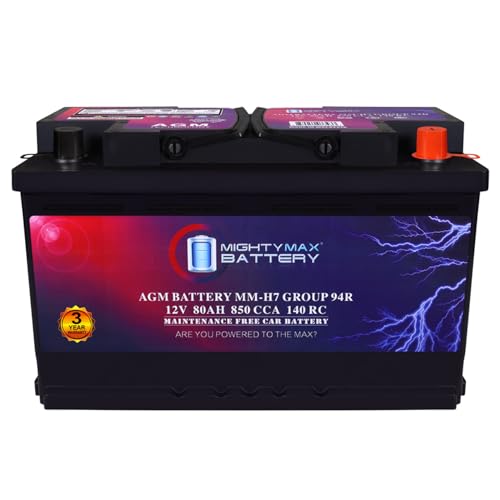
140 minutes of reserve capacity offers a generous buffer for larger vehicles and accessories.
The Mighty Max MM-H7 is a Group 94R AGM battery rated at 80Ah and 140 minutes of reserve capacity. That 140-minute figure means it can sustain a 25-amp load for well over two hours. The 850 cold cranking amps provide strong starting power for larger engines.
Its sealed AGM construction resists spills and handles deep discharges better than flooded batteries. This is a robust option for vehicles that demand more from their electrical system.
This battery fits many European sedans, SUVs, and trucks that use Group 94R sizing. The 140-minute RC is a good match for vehicles with power-hungry accessories like heated seats and advanced infotainment. It’s also a solid choice for vehicles that sit for long periods, since AGM batteries self-discharge slower.
One limitation: it’s heavier and pricier than standard flooded batteries. But the extra reserve capacity justifies the cost for many drivers.
|
6
|
Banshee H8 Group 49 AGM Car Battery, 12V 95Ah 850 CCA, 160 Minute Reserve Capacity, Automo |

160 minutes of reserve capacity gives you over two and a half hours of backup power.
The Banshee H8 Group 49 AGM battery is rated at 95Ah and 160 minutes of reserve capacity. That RC rating means it can run a 25-amp load for two hours and forty minutes. It also delivers 850 cold cranking amps for reliable starts.
The sealed AGM design allows versatile mounting positions, excluding upside down. This battery is built for vehicles that need both strong starting power and long reserve capacity.
This battery fits vehicles requiring Group 49, H8, or L5 sizing, including many BMW, Mercedes, and Audi models. The 160-minute RC is excellent for luxury cars with complex electronics. It’s also a good upgrade for any vehicle that frequently runs accessories with the engine off.
The limitation is fitment: you must verify dimensions, terminal orientation, and polarity before ordering. But if it fits, the reserve capacity is among the best in its class.
|
7
|
OPTIMA® Batteries High Performance D34/78 YELLOWTOP® Sealed AGM Battery | Dual Purpose Car |

120 minutes of reserve capacity in a spiral-cell design that resists vibration and deep discharge.
The OPTIMA D34/78 YellowTop is a dual-purpose AGM battery with 750 cold cranking amps and 120 minutes of reserve capacity. Its SpiralCell technology uses 99. 99% pure lead and delivers consistent power even in bad weather. The 120-minute RC provides a solid buffer for vehicles with high electrical demands.
It’s also maintenance-free and can be mounted in multiple positions. This battery is known for its durability and deep-cycle capability.
This battery suits trucks, SUVs, and cars that need both starting power and deep-cycle resilience. The spiral-cell design resists vibration 15 times better than standard flooded batteries, making it ideal for off-road use. It’s also a popular choice for vehicles with winches or audio systems.
The limitation is price: it costs more than conventional batteries. But its 120-minute RC and long lifespan often justify the investment.
|
8
|
Mighty Max Battery MM-H5 Start and Stop Car BCI Group Size 47 12V 60 AH, 100RC, 680 CCA Re |

100 minutes of reserve capacity in a compact AGM package for smaller vehicles.
The Mighty Max MM-H5 is a Group 47 AGM battery with 60Ah capacity and 100 minutes of reserve capacity. That 100-minute rating provides over an hour and a half of runtime at 25 amps. The 680 cold cranking amps ensure dependable starts in most climates.
Its sealed AGM design is spill-proof and vibration-resistant. This battery is a practical choice for compact cars and sedans that need a reliable, maintenance-free power source.
This battery fits vehicles that use Group 47 sizing, including many Asian and European compact cars. The 100-minute reserve capacity is sufficient for daily driving and short trips. It’s also a good option for cars with basic electrical systems.
The limitation is that 100 minutes is modest compared to higher-RC batteries. If you often drive with many accessories on, you might want more reserve capacity. But for typical commuters, it’s a solid, affordable choice.
|
9
|
Mighty Max Battery MM-G35 Group Size 35 12V, 55Ah, 100RC, AGM, 650 CCA, Replacement Batter |
100 minutes of reserve capacity with a direct fit for Toyota Corolla 1.8L models.
The Mighty Max MM-G35 is a Group 35 AGM battery rated at 55Ah and 100 minutes of reserve capacity. It’s specifically noted as a replacement for the Toyota Corolla 1. 8Liter 97, making fitment straightforward for that application. The 650 cold cranking amps provide reliable starting power.
Its sealed AGM construction resists spills and vibration. The 100-minute RC gives you a reasonable buffer if the alternator fails.
This battery is ideal for Toyota Corolla owners and other vehicles that use Group 35 sizing. The 100-minute reserve capacity covers most daily driving needs. It’s a direct-fit replacement, so installation is simple. The limitation is the same as other 100-RC batteries: it’s adequate but not exceptional.
If you want more reserve capacity, you’d need to step up to a larger group size. But for Corolla owners, this is a reliable, no-fuss option.
These nine batteries span reserve capacities from 100 to 295 minutes, covering compact cars, trucks, and deep-cycle equipment. The higher the RC, the longer you can drive if your alternator fails. Match the minutes to your typical driving conditions and accessory load.
How To Match Reserve Capacity To Your Driving
Reserve capacity isn’t one-size-fits-all. A commuter with a simple electrical system needs less RC than a truck running a plow. Here’s how to translate minutes into real-world driving scenarios.
The right reserve capacity depends on how you use your vehicle and what you run while driving. If you drive a basic sedan during the day, 60 to 100 minutes of RC is plenty. You’re not drawing much beyond the engine and maybe the radio.
If you drive at night with headlights, wipers, and defroster running, you’re closer to the full 25-amp load. In that case, 120 to 160 minutes gives you a safer buffer. If you run a winch, plow, or large inverter, you need 190 minutes or more.
The goal is to have enough RC to reach a safe location if your alternator fails. More minutes mean more peace of mind, but they also add weight and cost.
Reserve Capacity By Driving Scenario
| Driving Scenario | Typical Load | Recommended RC |
|---|---|---|
| Daytime commuting, basic car | 10-15 amps | 60-100 minutes |
| Night driving with accessories | 20-30 amps | 120-160 minutes |
| Towing or off-road with lights | 30-40 amps | 160-190 minutes |
| Commercial equipment or winch | 40+ amps | 190+ minutes |
- Check your owner’s manual for the minimum RC required for your vehicle.
- Add 20 minutes of RC if you frequently drive at night in bad weather.
- Choose a higher RC if you plan to run accessories with the engine off.
- Remember that cold weather reduces usable RC by up to 50 percent.
- Don’t sacrifice CCA for RC if you live in a cold climate; you need both.
- If you’re unsure, go one step higher in RC than you think you need.
Mistakes That Shorten Battery Reserve Capacity
Even a high-RC battery won’t deliver its rated minutes if you mistreat it. These common mistakes drain reserve capacity faster than you’d expect and can leave you stranded.
Reserve capacity is a measure of stored energy, and that energy depletes over time if you abuse the battery. One of the biggest mistakes is leaving accessories on with the engine off. Every minute you run the radio or lights without the alternator charging eats into your reserve.
Another mistake is ignoring corrosion on the terminals. Corroded connections increase resistance, which reduces the effective capacity you can draw. Extreme heat is also a killer. Heat accelerates grid corrosion inside the battery, permanently reducing its ability to hold a charge.
Cold doesn’t damage the battery, but it temporarily reduces RC. Finally, chronic undercharging from short trips prevents the battery from ever reaching full capacity. If you only drive five minutes at a time, your battery may never fully recharge, so its reserve capacity shrinks over time.
Turn off all accessories before shutting off the engine to avoid draining the battery.
Clean terminal connections every six months to prevent resistance buildup.
Take a longer drive at least once a week to let the alternator fully recharge the battery.
Park in the shade or a garage in hot climates to reduce heat-related damage.
Test your battery’s state of charge every few months with a voltmeter; it should read 12.6V or higher.
Replace the battery if reserve capacity drops noticeably or if it fails a load test.
Reserve capacity is the number of minutes a battery can run your car at 25 amps if the alternator stops charging. It’s your emergency buffer, and more minutes mean more time to find safety. Today, check your battery label or owner’s manual for the RC rating.
If it’s below 100 minutes and you do a lot of night driving, consider upgrading to a battery with 120 minutes or more. That simple check could save you from a roadside breakdown.

- Marine Chargers and Backup Batteries: 9 Options Compared (2026) - October 27, 2026
- LTO Cells vs. SLA Generator Batteries: 5 Options Compared (2026) - October 27, 2026
- 12V/24V Backup Batteries and the EcoFlow DELTA Pro 3 (2026) - October 27, 2026