What Causes Battery Terminal Corrosion?
That white, crusty stuff caked on your battery terminals isn’t just a cosmetic problem. It means something in your electrical system is working overtime, and ignoring it can turn into hard starts or a dead battery on a cold morning.
I wrote this guide to walk through the actual chemistry behind terminal corrosion , what’s producing that crust, why it keeps coming back , and then point you toward tools and products that genuinely address the problem instead of just scrubbing the surface.
The Chemistry Behind Terminal Corrosion
Terminal corrosion isn’t random grime that somehow worked its way up there. It’s a chemical reaction that starts the moment your battery ages.
Acid, metal, and oxygen combine in a pretty predictable way, which is why some cars sit in the garage for months with spotless terminals while others throw up that blue-white crust within a season.
Knowing what’s actually happening underneath helps you pick the right fix instead of just hauling out a wire brush and hoping for the best.
Here’s what’s actually going on: your battery’s sulfuric acid electrolyte slowly breaks down over thousands of charge and discharge cycles. Tiny amounts of acid vapor escape through the fill holes or vent tubes and drift over the terminals.
When that vapor hits the copper on the positive post or the lead on the negative post, it forms compounds like copper sulfate or lead sulfate. That’s your white, blue, or grayish crust.
Temperature swings make it worse , heat pushes more vapor out, cold pulls moisture in, and both accelerate the reaction. It’s a cycle that feeds itself unless you interrupt it.
What Each Color Means
| Color | Likely Cause | Terminal Type |
|---|---|---|
| White/Clear | Lead sulfate | Negative terminal |
| Blue/Green | Copper sulfate | Positive terminal |
| Gray | Lead oxide | Both terminals |
| Yellow/Brown | Iron oxide | Steel components |
How Charging Habits Feed the Problem
Your alternator does more than keep the battery topped off. How it charges , or overcharges, or undercharges , changes the whole chemical environment around your terminals.
I think a lot of people assume corrosion is purely a battery problem, but the charging behavior of the whole system matters just as much. This section lays out which charging patterns make things worse and what to watch for.
- Avoid frequent short trips that leave the battery partially charged
- Check your alternator output if the battery drains quickly
- Use a smart charger during long storage periods
- Keep terminals tight but not over-torqued
- Inspect for cracked casings or leaking seals annually
An overcharging alternator dumps excess voltage into the battery, forcing more acid vapor out through the vents. This shows up a lot in older vehicles with less refined charging regulation.
On the flip side, a chronically undercharged battery sits in a partial discharge state, which encourages sulfation , the buildup of lead sulfate crystals on the internal plates. That raises internal resistance and heats up the battery, which in turn speeds up the chemical reactions that produce vapor.
Long highway drives help a balanced system, but only if the voltage stays within the range your manufacturer spec’d. If it’s running hot or cold, the alternator or regulator is part of the problem, not just the battery.
Solutions To Stop Battery Terminal Corrosion
I’d frame the picks in this guide around three things that actually stop the corrosion cycle: neutralizing existing acid, scrubbing the metal back to a conductive surface, and sealing that surface so the next batch of vapor can’t react with it.
None of these products are just “cleaners” in the way a kitchen sponge is a cleaner. They’re targeted at interrupting the chemistry. I’d shortlist the ones below if you want something that both cleans and buys you time between future checkups.
|
1
|
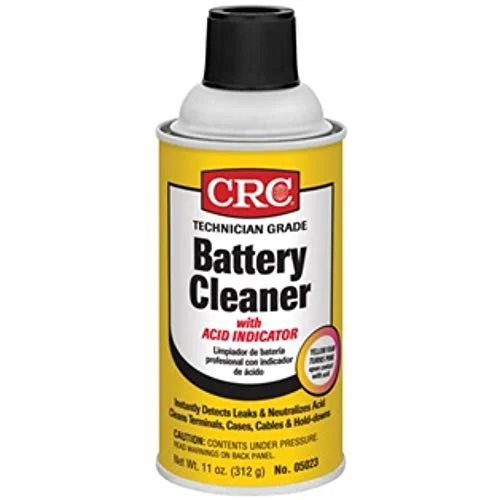
CRC Tech Grade Battery Cleaner w/Acid Indicator – 11 oz | Battery Acid Cleaner, Terminal a |

CRC’s acid-indicator tech actually shows you when the cleaning is done , you stop when the color change tells you to.
This is an 11 oz aerosol CRC makes for fleet and vehicle maintenance use, and it’s available through standard auto channels. You spray it directly on the corroded terminal, and the formula contains an acid indicator that shifts to pink where residual acid is still present.
That’s useful because you’re not just spraying and hoping. You wait, watch the color, and you know the corrosive material is actually gone before you tighten the clamp back down. It rinses out with plain water.
I’d point this toward mechanics and serious DIYers who work on multiple vehicles and need a fast, repeatable cleaning step. It handles battery posts, cable ends, trays, and bulkhead connectors.
One thing to keep in mind: on heavily rusted or thickly coated terminals where you can barely see the metal, the pink indicator can be hard to read. In those cases, I’d still rely on the rinse and visual inspection more than the color cue.
|
2
|
Battery Terminal Cleaner Tool Kit, 2-Pack Battery Post Wire Brush with Metal Case and 10 A |

The kit pairs mechanical cleaning (brushes) with a physical barrier (washers), so it covers both the ‘clean it now’ and ‘keep it clean’ parts of the problem.
What’s in the box: two stainless steel post brushes with dual-ended bristles (one end for the post, one for the inside of the clamp) and a set of 10 anti-corrosion fiber washers , five red, five green.
The reds go on positive, greens on negative, which saves you from mentally tracking polarity. The washers are fiber discs that sit between the terminal and the clamp, blocking acid mist and moisture. They’re rated for 6V and 12V batteries and work on both top-pole and side-pole configurations.
The inner ring on each washer is removable, so if your terminal is a bit oversized, you can swap it out without the washer slipping.
I’d shortlist this for someone maintaining a car, truck, RV, or outboard motor and wanting a low-maintenance prevention layer between cleaning sessions.
The one caveat I’d flag: 10 washers is fine for one or two batteries, but if you‘re a shop or you service a small fleet, you’ll burn through them fast and need to reorder.
|
3
|
NOCO NCP2 M401 Battery Terminal Cleaner and Protector Kit with Brush | Clean and protect c |

NOCO bundles the spray, the brush, and the seal into one kit, so you’re not juggling three separate purchases to get through the full clean-and-protect cycle.
The NCP2 kit works in three steps: spray the corrosion-dissolving solution, scrub with the included brush, then apply the sealing compound. The spray neutralizes and lifts existing buildup, the brush takes out what the liquid loosens, and the final coat makes the terminal surface impenetrable to acid fumes.
NOCO has been making battery maintenance products since the early 1900s, and this kit is aimed at people who want one process that covers all three tasks without reaching for a separate product at each step.
I’d recommend this to a daily-driver owner who wants a single, straightforward routine rather than picking and choosing components. It’s straightforward on standard 12V car batteries.
One practical note: if your engine bay is dusty or you’re working under a lift with loose parts, the sealing compound can attract grit if you lay it on thick. A thin, even coat works better than a heavy one in dirty environments.
|
4
|
TKDMR Battery Terminal Cleaners (2 pcs),12 pcs Battery Terminal Anti-Corrosion Fiber Washe |

You get the brush-and-washer combo at a lower price point than the single-brand kits, which makes it a practical option for households with more than one battery to maintain.
TKDMR’s set includes two nickel-plated steel brushes and 12 fiber washers (six red, six green). The brushes have sturdy wire bristles held in place with caps that lock shut for storage, so they won’t snag on whatever’s in your junk drawer.
The washers have removable inner rings, giving you flexibility if your terminal is on the larger side. At the price point TKDMR lists for this, I’d say it’s one of the cheaper ways to get both a cleaning tool and a prevention layer in one box.
I’d check this out if you’ve got a 6V motorcycle battery and a 12V car battery and just want a cheap kit that covers both.
The fiber washers are a bit thinner than what you’d see in a premium single-brand kit, so I’d position them carefully when installing to make sure they seat flat and don’t ride up or slip off the terminal.
|
5
|
Steelman Battery Post Terminal Cleaner for Automotive and Marine Batteries, Steel Bristle |

When the corrosion is really bad , think years of neglect, pitted posts, thick crust , a soft nylon brush won’t cut it. Steel bristles are the mechanical answer.
The Steelman post cleaner is a no-frills tool. The bristles are steel, anchored tightly in a wire spine so they don’t flatten or splay out under pressure.
It works on both top and side terminals, and there’s a protective cover that keeps the bristles from catching on other tools in your bag. The case is impact-resistant plastic, which also shields the brush from the acid solutions you’ll be spraying on it.
The whole thing is compact enough to live in a toolbox without taking up much room.
I’d reach for this one when I’m dealing with a battery that’s been sitting and the terminals are genuinely rough , not just a light film, but real buildup. It’s durable for repeated use.
The one thing I’d note: the plastic housing feels a step below metal in heft, so if you need maximum rigidity for aggressive scrubbing on a deeply pitted post, it won’t feel as solid as a all-steel tool.
|
6
|
CRC Battery Terminal Protector Spray – Anti-Corrosion Coating – 7.5 oz | Battery Terminal |

After you’ve cleaned the terminal, you need something to keep it clean. CRC’s protector spray is that barrier , a flexible, lead-free coating that sits on the metal and blocks the next batch of acid vapor.
This is a 7. 5 oz spray you apply over a freshly cleaned terminal. What makes it different from a waxy sealant is that the coating stays soft. Waxes crack and shrink as temperatures cycle, and that’s where the next corrosion cycle gets its entry point.
CRC’s formula moves with the metal, so it doesn’t fracture in winter or blister in summer. It isolates the terminal from acid vapors, moisture, and oxygen, which keeps the connection conductive and the battery running longer.
I’d use this as the final step after cleaning , not as a substitute for cleaning. If there’s active crust on the terminal, the coating will just seal it in place. Pair it with a dedicated corrosive-dissolving product first.
And same note as the NOCO seal: in a dirty engine bay, a thin layer works better than a thick one that ends up as a dust magnet.
|
7
|
Battery Brush Cable Cleaner with 8Pcs Protector Fiber & 1Pcs Brush |

The spiral brush shape gets inside the clamp and the cable end where a flat brush can’t reach, and the washers lock in the barrier layer.
This kit pairs a spiral-design brush with eight fiber washers. The spiral is the key detail here , it slides over the post and then into the inside of the clamp, catching buildup in the cavity where flat brushes just skim the surface.
The washers are color-coded red and green, and they fit between the terminal and the clamp. The metal construction on the brush is heavy enough that aggressive scrubbing won’t wear it out quickly.
I’d check this out for moderate corrosion on a standard automotive battery where the buildup is in the clamp rather than just on the flat face of the post. The fact that it works on both top and side posts makes it useful across different battery orientations.
The washers are a smaller count than some of the other kits , four pairs , so if you’ve got multiple batteries, you might want to budget for a reorder.
|
8
|
NOCO E404 12.25 Oz Battery Terminal Cleaner Spray and Corrosion Cleaner with Acid Detector |
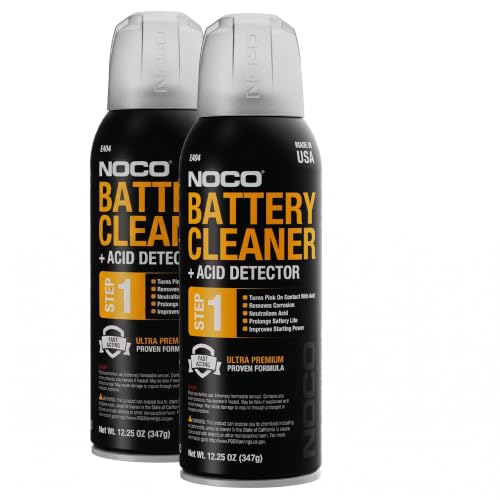
The acid detector gives you a clear ‘you’re done’ signal, which is harder to get when you’re just spraying and wiping by feel.
The NOCO E404 is a 12. 25 oz foaming cleaner. The foam breaks down tough corrosion fast , within seconds of contact, really , and it carries a built-in acid detector that turns pink when it senses residual acid.
You spray, let it foam, wipe, and check: if it’s still pink, you’re not done. The listing shows this in a two-pack, which makes sense if you want a backup can for the next cleaning cycle without hunting for a replacement.
I’d recommend this to a shop or a home mechanic who wants a repeatable, verifiable cleaning step. It works across cars, trucks, boats, and RVs.
One practical tip: the pink indicator fades quickly in direct sunlight, so I’d check it in shade or right after application rather than letting the can sit on a warm engine bay lid for a few minutes.
|
9
|
LotFancy Battery Terminal Cleaners (2 pcs), Plus 12 pcs Battery Terminal Anti-Corrosion Fi |

A strong match for the question above.
LotFancy’s 2-pack gives you brushes with two distinct ends , a cone shape that slides over standard posts and a flat end that reaches into clamp cavities , plus 12 washers with removable inner rings.
The cone end is good for getting around the post without damaging the clamp, and the flat end handles the inside surfaces. Washers are color-coded red for positive, green for negative, which cuts down on the chance of mixing them up.
The kit works on both top and side terminal layouts.
I’d shortlist this if you’re working across different vehicle types , a car, an RV, a small boat, maybe an ATV , and want one kit that handles all of them. The adjustable washer design means you can seat it on an oversized terminal without a gap forming.
One thing I’d look at before buying: the brush housings are plastic, and if you’re doing heavy-duty work on industrial or marine batteries with really corroded posts, a metal-reinforced handle would last longer.
|
10
|
Alltooetools Battery Terminal and Post Cleaner Wire Brush Tool SF0193 | Dual-head brush de |

The dual-head design and specific hole sizes make it a precision tool for people whose vehicles use non-standard terminal diameters.
Alltooetools’ SF0193 is a compact dual-brush tool. One head is a cone that fits over the outside of the post, the other is an internal spiral for cleaning inside the cable end.
The openings are sized for 7/8-inch and 5/8-inch terminals, which covers most European and Asian vehicles , Alfa Romeo, Audi, BMW, Ford, Nissan, and similar.
The handle has a non-slip grip so you can scrub with two-hand pressure without it twisting out, and the steel housing holds its shape under that pressure.
I’d point this toward anyone driving a non-US-spec vehicle where terminal sizes differ from the standard 3/8-inch post you see on most American cars. The precision sizing means the brush actually contacts the terminal surface rather than floating.
The one limit: if you’ve got an oversized industrial or forklift battery terminal, the fixed hole sizes won’t accommodate it, and you’d want to go with something like the removable-ring washers from the TKDMR or LotFancy kits instead.
Stepping back, these products all attack the corrosion cycle from different angles. The sprays (CRC, NOCO E404) dissolve what’s already there and neutralize the acid. The brushes (Steelman, LotFancy, Alltooetools, the TKDMR and Battery Brush kits) mechanically restore metal-to-metal contact.
The washers and sealants (CRC protector, NOCO NCP2 seal, TKDMR washers) block the next batch of vapor from reacting. No single product does all three well, which is why most of the kits bundle two or three of these steps together.
I’d pick based on which link in the chain you’re missing.
Maintaining Clean Terminals Over Time
Cleaning your terminals once a year won’t hold if you don’t build a small maintenance rhythm around it.
I’d check terminals at least twice a year , before summer heat and again before the first cold snap , and watch for that initial film of white or blue residue before it becomes a thick crust.
Seasonal shifts matter because heat drives more vapor out and cold pulls condensation in. If you start seeing corrosion build back within a few weeks of cleaning, that’s a cue to look at your charging system rather than just re-scrubbing.
Inspect terminals monthly for new corrosion growth or loosening
Clean and reapply protectant every three to four months
Test battery voltage at least twice per year
Replace fiber washers when they become compressed or torn
Schedule alternator testing during annual service visits
When you reassemble, tighten the clamps to snug , roughly 100 inch-pounds is the ballpark , but don’t crank it down like you’re bolting an axle. Over-tightening strips the post threads and can crack the terminal.
After everything’s seated, a thin coat of dielectric grease or even a light smear of petroleum jelly on the exposed metal gives you a secondary moisture barrier. Keep your cleaning brushes dry after use and swap out bristles that have bent or splayed.
A deformed brush just polishes the terminal instead of cleaning it.
When Corrosion Signals Bigger Problems
If you clean the terminals and they look clean for a week or two, then the crust is back before the next scheduled checkup, the problem probably isn’t the terminals. It’s upstream.
A tired alternator, a voltage regulator drifting out of spec, or a battery that’s just past its useful life will keep generating the conditions that produce acid vapor no matter how well you seal the terminals. I’d treat recurring corrosion as a diagnostic clue, not just a cleaning chore.
Voltage Imbalance Indicators
If you’re finding yourself re-cleaning every month despite using protective coatings, pull a multimeter and check the charging voltage with the engine running. I’d look for a steady reading between 13. 2 and 14. 8 volts. Above 14.
8, the alternator is overcharging and forcing extra acid vapor out of the battery. Below 13. 2, the battery is sitting in a partial state of charge, which feeds sulfation.
If your readings are outside that window, I’d have a technician check the voltage regulator and the alternator’s output before you spend money on more cleaning products. The corrosion will keep coming back until the voltage is in range.
Battery Age and Internal Failure
Batteries past the three-year mark start showing internal plate degradation. That means hot spots forming inside, uneven charge distribution, and more acid stratification in the electrolyte. You’ll see it externally as faster, more aggressive corrosion between cleanings.
If your battery is older and the crust is coming back quicker each time, the battery itself may be the source of the excess vapor. Swelling in the casing, slow cranking, or headlights that dim when you stop at a red light are all signs the internals are degrading.
Replacing the battery removes the vapor source rather than just managing the symptom.
Here’s a pattern worth noting: if corrosion is only on the positive terminal, that’s normal off-gassing and not usually a red flag. But if both terminals are throwing up buildup within a few weeks of cleaning, look at your electrical loads.
A parasitic draw , a light that stays on after you lock the car, a faulty relay, a dash cam left powered, a aftermarket accessory pulling amps overnight , keeps the battery in a partial discharge state. That accelerates sulfation and increases acid vapor production.
Tracking down and fixing the draw reduces the vapor load on your terminals and gives your protective coatings a real chance to do their job.
Battery terminal corrosion is, at its root, sulfuric acid vapor reacting with the metal posts during normal charge and discharge cycles. You can’t stop the battery from off-gassing , that’s just what it does , but you can interrupt the reaction.
Clean the terminals with a dedicated spray and a brush that actually reaches the clamp cavity, then seal the surface with a flexible coating or fiber washers so the next batch of vapor has nothing to react with. And keep an eye on your charging voltage.
If the alternator or the battery itself is generating more vapor than usual, no amount of cleaning or sealing will keep up. Replace the failing component, and the corrosion problem solves itself.

- 10 Best Battery For Generator Ev Battery Bank Marine 2026 - October 27, 2026
- 10 Best Battery For Generator Ev Battery Bank Lto 2026 - October 27, 2026
- 10 Best Battery For Generator Ev Battery Bank Low Voltage 2026 - October 27, 2026