What Causes Battery Corrosion In Cars?
Lifting the hood and spotting that chalky blue or white crust creeping across your battery terminals is never a welcome sight. That powdery buildup isn’t just ugly, it’s an active chemical reaction eating away at your electrical connections, often long before you notice the engine cranking sluggishly.
Figuring out why it forms in the first place makes it much easier to stop. I’ve put together this breakdown of what actually causes under-hood oxidation and which tools reliably keep your car starting on the first try.
Why Chemical Reactions Create Battery Corrosion Under Your Hood
Battery corrosion doesn‘t just appear out of nowhere. It’s usually the result of basic chemistry colliding with temperature swings and the everyday reality of how lead-acid batteries are built.
Electrolyte Gas Leaks
Most car batteries hold a liquid mix of sulfuric acid and water. Every time the battery charges or discharges, tiny amounts of gas vent out near the terminal posts.
When those warm, acidic vapors hit the cooler metal of your battery clamps, they condense and kick off a corrosive reaction almost immediately.
Dissimilar Metal Friction
There’s also a mismatch in metals at play. Battery posts are typically lead, but the cable clamps gripping them are often copper, brass, or zinc. When electricity flows between these different metals in a damp environment, galvanic corrosion speeds up.
The softer metal slowly sacrifices itself, leaving behind that familiar flaky mess.
Microscopic Sealing Gaps
Years of bouncing over potholes and vibrating at highway speeds take a toll, too. Microscopic gaps eventually open up where the lead posts push through the plastic casing.
Acid seeps upward through those cracks, pooling right at the base of the terminal and feeding continuous corrosion growth from the inside out.
- High under-hood heat accelerates electrolyte evaporation and forces gas out of the battery casing faster.
- Excessive overcharging by a failing alternator boils the internal acid and dramatically increases gas venting.
- Humid climates introduce moisture into the engine bay, creating the ideal liquid medium for rapid oxidation.
- Physical micro-cracks around the terminal posts allow liquid acid to wick upward continuously.
Tools And Cleaners We’d Pick To Stop Battery Corrosion
Getting rid of under-hood oxidation means matching the right neutralizing chemicals with mechanical scrubbers that won’t damage your cables. My read on these ten products is that they cover the full spectrum, from dissolving heavy crust to scrubbing posts clean and keeping the acid fumes at bay afterward.
|
1
|
CRC Tech Grade Battery Cleaner w/Acid Indicator – 11 oz | Battery Acid Cleaner, Terminal a |

I’d point to this CRC Tech Grade cleaner because its built-in acid indicator changes color to show you exactly where hidden residue is still active, while the formula works to dissolve it.
The CRC Tech Grade Battery Cleaner comes in an eleven-ounce aerosol can aimed squarely at fleet and vehicle maintenance. What stands out to me is the integrated acid indicator.
Instead of guessing if you’ve removed all the contamination, the formula reacts to lingering sulfuric acid by changing color, giving you a clear visual cue. You spray the foam directly onto the affected terminal and watch it go to work on the powdery white and blue crust.
I would shortlist this for anyone dealing with heavily neglected buildup on cars, trucks, or even lawn equipment. The aerosol nozzle gets into tight spots between cables and battery trays without demanding a lot of manual scrubbing. Just keep in mind that it’s strictly a cleaner.
It doesn’t leave behind a protective sealant, so I’d recommend following up with a separate grease or protector spray to keep the corrosion from creeping back next month.
|
2
|
NOCO NCP2 M401 Battery Terminal Cleaner and Protector Kit with Brush | Clean and protect c |

If you want everything in one box, my read is that this NOCO NCP2 kit covers all the bases by bundling a chemical dissolver, a dedicated terminal brush, and a protective oil treatment.
This setup makes sense for vehicle owners who don’t want to hunt down separate supplies for cleaning and protecting. The NOCO formula has been around the automotive space for a long time, and getting those terminals clean noticeably improves electrical flow for stronger cranking.
One thing I’d watch out for: the protective oil can feel a bit tacky if you apply it too thickly, which tends to attract road dust over time.
|
3
|
CRC Battery Terminal Protector Spray – Anti-Corrosion Coating – 7.5 oz | Battery Terminal |

I’d look at this CRC protector spray when you need a final defensive layer. It coats terminals in a soft, lead-free barrier specifically meant to block the acid fumes that cause hard starts.
Rather than attacking existing rust, the CRC Battery Terminal Protector Spray focuses entirely on prevention. It deposits a specialized, lead-free soft coating directly over your battery posts and cable connections.
Think of it as a shield against the moisture and acid fumes that cause premature battery failure and sluggish morning starts. You apply it to freshly cleaned metal surfaces to form a durable barrier.
I consider this the ideal final step after you’ve already scrubbed and rinsed your battery terminals. Laying down this film helps ensure months of trouble-free starts, especially when temperatures drop. It keeps connection points conductive and extends overall battery life.
Just remember, it won’t remove existing corrosion, you have to do the heavy lifting with a cleaner or brush first.
|
4
|
NOCO E404 12.25 Oz Battery Terminal Cleaner Spray and Corrosion Cleaner with Acid Detector |
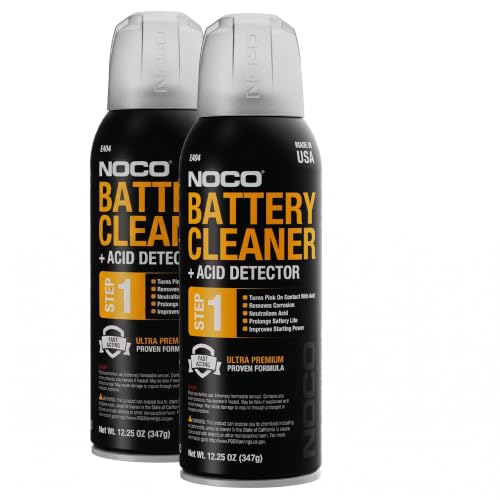
This two-pack of NOCO E404 spray catches my attention because of the fast-acting foam and the pink acid detector, which takes the guesswork out of neutralization.
The NOCO E404 aerosol relies on a fast-acting foaming action to break down tough corrosion within seconds. Like the CRC option, it features a built-in acid detector, but this one turns pink upon contact with active sulfuric acid. That instant visual feedback tells you exactly where the problem is worst.
Having a two-pack means you’re less likely to run dry halfway through a multi-car project.
I’d lean toward this for routine seasonal maintenance on family cars, trucks, or boats where you want quick, visible results. The foam lifts debris away efficiently, so a simple water rinse usually leaves the terminal post looking fresh.
The only caveat is the can size, if you’re treating several heavily corroded commercial batteries in one sitting, you might burn through the aerosol faster than expected.
|
5
|
TKDMR Battery Terminal Cleaners (2 pcs),12 pcs Battery Terminal Anti-Corrosion Fiber Washe |

For a purely physical approach, this TKDMR set pairs a stainless steel terminal brush with color-coded fiber washers that block acid right at the base of the post.
The TKDMR kit takes a mechanical route, giving you a pocket-sized stainless steel cleaning brush alongside twelve color-coded fiber washers. I like that the brush tucks into a protective nickel-plated metal case, making it easy to store in a glove box without scratching anything.
The fiber washers slide snugly under your battery terminals, red for positive, green for negative, to act as a physical barricade against future acid migration.
This bundle appeals to me for car and marine owners who prefer mechanical scrubbing paired with a physical barrier rather than relying solely on chemicals. The washers feature removable inner rings, which is a smart touch for accommodating different terminal post sizes.
Naturally, using the wire brush requires some actual elbow grease compared to sprays that dissolve grime on their own.
|
6
|
ZOKYUYS 4 in 1 Car Battery Cleaning Brush,Anti-Corrosion Battery Terminals,Copper Pipes Cl |

I’d consider this ZOKYUYS four-in-one tool if you need deep mechanical cleaning. Its multi-functional wire brushes are designed to get inside terminal clamps and pipe threads alike.
The ZOKYUYS four-in-one tool uses dual-ended brush heads built with durable steel wire bristles, housed in an ABS and stainless steel body. Its compact shape lets you twist the brush deep inside terminal clamps and drag it over battery posts to scrape away stubborn oxidation.
Beyond the battery, the layout handles small metal parts and pipe cleaning tasks around the garage, making it more than a single-use gadget.
I see this fitting well for DIY enthusiasts who like multi-functional gear that doesn’t clutter a toolbox. The handle design lets you apply firm rotational pressure to strip away tough white crust without gouging the relatively soft lead posts. Keep in mind, though, that this is strictly a mechanical tool.
You’ll still need to supply your own neutralizing spray or water rinse to finish the job properly.
|
7
|
Battery Brush Cable Cleaner with 8Pcs Protector Fiber & 1Pcs Brush |

This complete battery maintenance kit earns a spot here because it pairs a heavy-duty spiral brush with fiber washers that work on both top and side posts.
This cleaner kit brings together a heavy-duty metal terminal cleaning tool and four protective fiber washers.
I find the spiral brush design particularly clever, it scrubs the inside of your cable ends and the outside of the battery posts at the same time, restoring clean metal contact much faster than a standard wire brush.
The included color-coded fiber washers slide onto top-post and side-post batteries to catch acid mist before it spreads across the tray.
I’d point everyday drivers toward this set if they’re handling standard car or marine battery maintenance on a budget. The metal construction feels robust enough to withstand repeated use without bending or shedding bristles.
The main limitation is the washer count; with only four included, you’ll likely need to buy replacements if you service multiple vehicles frequently.
|
8
|
Battery Terminal Cleaner Tool Kit, 2-Pack Battery Post Wire Brush with Metal Case and 10 A |

When you have several vehicles to maintain, I’d look at this two-pack kit. It offers dual metal-case brushes and ten anti-corrosion washers built for heavier use.
This kit steps things up with two metal-case battery post wire brushes and ten anti-corrosion fiber washers, split evenly between red and green. The stainless steel bristles aggressively tackle stubborn oxides and built-up white powder to restore electrical conductivity, something you definitely want before winter hits.
Meanwhile, the fiber gaskets create a dense barrier that blocks harmful acid mist from reaching your terminal clamps.
My read is that this multi-pack makes the most sense for households juggling multiple cars, trucks, or RVs that need regular seasonal inspections. The twist-cap design protects the wire bristles from getting crushed or snagged inside your trunk.
Just be mindful of the stiffness of those steel wires; you need to use a careful hand so you don’t accidentally gouge the soft lead battery posts.
|
9
|
East Penn 00321 Battery Cleaner Spray – 15 oz. |

For severe buildup, I’d reach for this East Penn aerosol spray. It delivers a heavy-duty chemical punch in a larger fifteen-ounce container.
The East Penn battery cleaner spray comes in a generous fifteen-ounce aerosol can formulated to blast away heavy acid residue. Its chemical makeup breaks down thick crusts on automotive and marine batteries without forcing you to spend twenty minutes scrubbing manually.
You spray it across the affected terminals, watch it foam up against the oxidation, and simply rinse it clean with water.
I’d reserve this one for truck owners or marine operators dealing with severe, neglected corrosion in consistently damp environments. The larger can size provides enough solution to service several big battery banks before running empty.
Note that, like many aggressive liquid cleaners, it doesn’t leave a long-term rust inhibitor behind, so I’d always follow it up with a dedicated protective spray.
|
10
|
4 in 1 Car Battery Terminal Cleaning Brush, Anti-Rust Auto Battery Cleaner Brush Tool, Uni |

This blue-handled four-in-one brush tool stands out to me for its ergonomic grip and dual-ended wire cleaning, which makes working in tight engine bays much easier.
This blue-accented four-in-one cleaning tool features an ergonomic handle paired with rugged steel wire bristles built for long-term automotive maintenance. The dual ends twist and scrub inside cable clamps and over battery posts to effectively remove rust, acid stains, and oxidation.
What I appreciate is the compact length, which allows for easy maneuvering in crowded engine bays where bulkier standard brushes just struggle to fit.
I think this tool is ideal for DIY mechanics looking for an affordable, comfortable brush that simplifies routine battery upkeep. The durable ABS and stainless steel construction holds up well even when exposed to harsh chemical cleaners during the process.
The primary trade-off with any physical wire brushing is that it removes thin layers of metal over time, so I’d recommend using gentle rotation rather than bearing down hard.
Clearing stubborn terminal buildup usually comes down to pairing the right chemical neutralizers with mechanical wire brushes that fit your specific battery layout.
From my perspective, adding protective washers to the mix after you’ve finished cleaning is the easiest way to ensure your car maintains reliable electrical connections season after season.
How To Safely Clean And Prevent Future Corrosion Build-Up
Scraping away that white crust demands some caution, mainly because the powdery buildup contains diluted sulfuric acid capable of irritating skin or etching car paint. Following a deliberate procedure protects both you and your vehicle’s delicate wiring harnesses.
Always disconnect the negative battery cable first to prevent accidental electrical sparks.
Remove the positive cable next and set both connectors safely away from the posts.
Spray your chosen neutralizing cleaner over the crust and let the foaming agents work for sixty seconds.
Scrub the posts and clamp interiors firmly with a stainless steel wire brush until shiny metal appears.
Rinse the area thoroughly with clean water and dry everything completely before reattaching the cables.
Coat the cleaned terminals with a protective spray or anti-corrosion grease to lock out moisture.
Troubleshooting Charging System Issues Caused By Oxidation
Sometimes, cleaning the visible corrosion off your battery posts doesn’t actually solve the underlying electrical failure. Recognizing the deeper warning signs prevents you from getting stranded with a dead alternator or a failing battery that no amount of scrubbing can fix.
Thick corrosion essentially acts as an electrical insulator, blocking current from flowing freely between your battery and your starter motor. If your car still clicks or cranks sluggishly after a thorough cleaning, I would inspect the cable ends for internal acid rot.
Acid frequently wicks beneath the rubber insulation of the positive cable, quietly corroding the copper strands out of sight. When that happens, trimming back the insulation or replacing the entire cable assembly becomes necessary.
It’s also worth checking your alternator output with a multimeter to ensure it isn’t overcharging the battery and boiling excess acid out through the vents.
- A rotten egg sulfur smell near the battery indicates internal cell damage or severe overcharging.
- Bulging battery side cases mean the internal plates have warped from heat or freezing temperatures.
- Continuous corrosion returning within days of cleaning points to a cracked casing or failing alternator.
- Frayed cable insulation near the terminal indicates hidden internal copper corrosion.
Battery corrosion is primarily caused by escaping sulfuric acid vapors reacting with dissimilar metal terminals and engine heat. Take ten minutes this weekend to scrub your battery posts clean and spray a protective inhibitor to ensure reliable starting all year long.

- 10 Best Battery For Generator Ev Battery Bank Marine 2026 - October 27, 2026
- 10 Best Battery For Generator Ev Battery Bank Lto 2026 - October 27, 2026
- 10 Best Battery For Generator Ev Battery Bank Low Voltage 2026 - October 27, 2026