What Is Carbon Zinc Battery?
You’ve probably slid a carbon zinc battery into a TV remote without a second thought. These are the no-frills cells that run clocks, flashlights, and smoke detectors for pocket change.
Here’s the catch worth knowing before you buy a box of them: they can’t be recharged, no matter what a listing might imply, and they drain faster than alkaline or lithium under anything beyond a light load.
Knowing where they shine , and where they leak, literally , makes it much easier to decide when they’re good enough and when to switch. I’ll walk through the chemistry, the leakage problem, and what to do if you’re tired of buying disposables.
What Makes a Carbon Zinc Battery Different
Recommended Products


Before the next set goes in the recycling bin, it’s worth a quick look at what’s actually inside these cells. Carbon zinc predates alkaline chemistry by decades, and that old-school design explains both the low price and the modest performance. A little background makes the trade-offs pretty obvious.
At its core, a carbon zinc battery is a zinc can filled with a paste electrolyte , usually ammonium chloride or zinc chloride , wrapped around a carbon rod.
The zinc shell doubles as the negative terminal and gets eaten away as the cell discharges, while the carbon rod in the middle collects current. That rod is the only reason ‘carbon’ is in the name; it’s a conductor, not the fuel.
The reaction between zinc and manganese dioxide produces the electricity.
The design is cheap to manufacture and perfectly happy powering a wall clock, but it shows its age under load: voltage sags steadily instead of holding flat the way alkaline cells do, because alkaline uses a different electrolyte and a powdered zinc mix that handles heavier current draw.
In short, carbon zinc wins on sticker price in low-drain gadgets and loses almost everywhere else.
Carbon Zinc vs. Alkaline: Key Differences
| Feature | Carbon Zinc | Alkaline |
|---|---|---|
| Typical cost | Very low | Moderate |
| Energy density | Lower | Higher |
| Performance under load | Drops quickly | Holds steadier |
| Shelf life | 3-5 years | 5-10 years |
| Best use case | Clocks, remotes, low-drain | Toys, cameras, high-drain |
| Rechargeable | No | No (standard) |
- Choose carbon zinc for devices that sip power slowly, like wall clocks and remote controls.
- Skip them for digital cameras, gaming controllers, or anything with a motor.
- Buy them in bulk for emergency kits where long shelf life matters more than power.
- Avoid using them in devices that need consistent voltage, such as medical thermometers.
- Store them in a cool, dry place to slow self-discharge and prevent leakage.
- Never mix carbon zinc with alkaline batteries in the same device.
Why Carbon Zinc Batteries Leak and How To Prevent It
Recommended Products


Ask anyone who has opened a flashlight to a crusty white mess , leakage is the most common complaint about carbon zinc. Knowing why it happens makes it fairly easy to prevent, and that alone can save a favorite toy or remote from an early grave.
Leakage starts with the zinc can itself. Because the can is the negative electrode, it thins as the battery discharges. Leave a dead cell sitting in a device and the electrolyte paste eventually eats through what’s left of the zinc and seeps out.
Heat speeds the whole process up, which is why cells forgotten in a hot garage or glovebox are the usual culprits. Over-discharging makes it worse too , a device that keeps pulling current from a spent battery forces the chemistry past its comfortable endpoint and accelerates corrosion.
The prevention is unglamorous but effective: I’d pull batteries from anything that won’t be used for a month or more, check stored spares every few months, and retire cells before they run completely flat.
If you do find crust on the contacts, white vinegar on a cotton swab cleans it up.
Put on gloves and safety glasses before touching a leaking battery or the device it was in.
Remove the battery carefully and place it in a plastic bag, then seal the bag.
Clean the battery compartment with a cotton swab dipped in white vinegar or lemon juice.
Scrape off stubborn corrosion with a small brush or emery board, then wipe clean.
Let the compartment dry completely before inserting new batteries.
Dispose of the leaking battery at a hazardous waste facility, not in regular trash.
Chargers and Maintainers for Battery Care
Recommended Products


Here’s the honest answer to the question this page is built around: a carbon zinc battery cannot be recharged, and no charger will change that. What a charger does do is keep the rechargeable alternatives , NiMH AA cells, lead-acid vehicle batteries , healthy for years instead of weeks.
The picks below span both ends, from compact household chargers to wheeled fleet units, so you can match one to whatever you’re actually running.
|
1
|
Associated Equipments 6002B 6/12/18/24V 100/80/50/40 Amp 400 Amp Charger Cranking Assist w |

A wheeled, high-amperage unit for 6V to 24V systems , the answer for fleet batteries, not for anything that takes AAA cells.
The Associated Equipments 6002B is built for shop and fleet duty rather than a kitchen drawer. It covers 6, 12, 18, and 24-volt systems with selectable output up to 100 amps, plus a 400-amp cranking assist for turning over engines with weak batteries.
A fan-cooled design keeps it from overheating during long sessions, which the manufacturer credits with extending the unit’s lifespan, and the 500-amp fully insulated flexi-spring clamps and automatic timer round out the heavy-duty hardware. It’s CSA listed, made in the USA, and rated for operation in any weather.
This is obviously not a carbon zinc charger , it’s aimed squarely at lead-acid batteries in trucks and heavy equipment.
My read is that this suits mechanics, farmers, and fleet managers who move between multiple large batteries in a day. The wheeled base makes it easy to reposition around a shop, and the cranking assist doubles as a rescue tool for stubborn starts.
The trade-offs are size, weight, and power needs , some configurations want a 240V outlet, so I’d check your supply before ordering. For a household with one car, it’s overkill; for a fleet of lead-acid batteries, it’s the kind of unit that earns its footprint.
|
2
|
Keenstone 18650 Battery Charger, Smart Universal Charger LCD Display for Rechargeable Batt |

A four-bay universal smart charger for NiMH and NiCd cells , the rechargeable drop-in replacements for carbon zinc AAs and AAAs.
The Keenstone 18650 Battery Charger takes a wide menu of rechargeable chemistries , Li-ion, LiFePO4, NiMH, and NiCd , in sizes from 10440 up through 26650, plus standard A, AA, AAA, and AAAA cells.
Each of the four slots works independently, so you can mix battery types in one session, and the LCD reports voltage, current, and elapsed time per slot via the A/B/C/D buttons.
Built-in intelligent circuits guard against overcharge, over-discharge, short circuits, and reversed cells, and the unit carries UL, CE, FCC, RoHS, and other compliance certifications. If you’re swapping disposable carbon zinc cells for rechargeables, these four bays cover nearly every household size.
This fits hobbyists and households juggling rechargeables across flashlights, cameras, and toys. The adjustable current (500mA or 1000mA) lets you trade speed for gentleness on smaller cells.
The catch: it won’t touch lead-acid batteries, so it doesn’t replace a car charger, and like most smart chargers it wants the batteries out of the device first. As a single charger for a drawer full of mixed rechargeables, I’d shortlist it.
|
3
|
Car Battery Charger 12V Smart Automotive Battery Trickle Charger Maintainer | 7-Stage Safe |

A 6-amp smart maintainer for 12V lead-acid batteries , the upgrade path if your disposable-battery habit extends under the hood.
This 12V, 6-amp smart charger handles lead-acid batteries of every common flavor , AGM, GEL, SLA, and flooded , in cars, trucks, SUVs, motorcycles, lawn mowers, and boats.
Charging runs through seven stages, including a pulse-repair mode that targets sulfation and acid stratification to recover some lost performance and strengthen engine starts. The listing is upfront that it can’t activate a totally dead battery and isn’t a jump starter, so set expectations accordingly.
Multiple protections , reverse polarity, overcurrent, overcharge, short circuit , plus temperature compensation and a cooling system make it safe to leave connected for months of maintenance.
I’d point seasonal car owners here first: anyone parking a vehicle over winter or topping up a battery that sits for weeks at a time. The plug-and-play setup is friendly to beginners, and the cold-weather compensation takes the guesswork out of winter charging.
The limits are clear , no jump starting, no lithium chemistry, and it needs a wall outlet, so it’s not a roadside tool. For keeping a lead-acid battery healthy through storage, it does the job without fuss.
|
4
|
18650 Battery Charger, Ledorr Smart Universal Battery Charger with LCD Dispaly for 3.7V/3. |

A compact two-bay smart charger for NiMH and NiCd AA/AAA cells , a simpler, smaller alternative if four bays feel like more than you need.
The Ledorr 18650 Battery Charger covers Li-ion and NiMH/NiCd chemistries in sizes from 10440 to 26650, plus everyday AA and AAA cells. The LCD shows charging current, voltage, battery type, and status in real time, and you can set the Li-ion charging rate to 0.
5A, 1A, or 2A; NiMH and NiCd cells charge at a fixed, gentle 0. 5A. The two ports run independently, so different battery types can charge side by side. Overcharge, short-circuit, and overheating protection are built in.
For casual users topping up a few batteries at a time, the two-bay format is easier to store than a four-bay unit and still covers remotes, clocks, and small toys.
The obvious constraint is throughput , two cells at once won’t suit a household with a big fleet of devices , and it skips lead-acid and 9V entirely. If your rechargeable habit is mostly AA and AAA, this covers the basics without paying for capacity you won’t use.
|
5
|
10A Car Battery Charger 12V/24V Smart Pulse Repair Trickle Charger | Fully Automatic Batte |

A 10-amp, 12V/24V unit with pulse repair and automatic temperature compensation for lead-acid and LiFePO4 batteries in vehicles and boats.
This 10-amp charger is pitched as a 4-in-1: battery charger, maintainer, trickle charger, and desulfator. It handles 12V and 24V lead-acid (AGM, GEL, SLA, flooded) and LiFePO4 batteries across cars, trucks, motorcycles, boats, and lawnmowers.
A built-in thermal sensor adjusts the charging voltage on its own , easing off in summer heat, pushing a bit harder in the cold , and the multi-stage process includes diagnosis and desulfation steps.
The LCD reports voltage, current, temperature, and the current charging stage, with a clear 100% readout when it’s done, and it remembers your last mode after a power cut. The listing is upfront that it won’t revive a fully dead battery or jump-start an engine.
Vehicle owners with mixed needs , a truck, a boat, maybe an RV , get a lot of range from one unit here. The automatic voltage adjustment means there’s essentially nothing to configure, which I’d call the main selling point over cheaper manual chargers.
The limits: no 18650-style lithium-ion cells, and it needs a wall outlet, so it’s garage-bound. For long storage periods on a lead-acid or LiFePO4 battery, it’s a set-and-forget option.
|
6
|
Beleeb C20 Adjustable Battery Charger 12V 24V 36V 48V, 12A Pulses of High-Voltage Battery |

An adjustable 12V-48V charger for anyone juggling multiple battery systems, from golf carts to forklift packs.
The Beleeb C20 covers 12V, 24V, 36V, and 48V batteries at up to 12 amps, working with SLA, AGM, GEL, lithium, LiFePO4, and deep-cycle types.
Two modes do the heavy lifting: a normal mode for everyday charging, where you set the rate with the ampere knob, and an ‘H’ mode that pulses high voltage to equalize unbalanced packs or troubleshoot low-voltage batteries.
The charger reads battery status and adjusts voltage and current on its own within the selected setting, providing constant current and constant voltage output. Overload protection is included, and it can stay connected for maintenance charging.
Golf cart owners and anyone with a multi-battery system are the natural audience , the H mode’s equalization can rescue a sagging pack and extend the life of the whole set.
One thing I’d flag: you select the voltage manually, so you need to know your system before plugging in, and the guidance warns against leaving LiFePO4 batteries connected long-term unless they have a BMS.
For a workshop with several different voltages in play, one unit covering all four is genuinely convenient.
|
7
|
Haisito 20-Amp Smart Battery Charger (Lithium LiFePO4 & Lead-Acid), 12V/24V Rapid Automoti |
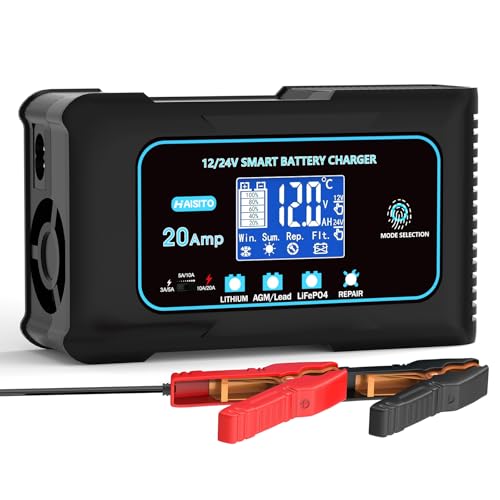
A high-output 20-amp charger for 12V/24V lithium and lead-acid batteries when charging speed is the priority.
The Haisito 20-Amp Smart Battery Charger pushes 20 amps into 12V systems and 10 amps into 24V , a pace the listing puts at up to 200% faster than typical 8A or 10A chargers.
It handles lithium LiFePO4 and lead-acid chemistries through three independent modes, with automatic 12V/24V detection and a forced charging mode for stubborn low-voltage 24V batteries. The LCD shows current, voltage, temperature, and battery percentage in real time, and a pulse repair mode rounds out the maintenance features.
This is the pick for large SUVs, pickups, and farm tractors where waiting hours for a charge isn’t practical, and the dedicated lithium algorithm matters if you’ve invested in LiFePO4.
The constraints are the usual ones , it can’t activate a battery sitting at 0V, it’s not a jump starter, and it’s tethered to a wall outlet. If speed is what you’re buying, this delivers it; just confirm your battery chemistry is on its list first.
|
8
|
EBL LCD Battery Charger Smart Individual 907 AA AAA Rechargeable Battery Charger for Ni-MH |

A four-slot NiMH/NiCd charger for AA and AAA cells with per-slot monitoring , the straightforward swap for disposable carbon zinc AAs.
The EBL LCD Battery Charger 907 charges up to four NiMH or NiCd AA and AAA batteries, each slot working independently so you’re never forced to charge in pairs.
The LCD tracks progress per slot, the battery icon stops flashing at full, and an error indicator flags batteries that are installed wrong or damaged beyond rescue.
Under the hood, advanced MCU control with a minus-delta-V cutoff provides overheat, overcurrent, and short-circuit protection, and a trickle mode tops cells off to full capacity once the main charge finishes.
Households converting their remotes, clocks, and small toys to rechargeable AA and AAA cells are exactly who this is for. Independent slots sound like a small feature but matter in practice , one battery can finish while three keep charging.
It’s limited to NiMH and NiCd, won’t handle lithium or lead-acid, and doesn’t include batteries, so budget for a set of cells alongside it. As a starting point for ditching disposables, it’s about as simple as it gets.
|
9
|
EBL LCD 8 Bay Battery Charger, AA AAA C D Rechargeable Battery Charger for Rechargeable Ba |

An eight-bay charger for AA, AAA, C, and D NiMH cells , the one to consider if bigger devices still run on carbon zinc D batteries.
The EBL LCD 8 Bay Battery Charger handles eight AA or AAA cells at once, or four C or D batteries, with every channel charging independently so you can mix sizes and quantities freely. The LCD shows status per bay and flags damaged or incorrectly seated cells.
A battery repair function tries to recover underperforming NiMH cells, and charging automatically shifts to trickle as batteries near full. Power comes in over a Type-C port rated 5V/2A, though the adapter itself isn’t in the box.
Flashlights, portable radios, and other C-and-D-cell devices are where this earns its space , those are exactly the formats carbon zinc still dominates, and switching them to rechargeable NiMH pays off fastest.
The caveats: you may need to supply your own 2A adapter, flat-top cells aren’t supported, and lithium is out of scope. For a household burning through D batteries, I’d shortlist this over a standard four-bay unit.
|
10
|
ZIMISI 12V 1300mA Sealed Lead Acid (SLA) Battery Charger, Automatic Trickle Charger Mainta |

A two-pack of simple 12V SLA trickle chargers , bare-bones maintenance for sealed lead-acid batteries in motorcycles and backup systems.
The ZIMISI 12V 1300mA charger arrives as a two-pack of automatic trickle chargers for 12V sealed lead-acid batteries , the kind found in motorcycles, ATVs, ride-on toys, and emergency power supplies.
The integrated circuit quickly detects short circuits, overcurrent, and overvoltage, and LED indicators switch from red (charging) to green (full). The flame-retardant housing is built to resist heat, wear, and corrosion. Operation is as basic as it gets: red pin to positive, black to negative, plug it in.
These suit smaller SLA batteries rather than car-sized ones , at 1300mA, a large automotive battery would take a very long time, so I’d treat these as maintainers, not fast chargers. The two-pack is the practical part: one for the garage, one for the shed, or one as a spare.
They only do 12V sealed lead-acid, so no lithium or NiMH. For keeping a motorcycle or backup battery topped off through storage season, they’re an inexpensive, no-drama option.
To be clear about the core question: none of these chargers will recharge a carbon zinc battery, because that chemistry has no recharge cycle to return to. What they offer is an exit route.
Pick a four-bay NiMH charger for the AA and AAA cells in your remotes and clocks, or a smart maintainer if the batteries you’re tired of replacing live under a hood.
Match the charger to the battery chemistry, and the disposable habit mostly takes care of itself , fewer dead cells in the trash and less money spent replacing them.
How To Choose Between Carbon Zinc and Rechargeable Options
Recommended Products


Once you know what carbon zinc actually is, the real question becomes whether to keep buying it or switch to rechargeables. The answer depends less on price tags and more on how your devices get used , and how often you’re currently swapping cells.
Carbon zinc is cheap at the register and expensive over time in anything that drains quickly. A wall clock can run a year on one set; a power-hungry toy can flatten them in days.
Rechargeable NiMH cells cost more up front but survive hundreds of cycles, which usually puts the break-even point just a few recharges in. There’s one place carbon zinc still makes sense: devices that sit idle for months, where its slow self-discharge is a genuine advantage.
For anything used daily, rechargeables win on both cost and waste, and lead-acid follows the same logic for vehicles and backup power. My rule of thumb would be to match the battery to the usage pattern, not the sticker price.
Cost and Waste Comparison Over One Year
| Scenario | Carbon Zinc | Rechargeable NiMH |
|---|---|---|
| Upfront cost | Low per pack | Higher per pack + charger |
| Recharges possible | None | 500-1000 cycles |
| Yearly cost for daily device | High | Low after first month |
| Waste generated | Many dead cells | Minimal after initial buy |
| Best for | Low-drain, rarely used | High-drain, daily use |
- If the device runs for over a year on one set, stick with carbon zinc.
- If you replace batteries monthly or more, switch to rechargeable NiMH.
- If the device is for emergencies, carbon zinc’s shelf life is a plus.
- If you want to reduce waste, rechargeables are the clear winner.
- If you need consistent voltage, alkaline or lithium outperform carbon zinc.
Storing and Disposing of Carbon Zinc Batteries Responsibly
Carbon zinc batteries last longer on the shelf than most people assume, but storage conditions matter , and disposal isn’t as simple as the kitchen trash everywhere. Here’s how to handle both ends of the lifecycle.
Store them cool and dry , somewhere in the 50 to 77 degrees Fahrenheit range is the commonly cited window , since heat speeds up self-discharge and raises the leak risk.
Keep cells in their original packaging rather than loose in a drawer, where keys and coins can bridge the terminals and short them; a plastic battery organizer solves this cheaply.
On disposal, rules vary: many municipalities allow carbon zinc in regular trash because it contains no mercury, but some require hazardous waste collection, so it’s worth a quick call to your waste management provider if you’re unsure. Never burn or puncture them.
And if you spot white crust on a cell, treat it as leaking , gloves on, and clean the device contacts with vinegar on a cotton swab.
Designate a cool, dry drawer or bin for spare batteries, away from direct sunlight.
Keep batteries in original packaging or a plastic organizer to prevent terminal contact.
Check stored batteries every six months and remove any that show signs of leakage.
Test batteries with a multimeter before use to confirm they still hold voltage.
Dispose of dead carbon zinc batteries according to your local waste rules.
Consider switching frequently used devices to rechargeable batteries to cut waste.
A carbon zinc battery is the budget cell of the battery world: fine for clocks, remotes, and other low-drain devices, and out of its depth anywhere else.
It can’t be recharged, and no charger on this list pretends otherwise , what they do is make the switch to rechargeables painless, whether that’s a set of NiMH AAs or a maintained lead-acid battery.
If you’re replacing carbon zinc cells every few weeks, picking up a smart charger and a pack of rechargeables will cut both your spending and your waste almost immediately. For the gadgets that barely sip power, a pack of carbon zinc on the shelf still earns its keep.

- 10 Best Battery For Generator Ev Battery Bank Marine 2026 - October 27, 2026
- 10 Best Battery For Generator Ev Battery Bank Lto 2026 - October 27, 2026
- 10 Best Battery For Generator Ev Battery Bank Low Voltage 2026 - October 27, 2026