What Is Domestic Battery 3rd Degree?
Facing a domestic battery charge, especially one as serious as a third-degree offense, can leave you feeling overwhelmed, not just legally but practically. Beyond the courtroom, understanding how to properly maintain your batteries can prevent similar situations from arising in the first place.
This guide breaks down what a third-degree domestic battery charge entails, why it happens, and how smart charging solutions can help you avoid battery-related issues entirely.
We’ve also rounded up some of the best marine battery chargers on the market, designed to keep your batteries healthy and your peace of mind intact.
Understanding Domestic Battery 3rd Degree
Recommended Products

A third-degree domestic battery charge isn’t just about physical harm, it often stems from a deeper issue: improper battery handling. Whether it’s leaving a charger connected too long, using the wrong type of charger, or ignoring warning signs like overheating, these mistakes can escalate quickly.
In legal terms, it’s a serious offense, but in practical terms, it’s a wake-up call to take battery care more seriously. Let’s explore what goes wrong and how to avoid it.
When a battery reaches a third-degree charge scenario, it’s usually a sign that something went critically wrong during charging. This could mean the battery was left plugged in for days, exposed to extreme temperatures, or connected to an incompatible charger that overworked its cells. The results?
Reduced capacity, potential leaks, and in worst cases, safety hazards like fires or explosions. My read is that most of these issues aren’t intentional, they’re the result of overlooking basic maintenance or assuming a charger will ‘just work’ without supervision. The good news?
High-quality chargers with smart features can catch these problems before they spiral out of control.
- Battery swelling or distortion
- Excessive heat or burning smell
- Leaking or corrosion around the battery
- Reduced battery performance and lifespan
- Increased risk of fire or explosion
Top Marine Battery Chargers
To steer clear of battery-related headaches, both legally and mechanically, I would shortlist chargers that go beyond basic functionality. Look for models with built-in diagnostics, automatic repair modes, and the ability to handle different battery types independently. These aren’t just tools; they’re safeguards.
Here are six top-tier marine battery chargers that prioritize safety, precision, and adaptability to keep your batteries (and your peace of mind) in check.
|
1
|
3 Bank Marine Battery Charger 5X3 15A (5A/Bank) – 12V Boat Charger | Charges 3 Batteries a |

The 3 Bank Marine Battery Charger 5X3 15A stands out for its hands-off approach to charging. With three independent banks, it can tackle up to three 12V batteries at once, whether they’re marine, deep-cycle, or lithium, while automatically adjusting for issues like overvoltage or bad connections. The IP68 waterproof rating means it’s built to handle the salt, spray, and rough conditions of marine environments without flinching.
If you’re juggling multiple batteries, say, for a boat, RV, or off-grid setup, this charger is a game-changer. It’s designed to charge three 12V batteries simultaneously, each on its own schedule, thanks to selectable modes for lead-acid, AGM, or lithium types.
The auto repair mode is a standout: if a battery’s health is flagging, the charger steps in to revive it without you lifting a finger. It’s also fully waterproof, so you can leave it onboard without worrying about moisture or corrosion.
I’d recommend this charger for anyone who needs reliability without the fuss. It’s less about raw power and more about precision and protection, making it ideal for regular use rather than heavy-duty industrial applications.
That said, if you’re dealing with extremely high-capacity batteries, you might want to pair it with a more robust system.
|
2
|
NOCO GEN5X3 12V 15A 3-Bank OnBoard Marine Battery Charger & Maintainer | Charges 3 Batteri |
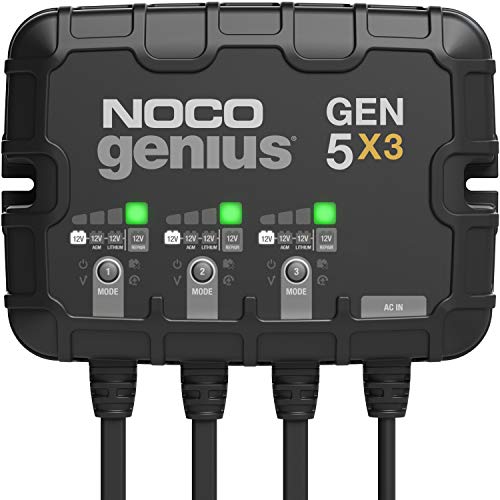
The NOCO GEN5X3 is a compact powerhouse, cramming advanced features into a space-saving design. Its three independent banks let you charge different battery types at once, and the selectable modes ensure each gets the right treatment, whether it’s a flooded lead-acid, AGM, or lithium battery. The charger’s diagnostics are another strong suit, alerting you to issues like overvoltage or reverse connections before they become problems.
NOCO’s GEN5X3 is all about efficiency and adaptability. It’s 37% smaller than its predecessor but packs in more power, making it a great fit for tight spaces like cabins or under-seat storage.
The three-bank setup means you can charge a starter battery, a deep-cycle battery, and a lithium battery all at the same time, each on its own optimized cycle. It’s also IP68 rated, so saltwater, rain, or splashes won’t phase it.
This charger shines for users who value space and smart technology. It’s not the heaviest-duty option out there, so I’d steer clear if you’re working with industrial-sized batteries. But for most marine, RV, or backup power setups, it’s a no-brainer for keeping batteries topped up safely and efficiently.
|
3
|
CXRCY 3 Bank Marine Battery Charger & Maintainer 12V 10X3 30A (10A/Bank) | Charges 3 batte |

The CXRCY 3 Bank Marine Battery Charger 10X3 30A takes a data-driven approach to charging, using nine distinct stages to tailor the process to your battery’s needs. Its advanced diagnostics and auto repair mode make it a proactive choice, stepping in to fix issues like sulfation or deep discharge before they worsen. The 10A per bank output gives it a solid punch for most applications, while the IP68 rating ensures it’s up to the task in wet or dusty environments.
This charger is built for users who want intelligence in their charging process. The nine-stage smart charging adjusts current and voltage based on the battery type and condition, while the auto repair mode can breathe new life into a weakened battery.
It’s also fully waterproof, so you can use it on deck, in a garage, or even submerged without worry. The three independent banks mean you can charge a mix of lead-acid, AGM, and lithium batteries at once, each getting the right treatment.
I’d prioritize this charger if you’re after a balance of power and precision. It’s not the most compact option, so if space is a premium, you might want to look elsewhere.
But for most marine or off-grid setups, its smart features and robust diagnostics make it a standout for long-term battery health.
|
4
|
3 Bank Marine Battery Charger 10X3, 30A(10A/Bank)- 12V Boat Battery Charger | Charges 3 Ba |
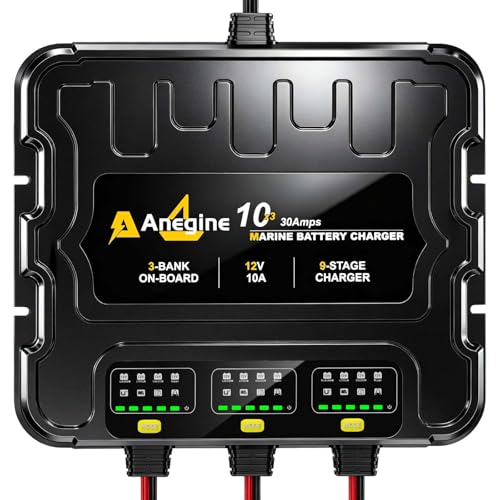
With a 30A total output and 10A per bank, the 3 Bank Marine Battery Charger 10X3 is built for users who need serious charging power without sacrificing safety. Its nine-stage smart charging ensures batteries get the right treatment, while the auto repair mode can revive deeply discharged cells. The IP68 waterproof rating means it’s ready for the harshest marine conditions, and the independent bank control lets you tailor charging to each battery’s specific needs.
This charger is a heavyweight in the marine battery space, delivering up to 30A of power across three banks. It’s designed to handle everything from starter batteries to deep-cycle marine batteries, with smart charging that adapts to the battery type and condition.
The auto repair mode is a lifesaver for batteries that have been left discharged for too long, and the IP68 rating means it’s built to last in saltwater, rain, or even submerged conditions.
I’d recommend this for anyone who needs raw power combined with smart features. It’s not the most compact charger, so if you’re working in a tight space, you might prefer a more streamlined model.
But for most marine, RV, or industrial applications, its combination of output and intelligence makes it a top contender.
|
5
|
NOCO GENPRO10X3 12V 30A 3-Bank OnBoard Marine Battery Charger & Maintainer | Charges 3 Bat |
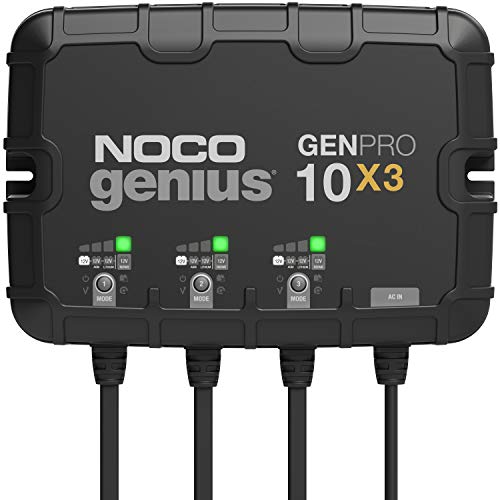
NOCO’s GENPRO10X3 is a refined take on the classic marine battery charger, offering 30A of total power across three independent banks. Its compact design belies its capabilities, with selectable modes for lead-acid, AGM, and lithium batteries, plus an auto repair function to revive weakened cells. The charger’s diagnostics are thorough, flagging issues like overvoltage or reverse connections before they cause damage.
NOCO’s GENPRO10X3 is all about efficiency in a small package. It’s 27% smaller than its predecessor but delivers 33% more power, making it a great fit for boats, RVs, or off-grid setups where space is limited.
The three-bank system lets you charge up to three 12V batteries at once, each on its own optimized cycle. It’s also IP68 rated, so it can handle the toughest marine environments without skipping a beat.
This charger is ideal for users who need power and precision in a compact form. It’s not the most heavy-duty option, so if you’re dealing with extremely large batteries, you might want to look elsewhere.
But for most marine or recreational applications, its balance of performance and portability makes it a smart choice.
|
6
|
3 Bank Marine Battery Charger 10X3 30A (10A/Bank) – 12V Boat Charger | Charges 3 Batteries |

The 3 Bank Marine Battery Charger 10X3 30A is a versatile workhorse, offering 10A per bank across three independent channels. Its nine-stage smart charging ensures batteries get the right treatment, while the auto repair mode can revive even deeply discharged cells. The IP68 waterproof rating means it’s built to handle the salt, spray, and humidity of marine environments without issue.
This charger is designed for users who need reliability and adaptability. With three independent banks, it can charge up to three 12V batteries at once, whether they’re marine, deep-cycle, or lithium, each on its own optimized cycle.
The nine-stage smart charging adjusts the process based on the battery type and condition, while the auto repair mode steps in to fix issues like sulfation or deep discharge. It’s also fully waterproof, so you can use it onboard without worrying about moisture or corrosion.
I’d shortlist this charger for anyone who values a mix of power and smart features. It’s not the most compact option, so if space is a concern, you might want to consider a more streamlined model.
But for most marine, RV, or backup power setups, its combination of output and intelligence makes it a solid pick for long-term battery care.
These chargers aren’t just about getting the job done, they’re about doing it *safely* and *smartly*.
From auto repair modes that revive weakened batteries to diagnostics that catch issues before they escalate, each of these models is designed to protect your investment and prevent the kind of battery failures that can lead to bigger problems.
If you’re serious about maintaining your batteries (and avoiding unwanted attention from the law), these are the tools to trust.
How to Maintain Your Marine Batteries
Preventing a third-degree battery charge starts with basic but critical maintenance. It’s not just about plugging in a charger and walking away, it’s about paying attention to the details that keep your batteries healthy and your setup safe. Here’s how to keep your batteries in top shape and avoid common pitfalls.
First, I would check the battery terminals regularly for corrosion. A quick wipe-down with a baking soda and water solution can work wonders to keep connections clean and efficient. Beyond that, storage matters: keep batteries in a cool, dry place, away from direct sunlight or heat sources.
Extreme temperatures are a battery’s worst enemy, accelerating wear and increasing the risk of overcharging. If you’re storing batteries long-term, consider disconnecting them or using a trickle charger to maintain their charge without overworking them.
- Regularly check and clean battery terminals
- Store batteries in a cool, dry place
- Avoid overcharging and undercharging
- Use high-quality chargers with advanced features
- Monitor battery performance and replace when necessary
Troubleshooting Common Battery Issues
Even with the best charger and maintenance routine, batteries can still act up. If you notice a battery struggling, like slow cranking, reduced runtime, or swelling, it’s time to troubleshoot. Here’s how to diagnose and fix common issues before they become serious.
A battery that’s losing performance might be suffering from sulfation, where lead sulfate crystals build up on the plates over time. This often happens when a battery is left undercharged or exposed to high temperatures.
If you suspect sulfation, I would try using a charger with a dedicated repair mode or a battery desulfator. These tools can help break down the crystals and restore the battery’s capacity. For more severe cases, it might be time to replace the battery, some damage just isn’t reversible.
- Check for signs of sulfation and corrosion
- Use a battery desulfator or charger with repair mode
- Monitor battery performance and replace when necessary
- Ensure proper charging practices and storage conditions
- Consult a professional if you’re unsure about the issue
A third-degree domestic battery charge is a serious issue, but the root cause often boils down to neglect, not malice. The good news? High-quality chargers with smart features can act as your first line of defense, catching problems early and keeping your batteries in safe operating condition.
Pair that with regular maintenance, and you’ll not only extend the life of your batteries but also avoid the headaches (and legal troubles) that come with poor battery care.
If you’re in the market for a charger, prioritize models with diagnostics, auto repair, and independent bank control, they’re the best tools for keeping your batteries (and your peace of mind) in check.

- 10 Best Battery For Generator Ev Battery Bank Marine 2026 - October 27, 2026
- 10 Best Battery For Generator Ev Battery Bank Lto 2026 - October 27, 2026
- 10 Best Battery For Generator Ev Battery Bank Low Voltage 2026 - October 27, 2026