Checking Battery Health: Capacity, Starting Power and Testers
There’s nothing quite like turning the key and hearing a slow, defeated click. Guessing whether your battery is dying or your alternator is on its way out usually ends with buying parts you don’t need.
I always suggest testing battery health early because it reveals weak cells, charging system flaws, or alternator strain long before you’re stuck in a parking lot. The right tester turns vague electrical gremlins into a clear next step: recharge, replace, or look elsewhere.
Below, I’ll walk through why batteries quietly fail and which devices actually diagnose the problem.
Why Batteries Fail Without Warning
Batteries don’t just die overnight. They degrade silently through chemical breakdown, sulfation, and internal resistance buildup. Temperature swings, deep discharges, and plain old age speed up that decay. A tester quantifies these hidden issues so you aren’t caught off guard when your car refuses to start.
Lead-acid batteries lose capacity as sulfur crystals form on the plates, shrinking the active surface area. Cold cranking amps (CCA) drop, and internal resistance climbs, meaning the battery struggles under load. AGM and gel variants resist this longer, but they still degrade eventually.
A good tester measures CCA, voltage, and resistance to spot these changes early. Without testing, my read is that you’re just assuming the battery is fine until it fails to deliver enough current on a freezing morning.
- Engine cranks slowly, especially in cold weather
- Headlights dim noticeably when idling or starting
- Battery is over three years old and untested
- Electrical accessories drain power faster than usual
- Dashboard warning lights flicker or stay illuminated
- Vehicle sits unused for weeks, accelerating self-discharge
What a Battery Test Actually Measures
A proper test checks more than just resting voltage. It evaluates the battery’s ability to deliver and sustain current under real-world stress. These metrics reveal whether the actual issue lies in the battery, the alternator, or the starter.
| Metric | What It Reveals | Healthy Range |
|---|---|---|
| State of Health (SOH) | Remaining capacity vs. original design | 80-100% |
| State of Charge (SOC) | Current charge level | 70-100% |
| Cold Cranking Amps (CCA) | Starting power in cold conditions | Meets or exceeds rated CCA |
| Internal Resistance | Ease of current flow; high = degradation | Low and stable |
| Voltage | Electrical potential; low = discharge or failure | 12.6V (fully charged) |
| Cranking Test | Starter motor performance under load | Voltage drop within spec |
| Charging Test | Alternator output and rectifier function | 13.8-14.4V at idle |
State of Health (SOH) and State of Charge (SOC) are distinct but related. SOH reflects long-term capacity loss, while SOC is just a snapshot of current energy. CCA testing simulates winter starts, exposing weak cells that a simple voltage reading will miss entirely.
Internal resistance rises as plates corrode, and high readings often precede total failure. I would shortlist any tester that measures all four, plus cranking and charging, because it gives you the full picture. Otherwise, you might replace a perfectly good battery or completely overlook a failing alternator.
Tools to Diagnose Battery Health Accurately
These testers translate hidden battery issues into actionable data. They measure CCA, voltage, resistance, and overall system health so you can decide whether to recharge, replace, or dig deeper into the charging system. Each one excels in different scenarios, from quick home garage checks to professional diagnostics.
|
1
|
ANCEL BA101 Car Battery Tester, 12V Digital Automotive Alternator Meter Diagnostic Tool,10 |

Featured in Project Farm videos, it catches issues early with SOH, SOC, and CCA readings for 12V systems.
The ANCEL BA101 is a 12V digital tester designed for cars, trucks, boats, and RVs. It measures State of Health, State of Charge, voltage, current, and CCA, giving you a full diagnostic in seconds.
High-quality copper clips and a smart chip ensure accurate results, provided you enter the correct battery type and rating. I appreciate that the backlit screen remains readable whether you’re working in bright sunlight or a dim garage, and built-in protection guards against common mistakes like reverse polarity.
I would point DIY users who want to avoid unexpected breakdowns toward this model. It works with flooded, AGM, GEL, and EFB batteries. Keep in mind it lacks lithium support and requires precise input for accurate readings, which might frustrate absolute beginners.
The durable ABS housing holds up well in typical garage conditions, but its 12V-only limitation means it won’t test motorcycles or 24V systems unless you step up to the Plus or PRO versions.
|
2
|
TOPDON BT100 12V Car Battery Tester, Automotive Battery Load Tester | 100-2000 CCA Auto Ba |

Delivers SOH, SOC, and CCA for 12V lead-acid batteries with a simple, menu-driven interface and LED indicators.
The TOPDON BT100 tests 12V batteries in cars, trucks, motorcycles, and boats, offering SOH, SOC, voltage, and CCA data. Its passive testing approach powers the device only when properly connected, which I think is a smart safety feature.
The three-color LED system quickly signals battery health, and copper clamps help prevent sparks. Compact enough to toss in a glove box, it supports flooded, AGM, EFB, and GEL batteries without needing an internal charge.
This tester is what I’d grab for quick, no-fuss checks before a road trip or during routine maintenance. It does lack 24V support and advanced features like alternator diagnostics, which limits its appeal for professional mechanics.
The menu system is intuitive, though the small screen can be tough to read in direct sunlight if you don’t have the backlight angled just right.
|
3
|
KINGBOLEN BM550 6V 12V 24V Car Battery Tester,Auto Battery Analyzer | 100-2000 CCA BM550 B |

Tests 6V, 12V, and 24V systems with SOH, SOC, and internal resistance for a broad range of vehicles.
The KINGBOLEN BM550 covers 6V, 12V, and 24V batteries from 100 to 2000 CCA, making it unusually versatile for everything from standard cars to heavy-duty trucks and boats. It displays SOH, SOC, CCA, and internal resistance on a 1. 8-inch HD screen, and works both in-vehicle and out-of-vehicle.
Reverse connection protection prevents damage from miswired clips, and its plug-and-play design means you never have to hunt for a charger for the tool itself.
My read is that this tester fits users managing mixed fleets or smaller engines like ATVs and lawnmowers. It doesn’t support lithium batteries or deep-cycle types, and the screen may flicker if the clips aren’t firmly seated.
The simplicity is a genuine plus for beginners, but advanced users might find themselves missing dedicated alternator testing features.
|
4
|
TOPDON BT200 Car Battery Tester, 12V/24V, 100-2000 CCA Load Tester | Battery and Alternato |

Upgraded from BT100, it adds 24V support, a color screen, and extreme-temperature reliability for professional diagnostics.
The TOPDON BT200 is a 12V/24V tester built for lab-grade accuracy across flooded, AGM, GEL, and deep-cycle batteries. It performs cranking and charging system tests, paired with a 2. 4-inch color LCD that handles sunlight better than most.
The rugged housing includes a memory function to recall your last test, and it operates reliably in temperatures ranging from -4°F to 140°F. Copper clamps keep connections secure even on corroded terminals.
I would shortlist this model for mechanics and serious DIYers who need consistent results in harsh environments. It’s bulkier than the BT100, and the color screen naturally draws more power, though the device pulls directly from the battery being tested.
The lack of 6V support might disappoint some motorcycle owners, but its 24V capability and physical durability make it a strong fit for trucks and RVs.
|
5
|
MOTOPOWER MP0515A 12V Car Battery Tester Automotive 100-2000 CCA Battery Load Tester Auto |

Provides real-time wave display and data printing for detailed alternator and battery analysis in 12V systems.
The MOTOPOWER MP0515A tests 12V batteries from 100 to 2000 CCA, delivering SOH, SOC, internal resistance, and alternator diagnostics. Its 3-inch color LCD supports nine languages, and the wave display function lets you monitor output curves in real time, a detail I rarely see at this level.
Data can be printed for records, which is incredibly useful for workshop documentation. It also runs standard cranking and charging system checks.
This is what I’d recommend for users who want detailed insights and paper trails. The printing feature stands out for professionals, though the lack of 24V or 6V support limits its reach.
The large screen is easy to read, but the unit is slightly bulkier than pocket-sized testers, making it less convenient if you’re constantly moving between bays.
|
6
|
KONNWEI KW208 12V Car Battery Tester, Battery Load Tester Automotive 12V Alternator Starte |

Budget-friendly with 99.7% accuracy, galvanized alloy clips, and alternator/starter testing for 12V systems.
The KONNWEI KW208 is a cost-effective 12V tester that leans on a smart AI chip for high accuracy. It tests voltage, internal resistance, CCA, and AH capacity, while including cranking and charging system diagnostics. Galvanized alloy clips improve both durability and contact area, and the tester supports eight languages.
It functions in-vehicle, out-of-vehicle, and even on dead batteries, which saves a lot of hassle.
I’d point budget-conscious users here if they still want professional-grade features. The fully wrapped clips add a layer of safety, but the device strictly handles 12V systems, skipping 24V or 6V entirely.
Its speed and accuracy explain its popularity, though the absence of a color screen might feel dated to some buyers.
|
7
|
Acclope BT60 PRO 2-120Ah Battery Tester 6V/12V/24V 100-3000 CCA QR Report | Tests Regular/ |
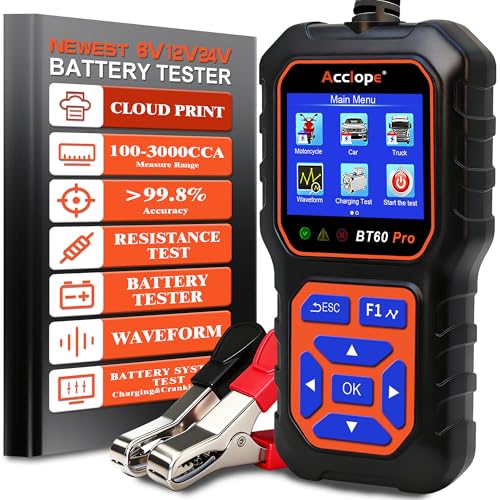
Supports 6V/12V/24V and lithium batteries with QR code reports and advanced conductance technology.
The Acclope BT60 PRO handles 6V, 12V, and 24V batteries, including lead-acid and lithium (LiFePO4 for voltage and health checks). It measures SOH, SOC, voltage, resistance, and CCA using advanced conductance algorithms. A unique QR code feature allows cloud printing and sharing of results without needing a dedicated app.
The dedicated 6V mode is particularly handy for motorcycles and vintage equipment.
This is my top pick for professionals who test a wide variety of batteries and need to share results digitally. While it supports lithium voltage and health checks, CCA accuracy for LiFePO4 isn’t guaranteed, so keep that in mind.
The QR printing is a standout workflow addition, but the higher price tag makes it less practical for someone who just wants to check their sedan once a year.
|
8
|
Car Battery Tester 6V 12V 24V Battery Voltage Tester, BR502 100-2000 CCA Internal Resistan |

Tests 6V/12V/24V batteries with 99.6% accuracy and a simple plug-and-play design for beginners.
The BR502 is a straightforward tester for 6V, 12V, and 24V batteries ranging from 100 to 2000 CCA. It displays SOH, SOC, CCA, internal resistance, and voltage on a 1. 8-inch HD screen. Reverse polarity protection prevents accidental damage, and the device works on in-vehicle, out-of-vehicle, and dead batteries.
Results typically appear in about two seconds with 99. 6% claimed accuracy.
I would hand this to anyone who wants a no-frills, highly accurate tool without wading through complex menus. It skips advanced features like alternator testing or data printing, and the compact screen might require reading glasses for some.
That said, the speed and simplicity make it a reliable entry-level choice, even if seasoned pros might outgrow it quickly.
|
9
|
FOXWELL BT705 Car Battery Tester 24V 12V, Alternator and Load Tester | 100-2000CCA High-Ac |
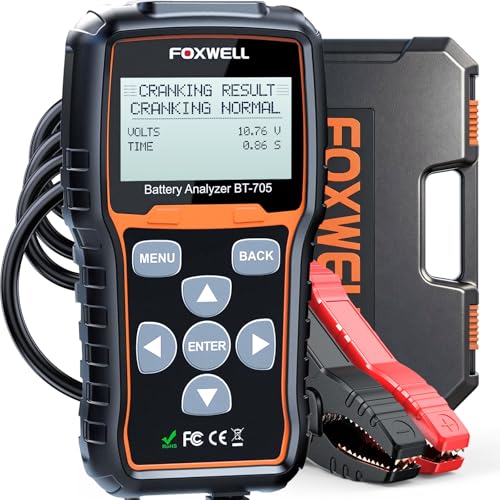
Featured in Project Farm’s 2026 tests, it offers guided prompts, one-person testing, and 12V/24V coverage with a long cable.
The FOXWELL BT705 is a 12V/24V tester measuring CCA, voltage, internal resistance, and SOH. What I really like is the guided prompts for battery, cranking, and charging tests, which summarize results clearly as GOOD, RECHARGE, or REPLACE. The 5. 9-foot cable allows one-person testing straight from the driver’s seat.
A protective case and durable clamps round out the package, supporting flooded, AGM, GEL, and EFB batteries.
This tester is ideal for users who want clear, actionable answers without interpreting raw electrical data. That long cable is a massive convenience for solo testing, though the lack of 6V support rules out smaller engines.
Its rugged build suits frequent use in busy garages, and the guided interface significantly reduces user error, making it approachable for first-timers.
|
10
|
ANCEL BT410 12V 24V Car Battery Tester for Lead-Acid & Lithium Batteries, 100-2000 CCA Aut |

Tests 12V/24V lead-acid and lithium batteries with QR reports, cranking/charging diagnostics, and 99.9% accuracy.
The ANCEL BT410 supports 12V and 24V lead-acid (AGM, GEL, flooded, EFB) alongside lithium-ion batteries. It measures SOC, SOH, voltage, and internal resistance, delivering plain-language results like GOOD BATTERY or REPLACE BATTERY. Cranking and charging system diagnostics pinpoint whether the fault lies with the starter or the alternator. The 2.
4-inch color TFT screen adjusts for day or night use, and QR reports simplify record-keeping.
I would shortlist this for users juggling mixed battery chemistries, especially those incorporating lithium. The QR report feature is excellent for tracking fleet health or sharing findings with customers, but the lack of 6V support limits its use for motorcycles.
The high accuracy and color display justify its premium positioning, though the price reflects those advanced capabilities.
These testers range from simple plug-and-play units to professional-grade tools packed with advanced diagnostics. Each approaches battery health differently, whether through CCA, SOH, or broader system tests.
My read is that the right pick depends entirely on the vehicles you maintain, the battery chemistries you encounter, and whether you need extras like data sharing or extreme-temperature reliability.
How to Test a Battery Correctly Every Time
Even the best tester gives bad data if used incorrectly. I always recommend following a few basic steps to ensure accurate results and avoid misdiagnosing a healthy battery or missing a failing one.
Park the vehicle on a flat surface, turn off the engine, and remove all electrical loads like headlights or the radio.
Clean the battery terminals with a wire brush to ensure a solid connection and prevent resistance errors.
Connect the tester’s red clamp to the positive terminal and the black clamp to the negative terminal.
Enter the battery type (flooded, AGM, etc.), rated CCA, and temperature as shown on the battery label.
Start the test and wait for the results; most testers display SOH, SOC, and CCA within seconds.
For cranking tests, start the engine while the tester is connected to monitor voltage drop and starter performance.
- Testing a battery immediately after charging; wait at least an hour for a stable reading
- Ignoring temperature corrections; cold batteries perform worse than warm ones
- Using the wrong battery type setting; AGM and flooded have different internal resistances
- Testing a battery that’s not fully charged; SOC affects SOH readings
- Disconnecting clamps during testing; this can cause arcing or inaccurate results
- Assuming a good voltage means a good battery; CCA and resistance tests are critical
When to Replace vs. Recharge a Battery
Test results guide your next move, but interpreting them correctly is what actually saves money and hassle. These thresholds help you decide whether to recharge, replace, or investigate further.
| Metric | Recharge | Replace |
|---|---|---|
| SOH | 80-100% | Below 80% |
| SOC | Below 70% | N/A |
| CCA | Meets rated CCA | Below 80% of rated CCA |
| Internal Resistance | Stable and low | Rising or above spec |
| Voltage (Engine Off) | 12.4-12.6V | Below 12.2V |
| Cranking Test | Voltage drop within spec | Excessive drop or slow crank |
| Charging Test | 13.8-14.4V at idle | Below 13.5V or above 14.8V |
A battery with SOH below 80% has lost significant capacity and will likely struggle in cold weather. If CCA falls below 80% of the rated value, it simply can’t deliver the current needed to crank the engine reliably.
High internal resistance often signals plate sulfation or corrosion, which won’t magically fix itself with a recharge. If the charging test shows low voltage, the alternator may be failing, not the battery.
I would always retest after a full charge if the SOC is low, because a deeply discharged battery can skew SOH results.
Maintaining Battery Health Between Tests
Regular testing catches problems early, but good habits extend battery life. These practices reduce the risk of premature failure and keep your electrical system running smoothly.
- Drive the vehicle regularly to keep the battery charged and prevent sulfation
- Clean corrosion from terminals every few months to maintain good connections
- Use a battery maintainer if the vehicle sits unused for weeks
- Avoid deep discharges; recharge before the battery drops below 20% SOC
- Park in a garage or shaded area to reduce temperature extremes
- Leaving lights or accessories on when the engine is off
- Ignoring early signs of weakness like slow cranking or dim lights
- Using tap water to top off lead-acid batteries; use distilled water only
- Jump-starting a frozen battery; thaw it first to prevent explosions
- Mixing battery types in a system (e.g., AGM with flooded)
Testing battery health is the only reliable way to know if your vehicle will start tomorrow or leave you stranded. Pick a tester that matches your specific vehicles, then run a full diagnostic today.
If the results show SOH below 80% or CCA under spec, my advice is to replace the battery now rather than waiting for it to fail you on a freezing morning.

- Marine Chargers and Backup Batteries: 9 Options Compared (2026) - October 27, 2026
- LTO Cells vs. SLA Generator Batteries: 5 Options Compared (2026) - October 27, 2026
- 12V/24V Backup Batteries and the EcoFlow DELTA Pro 3 (2026) - October 27, 2026