Battery Voltmeter Testing: Resting Voltage and Test Setup
You twist the key and hear that sluggish crank, same sound that makes you wonder if the battery is about to die. Instead of guessing, a voltage tester gives you a clear answer in minutes. The catch? You need to know what the numbers actually mean.
This guide breaks down how to test a battery properly, what the readings reveal, and which testers turn vague suspicions into a definite yes or no. Think of it as translating battery speak into plain English, so you can act before you’re stranded somewhere you don’t want to be.
What Your Voltmeter Reading Actually Means
A voltmeter doesn’t just show a number, it tells a story about charge and health. But that story only makes sense if you know what to look for. Here’s how to interpret the readings before you even touch a tester.
Resting Voltage Cheat Sheet
| Reading (12V battery) | What It Means | Action |
|---|---|---|
| 12.6V or higher | Fully charged | Battery is fine |
| 12.4V | About 75% charged | Recharge soon |
| 12.2V | About 50% charged | Recharge now |
| 12.0V | About 25% charged | Charge or replace |
| Below 11.9V | Discharged | Charge and retest |
| Below 10.5V under load | Failing | Replace likely |
Voltage alone tells you state of charge, not state of health. A battery can read a perfect 12. 6 volts at rest and still fail the moment you ask it to crank an engine. That is why a good test has two parts: a resting check and a load check.
The resting check happens with the engine off and all accessories shut down. Let the battery sit for a few hours, or at least turn off the headlights and wait a minute. Then touch the probes to the terminals. If you get 12.
6 volts or higher, the battery is charged. Anything lower means it needs charging before you judge its health. A reading below 12 volts after a full charge points to a weak or dying battery.
How To Run The Test Without Guessing
The steps are simple, but small mistakes can give you a false sense of security. Follow this order, and you’ll get a reading you can actually trust. Most people skip this part, and end up buying a new battery they didn’t need.
Turn off the engine, lights, radio, and any chargers, then wait a minute for the surface charge to fade.
Set your voltmeter to DC volts, choosing the 20V range if it is a manual meter.
Touch the red probe to the positive terminal and the black probe to the negative terminal.
Read the resting voltage and compare it to the cheat sheet above before doing anything else.
Start the engine and watch the reading; it should climb to 13.7 to 14.7 volts if the alternator works.
Turn on headlights and watch the reading drop; if it falls below 10.5 volts, the battery is weak.
- Testing right after driving gives a false high reading from surface charge; wait a minute.
- Touching probes to dirty terminals adds resistance; clean them with a wire brush first.
- Leaving the meter on the wrong range hides the real number; check the dial before you connect.
- Testing a battery that is still charging gives a misleading voltage; disconnect the charger.
- Ignoring a slow crank after a good reading means you missed the load test.
- Assuming a new battery is good; test it before you trust it.
A voltmeter is a starting point, not the final word. If the resting voltage looks fine but the car still struggles to start, the problem may be the alternator, a loose cable, or a battery that fails under load. That is when a dedicated battery tester earns its place.
These tools apply a load and measure how the battery behaves under stress, which is the closest thing to real-world conditions. For a quick check, a simple voltmeter works. For a confident decision about replacement, a load tester gives you the cranking and charging data a plain voltage reading cannot.
Tools That Make Testing A Battery Easy
A voltmeter is only as reliable as the tool in your hand. Some people want a quick voltage read; others want cranking amps, state of health, and alternator feedback. The ten options below cover both approaches.
Each one answers the same core question in a slightly different way, so pick the one that matches how deep you want to go.
|
1
|
ANCEL BA101 Car Battery Tester, 12V Digital Automotive Alternator Meter Diagnostic Tool,10 |

It doesn’t just read voltage, it calculates state of health, state of charge, cranking performance, and alternator output in one go.
The ANCEL BA101 is a 12V tester that goes beyond voltage to deliver state of health, state of charge, CCA, and cranking results. It earned a spot in two Project Farm videos, which speaks to its credibility among DIY testers.
The copper crocodile clips and precision smart chip are built for dependable readings, and since it runs directly from the vehicle battery, there’s no internal battery to charge. The classic black-and-white screen with adjustable contrast stays readable in bright sunlight or deep shade.
It’s a fit for anyone who wants a real diagnosis, not just a single number.
This tester works with flooded, AGM, GEL, and EFB batteries across cars, trucks, boats, and RVs over 30Ah. The limitation is compatibility: it won’t handle lithium, 6V, 8V, or 24V batteries, and it’s not designed for motorcycles under 30Ah.
If you need those, ANCEL offers Plus and PRO versions for different voltage ranges. For 12V lead-acid batteries, this is a standout choice.
|
2
|
AstroAI Digital Multimeter Tester 2000 Counts with DC AC Voltmeter and Ohm Volt Amp Meter; |
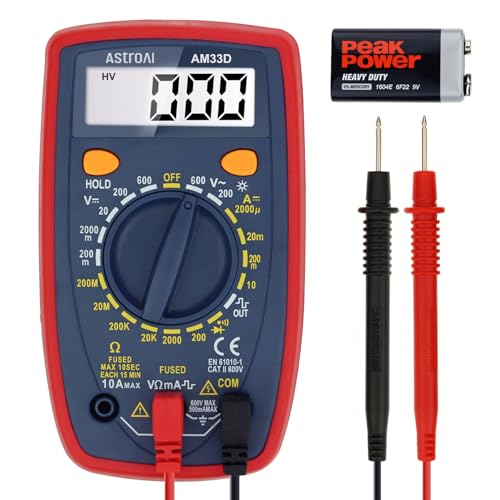
It’s a general-purpose multimeter that measures DC voltage, the exact function you need for battery testing.
The AstroAI Digital Multimeter is a 2000-count meter that handles AC and DC voltage, current, resistance, continuity, and diodes. For battery testing, the DC voltage function is the one you’ll use most. It samples twice per second and has a backlit LCD with 3. 5 digits, so readings appear fast.
The silicone cover protects it from drops, and a low battery indicator warns you before the meter dies. It runs on a 9V battery and includes test leads, making it a versatile first tool for electrical troubleshooting.
If you want one tool for both batteries and household electrical work, this is the pick. It handles vehicle batteries, outlets, fuses, and automotive circuits without needing a second device.
The limitation is that it only reads voltage, not cranking amps or state of health, so a load test is still on you. The manual warns that leads must be fully seated and the dial set correctly, or you’ll get no reading at all.
|
3
|
MOTOPOWER MP0514A 12V Digital Car Battery Tester Voltmeter and Charging System Analyzer wi |
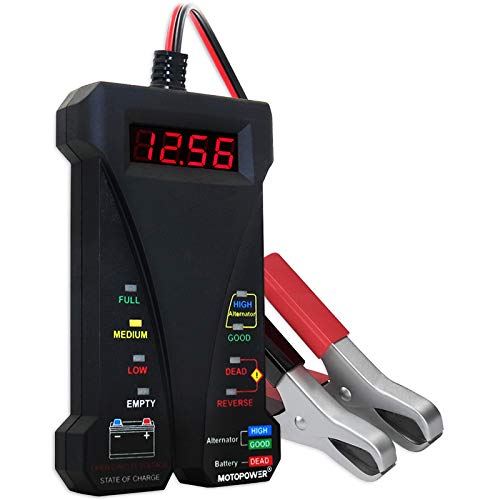
Plug it in and go, this tester reads battery and alternator status without any setup or dial switching.
The MOTOPOWER MP0514A is a 12V tester with a plug-and-test approach. Connect it to the battery, and you get a reading before starting the engine. After you start it, you get an alternator output reading. The 4-digit LCD shows voltage to 0.
01 volts, and eight colored LEDs give a quick visual verdict. A 50cm extension cable and 30A alligator clips make tight terminals easier to reach.
This is for the car owner who wants a fast answer without learning how to use a meter. Reverse connection and over-voltage protection reduce the risk of costly mistakes. The 4 to 20V DC range covers 12V batteries and many other devices.
The limitation is depth: it provides voltage and a status light, not a full state-of-health or cranking-amp analysis. For a quick yes-or-no on battery and alternator, it’s hard to beat.
|
4
|
Digital Multimeter Voltmeter Battery Voltage Multi Tester Continuity Ohm Volt Amp DC AC Cu |

A budget-friendly multimeter that covers DC voltage, continuity, and resistance for basic battery checks.
This Digital Multimeter is a 2000-count meter that measures AC and DC voltage, DC current, resistance, continuity, and diodes. The 2. 7-inch backlit LCD and data hold make readings easy to capture in dim garages.
A removable orange rubber shell adds drop protection, and a fold-out stand lets it sit upright for hands-free use. It ships with a 9V battery, test leads, and a manual, plus a two-year guarantee.
If you’re a student, home user, or car owner who wants a low-cost entry into electrical testing, this fits the bill. The audible continuity buzzer is handy for checking fuses and wires alongside battery voltage.
The limitation is build quality: at this price, the leads and housing are basic, and accuracy is fine for troubleshooting but not lab-grade. For occasional battery and circuit checks, it covers the job.
|
5
|
TOPDON BT100 12V Car Battery Tester, Automotive Battery Load Tester | 100-2000 CCA Auto Ba |

Three testing modes, battery health, cranking power, and charging system, delivered in one compact unit.
The TOPDON BT100 is a 12V battery load tester that reports state of health, state of charge, voltage, current, and rating. It runs three tests: battery health, cranking, and charging system. The passive testing approach means it powers on only when properly attached, which is a safety plus.
Copper clamps with reverse-polarity prevention and spark-proof design keep connections secure. It supports 100 to 2000 CCA across flooded, AGM, EFB, and GEL batteries.
This tester suits DIY users and small shops that check batteries often. It works on cars, motorcycles, trucks, RVs, SUVs, boats, and even lawnmowers. The three-color LEDs and menu system speed up the verdict. The limitation is that it’s a 12V tester only, so 6V or 24V systems are out.
Its compact size means it fits in a glove box without taking up space.
|
6
|
WINAMOO Automotive Test Light with 3-48V LED Digital Voltage Display, Auto Circuit Tester |

It doubles as a circuit tester and voltmeter with a digital readout for 3 to 48V systems.
The WINAMOO Automotive Test Light is a circuit tester with a 3 to 48V LED digital voltage display. It shows readings at 0. 1V resolution, and a bidirectional LED indicates polarity: red for positive, green for negative.
The 96-inch spring wire and large crocodile clip allow single-handed operation across a wide area. A sharp stainless steel probe pierces insulation and reaches tight spots, with a protective sleeve to prevent damage.
If you’re chasing electrical gremlins, not just battery voltage, this tool fits the job. It checks headlights, taillights, turn signals, fuse connections, and charging systems. The 3 to 48V range covers most car and truck circuits.
The limitation is that it’s a circuit tester first, so it won’t give you cranking amps or a full battery health score. For tracing where power stops, it’s a fast and practical choice.
|
7
|
D-FantiX Battery Tester for AAA AA C D 9V, Universal Battery Charge Checker | Small 1.5V B |
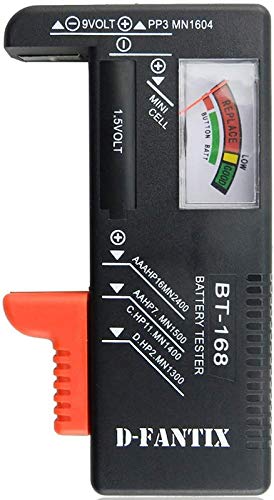
A no-power-needed analog tester for household batteries, powered by the battery itself.
The D-FantiX BT-168 is a compact battery tester for AA, AAA, C, D, 9V, and 1. 5V button cells. It uses an analog needle on a color-coded scale to show good, low, or replace. No battery is required to operate it because the battery under test powers the meter.
The size is small and light, so it stores easily in a drawer. It works with both standard and rechargeable household batteries.
If you’re a home user who wants to know whether to toss or keep a battery, this is the pick. It saves money by preventing perfectly good batteries from being thrown out.
The limitation is precision: the needle gives a rough band, not an exact voltage, and it won’t measure capacity precisely. It also doesn’t test car batteries. For a quick household verdict, it does the job.
|
8
|
VTECHOLOGY 2Pcs Battery Tester for AA AAA C D 9V 1.5V Household Batteries | Universal Batt |

A two-pack of analog testers for household batteries, activated by the battery being checked.
The VTECHOLOGY BT-168 comes as a two-pack of universal battery testers for AA, AAA, C, D, 9V, and 1. 5V button cells. Like the D-FantiX version, it uses an analog needle with green, yellow, and red zones to indicate good, low, or replace.
No battery is needed to run it since the battery under test supplies the power. The compact, lightweight body makes it easy to keep in a kitchen drawer or toolbox.
A two-pack is ideal for households that want a tester in multiple spots or a spare for the garage and kitchen. It handles regular and rechargeable batteries, so you can sort a drawer full quickly.
The limitation is the same as any analog checker: it shows a rough range, not a precise voltage, and it can’t test car batteries. Keep test times short to avoid draining the battery being checked.
|
9
|
ANENG 12V Car Battery Tester,Automotive Voltmeter and Alternator Analyzer | Digital Automo |

It reads 12V battery voltage to 0.01V and checks alternator output with LED indicators.
The ANENG BT172 is a 12V car battery tester with a digital LCD and LED indication. It reads voltage to about 0. 01V and has three modes for testing the alternator and battery. In the middle mode, the LCD shows real-time voltage while LEDs indicate alternator status.
In 12V mode, it shows real-time voltage with LEDs for battery status. The voltage range is 4 to 30V DC, with reverse connection protection built in.
This tester is for car, truck, motorcycle, and RV owners who want a clear voltage readout plus a quick alternator check. If voltage falls outside the range, the screen shows LO or HI, which protects against over-voltage.
The limitation is that it reports voltage and alternator status, not cranking amps or state of health, so a battery that fails under load may still read fine at rest. It includes clamps, an adapter cable, and a manual.
|
10
|
Klein Tools MM325 Digital Manual-Ranging Multimeter | 600V AC/DC Voltage Tester, Tests Bat |
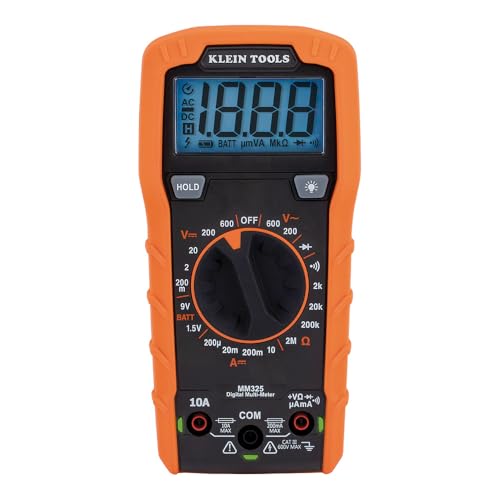
A trusted brand multimeter with a dedicated battery test mode and lead-alert safety features.
The Klein Tools MM325 is a manual-ranging digital multimeter that measures AC and DC voltage up to 600V, 10A DC current, and 2MΩ resistance. It also tests batteries, continuity, and diodes. Lead-alert LEDs illuminate to show correct test lead placement, reducing wiring mistakes.
The backlit LCD stays readable in low light, and test lead holders plus a kickstand allow hands-free use. An optional magnetic hanger is available separately.
This meter suits electricians and serious DIYers who want a durable tool from a known brand. The battery test mode checks whether a battery is working, and the DC voltage function handles car batteries.
The limitation is that manual ranging requires you to pick the range yourself, which adds a step for beginners. It’s also a voltage and continuity meter, not a load tester, so cranking amps still need a dedicated device.
A basic multimeter handles the voltage check, while a dedicated tester adds cranking and charging data. If you only need to know whether a battery is charged, any of the multimeters will do.
If you want to know whether it will survive the next cold morning, the load testers give you that answer. Match the tool to the depth of answer you need.
When A Good Voltage Reading Still Means A Bad Battery
A battery can pass a voltage test and still leave you stranded. Understanding the exceptions turns a guess into a diagnosis. These are the moments when the number on the screen doesn’t tell the whole story.
Why The Reading Looks High Right After Driving
When you drive, the alternator pushes voltage into the battery, leaving a surface charge on the plates. If you test right after shutting off the engine, you might see 13 volts or more on a battery that’s actually weak.
The fix is simple: turn on the headlights for a minute to drain the surface charge, or wait a few hours. Then test again. A true resting voltage settles around 12. 6 volts for a healthy battery. If it drops to 12.
2 or lower after the surface charge clears, the battery isn’t holding a charge like it should.
Why Load Matters More Than Rest
A battery stores chemical energy and releases it under demand. Voltage at rest measures the stored energy; voltage under load measures how well it can deliver it. A battery with a weak cell might show 12.
6 volts at rest but collapse to 9 volts the moment you turn the key. That’s why a load test, or a cranking test on a dedicated tester, matters. If the voltage drops below 10. 5 volts during cranking, the battery is failing even if the resting number looked fine.
This is the most common reason a good reading leads to a bad surprise.
- The battery is more than four years old and voltage drops fast after charging.
- Cranking voltage falls below 10.5 volts even after a full charge.
- The case is swollen, cracked, or leaking, which means internal damage.
- The battery will not hold a charge overnight after a full top-up.
- Terminals show heavy corrosion that returns quickly after cleaning.
- A load tester reports low state of health despite a full charge.
Keeping Your Test Results Honest Over Time
A single test is a snapshot. Testing the same way, at the same intervals, turns that snapshot into a trend. Here’s how to keep your readings consistent and your battery alive longer.
The real value of a battery test comes from repetition. If you check voltage once a year, you learn almost nothing. If you test every few months under the same conditions, you catch the slow decline before it becomes a no-start morning.
Pick a routine: test after the car has sat overnight, before you start it. Write down the number. A healthy battery will read around 12. 6 volts. When you see it drifting toward 12. 4 and then 12. 2 over several months, you have warning.
That’s your cue to charge it, check the alternator, or plan a replacement on your schedule instead of on the side of the road.
A Simple Testing Schedule
| Interval | What To Check | Why |
|---|---|---|
| Monthly | Resting voltage | Catches slow drain early |
| Seasonal | Cranking voltage | Cold and heat stress batteries |
| Before trips | Charging voltage | Confirms alternator output |
| Yearly | Load test | Measures true capacity |
| After any jump | Full recharge | Prevents sulfation damage |
Clean terminals matter as much as a good meter. Corrosion adds resistance that skews readings and slows charging. Before each test, inspect the terminals. If you see white or blue powder, disconnect the negative cable first, brush the posts and clamps, and reconnect.
A thin coat of dielectric grease slows corrosion’s return. Also check that the battery hold-down is snug, because vibration shortens battery life. These small habits keep your voltage readings meaningful and your battery working through more seasons than it otherwise would.
To test a battery with a voltmeter, set the meter to DC volts, touch red to positive and black to negative, and read the resting number against the 12. 6-volt standard. That single check tells you whether the battery is charged, and a cranking check tells you whether it’s healthy.
Today, grab whatever meter you have and test your battery before it tests you on a cold morning. If the reading is low, charge it and retest. If it stays low, you now know exactly what to do.

- Marine Chargers and Backup Batteries: 9 Options Compared (2026) - October 27, 2026
- LTO Cells vs. SLA Generator Batteries: 5 Options Compared (2026) - October 27, 2026
- 12V/24V Backup Batteries and the EcoFlow DELTA Pro 3 (2026) - October 27, 2026