Testing a Battery Charger: Output Voltage, Current and Diagnostic Tools
A battery charger might look perfectly fine on the outside while delivering the wrong voltage behind the scenes. Hooking a faulty unit up to your car or boat battery risks permanent damage, and I’ve seen too many people learn that lesson the hard way.
The real question isn’t just ‘does it charge?’ but ‘how do I verify it’s safe before trusting it with expensive equipment?’ You need to check output accuracy, confirm safety protections are active, and ensure the charging stages actually work as advertised. Skipping this step means you’re guessing instead of knowing.
Below, I’ll walk you through exactly what to measure, which readings matter most, and the specific tools that handle the job reliably.
Why Testing Your Battery Charger Matters
That charger sitting in your garage degrades over time. Heat, moisture, and internal component wear can shift its output without giving you any visible warning signs.
Most of us assume a battery charger works fine until a vehicle refuses to start. That assumption ends up costing money. Chargers contain rectifiers, transformers, and microprocessors that drift out of specification after years of use. A unit rated for 12 volts might actually push 14. 5 volts continuously.
That excess voltage boils the electrolyte inside lead-acid batteries and permanently damages sensitive AGM or gel cells. Testing a battery charger means verifying three things: Does the open-circuit voltage match the label? Does the amperage drop appropriately as the battery fills? Do the safety cutoffs trigger when they should?
Without answering these questions, you are just plugging it in and hoping. A dedicated testing routine takes less than five minutes, but it prevents ruined batteries and avoids electrical hazards in your workspace.
- Measure resting voltage before connecting any load to the charger.
- Confirm the charger switches from bulk to float stage automatically.
- Check that reverse polarity protection stops current flow immediately.
- Verify the output amperage matches the manufacturer rating under load.
- Inspect cables and clamps for fraying or loose connections each time.
Reading Voltage And Amperage Correctly
Raw numbers mean nothing without context. Understanding what your meter displays is the only way to know if the charger actually protects your battery.
Expected Readings For 12V Systems
| Charger Stage | Voltage Range | Amperage Behavior |
|---|---|---|
| Bulk Charge | 13.8V – 14.4V | Maximum constant output |
| Absorption | 14.2V – 14.4V | Gradually decreasing current |
| Float / Maintenance | 13.2V – 13.6V | Near zero trickle current |
| Fault State | Below 12V or above 15V | Erratic or no output |
A digital multimeter gives you the baseline truth about any charger. I would set the meter to DC voltage and touch the probes to the clamps while the charger runs without a battery attached. The reading should sit near the float voltage specified on the unit.
If it spikes wildly or reads zero, the internal circuitry has likely failed. Next, connect the charger to a known good battery and watch the amperage on your tester. It should start high during the bulk phase and taper off smoothly.
A charger that holds maximum amperage indefinitely will cook the battery. Dedicated battery charger testers automate this process by applying simulated loads and calculating whether the charger meets its stated specifications, removing human error from the equation entirely.
Tools To Test Your Charger Safely
Dedicated testers remove the guesswork from evaluating charger performance. These ten options cover everything from simple voltage checks to full system diagnostics, and each one answers the core question by proving whether your equipment delivers safe power.
|
1
|
FOXWELL BC521 2-in-1 Battery Charger & Tester, Test Before Charging 12V 5A | Test Car Batt |

Its built-in 12V testing mode directly verifies if your charger outputs correct voltage and current safely.
The FOXWELL BC521 combines a 5A charger with a 12V battery tester in one housing. This matters when you need to test a battery charger because the unit evaluates CCA, internal resistance, and alternator output.
You can check if an existing charger damaged a battery before applying the BC521’s own 8-stage charge. The LCD screen displays history records so you can track changes over multiple sessions. It supports AGM, GEL, EFB, and flooded lead-acid types up to 12V.
This tool fits anyone maintaining cars, boats, RVs, or motorcycles who wants verification before charging. The IP65 rating handles dusty garages and outdoor driveways easily. However, it strictly limits you to 12V lead-acid batteries. It cannot test lithium packs or serve as a jump starter.
If you need to evaluate a 24V truck charger, you must look elsewhere. Still, for standard 12V systems, the pulse repair feature helps recover sulfated cells after a bad charger caused damage.
|
2
|
ANCEL BA101 Car Battery Tester, 12V Digital Automotive Alternator Meter Diagnostic Tool,10 |

It isolates charging system faults by testing alternator output and cranking performance independently from the charger itself.
The ANCEL BA101 focuses purely on diagnostics rather than charging. It measures 100 to 2000 CCA and provides State of Health plus State of Charge readings. When figuring out how to test a battery charger, you first need to know the battery’s true baseline condition.
High-quality copper crocodile clips ensure stable connections during testing. The black-and-white screen features adjustable contrast and a white backlight for reading results in bright sunlight or dark engine bays.
Multi-language support makes this accessible for diverse workshop environments. It draws power directly from the vehicle battery, eliminating internal batteries that die over time. The reinforced ABS housing survives drops on concrete floors.
Its main limitation is compatibility; it only works with 12V batteries over 30Ah, excluding small motorcycle or powersport cells. For 6V or 24V applications, ANCEL requires different models. But for standard automotive testing, the precision smart chip delivers dependable data every time.
|
3
|
KONNWEI 3 in 1 Car Battery Charger, KW510 Battery Tester 12V 5-Amp Fully Automatic Smart C |
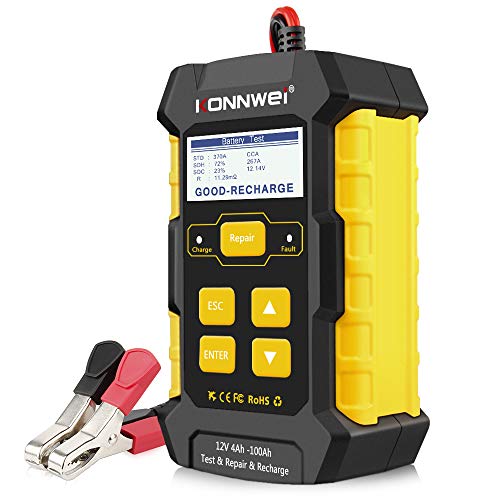
Its 3-in-1 design lets you test battery health immediately before and after using any external charger to verify results.
The KONNWEI KW510 acts as a tester, 5-amp charger, and desulfator simultaneously. Its large color LCD display makes reading voltage, internal resistance, and charge status much easier than monochrome screens. When you want to test a battery charger, you can use the KW510 to establish the battery’s exact starting metrics.
Then apply your external charger and retest to see if the target charger delivered the promised current. It handles 100 to 2000 CCA lead-acid batteries.
Temperature compensation adjusts the charging algorithm based on ambient climate conditions automatically. Eight built-in protections guard against reverse polarity, overload, and short circuits during operation. This fits DIY users working on cars, lawnmowers, or boats in varying weather. One drawback is the 5-amp maximum output limit.
Larger deep-cycle marine batteries will take significantly longer to fill compared to higher-amperage units. Still, the automated pulse repair technology effectively addresses acid stratification caused by older, poorly regulated chargers.
|
4
|
BT-C2400 Battery Charger Analyzer Tester for AA AAA NiMH NiCd Rechargeable Batteries |
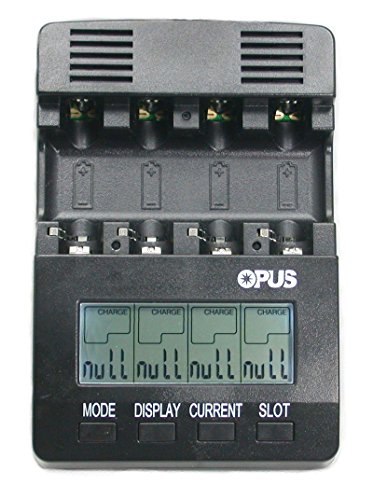
It tests individual AA and AAA charger channels independently, proving if household battery chargers deliver balanced current.
Not all battery chargers power vehicles. The BT-C2400 targets AA and AAA NiMH and NiCd rechargeable cells. If you need to test a battery charger meant for household electronics, this analyzer measures capacity, voltage, elapsed time, and current across four independent channels.
You can set each channel differently or run them uniformly. The backlit LCD display shows digital readouts clearly. It even tests internal resistance, which reveals if a charger stressed the cell during previous cycles.
This device suits photographers, remote control enthusiasts, or anyone relying heavily on rechargeable household batteries. The highest capacity limit reaches 20,000 mAh, accommodating modern high-drain cells easily. Charge, discharge, refresh, and test modes give complete control over battery maintenance. The primary limitation is its strict chemistry focus.
It cannot test lithium-ion cells or larger 12V automotive chargers. However, for verifying that a multi-slot AA charger distributes power evenly without overheating cells, it remains highly effective and straightforward to operate daily.
|
5
|
NOCO GENIUS1 1A 6/12V Smart Battery Charger, Trickle Charger & Maintainer | Overcharge Pro |

Its integrated thermal sensor and precise monitoring reveal if another charger lacks proper temperature-based voltage adjustments.
The NOCO GENIUS1 delivers 1 amp of charging power for 6-volt and 12-volt batteries. While primarily a maintainer, its precision charging algorithms make it an excellent benchmark tool. When learning how to test a battery charger, you can compare your suspect charger’s behavior against the GENIUS1’s integrated thermal sensor readings.
It dynamically adjusts charge based on ambient temperature. It supports lead-acid wet, gel, AGM, and lithium LiFePO4 chemistries, making it incredibly versatile for cross-referencing output standards.
Force Mode manually charges completely dead batteries down to zero volts, recovering deeply neglected cells. Its compact size, 35 percent smaller than the older G750 model, fits easily inside tight engine compartments. This works best for maintaining motorcycles, ATVs, or classic cars stored long-term.
The honest limitation is its low 1-amp output rate. It cannot rapidly charge a depleted truck battery. Instead, it serves as a reliable reference point to verify whether a faster charger is pushing dangerous voltage levels.
|
6
|
Schumacher Electric 15A Car Battery Charger & Maintainer, 6V/12V – SC1280 | 3A Trickle Cha |

Its microprocessor-controlled testing mode automatically detects voltage, letting you verify if other chargers match expected output ranges.
The Schumacher SC1280 provides 15 amps of charging power alongside maintaining and testing capabilities. Its auto voltage detection identifies 6V and 12V batteries instantly. To test a battery charger, you can use the SC1280’s diagnostic functions to measure the battery’s state before and after using another unit.
Advanced desulfation mode attempts to restore batteries damaged by improper charging. The microprocessor controls multi-stage charging algorithms precisely, ensuring the unit itself serves as a reliable standard for comparison.
This heavy-duty option fits truck owners, marine enthusiasts, and shops handling larger battery banks regularly. The 15-amp rapid charging restores standard, AGM, gel, and deep-cycle batteries efficiently. It prevents battery failure after seasonal storage periods effectively. One limitation involves its physical footprint.
It is bulkier than smart trickle chargers, taking up more bench space. Additionally, while it tests and restores batteries well, it relies on automated processes rather than giving users raw manual data readouts for granular troubleshooting.
|
7
|
Schumacher Electric 6A Car Battery Charger & Maintainer, 6V/12V – SC1281 | 100A Engine Sta |

Its dedicated alternator and battery testing functions provide exact metrics to compare against any external charger’s actual performance.
The Schumacher SC1281 goes beyond basic charging by including a 100-amp engine start and dedicated battery and alternator tester. When you need to test a battery charger thoroughly, this unit evaluates the entire charging system. It measures 12-amp to 30-amp boost charges and verifies generator function.
The microprocessor-controlled smart trickle charge maintains voltage safely over time. Automatic voltage detection handles both 6V and 12V systems, providing comprehensive diagnostic coverage for almost any standard automotive application you encounter in the shop.
Daily drivers and weekend vehicles benefit from the immediate 100-amp jump capability paired with diagnostic insights. The advanced desulfation mode repairs cells degraded by cheap chargers. Multi-stage algorithms protect sensitive electronics during testing. The trade-off is complexity.
With five distinct functions packed into one box, new users face a steeper learning curve compared to simpler testers. It also demands significant AC power to deliver the 100-amp start, meaning you cannot use it remotely without a proper outlet connection nearby.
|
8
|
TOPDON BT100 12V Car Battery Tester, Automotive Battery Load Tester | 100-2000 CCA Auto Ba |

Its passive testing approach safely checks cranking and charging systems without risking damage from a potentially faulty charger.
The TOPDON BT100 operates exclusively as a 12V load tester supporting 100 to 2000 CCA. It provides SOH, SOC, voltage, and current analytical data clearly. Figuring out how to test a battery charger becomes safer with this unit because it uses a passive testing approach.
It only powers on once properly attached to the battery terminals. Premium copper clamps feature polarity reverse prevention and spark-proof designs. Three colored LEDs help you rapidly determine overall battery health at a glance.
Compact dimensions allow storage directly inside a glove box or center console for roadside emergencies. It tests regular flooded, AGM flat plate, spiral, EFB, and GEL chemistries accurately. This fits mobile mechanics or DIY users checking multiple vehicles frequently. The limitation is its strict 12V focus.
It cannot evaluate 6V vintage systems or 24V commercial trucks. Furthermore, it tests the battery and vehicle charging system but does not plug into wall-powered battery chargers directly for bench testing purposes.
|
9
|
KONNWEI KW520 3-in-1 Car Battery Tester Charger 12V 24V 10A/5A Pulse Repair | Test Automot |

It tests both 12V and 24V systems, allowing verification of heavy-duty chargers that smaller single-voltage testers cannot handle.
The KONNWEI KW520 handles both 12V 10A and 24V 5A testing and charging duties. This dual-voltage capability is essential when you need to test a battery charger designed for heavy equipment. It measures CCA from 100 to 2000, internal resistance, and voltage while detecting bad cells automatically.
The 7-stage output applies pulse repair technology to address sulfation. Supporting eight languages makes it practical for international workshops dealing with varied automotive starting batteries including flooded, AGM, gel, and lithium LiFePO4 types.
Truck owners, agricultural equipment operators, and marine professionals benefit most from the 24V compatibility. The automatic switch to trickle maintenance mode prevents overcharging during extended diagnostic sessions. One-click repair simplifies recovering aging batteries left damaged by inferior chargers. The honest limitation involves its 10-amp maximum at 12V.
While sufficient for testing and maintenance, it charges large depleted banks slower than dedicated 15-amp or 30-amp units. Still, as a diagnostic bridge between testing and charging, it covers more ground than single-voltage alternatives.
|
10
|
MOTOPOWER MP0514A 12V Digital Car Battery Tester Voltmeter and Charging System Analyzer wi |
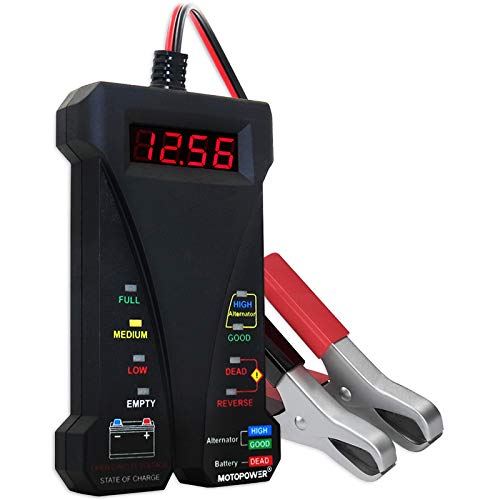
Its 0.01-volt precision LCD quickly exposes voltage irregularities caused by failing chargers that broader diagnostic tools might miss.
The MOTOPOWER MP0514A functions as a digital voltmeter and charging system analyzer. It features a 4-digit LCD display offering voltage testing accuracy up to 0. 01 volts. When you want to test a battery charger, this level of precision reveals tiny fluctuations that indicate failing components.
Eight colored LED indicators show battery or alternator status intuitively. The plug-and-test design requires no complex setup. Simply attach the 30A alligator clips using the 50cm extension cable to read conditions instantly without starting the vehicle.
Weighing only 150 grams with a black rubber paint finish, it provides a secure grip during use. Reverse connection and over-voltage protection safeguard both the tester and vehicle circuits from accidental mistakes. This suits casual car owners wanting fast, understandable answers without navigating digital menus. The limitation is its scope.
It measures voltage and basic charging system health but lacks CCA testing or internal resistance analysis found in advanced units. For quick spot-checks of charger output stability, however, it performs exceptionally well.
These ten tools range from household analyzers to heavy-duty 24V diagnostic units. Selecting the right one depends entirely on the charger type you need to evaluate. Once you have verified your equipment, applying consistent testing habits ensures long-term reliability.
Setting Up A Reliable Charger Testing Routine
Buying a tester solves half the problem. Using it consistently prevents slow degradation from going unnoticed between seasonal vehicle startups.
Disconnect the charger from AC power before attaching any testing equipment.
Connect the tester clamps securely to the battery terminals following color codes.
Power on the charger and observe the initial bulk charging voltage reading immediately.
Record the amperage output after five minutes to confirm it matches specifications.
Switch the charger off and disconnect the tester before removing the battery clamps.
A testing routine only works if you document the results. I would write down the voltage and amperage readings each time you check a charger. Over months, these numbers reveal gradual component failure before it destroys a battery. Pay attention to ambient temperature during testing.
Chargers behave differently in freezing garages compared to hot summer driveways. If your readings fluctuate wildly between seasons, the charger likely lacks proper temperature compensation. Always test the charger under the same conditions you normally use it. Testing a marine charger indoors yields different baselines than testing it dockside.
Consistency turns random measurements into actionable data that protects your investment.
Common Mistakes That Skew Charger Test Results
Even quality testers produce bad data if used incorrectly. Avoiding a few specific errors keeps your charger evaluations accurate and trustworthy.
To test a battery charger, you must measure its voltage output, verify amperage delivery under load, and confirm safety cutoffs engage properly. Guessing based on indicator lights leads to damaged batteries and stranded vehicles. Pick a tester matched to your specific battery chemistry and voltage requirements today.
Run a baseline test on your current charger this afternoon and record the numbers. Keep those readings in your maintenance log. Checking twice a year takes minutes but prevents hundreds of dollars in replacement costs. Your batteries deserve verified power, not blind trust.

- Marine Chargers and Backup Batteries: 9 Options Compared (2026) - October 27, 2026
- LTO Cells vs. SLA Generator Batteries: 5 Options Compared (2026) - October 27, 2026
- 12V/24V Backup Batteries and the EcoFlow DELTA Pro 3 (2026) - October 27, 2026