How To Tell When You Need A New Car Battery?
A dead battery on a cold morning or a failed start before an important trip can turn any driver’s routine into a nightmare. The real problem isn’t just replacing the battery; it’s knowing when the time is coming.
Most drivers only discover their battery is failing when the warning signs are already obvious. Understanding the subtle indicators can save you from unexpected roadside moments and costly last-minute replacements.
This guide explains how to read the signals your battery sends and then points to the best testers for confirming its health before it’s too late.
Warning Signs Your Car Battery Is Failing
Recommended Products

Before reaching for a tester, learn the telltale clues that signal a battery’s decline. These visual and performance cues appear months before complete failure.
Age is often the first silent factor. Most lead-acid batteries last three to five years under normal conditions. After this window, internal capacity naturally erodes. You might notice slower engine cranking, especially on cold mornings when the battery struggles to turn the engine over quickly.
A dimming or flickering headlight, particularly when the engine is off, points to diminished charge storage. If you need to jump-start the car more than once a month, the battery may no longer hold a full charge.
You might also hear a clicking or grinding sound when turning the key, which indicates the starter motor isn’t receiving enough power to engage properly. These signs together suggest the battery’s ability to deliver consistent power is waning and needs verification.
Corrosion and Leaking
Look at the battery terminals for white or blue powdery buildup, a sign of chemical leakage and poor connections. Swelling or cracks in the case suggest internal damage. If the battery feels warm to touch after driving, it might be overworked or failing internally.
Any fluid visible outside the cells is a clear sign of imminent failure.
Performance Changes
A sluggish start-that should be instant-now requires multiple crank attempts. The radio or other electronics may act erratically when the engine is off.
If you frequently jump the car with a portable device and need to run it for several minutes before the engine catches, the battery is likely near its end.
When Accurate Testing Becomes Essential
Recommended Products


Visual checks only tell part of the story. Electrical testing provides the precise data needed to make an informed replacement decision without guessing.
A battery tester measures the state of health, state of charge, internal resistance, and cold cranking amps. These metrics reveal whether a battery still has usable capacity or needs replacement soon. Handheld devices use conductance or load testing to apply controlled stress and observe the response.
This approach catches subtle weaknesses that a voltmeter alone cannot detect. Without this verification, you risk replacing a battery that still has life left or waiting too long and facing a roadside breakdown when the battery finally dies unexpectedly during a trip.
Key Metrics and What They Mean
| Metric | Good Reading | Action Needed |
|---|---|---|
| State of Health | 80-100% | Acceptable capacity |
| State of Health | 60-79% | Monitor closely |
| State of Health | Below 60% | Plan replacement |
| Voltage | 12.6V+ (no load) | Fully charged |
| Voltage | 12.4V-12.5V | Needs charging |
| Voltage | Below 12.4V | Replace soon |
Testers That Reveal When Your Battery Needs Replacing
Recommended Products


With the warning signs identified, a reliable tester provides the definitive answer. These products differ in how they present data, their range of vehicle compatibility, and their ease of use under real-world conditions.
|
1
|
ANCEL BA101 Car Battery Tester, 12V Digital Automotive Alternator Meter Diagnostic Tool,10 |

The ANCEL BA101 delivers labeled Health and Charge readings plus a Project Farm video endorsement for trustworthy results.
The ANCEL BA101 gives you State of Health and State of Charge numbers straight away, alongside voltage, current, and CCA. It leans on a precision chip and copper clips, and it asks you to enter the exact battery specs printed on the label so the reading reflects what’s really there.
The monochrome screen stays readable in sun or shade, and the 4-in-1 protection keeps things safe if you misstep during a test.
It covers 12V batteries from 100 to 2000 CCA across flooded, AGM, GEL, and EFB types, which handles most cars, trucks, boats, RVs, and golf carts you’ll run into.
The one gap that sticks out is 6V, 24V, and small motorcycle batteries under 30Ah; ANCEL’s BA101 Plus or PRO variants are the ones to reach for there.
|
2
|
TOPDON BT100 12V Car Battery Tester, Automotive Battery Load Tester | 100-2000 CCA Auto Ba |

TOPDON’s color-coded LED menu guides users through a three-stage health, crank, and charge test with clear pass/fail indicators.
The TOPDON BT100 uses a three LED setup and menu to walk you through battery health, cranking, and charging checks without fuss. The copper clamps include polarity reversal prevention, and the compact body slips into a glove box without taking a fight.
For a quick read before a trip or just checking in, this is the kind of tool I’d keep handy.
It works on 12V lead-acid batteries from 100 to 2000 CCA, covering cars, motorcycles, trucks, RVs, ATVs, and boats without needing a charge first. The tradeoff is no support for 24V systems or lithium batteries, so anything heavier duty or newer hybrid/electric needs a different tool.
|
3
|
MOTOPOWER MP0515A 12V Car Battery Tester Automotive 100-2000 CCA Battery Load Tester Auto |

MOTOPOWER’s color LCD screen displays real-time waveforms and supports nine languages for detailed analysis in any region.
The MOTOPOWER MP0515A puts a 3-inch color LCD to work, and the waveform function actually shows the curve as the alternator loads or the starter kicks in. That’s useful when you’re chasing down a finicky charging issue rather than a flat battery.
The nine language support matters if you’re handing the tool off to someone else.
It reads health, charging condition, internal resistance, and gives a plain conclusion of mediocre, good, or excellent. It stays within the 12V, 100-2000 CCA lane though, so 24V systems or lithium packs are off the table. If you’re running a fleet mix, this one needs a buddy device.
|
4
|
MOTOPOWER MP0514A 12V Digital Car Battery Tester Voltmeter and Charging System Analyzer wi |
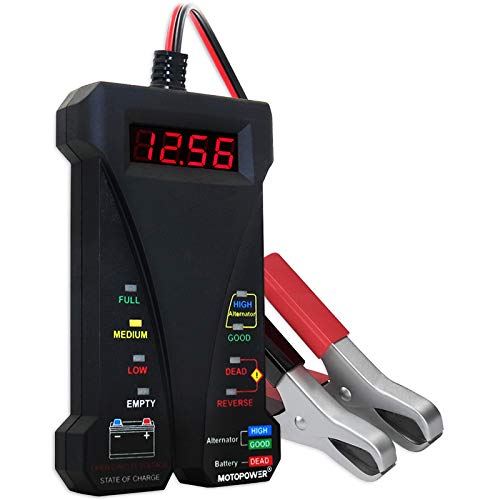
MP0514A’s LED array and 4-digit LCD deliver a quick pass/fail grade for battery and alternator status without interpreting complex numbers.
The MOTOPOWER MP0514A strips testing down to readouts: a 4-digit LCD that lands voltage to 0. 01 volts, and eight colored LEDs that say it all at a glance. The plug-and-test approach means you connect it, read the battery without turning the key, then start and grab the alternator status.
That’s the kind of straightforward flow I’d want on a morning run.
The 50 cm cable and 30A clips reach into tight bays, and reverse connection plus over-voltage protection keep it from frying itself or the car. At 150 grams it’s easy to carry, but there’s no load testing here, so this is for confirmation rather than deep diagnosis.
|
5
|
KONNWEI KW208 12V Car Battery Tester, Battery Load Tester Automotive 12V Alternator Starte |

KONNWEI’s 99.7% AI accuracy and 7000+ Amazon ratings make it a trusted choice for pinpointing the exact replacement threshold.
The KONNWEI KW208 runs its readings through a smart chip that claims over 99 percent precision and delivers them in milliseconds. You get voltage, CCA, internal resistance, health, and charge status, plus a call on whether to replace or recharge.
The galvanized alloy clips feel sturdier than the usual crocodile style, and the menu system moves in seven languages.
It tests batteries in-vehicle or out, including ones that are already dead, across 100 to 2000 CCA. The limitation is squarely 12V systems though; anything at 6V or 24V means pulling another tool. Replacements are available if the unit itself takes a beating.
|
6
|
TOPDON BT200 Car Battery Tester, 12V/24V, 100-2000 CCA Load Tester | Battery and Alternato |

BT200’s dual 12V/24V coverage and sunlight-readable color screen handle fleet-wide testing across diverse vehicle types.
The TOPDON BT200 steps up from the BT100 with a 2. 4-inch color screen that actually reads in direct sun, and memory that holds your last test. The conductance tech puts it at 99.
9 percent accuracy across both 12V and 24V batteries in the 100-2000 CCA range, which is the kind of spread you need if you’re managing more than one vehicle type.
It runs from minus 4 degrees Fahrenheit to 140, so it doesn’t care about weather extremes, and it covers cars, semis, RVs, motorcycles, and boats with the rugged housing and copper clamps backing that claim.
The cost bumps it up from single-voltage testers, so it makes more sense for multi-vehicle owners or small shop use than one commuter.
|
7
|
Car Battery Tester with Next-Step Guidance for 6V 12V Automotive Batteries |

Bluetooth’s long cable and next-step guidance reduce guesswork, showing users exactly whether to recharge or replace.
The BT900’s 8. 2-foot cable means you can stay in the driver’s seat while cranking instead of hanging halfway out the window. The color display gives the numbers and then a second screen with plain direction: recharge, retest, check the alternator, or replace.
That second step is what I’d want when a cold morning throws up a question mark.
It covers 6V and 12V lead-acid types including Flooded, AGM Flat, AGM Spiral, GEL, and EFB, and the guided setup walks through location, type, and rating without hunting menus. The restriction to 12V tops out there though; 24V systems and anything lithium stays unsupported.
|
8
|
Car Battery Tester 6V 12V 24V Battery Voltage Tester, BR502 100-2000 CCA Internal Resistan |

BR502’s nine-language menu and dual 6V/12V/24V range handle virtually any automotive battery without missing thresholds.
The KAIWEETS BR502 stretches across 6V, 12V, and 24V batteries from 100 to 2000 CCA, which handles most automotive batteries in one pass. The 1. 8-inch HD screen delivers State of Health, State of Charge, internal resistance, and voltage in under two seconds, and the 99.
6 percent accuracy keeps those readings honest. It works in-vehicle or on a bench.
Polarity reverse protection guards against a miswired connection, and the case plus carry box keep it safe in a toolbox. The screen is smaller than the pricier models though, and in dim garage light it takes a little more effort to read than I’d like.
|
9
|
FOXWELL BT705 Car Battery Tester 24V 12V, Alternator and Load Tester | 100-2000CCA High-Ac |
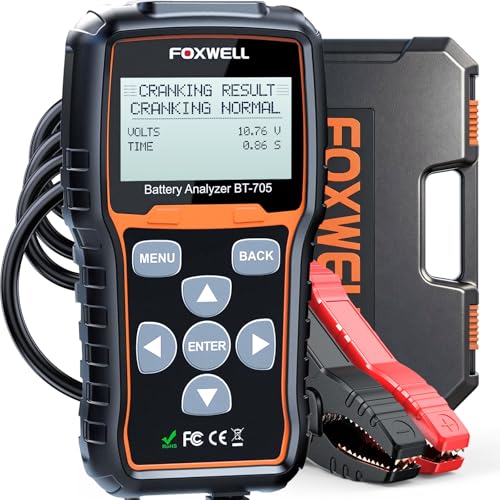
FOXWELL’s 5.9ft cable and cold-tested reliability let drivers verify their battery alone before long trips in any weather.
The FOXWELL BT705 runs on a 5. 9-foot cable that keeps you in the driver’s seat while the engine cranks, which I’d consider worth it for doing this alone. The 2. 8-inch screen walks through health, cranking, and charging with GOOD, RECHARGE, or REPLACE prompts that cut through the guesswork.
It’s been through Project Farm’s 2026 comparison, so it’s tested against cold conditions.
It covers 12V and 24V batteries from 100 to 2000 CCA including Flooded, AGM, GEL, and EFB types across cars, pickups, trucks, RVs, and boats. Lithium batteries stay out of reach though, so hybrids and EVs are still outside its window.
|
10
|
KAIWEETS Digital Multimeter Voltmeter with Case for Car Batterry Test DIY | AC/DC Voltage, |

The KAIWEETS multimeter combines voltage testing with continuity and diode checks for comprehensive diagnostics beyond just battery health.
The KAIWEETS Digital Multimeter steps outside pure battery testing and into general diagnostics: voltage, resistance, continuity, and diode checks at CAT III 600V. The backlit LCD runs on two AAA batteries, and the double fuse plus overload protection keep it from taking damage on a messy circuit.
The case and leads make it road-ready for a garage or a roadside stop. But it doesn’t do load or conductance testing, so you won’t get CCA or State of Health from it directly.
If you need a full battery picture, this pairs with one of the dedicated testers rather than replacing it.
Each tester here turns guesswork into concrete data before a breakdown happens. From budget-friendly LED models to multi-voltage units built for a fleet, you can match the tool to your vehicle mix and how often you’re checking.
Using Your Tester for Accurate Results
Even a quality tester can give misleading data if used incorrectly. Follow these steps to ensure every measurement truly reflects your battery’s condition.
Park the vehicle on a flat surface, turn off the engine, and engage the parking brake. Remove any jewelry to avoid shorts on the terminal connections.
Connect the tester clips to the battery terminals, observing polarity. Red clamp to positive, black to negative. If the device does not power on, check the connections before applying force.
Select the battery type from the menu exactly as labeled, then enter the CCA rating and temperature shown on the battery nameplate. Accurate input ensures meaningful results.
Perform the test and wait for the complete reading to appear. Record SOH, SOC, voltage, and CCA values for future reference when tracking battery decline over time.
Interpret the results: health above 80 percent means good capacity, 60 to 79 percent signals monitoring, and below 60 percent calls for replacement planning.
Testing frequency matters as much as technique. I’d check the battery at least twice a year, especially before winter and summer extremes. If you drive the car daily, monthly checks catch slow degradation early.
For vehicles parked long, test before each road trip to make sure stored charge is still enough. When multiple metrics trend downward together, that’s not a fluke, it’s a sign the battery is heading toward the end.
Maintaining Battery Health Beyond Testing
A battery tester reveals problems but regular maintenance prevents many from arising in the first place. These practices extend service life and reduce the likelihood of surprise failures.
- Wipe terminals with a wire brush monthly to remove corrosion buildup that increases resistance.
- Tighten cable clamps quarterly; loose connections cause voltage drops and heat buildup.
- Park in shade or use a battery blanket in extreme heat to slow chemical degradation.
- Drive the vehicle for at least 20 minutes weekly to keep the battery fully charged via the alternator.
- Store the car on a battery maintainer if parked longer than a month to prevent deep discharge.
Beyond surface cleaning and tightening, watch the factors that wear a battery down. Driving patterns matter: short trips under 15 minutes keep the alternator from fully recharging the battery, and that shortens its life. Temperature is a dual enemy: heat speeds up electrolyte loss while cold cuts available power.
A memory saver helps keep radio codes and ECU settings during electrical work, but it doesn’t replace the need to periodically verify the battery can still do the job when it counts.
When your battery drops below 60 percent SOH, cranks slower, or shows corroded terminals, that’s the point to act. Get a tester, run a full check, and keep jumper cables in the trunk so you’re never waiting on a tow.

- 10 Best Battery For Generator Ev Battery Bank Marine 2026 - October 27, 2026
- 10 Best Battery For Generator Ev Battery Bank Lto 2026 - October 27, 2026
- 10 Best Battery For Generator Ev Battery Bank Low Voltage 2026 - October 27, 2026