What Volt Is A Lawn Mower Battery?
When a riding mower refuses to turn over, the first question is usually about voltage. Most gas-powered lawn tractors and zero-turns run on a 12-volt system, but that number alone doesn’t guarantee a fit.
Cordless electric mowers use entirely different high-voltage packs, and even among 12V batteries, physical size, terminal polarity, and cold cranking amps (CCA) matter just as much.
I wrote this guide to separate nominal voltage from actual starting power, explain why 12 volts is only part of the equation, and highlight replacements that actually fit common U1 trays.
Why Most Riding Mower Batteries Are 12 Volt
Recommended Products


The quick answer is that most gasoline riding mowers use a 12-volt starting system. The nuanced answer is that voltage is just the baseline. Your mower also needs sufficient cold cranking amps to spin the engine reliably, especially during cool spring mornings or after long storage.
A 12-volt lawn mower battery belongs to the same electrical family as a car battery but is typically smaller and optimized for short, high-current bursts rather than sustained accessory load.
Riding mowers and garden tractors usually recharge via a stator or small alternator while the engine runs, and that system expects a 12-volt lead-acid battery in a U1 or U1R case size.
Think of voltage as the pressure pushing current through the starter, while CCA measures the volume of current available for starting. Reserve capacity matters less here than in automotive applications. I’ve seen batteries read a perfect 12 volts at rest yet fail under load because internal plates were degraded.
That’s why a weak mower can show normal resting voltage but still crank sluggishly when you need it most.
What The Number On A Mower Battery Really Means
| Label | What It Tells You | Why It Matters |
|---|---|---|
| 12V | System voltage | Must match mower charging system |
| CCA | Starting current | Higher helps cold mornings |
| Ah | Stored energy | Supports lights and accessories |
| U1 or U1R | Case size | Must fit tray and hold down |
| Polarity | Terminal side | Wrong side can reverse cables |
When A Mower Battery Might Not Be 12 Volt
Recommended Products


While 12 volts covers most riding mowers, it doesn’t apply to every machine on the market. Cordless electric mowers, vintage garden tractors, and some compact utility equipment use different electrical architectures. Checking the label is always safer than assuming based on mower type.
Cordless Electric Mowers Use Higher Voltage Packs
Battery-powered push mowers from brands like EGO, Greenworks, Kobalt, and Ryobi often use 40V, 56V, 60V, or 80V packs. Those numbers describe the tool platform, not a replacement starting battery.
A 56-volt lawn mower battery cannot replace a 12-volt U1 tractor battery, the charger, motor controller, terminals, and battery management systems are completely incompatible. If your mower plugs into a wall charger and has no gas engine, the pack voltage is usually printed directly on the battery casing.
Small Or Old Equipment Can Break The Pattern
Some vintage garden tractors used 6-volt systems, though they’re rare today. Certain compact utility machines may also use non-standard battery groups or terminal layouts. My advice is to read both the battery label and the mower manual before ordering.
Look for nominal voltage, BCI group size, terminal position, and CCA together. If the old battery is missing, check the wiring diagram or measure charging output with a multimeter. A reading around 14 volts while running typically confirms a 12-volt system.
- Confirm the mower manual lists a 12 volt system.
- Match U1 or U1R case size before looking at CCA.
- Check whether positive is left or right.
- Compare CCA against the old battery label.
- Do not use cordless pack voltage as a guide.
- Measure tray length, width, and height.
12 Volt Replacements For A Dead Mower
Recommended Products


Once you’ve confirmed your mower uses a 12-volt system, the real shopping criteria become physical fit and cranking power. The picks below all satisfy the 12-volt requirement but differ in CCA, case dimensions, terminal layout, warranty terms, and intended application.
That specificity gives you a clearer path than simply chasing the highest amp rating.
|
1
|
ML-U1-CCAHR -12 Volt, 320 CCA, Nut and Bolt (NB) Terminal, Rechargeable SLA AGM High Rate |

This ML-U1-CCAHR is a 12-volt, 320 CCA U1 battery suited for riders needing reliable starts in standard trays.
The ML-U1-CCAHR is a 12-volt sealed AGM battery rated at 320 cold cranking amps. It fits the common U1 footprint used by many Craftsman, Cub Cadet, Husqvarna, Toro, and John Deere riders. Nut-and-bolt terminals provide a secure connection for older mower cable ends.
Note that the listing includes only the battery and screws, no harness or mounting bracket is provided. I’d flag this because some replacement jobs require reusing original hardware or sourcing new straps separately.
I’d shortlist this for gasoline riding mowers that need solid starting power without stepping up to a larger case. AGM construction resists spills, vibration, and the bouncing inherent to rough lawns. The 7. 75 x 5. 11 x 6. 25-inch dimensions should be verified against your tray before ordering.
One practical limitation is the lack of included hold-down parts; buyers must reuse original straps or purchase mounting hardware separately.
|
2
|
ML-U1-CCA -12 Volt, 200 CCA, Nut and Bolt (NB) Terminal, Rechargeable SLA AGM Battery |
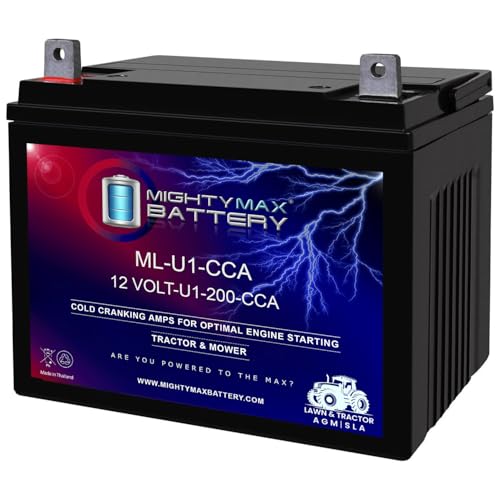
This ML-U1-CCA provides 12 volts with 200 CCA for lighter-duty starting demands.
The ML-U1-CCA is a 12-volt SLA AGM battery with a more modest 200 CCA rating. It shares the familiar U1 lawn mower battery shape and left-positive polarity, making it relevant when the mower is 12 volts but doesn’t require maximum cranking output.
The lower CCA can suit smaller engines and warmer climates. It’s also a straightforward like-for-like replacement when matching an existing spec.
Choose this when your old battery shows similar amp ratings and the engine turns over easily. The sealed design eliminates watering and acid handling, and it stores better than flooded batteries left unattended in a shed.
The honest trade-off is starting strength: a 200 CCA battery may struggle with larger engines, thick oil, or cold spring mornings. Match it to your mower’s actual needs rather than upgrading blindly.
|
3
|
UPLUS U1 Riding Lawn Mower Battery, 12V 330CCA for Garden Tractors | Maintenance Free AGM |

This UPLUS 12V 330CCA U1 battery targets stronger starts and extended service life.
The UPLUS U1 330CCA is a 12-volt, 25Ah AGM battery built for garden tractors and riding mowers. Its 330 cold cranking amps exceed many standard replacements. The brand advertises 99. 99% primary lead for cleaner charging and reduced fumes. Dimensions are 7. 68 x 4. 92 x 6.
93 inches, with a left-positive terminal layout that fits many popular mower cable arrangements.
This option suits owners who want extra margin for spring starts and occasional cold snaps. UPLUS claims starting capability down to -22°F, and a 15-month warranty plus 60-day refund window add practical support. One caveat: the 6. 93-inch height may be snug in some trays.
I’d recommend checking vertical clearance and hold-down compatibility before buying.
|
4
|
UPLUS U1 Riding Lawn Mower Battery, 12V 280CCA Garden Tractors Battery | Maintenance Free |
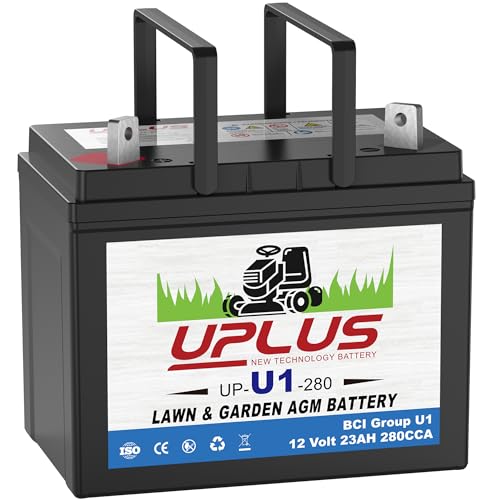
This UPLUS 12V 280CCA model offers balanced U1 power without the largest case footprint.
The UPLUS 280CCA U1 is a 12-volt sealed AGM battery rated at 23Ah and 280 cold cranking amps. It serves mowers that need more than a basic replacement but less than max-output units. The case measures 7. 68 x 4. 92 x 6.
93 inches and uses the common left-positive/right-negative layout. Maintenance-free design means no watering or acid checks.
I see this as a sensible middle ground for Craftsman, John Deere, Toro, Cub Cadet, and similar riders. Calcium technology aims to reduce self-discharge and grid corrosion while maintaining familiar U1 fitment. The trade-off is that 280 CCA may not satisfy larger engines in very cold weather.
If your old battery was 300+ CCA, I’d step up rather than down.
|
5
|
Mighty Max Battery YTZ12S -12 Volt 11 AH, 210 CCA, Rechargeable Maintenance Free SLA AGM M |

The Mighty Max YTZ12S is 12 volts but housed in a smaller motorcycle-style case.
The Mighty Max YTZ12S is a 12-volt, 11Ah AGM battery rated at 210 CCA. Its compact 6. 00 x 3. 44 x 4. 38-inch size makes it suitable only for smaller equipment, it is not a standard U1 riding mower battery.
The listing targets motorcycles and powersports machines, which matters because lawn tractor trays typically require a larger case.
This product answers the voltage question but illustrates why voltage alone isn’t enough. A 12-volt label doesn’t guarantee lawn mower fit; terminal layout and case size differ significantly from U1 tractor batteries. It could work in compact utility machines, sprayers, or custom adapters where space is tight.
My caution: do not buy this for a full-size riding mower unless the manual explicitly specifies this group.
|
6
|
MARXON U1 Riding Lawn Mower Battery, Garden Tractors Battery 12V 360CCA | Maintenance Free |

This MARXON 12V 360CCA U1 battery is engineered for high-demand mower starting.
The MARXON U1 360CCA is a 12-volt AGM battery with robust starting output. Its 360 CCA rating places it among the more powerful U1 options listed. The case measures 7. 68 x 4. 92 x 6. 14 inches with left-positive polarity matching many common mowers.
Compatibility includes Toro, Cub Cadet, Craftsman, Ariens, Poulan Pro, and Troy-Bilt models.
I’d consider this for larger riders, zero-turns, or mowers that crank hard after winter storage. Shock-resistant materials and corrosion-resistant alloy address vibration and heat concerns. US-based support and a 15-month warranty add post-purchase security.
The trade-off is that maximum CCA isn’t necessary for every engine; smaller mowers may not utilize the extra output. Also note that mounting accessories are not included.
|
7
|
ML-U1R-CCAHR -12 Volt, 320 CCA, Nut and Bolt (NB) Terminal, Rechargeable SLA AGM High Rate |

The ML-U1R-CCAHR is a 12-volt, 320 CCA battery with reversed U1R polarity.
The ML-U1R-CCAHR is a 12-volt AGM battery rated at 320 CCA. The ‘R’ denotes reversed polarity compared to standard U1 batteries, a small detail that determines whether the positive cable reaches cleanly. It targets mowers requiring right-side positive orientation instead of left-side positive.
The high-rate series aims for stronger starts than basic replacements.
This is the correct choice when your old battery has the positive post on the right. Forcing standard polarity can stretch cables or risk reversed connections. Sealed AGM construction resists leaks and vibration.
The key limitation is that reversed polarity is easy to overlook; compare photos of your old battery before ordering. Otherwise, even a strong 320 CCA unit can be the wrong fit.
|
8
|
UPLUS U1 Riding Lawn Mower Battery, 12V 360CCA for Garden Tractors | Maintenance Free AGM |

This UPLUS 12V 360CCA U1 combines top-tier U1 output with 26Ah capacity.
The UPLUS 360CCA U1 is a 12-volt AGM battery rated at 26Ah and 360 CCA, sitting at the strong end of U1 replacements. The 7. 68 x 4. 92 x 6. 93-inch case uses left-positive polarity.
Maintenance-free construction avoids spills and watering, while primary lead chemistry is advertised for better charge acceptance and lower fume release.
Choose this for demanding riders, frequent starts, or mowers with extra electrical loads. It fits many John Deere, Cub Cadet, Husqvarna, Craftsman, Toro, and Troy-Bilt models. Low-temperature starting claims add appeal for early-season cuts.
The limitations are price and size sensitivity, it may be more battery than a small yard tractor needs. Confirm height and tray clearance first.
|
9
|
MARXON U1 Riding Lawn Mower Batteries Garden Tractors Battery 280CCA | Maintenance Free AG |

This MARXON 12V 280CCA battery offers a budget-conscious U1 fit with five-year longevity claims.
The MARXON 280CCA U1 is a 12-volt AGM battery for standard riding mower trays, providing 280 cold cranking amps in a 7. 68 x 4. 92 x 6. 14-inch case. Left-positive terminal layout matches many popular machines.
The brand highlights high-purity lead and corrosion-resistant structure, with maintenance-free design eliminating acid filling and water checks.
This fits shoppers seeking a straightforward 12-volt replacement without paying for maximum output. Listed compatibility includes Troy-Bilt, John Deere, Toro, Cub Cadet, Craftsman, Ariens, and Poulan Pro. Shockproof casing helps on bumpy lawns. One caveat: real-world longevity depends heavily on charging habits, storage conditions, and heat exposure.
I’d keep it on a maintainer during winter regardless of marketing claims.
The common thread is 12 volts, but the right pick still hinges on physical fit. U1 and U1R cases aren’t interchangeable when polarity differs. CCA should align with engine size, climate, and your old battery’s label. Compact packs like the YTZ12S demonstrate that voltage alone can’t confirm mower compatibility.
How To Confirm Your Mower Needs 12 Volts
Recommended Products


Before spending money, confirm your mower actually expects 12 volts. A few minutes with the manual, battery label, and multimeter can prevent a wrong order. These checks are simple and eliminate guesswork from product titles.
Open the manual and find the battery specification section for voltage and group size.
Inspect the old battery label for 12V, U1, U1R, CCA, and terminal side.
Measure the tray length, width, height, and cable reach before ordering.
Set a multimeter to DC volts and test a resting battery near full charge.
Start the mower and confirm charging voltage rises into the mid thirteen to fourteen volt range.
A healthy resting 12-volt battery typically reads around 12. 6 volts. A reading near 12. 0 volts suggests discharge or aging. While running, the mower’s charging system should elevate voltage; seeing roughly 13. 5-14. 5 volts supports a standard 12-volt setup.
If charging exceeds that range, the regulator may be failing. If it never rises, inspect the charging circuit or wiring. This matters because a new battery won’t fix a mower that never recharges. Voltage confirms the system family, but charging behavior confirms the mower can sustain it.
- Buying by voltage alone and ignoring case group.
- Ignoring positive terminal left versus right.
- Assuming higher CCA always improves small mowers.
- Choosing a compact powersports battery for a tractor tray.
- Skipping tray height and hold down measurements.
- Forgetting that cordless mower packs are not starter batteries.
Keeping A 12 Volt Mower Battery Alive Longer
Even a correct 12-volt replacement dies prematurely if storage and charging are neglected. Mowers often sit unused for months, and lead-acid batteries degrade under slow discharge. A minimal maintenance routine protects both your investment and your first cut of spring.
Storage Decides Most Failures
The biggest enemy is a battery left partially discharged in a cold or hot shed. AGM batteries handle storage better than flooded units but still lose charge over time. Disconnect the negative cable during long off-seasons, and use a maintainer designed for AGM batteries when possible.
Avoid letting the mower sit with a dead battery until grass season returns; deep discharge shortens lifespan and can mask damage until the first warm Saturday.
Heat, Vibration, And Loose Mounts
Mower batteries live near engines, belts, and vibration sources. A loose hold-down lets the case rub and crack, while excess heat accelerates water loss and grid corrosion even in sealed designs. Keep terminals clean and lightly protected from moisture.
Ensure the strap is snug but not crushing the case, and check cable ends for green corrosion each spring. Clean connections reduce cranking resistance and false no-start complaints.
Seasonal Care For Longer Battery Life
| Season | Action | Reason |
|---|---|---|
| Spring | Clean terminals and test voltage | Removes corrosion before starting |
| Summer | Check hold down tightness | Reduces vibration damage |
| Fall | Charge fully before storage | Prevents sulfation |
| Winter | Use a compatible maintainer | Keeps voltage stable |
| Any time | Fix charging problems early | Protects new battery life |
If the mower cranks slowly after months of storage, charge it before replacing. A load test reveals more than voltage alone; many batteries show 12 volts yet collapse under starter demand.
When replacement becomes necessary, copy the group size and polarity from the old unit, then choose CCA based on engine size and local weather. That approach keeps things simple: the mower is usually 12 volts, but fit and care determine whether it actually starts.
Most gasoline riding lawn mower batteries are 12 volts, but the next step is checking your old label for U1/U1R designation, polarity, and CCA. Measure your tray and compare those details against any prospective replacement.
Today, open your mower manual or battery compartment and note voltage, case group, terminal side, and CCA, that thirty-second task prevents most wrong orders. Keep the battery charged during storage, and it should be ready when the grass needs cutting.

- 10 Best Battery For Generator Ev Battery Bank Marine 2026 - October 27, 2026
- 10 Best Battery For Generator Ev Battery Bank Lto 2026 - October 27, 2026
- 10 Best Battery For Generator Ev Battery Bank Low Voltage 2026 - October 27, 2026