How To Test Lithium Battery?
Testing a lithium battery shouldn’t feel like a roll of the dice, but many people treat it that way.
Whether you’re checking why your drone’s battery drains faster than expected, verifying the health of a power bank before a camping trip, or diagnosing why your Li-ion tool battery suddenly won’t hold a charge, accurate testing can save you from wasted money and frustration.
A quick voltage check might give you *some* clues, but it won’t tell you everything, especially if you’re using the wrong tool.
This guide breaks down how to test lithium batteries the right way, highlights the best testers for different scenarios, and helps you avoid common pitfalls that lead to bad decisions or even safety risks.
Why Lithium Batteries Need Proper Testing
Recommended Products


Lithium batteries are far more sensitive than your average alkaline or lead-acid battery. A small voltage drop under load, subtle shifts in internal resistance, or even ambient temperature can all signal whether a battery is degrading, if you know what to look for.
Without consistent testing conditions, readings can be misleading, leading to false assumptions about a battery’s health. Understanding these nuances is key to interpreting what your multimeter or dedicated tester is actually telling you.
Li-ion and LiFePO4 cells don’t behave like traditional batteries when under load. A resting voltage of 3. 7V might *look* fine, but drop it under a real-world current draw, and you’ll see a sharp decline, especially in older cells. Internal resistance creeps up over time, sapping capacity before you even notice.
And temperature? A cold battery will read lower than it actually is, while heat can inflate readings and mask underlying issues. Testing without accounting for these variables is like reading a map in the dark: you might *think* you’re heading in the right direction, but you’re just guessing.
To get reliable results, stick to standardized methods with consistent load and ambient conditions. That way, you’re not left wondering whether your battery is *truly* failing, or if you just tested it at the wrong time.
- Test after full charge and 1-hour rest period.
- Always use a load appropriate for the cell’s C-rating.
- Avoid testing in direct sunlight or freezing temps.
- Never short-circuit terminals during voltage checks.
- Log results over multiple cycles for trend tracking.
- Use lithium-specific settings, never lead-acid defaults.
- Stop immediately if the cell heats up or swells.
Picks To Test Your Lithium Battery Accurately
Recommended Products


Not all battery testers play nice with lithium. A basic multimeter can give you a voltage reading, but only a proper load tester will show you the full picture, including capacity, resistance, and whether that battery is actually worth keeping.
Below are the best options for DIYers and pros alike, each tailored to different voltage ranges, battery types, and what you need the tester to *actually do*.
The right choice depends on whether you’re dealing with a 12V car battery, a small Li-ion pack, or something in between, and whether you need hard data or just a quick verdict.
|
1
|
ANCEL BT410 12V 24V Car Battery Tester for Lead-Acid & Lithium Batteries, 100-2000 CCA Aut |

Covers both 12V and 24V lithium and lead-acid batteries with a color display and QR reports for easy sharing of results.
The ANCEL BT410 is a solid all-in-one solution for vehicle owners who need to test everything from car starters to lithium power packs. It handles 12V and 24V systems with ease, working seamlessly with Li-ion, AGM, GEL, and flooded lead-acid batteries. The 2.
4-inch color screen clearly displays SOC, SOH, voltage, and internal resistance, then simplifies the results into actionable verdicts, whether it’s ‘Good Battery,’ ‘Recharge,’ or ‘Replace.
’ A QR code generates a shareable report, which is handy if you’re tracking battery health over time or need to prove its condition to someone else.
This tester is a great fit for anyone who wants quick, no-nonsense answers about their vehicle’s battery health. It’s especially useful for 12V lithium setups in cars, trucks, or RVs.
That said, if you’re working with high-capacity lithium packs, like those in solar setups or electric vehicles, you might find its limits a bit restrictive. The reverse polarity and short-circuit protection are also nice touches, making it safer for beginners or those juggling multiple battery types.
|
2
|
Acclope BT60 PRO 2-120AH Battery Tester 6V/12V/24V 100-3000 CCA QR Report | Support Regula |

Tests 6V to 24V lithium and lead-acid batteries with over 99.8% accuracy, plus QR-based cloud reporting for easy record-keeping.
The Acclope BT60 PRO is a compact powerhouse, capable of handling 6V, 12V, and 24V batteries up to 3000 CCA. It supports a wide range of chemistries, including AGM, GEL, EFB, and lithium-ion, making it versatile for everything from motorcycles to boats.
Diagnostics cover SOH, SOC, voltage, resistance, and even ripple analysis, so you’re not just getting a pass/fail result, but a detailed snapshot of battery behavior. The QR code feature lets you pull up results on any device without needing an app, and multi-language support makes it accessible for international users.
This tester shines for motorcycle enthusiasts, small-engine users, or anyone who needs to test batteries across a broad voltage range. It handles common 12V lithium setups well and simplifies fleet documentation with its cloud printing.
If you’re diving into advanced EV diagnostics or lab-grade testing, you might want something more specialized, but for general maintenance and troubleshooting, the BT60 PRO delivers solid, reliable results.
|
3
|
ANCEL BT310 Battery Tester 12V 24V, 100-2000 CCA Load Tester with Test Data | Car Battery |

Budget-friendly 12V/24V lithium and lead-acid tester with SOH/SOC tracking and data history for tracking battery trends.
The ANCEL BT310 is an all-in-one tester designed for quick, accurate checks on 12V and 24V lithium and lead-acid batteries. It measures SOH, SOC, voltage, CCA, and internal resistance, then breaks down the results into five clear categories, from ‘Good Battery’ to ‘Replace.
’ With an accuracy claim of up to 99. 98% (thanks to a smart chip and quality clamps), it’s a reliable tool for making confident decisions. The backlit LCD is easy to read in any lighting, and the Review Data function lets you track battery performance over time.
If you’re looking for a tester to check your battery before a road trip or as part of routine maintenance, the BT310 is a great entry-level option. It handles batteries from 30Ah to 220Ah well, and the ability to store past readings helps spot trends before they become problems.
That said, it doesn’t include printing or advanced alternator diagnostics, so it’s best suited for those who want accuracy without extra frills.
|
4
|
Acclope BT90 PRO QR Report 2-360Ah Battery Tester 30-3800 CCA 6V/12V/24V | No APP WIFI wit |

Handles 2-360Ah lithium and lead-acid batteries with real-time temperature adjustments and QR cloud reports for traceable records.
The Acclope BT90 PRO is built for serious use, scaling up to 3800 CCA across 6V, 12V, and 24V systems. It supports lithium voltage and health checks, with real-time ambient temperature adjustments to correct for cold or hot conditions, so you’re not misled by seasonal extremes.
QR cloud printing lets you generate shareable reports with embedded environmental data, which is a huge plus for technicians or fleet managers who need to document battery performance over time.
This tester is ideal for service lanes, technicians managing larger fleets, or anyone working with high-capacity lithium packs. The temperature fusion feature improves cold-start reliability, and the ability to print labels or track traceable data makes it a workhorse for professional settings.
If you’re a hobbyist or only deal with small lithium cells, some of its features might feel overkill, but where consistency and documentation matter, the BT90 PRO excels.
|
5
|
Dlyfull Battery Tester for AA AAA C D 9V, Button Cell & Household Batteries | LCD Display |

Quickly checks household lithium and non-rechargeable button cells with a clear LCD and ultra-portable design.
The Dlyfull tester is a handy little tool for sorting through AA, AAA, C, D, 9V, and button-cell lithium batteries. The crisp LCD display shows whether each battery is in ‘Poor,’ ‘Weak,’ or ‘Good’ condition, and the results appear almost instantly after insertion.
Its pocket-sized design makes it easy to toss in a tool pouch or carry in your bag, and it runs on a single AAA battery, no charging required. Simple, no-frills, and effective for basic checks.
This tester is perfect for anyone dealing with mixed battery bins at home or verifying the health of small lithium cells in toys, remotes, or backup devices. It won’t test rechargeable lithium-ion packs, and it’s limited to voltage checks, no internal resistance or capacity deep dives.
But for quick sorting or a sanity check on household batteries, it’s a reliable, affordable choice. Just don’t rely on it for anything beyond basic voltage verification.
|
6
|
AUTOOL Car Battery Tester 12V 24V,Lithium Battery Tester with Printer | 30-2000 CCA Cranki |

Load-tests lithium and lead-acid batteries with on-site printing for 30-2000 CCA systems, plus leakage detection and data review.
The AUTOOL BT960 is a robust tester for both lithium and lead-acid batteries across 12V and 24V systems. It measures SOH, CCA, cranking voltage, SOC, and even current leakage, so you’re not just guessing about battery health, but getting a full diagnostic picture.
The built-in thermal printer outputs reports instantly, which is a game-changer for roadside or field use where paper records are essential. It also supports external power options via Type-C or dry cells, and the Data Review function lets you compare past results over time.
Designed with mobile technicians and fleet managers in mind, the BT960 is built to handle real-world conditions. It loads LiFePO4 and Li-ion packs effectively, and features like insulated clips and misconnection protection add an extra layer of safety.
The three-year warranty is a strong sign of its reliability, though its bulkier size means it’s not as pocket-friendly as handheld units. If you need a tester that delivers hard copy reports and stands up to frequent use, this is a solid pick.
|
7
|
Acclope BT60 PRO 2-120Ah Battery Tester 6V/12V/24V 100-3000 CCA QR Report | Tests Regular/ |
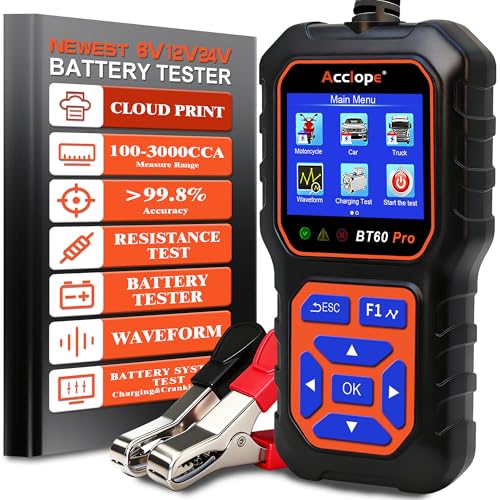
Tests 2-120Ah lithium and lead-acid batteries with QR cloud reports across 6V to 24V and 100-3000 CCA.
The Acclope BT60 PRO is a no-app, all-in-one battery analyzer that supports 6V, 12V, and 24V systems up to 3000 CCA. It works with lithium, AGM, GEL, EFB, and flooded batteries, diagnosing everything from SOH and SOC to cranking and charging performance.
The QR code feature lets you pull up and share reports without needing to pair a phone or download anything, making it a breeze for technicians on the go. Multi-language support is a nice touch for international use.
This tester handles everything from small motorcycle lithium batteries to large truck systems in one pass, making it a versatile tool for field checks. It performs well for repeated use, and while it covers basic LiFePO4 voltage and health checks, it’s best suited for common lithium chemistries.
If you’re a technician who switches between vehicle types and battery specs weekly, the BT60 PRO is a reliable workhorse that simplifies diagnostics.
|
8
|
La Crosse 911-65557-INT Portable Digital Battery Tester,Black |

Simple handheld tester for lithium button cells and common alkaline sizes using voltage range selection.
The La Crosse 911-65557-INT is a straightforward, portable tester for AAA, AA, C, D, N, 9V, and lithium button cells. You simply select the voltage range (1. 5V, 1. 2V, or 3. 0V) before inserting the battery, and the LED indicators show you whether it’s strong, weak, or dead.
The slide-out tray holds batteries securely during testing, and the touch contacts accommodate 9V lithium blocks without fuss. No complex setup, just plug and read.
This tester is ideal for travelers, hikers, or hobbyists who need to quickly check small lithium and alkaline cells. It’s app-free, requires no charging, and fits easily in a pocket or backpack. That said, it’s limited to basic voltage output, no internal resistance or capacity testing.
The durable plastic housing can handle a few drops, and the results are fast, but if you need detailed data logging or print features, you’ll want something more advanced. For a quick sanity check on household batteries, though, it’s hard to beat.
|
9
|
BT960 Car Battery Tester for Lead-Acid & Lithium Batteries with Printer,30-2000 CCA Automo |

Prints on-site reports for lithium and lead-acid batteries with leakage detection and temperature compensation.
The BT960 tester is built for professionals who need to test lithium, AGM, and flooded lead-acid batteries across a wide CCA range (30-2000). It checks voltage, CCA, and health with temperature compensation between -4°F and 122°F, ensuring accurate readings in extreme conditions. Leakage detection as low as 0.
01A warns of parasitic drain, and the integrated printer generates custom reports on the spot, complete with license plate numbers and dates. No more scribbling notes or relying on memory.
This tester is a powerhouse for auto shops or technicians who need to track lithium battery performance across multiple jobs. It covers seven electrical tests, including cranking, charging, and max load, with reverse polarity protection to guard against wiring mistakes.
The ability to print custom labels simplifies record-keeping, and the bulkier size is justified by its reliability and features. With a lifetime tech support offer and a three-year warranty, it’s built to last, and to give you peace of mind when battery diagnostics matter most.
From sorting through a drawer of dead AA batteries to diagnosing a failing 12V lithium pack in your RV, these testers cover a wide range of needs. Entry-level units give you a quick voltage check for small cells, while pro-grade models add load testing, temperature adjustments, and even on-demand printing.
The key is matching the tool to your battery type, voltage range, and what you actually need from the results, not just what features sound impressive.
Start by identifying whether you’re dealing with button cells, a 12V car battery, or something in between, then pick the tester that aligns with your setup and testing goals.
How To Interpret Lithium Battery Test Results
Recommended Products


A single voltage reading won’t tell you everything about how a lithium battery is performing. Capacity loss, increasing internal resistance, and how the battery behaves under load all play a role in its true health. Ignoring these factors can lead to premature replacements, or, worse, using a battery that’s actually unsafe.
Knowing which metrics matter most helps you avoid costly mistakes and keeps your lithium-powered devices running smoothly.
| Voltage Range | Condition | Action |
|---|---|---|
| 4.20-4.25V | Fully charged | Safe to use |
| 3.70-4.19V | Moderate charge | Monitor usage |
| 3.50-3.69V | Low charge | Recharge soon |
| 3.00-3.49V | Deeply discharged | Recharge immediately |
| Below 3.00V | Over-discharged | Check and recharge carefully |
- Capacity drops below 80% of rated Ah value.
- Internal resistance doubles compared to new baseline.
- Voltage collapses under rated load consistently.
- Cell swells or shows physical damage of any kind.
- Temperature rises excessively during normal use.
Maintaining Accuracy Over Time
Recommended Products


Battery testers aren’t foolproof, they can drift over time if not properly maintained. Loose connections, oxidized clamps, or even software delays can throw off readings, leaving you with inaccurate data. A little upkeep goes a long way in keeping your tester reliable, especially when you’re dealing with sensitive lithium chemistries.
First, always keep the tester’s terminals clean and corrosion-free. A quick wipe with isopropyl alcohol before testing can make a big difference, especially with lithium batteries where even a thin layer of grime can skew results.
Avoid probing swollen or hot cells directly, this isn’t just a safety precaution, but also a way to protect your tester from damage. Many modern testers auto-compensate for small deviations, but if you notice readings that don’t add up, a manual recalibration can help catch larger drift.
Storing your tester in a protective case when not in use keeps dust and impacts at bay, and replacing worn leads promptly is a must, poor conductivity can mimic faulty battery symptoms, leading you to draw the wrong conclusions. A little maintenance now means more accurate tests later.
Testing a lithium battery accurately isn’t just about plugging in a tester and reading the numbers, it’s about matching the right tool to your battery’s specific use case.
Start by confirming whether you’re dealing with a 12V car battery, a small button cell, or a high-capacity LiFePO4 pack, then choose a tester that aligns with its voltage range and chemistry. Pay attention to load testing, temperature effects, and internal resistance, not just voltage, for the most reliable insights.
And remember: a little upfront care for your tester can save you from headaches (and wasted batteries) down the road.

- 10 Best Battery For Generator Ev Battery Bank Marine 2026 - October 27, 2026
- 10 Best Battery For Generator Ev Battery Bank Lto 2026 - October 27, 2026
- 10 Best Battery For Generator Ev Battery Bank Low Voltage 2026 - October 27, 2026