Difference Between Lithium And Lithium Ion Battery
If you want rechargeable power for a power bank, phone, or UPS, choose lithium-ion; plain “lithium” often means a non-rechargeable lithium metal cell that must never be charged. The single most important spec to check is whether the cell is rechargeable and its nominal voltage. A common mistake is assuming all lithium cells are interchangeable, so first check the battery label for “Li-ion” or “Rechargeable” and the voltage rating.
Difference between lithium and lithium ion battery: lithium batteries use metallic lithium and are usually single-use (primary); lithium-ion batteries use lithium compounds and are rechargeable (secondary). Li-ion cells typically have nominal voltages around 3.6 to 3.7 volts and are used in phones, power banks, and solar generators.
Lithium vs Lithium Ion Basics
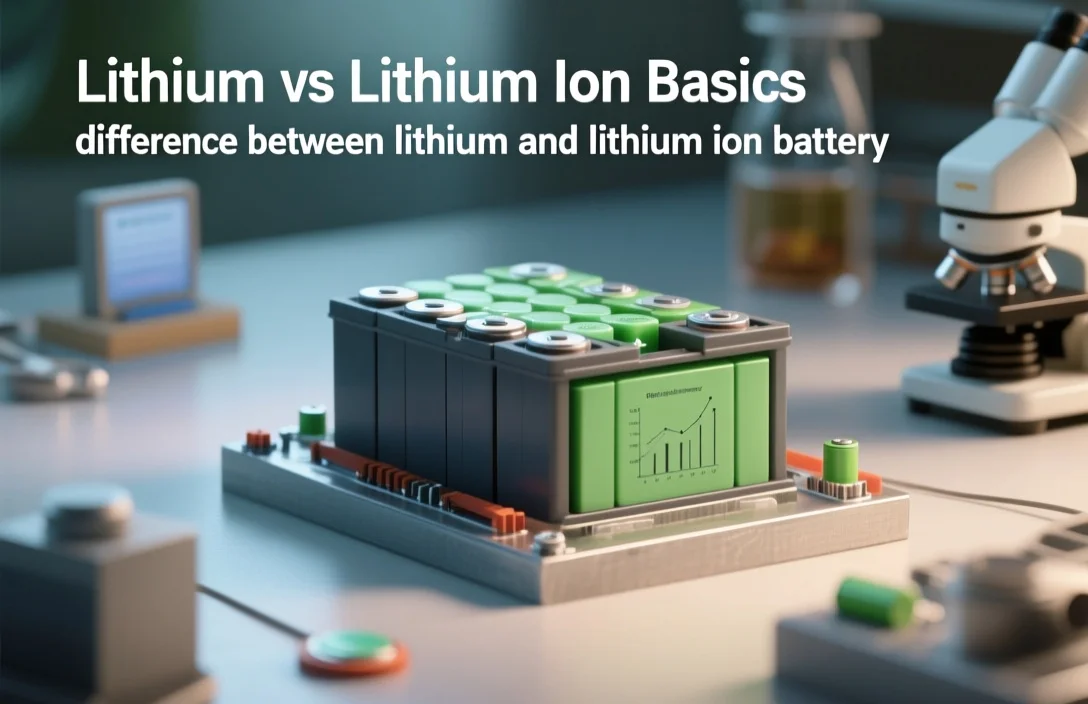
Primary metallic-lithium cells are single-use batteries that contain elemental lithium and must never be recharged, while lithium-ion cells are rechargeable batteries that use lithium compounds in their electrodes and require charging circuitry and a battery management system. The label word “lithium” can mean either type, so the exact marking matters for device compatibility and safety.
Primary lithium cells are built for long shelf life and one-time high-energy use, common where replacement is acceptable. Lithium-ion cells are built to be cycled hundreds to thousands of times, and charging them safely needs the right charger and protection electronics.
For example, coin cells and many camera or specialty AA/AAA “lithium” disposables use metallic lithium and are identified by cell codes and the word lithium on the package. Rechargeable devices such as phones, laptops, power banks, cordless tools, and electric bikes almost always use some form of lithium-ion chemistry and are labeled Li-ion, LiPo, LiFePO4, or similar.
| Attribute | Primary metallic-lithium | Lithium-ion (rechargeable) |
|---|---|---|
| Rechargeable? | No | Yes |
| Contains elemental lithium? | Yes | No, uses lithium compounds |
| Common products | Coin cells, camera disposables, specialty AA/AAA | Phones, laptops, power banks, e-bikes, power tools |
| Needs BMS/charger | No, do not charge | Yes, requires proper charger and protection |
| Risk if charged improperly | High, can catch fire | High, but managed with correct chargers and BMS |
Never attempt to recharge single-use lithium cells.
If you are unsure about a battery, check the device manual and the battery or package marking before attempting to charge or replace it. For replacements, prefer a labeled Li-ion pack when the device calls for rechargeable lithium chemistry, and dispose of single-use lithium cells through approved battery recycling channels if available.
Chemistry and Construction Differences
Lithium batteries use metallic lithium as an anode, while lithium-ion batteries employ intercalation chemistry with materials like graphite. This fundamental difference impacts their voltage, energy density, and safety characteristics.
In lithium batteries, the anode consists of pure lithium, which allows for a higher energy density but poses significant safety risks due to its reactivity. In contrast, lithium-ion batteries utilize materials such as lithium cobalt oxide or lithium iron phosphate in the cathode and graphite in the anode, which provide improved safety and stability.
The electrolytes also differ between these two battery types. Lithium batteries typically use a non-aqueous electrolyte that can be volatile, while lithium-ion batteries often use a liquid or polymer electrolyte that is designed to minimize risks associated with leakage and flammability.
“Lithium-ion technology has become the standard for consumer electronics due to its balance of safety, energy density, and cycle life.”
Cell formats vary as well. Lithium batteries are often found in specific applications like aerospace, while lithium-ion batteries are common in various formats:
| Cell Format | Description | Common Uses |
|---|---|---|
| Coin | Small, round cells | Watches, small electronics |
| Cylindrical | Standard battery shape | Laptops, power tools |
| Prismatic | Flat, rectangular cells | Smartphones, tablets |
| Pouch | Flexible, lightweight cells | Electric vehicles, drones |
Ultimately, the choice between lithium and lithium-ion batteries hinges on applications where safety, energy density, and longevity are critical factors. For most consumer electronics, lithium-ion batteries are favored due to their enhanced safety profiles and overall performance.
Voltage, Capacity, Runtime
Primary lithium (non-rechargeable) and lithium-ion (rechargeable) differ in typical cell voltages and in how capacity maps to usable energy, so you must compare watt-hours, not milliamp-hours, to predict runtime. Lithium-ion cells normally use a nominal cell voltage near 3.6 to 3.7 volts and an operating range roughly 4.2 volts full to about 3.0 volts empty, while primary lithium cells vary by chemistry (common coin and cylindrical types are often 3 volts or 1.5 volts nominal) and cannot be cycled.
Energy density per weight and volume also differs by specific chemistry; li-ion packs used in consumer gear usually give high energy per kilogram while certain lithium metal primaries can deliver even higher energy for single-use applications. That makes primary lithium attractive for long shelf-life, low-drain devices, and li-ion better for repeated use where cycle life and recharge behavior matter.
For example, a 3000 mAh cell at 3.7 volts equals about 11.1 Wh, while a 3000 mAh cell at 1.5 volts equals 4.5 Wh, so the higher nominal voltage delivers more usable energy for the same mAh rating.
Charging and Compatibility
Lithium metal cells, the non-rechargeable “lithium” batteries, must never be charged; lithium-ion cells are rechargeable and require a controlled charge profile plus protection electronics. Charging compatibility comes down to chemistry, required charge voltage/current, and whether the pack or cell has a battery management system, or BMS, to enforce safe limits.
Rechargeable versus non-rechargeable rules are simple in practice: do not attempt to charge primary lithium metal cells such as lithium coin cells or single-use AA/AAA lithiums. Lithium-ion, lithium polymer and other secondary lithium chemistries can be charged but only with chargers that provide the correct charge algorithm, usually constant-current then constant-voltage, and proper end-of-charge cutoff.
A BMS and protection circuits are the safety backbone for lithium-ion packs. A BMS cuts charge on overvoltage, opens the pack on over-current, balances cell voltages, and monitors temperature; many single cells also include a separate protection PCB. If a pack has no BMS, treat it as unsafe to charge with standard chargers unless the manufacturer explicitly allows it.
| Type | Rechargeable? | Protection required | What to check |
|---|---|---|---|
| Lithium metal (primary) | No | Do not charge | Do not connect to chargers, dispose/recycle per rules |
| Lithium-ion (secondary) | Yes | BMS, CC/CV charger | Charge voltage, max current, BMS presence, PD support |
Warning: Do not charge non-rechargeable lithium metal cells under any circumstances, and do not use unknown adapters or bypass protection circuits on lithium-ion packs.
Safety: Heat, Swelling, Failure
Metallic lithium primary cells are single-use and chemically more reactive, so they can vent or burn more violently if shorted, crushed, or heated; lithium-ion rechargeable cells use intercalation electrodes and normally include separators and protection, but they can still overheat, swell, and enter thermal runaway when abused. Safety behavior differs: lithium metal has higher intrinsic reactivity, lithium-ion usually fails from internal shorts or electrolyte breakdown after abuse or age.
For example, a crushed lithium primary AA cell can spark and flame quickly, while a damaged lithium-ion phone battery is more likely to swell first, leak gas, and then burn if charging continues or the internal short grows.
Device Fit and Use Cases
Primary lithium cells are single‑use batteries with high energy per cell and low self-discharge, commonly used in coin cells, remote controls, and some sensors. Lithium‑ion batteries are rechargeable packs used in phones, laptops, power banks, electric vehicles, and portable power stations because they support high cycle life and higher continuous currents.
When replacing or upgrading, match three things first: voltage (device rating and cell nominal voltage), capacity (mAh or Wh for runtime), and discharge capability (maximum continuous current or C‑rating). Also check physical size, connector/polarity, and whether the device expects a protected pack or simple single cells.
| Aspect | Primary Lithium (nonrechargeable) | Lithium‑Ion (rechargeable) |
|---|---|---|
| Typical applications | Coin cells (CR2032) in watches, key fobs, small sensors; AA/AAA lithium in cameras and smoke alarms where long shelf life matters. | Smartphones, laptops, cameras (as packs), power banks, electric bikes, EVs, solar generators, UPS units. |
| Nominal cell voltage | About 3.0V per cell for common primary lithium chemistries (check cell code). | About 3.6 to 3.7V per cell nominal, packs arranged in series/parallel to reach device voltage. |
| Rechargeable? | No, do not attempt to recharge. | Yes, requires correct charger and usually a battery management system, BMS. |
| Discharge capability | Good for low to moderate drain; some primary cells handle pulse currents but capacity falls with heavy draw. | Can be designed for high continuous discharge (power tools, EVs) or for energy density (phones); check A or C rating. |
| Replacement advice | Replace with the exact same cell code and size, never substitute with a rechargeable cell unless device supports it. | Replace packs with OEM or certified compatible packs that match pack voltage, capacity range, connector, and include appropriate BMS. |
For devices with safety or performance requirements, use a proper pack replacement rather than assembling cells yourself. High‑current tools, EVs, and medical devices need professionally built packs that include balancing and protection, otherwise you risk poor performance or charger mismatch.
For example, replacing a camera battery pack means checking the pack voltage, checking the camera manual for compatible part numbers, and preferring an OEM or well‑reviewed third‑party pack that lists pack voltage, Wh, and BMS features rather than mixing loose cells to save money.
Buying Checks and Troubleshooting
Lithium is a broad label that can mean either primary lithium metal cells, which are usually nonrechargeable, or lithium-ion, which names a family of rechargeable cells with an internal chemistry and a battery management system. Always confirm the chemistry on the label or datasheet before you buy or attempt to charge, because chargers and safe handling differ between primary lithium and lithium-ion cells.
Label or datasheet mismatch
Symptom: The cell or pack label says only “lithium” or lists capacity but no chemistry, charge voltage, or BMS details. Cause: Seller either omitted critical information or the product is repackaged, which hides whether the cell is primary or rechargeable. Fix: Do not charge the cell until you get a manufacturer datasheet; request proof of chemistry and recommended charge method, and return it if the vendor cannot provide it.
Symptom: Datasheet lists nominal voltage inconsistent with the pack label. Cause: Wrong parts or mislabeled inventory can cause overvoltage or undercharge when the wrong charger is used. Fix: Match chargers to the exact chemistry and charge voltage shown on the datasheet, and refuse items with conflicting specs.
Simple multimeter and load tests
Symptom: New battery shows unexpectedly low open circuit voltage or drops quickly under simple load. Cause: The cell may be deeply discharged, has high internal resistance, or is damaged from storage or transport. Fix: Measure open circuit voltage with a multimeter, and run a short, controlled load test to check behavior before committing to a full charge.
Symptom: Battery heats up, sparks, or the voltage collapses during load. Cause: Shorted or overheated cells, internal damage, or wrong chemistry for the charger. Fix: Stop the test immediately, isolate the battery, and follow safe disposal or return steps; do not try to revive a cell that behaves violently.
Signs of counterfeit or degraded cells
Symptom: Capacity claims that seem too large for the cell size, missing manufacturer markings, or inconsistent branding. Cause: Counterfeit sellers often relabel old, rewrapped, or low-quality cells to match popular part numbers. Fix: Avoid deals that look too good, buy from reputable distributors, and demand a datasheet and serial number traceability.
Symptom: Physical swelling, rust, sticky residue, or visible venting. Cause: Cell degradation, internal chemical failure, or exposure to moisture. Fix: Stop using the pack immediately, move it to a nonflammable surface, and contact the seller or a certified recycler; do not pierce or try to recharge swollen cells.
Return, warranty, and end-of-life disposal
Symptom: Battery fails testing within the warranty period or shows rapid capacity loss. Cause: Manufacturing defect, transport damage, or early cycle failure. Fix: Document your tests (voltage, load sag, pictures), contact the seller, and invoke the return or warranty process using date codes and proof of purchase.
Symptom: Battery is swollen, burned, or physically damaged and cannot be safely shipped. Cause: Internal short, thermal event, or physical damage. Fix: Isolate the battery in a safe container and contact local hazardous-waste recycling services; do not place damaged lithium or lithium-ion cells in household trash.
Quick Summary
Lithium batteries are distinct from lithium-ion batteries in composition, usage, and specific applications.
Frequently Asked Questions
What is the main difference between lithium and lithium ion batteries?
The main difference is that lithium batteries use metallic lithium as an anode, while lithium ion batteries use lithium compounds. This results in lithium ion batteries being rechargeable, whereas lithium batteries are typically single-use.
Are lithium and lithium ion batteries interchangeable in devices?
No, they are not interchangeable. Using a lithium battery in a device designed for lithium ion can damage the device and create safety hazards due to different voltage and charge characteristics.
How does heat affect lithium and lithium ion batteries?
Both types can generate heat during charging and discharging, but lithium ion batteries are more sensitive to high temperatures, which can lead to swelling or thermal runaway. It is crucial to keep them within a safe temperature range of 0°C to 45°C during operation.
What is the typical runtime of lithium versus lithium ion batteries?
Runtime can vary widely, but in general, lithium ion batteries tend to have a higher energy density, meaning they can provide longer usage times for the same size and weight compared to lithium batteries. Always check the specific capacity rating in milliamp hours (mAh) for accurate comparisons.
When should I replace my lithium or lithium ion battery?
For lithium ion batteries, consider replacing them after 300 to 500 charge cycles or when they hold significantly less charge than when new. For lithium batteries, they should be replaced once they show signs of depletion or leakage, as they are not rechargeable.

- Top 10 Best Solar Battery Installers Qld 2026 - September 12, 2026
- Top 10 Best Solar Battery Deals Qld Reviews 2026 - September 12, 2026
- Top 10 Best Solar Battery Deals Qld Price 2026 - September 12, 2026