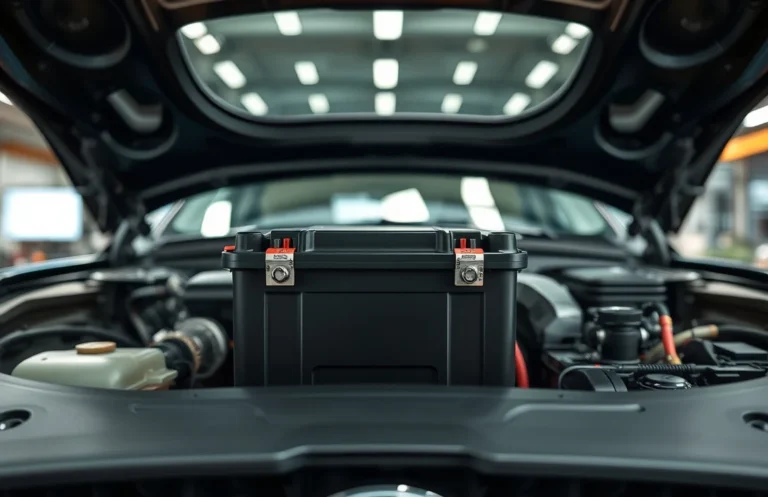
Car Battery Voltage at Rest, While Running and in Cold Weather
I would check car battery voltage before it becomes a roadside problem: a resting reading around 12. 4V to 12. 7V usually means the battery is holding enough charge, while a number drifting lower is your early warning.
If the reading jumps too high once the engine is running, the charging system may be cooking the battery instead of feeding it.
This piece keeps the focus on the voltage ranges that actually matter, then matches them to testers and meters that make the check simple enough to do in your driveway.
Why Your Car Battery Voltage Isn’t Just 12V
The “12 volt” label is really a moving target. Charge level, heat, cold, and battery age all nudge the number up or down, so a single glance at 12. 0V can mean anything from “fine yesterday” to “sulfated and tired.
” My read is that the useful skill is not memorizing one perfect figure; it is knowing whether the battery sits in the healthy band at rest, whether the alternator pushes it into the normal charging band while running, and when an odd reading means stop driving.
At Rest (Engine Off)
With the engine off and the car sitting for several hours, I would want to see **12. 4V to 12. 7V** on a healthy 12V battery, roughly a **75-100% charge**. Once it slips under **12. 2V**, starts can get lazy and a no-start may be close.
A resting result **below 12V** often points to sulfation or a battery near retirement. For the cleanest number, test with the engine off and lights, chargers, and accessories unplugged.
While Driving (Engine On)
Once the engine is running, the alternator should pull the reading up to about **13. 8V-14. 4V**. I would treat **below 13. 5V** as a possible charging-system weakness, especially if headlights dim at idle. On the other end, **above 14.
5V** suggests overcharging, which can vent electrolyte and shorten battery life. A steady reading inside the normal band is the quick confirmation that the charging path is doing its job.
Cold Weather Adjustments
Cold weather can make a strong battery look merely adequate. In freezing conditions, a fully charged battery may show **12. 2V-12. 4V** instead of the warmer-weather **12. 6V**, so context matters before condemning it.
If winter readings keep sagging after a drive, I would recharge and retest rather than assume the battery is finished. Give the battery a few minutes to settle after extreme cold or heat so the number is not skewed by temperature alone.
| Voltage Range (Engine Off) | Charge Level | Action Needed |
|---|---|---|
| 12.4V-12.7V | 75-100% charged | Healthy; no action |
| 12.2V-12.3V | 50-75% charged | Charge soon or check load |
| 12.0V-12.1V | 25-50% charged | Charge ASAP; test for sulfation |
| Below 12.0V | 0-25% charged | Jump-start or replace |
Tools to Check Your Car Battery Voltage Accurately
A basic multimeter can answer “is it roughly alive? ”, but a dedicated tester tells you much more: cranking condition, alternator output, internal resistance, and whether the battery is quietly losing capacity.
I would shortlist from the group below based on the job at hand, fast go/no-go checks in the driveway, deeper troubleshooting before a long trip, or a permanent voltage readout for a boat, RV, or work truck.
|
1
|
MOTOPOWER MP0514A 12V Digital Car Battery Tester Voltmeter and Charging System Analyzer wi |
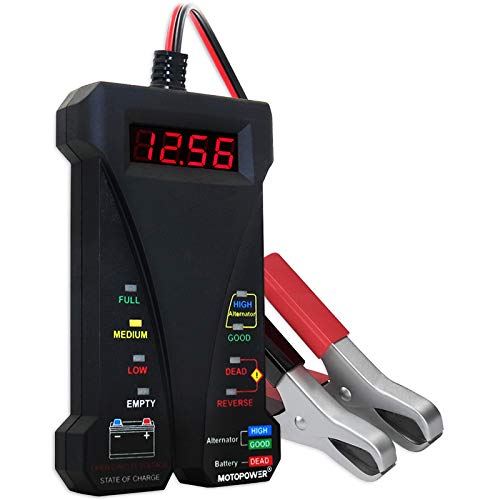
I would shortlist this one for the safety margin alone: reverse-polarity protection plus over-voltage protection, paired with a precise 0.01V LCD for people who want a simple read without babysitting the setup.
The MOTOPOWER MP0514A leans into **plug-and-test simplicity**: connect the clips, read the screen, and skip the complicated setup. Its **4-digit LCD** resolves down to **0. 01V**, and the **8 colored LEDs** give a fast visual status read when you do not want to interpret numbers in a cold garage.
The **black rubber paint** adds grip, which matters when the tester comes out of a glove box at night. At under $20, it makes sense for occasional checks where accuracy matters more than deep diagnostics.
This is the tool I would reach for for **quick battery-and-alternator checks** before a road trip, not for full load analysis. The **4-20V range** covers common 12V scenarios, but it does not prove cranking strength the way a load test can.
If the battery is already borderline dead, I would pair the reading with a jump starter rather than treat one voltage number as the whole story.
|
2
|
ANCEL BA101 Car Battery Tester, 12V Digital Automotive Alternator Meter Diagnostic Tool,10 |

The Project Farm videos give this one unusual visibility, and the SOH/SOC readouts are the kind of early warning I would want before a battery strands someone far from home.
The ANCEL BA101 is built around clarity: **State of Health (SOH)** and **State of Charge (SOC)**, plus **voltage, current, CCA**, and cranking/charging tests, so the result is easier to act on than a raw number alone.
The **copper crocodile clips** are a small detail that can matter for stable connections, and the **adjustable contrast with white backlight** helps in glare or dusk. With a **100-2000 CCA range**, it covers many passenger vehicles and some marine batteries, while **multi-language support** keeps the menu from becoming the barrier.
I would use this for **preventive maintenance**, especially when the goal is catching decline before it becomes a no-start. The limit is that it stays in the **12V** world, so it is not the pick for mixed 24V fleets.
The **black-and-white screen** is more practical than flashy, and the **protection design** helps justify the step up for owners who want more than a basic voltmeter.
|
3
|
DaierTek Battery Voltage Meter Waterproof DC 12V 24V LED Voltmeter Panel 12 Volt 24 Volt 3 |

For a dashboard or panel that stays installed, this waterproof LED voltmeter is the one I would consider for boats, off-road rigs, or any vehicle where moisture is part of the job.
The DaierTek meter is meant to be mounted and forgotten, with a **blue LED display** that stays readable when cabin lighting is poor. Its **waterproof ABS housing** is the real story here, giving it a better shot in marine spray, rain, or dusty trail conditions.
It covers **8-48V**, so it is not locked to passenger cars, and the **panel plus nylon nut** setup supports either a 29mm hole or the included matching panel.
This is less a diagnostic tool and more a **live monitor** for RVs, boats, ATVs, trucks, and similar equipment. It will not load-test a battery or walk you through cranking and charging tests, so I would not ask it to do a handheld tester’s job.
If the need is continuous awareness rather than occasional troubleshooting, the permanent-mount format is the point.
|
4
|
Jebsens USB C Car Charger Adapter with Voltage Display, 30W Cigarette Lighter Type C Fast |

I would keep this in mind when the same 12V socket needs to charge a phone and quietly keep an eye on battery voltage without adding another gadget to the cabin.
The Jebsens adapter is really two tools sharing one plug: a **30W USB-C/USB-A charger** with PD and QC 3. 0 support, plus a **voltage display** claimed at **±0. 2V** accuracy. The screen is bright enough to notice but designed not to turn into a distraction at night.
With **dual ports**, it can top up two devices while still giving a quick look at whether the electrical system is behaving.
This makes the most sense for **everyday drivers** who want passive awareness during normal commuting. It is not going to diagnose a failing alternator or prove cranking amps, so I would treat it as a convenience with a useful side job.
In direct sun the small display may be harder to read, but if the goal is zero-extra-bulk monitoring, it earns its socket space.
|
5
|
KONNWEI KW208 12V Car Battery Tester, Battery Load Tester Automotive 12V Alternator Starte |

The galvanized alloy clips and the claimed 99.7% accuracy are why I would look twice here: it reads like a tool aimed at people who care about contact quality and repeatable numbers.
The KONNWEI KW208 covers the core battery jobs in one handheld unit: **100-2000 CCA** support across flooded, AGM flat plate, AGM spiral, and gel batteries, plus cranking, charging, alternator, and starter tests. The listing leans hard on its **smart AI chip** for fast, **99.
7% accurate** results, while the updated **galvanized alloy clips** are meant to improve contact, durability, and safety. It also translates raw data into advice on whether to recharge or replace, which is useful when the numbers are clear but the decision is not.
This is the one I would point a DIYer toward when they want one tester for routine checks and deeper diagnosis without jumping straight to pro-level pricing. The tradeoff is portability: it is more tool than keychain gadget, and it is still centered on **12V batteries**.
If your garage sees frequent battery questions, the breadth here is compelling.
|
6
|
TOPDON BT100 12V Car Battery Tester, Automotive Battery Load Tester | 100-2000 CCA Auto Ba |

The passive power-on approach stands out to me because it removes the awkward moment when the tester itself needs juice before it can judge a dead battery.
The TOPDON BT100 is designed around **safe passive testing**: it powers on only when properly connected, so a dead vehicle battery does not leave you with a dead tester too.
It handles **100-2000 CCA** batteries across flooded, AGM flat plate/spiral, EFB, and gel types, then lays out **SOH, SOC, voltage, current**, and other readable data. The three-test flow, battery health, cranking, and charging, gives a structured way to separate a tired battery from a charging problem.
I would keep this one in the glove box for **emergencies and pre-trip checks**, especially when the vehicle might not have enough power to wake up accessories.
The caveat is that alternator/charging-system insight is more limited than on some rivals, so it may not be the only tool needed for a full diagnosis. For quick roadside confidence, though, the passive-start logic is genuinely useful.
|
7
|
MUQIDA Car LED Cigarette Lighter Voltmeter, DC 12V-24V Vehicle Cigarette Lighter Digital V |

If I wanted the easiest possible voltage check with no wiring and no clamping, a cigarette-lighter plug-in meter like this is the lowest-friction format.
The MUQIDA voltmeter goes straight into the **12V lighter socket** and shows battery voltage with **red and blue dual-color LEDs**. The **ABS build** is meant for ordinary cabin abuse, and the larger display is easier to catch at a glance than tiny integrated readouts.
Because it is sold in **one-piece or two-piece sets**, it can make sense for a single daily driver or for households tracking more than one vehicle.
This is best viewed as **casual monitoring**, not diagnosis. It will show trends and obvious trouble, but the format is not built for decimal-level precision or load testing. Vehicles without a lighter socket are out of luck, and anyone needing detailed battery health should step up to a clip-on tester.
For a simple “is the voltage behaving? ” readout, it is hard to make simpler.
|
8
|
ecocstm Car Battery Voltage Meter, DC 12V 24V Digital Volt Gauge Meter | Waterproof 12v Ba |
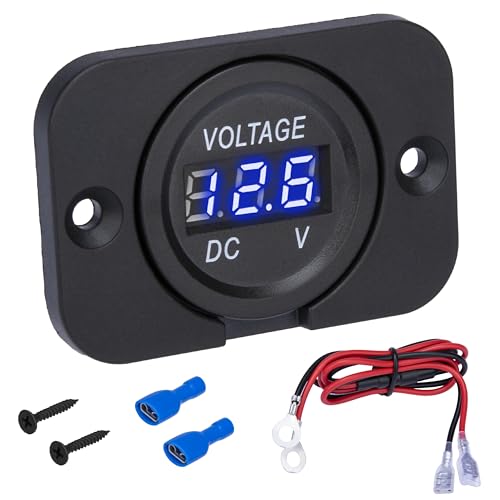
For 12V and 24V environments where water, vibration, and non-automotive voltage are all on the table, this waterproof panel meter is the kind I would shortlist.
The ecocstm voltmeter spans **5-48V** with **0. 1V** resolution, which opens it beyond cars to boats, RVs, trucks, tractors, and solar-style setups. Its **waterproof ABS housing** and **copper wiring** are aimed at installs where exposure is expected rather than accidental.
The included mounting hardware makes it more of a project part than a pocket tool, and the LED display keeps the read visible when lighting is less than ideal.
I would choose this for **permanent monitoring in harsh environments**, not for weekend battery forensics. It will not perform cranking, CCA, or internal-resistance tests, so it should not replace a dedicated tester when failure diagnosis is the goal.
If the priority is a rugged voltage window across mixed voltages, the wide range is the reason to consider it.
|
9
|
ANENG 12V Car Battery Tester,Automotive Voltmeter and Alternator Analyzer | Digital Automo |

The LCD-plus-LED dual display is a practical touch: one readout for the number, another for fast status, which I would appreciate when checking different vehicles under changing light.
The ANENG BT172 pairs an **LCD screen** with **LED indicators** for battery and alternator status, which makes the result readable at a glance and still precise enough to note.
It tests **4-30V DC** and includes **reverse-polarity protection**, useful when the job happens quickly and the clips are not always perfectly placed. The three modes, alternator, battery, and combined, give it enough flexibility for cars, trucks, RVs, and similar 12V systems.
This lands in the **general-purpose** bucket: more informative than a plug-in meter, less specialized than premium diagnostic testers. The limitation is that it does not replace a proper load test when cranking strength is the question, and smaller clamps can be awkward on bulky terminals.
For owners who want clear readouts without a steep learning curve, it hits a sensible middle ground.
|
10
|
Anina Real-time Battery Voltage Meter for Car & Marine, Waterproof DC 12V 24V Battery Moni |
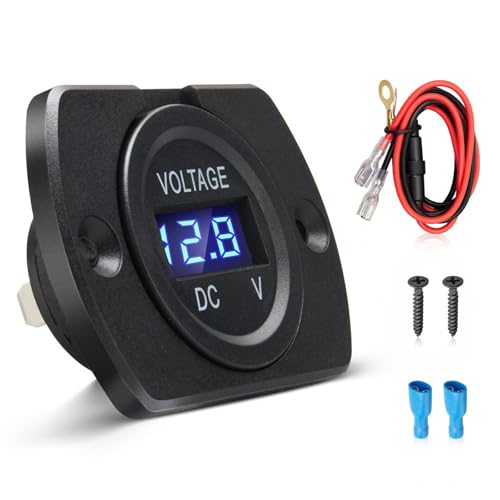
A permanent 6V-30V panel readout is what I would want for continuous awareness on solar, RV, boat, or light-duty setups where voltage behavior matters over time.
The Anina meter is built to live on the panel, with a **29mm mounting kit** and a display covering **6-30V** at **0. 1V** accuracy. The **waterproof design** suits installs where splashes and weather are normal, and the **blue LED** remains readable across changing cabin or cockpit light.
Included screws and wiring keep the project straightforward for someone comfortable with a basic panel install.
This is an **always-on monitor**, not a troubleshooting instrument, so it will not decide whether a battery needs replacement by itself. Because it is fixed in place, it is less flexible than a handheld tester that can move from vehicle to vehicle.
If the goal is a constant voltage reference for a non-standard setup, that permanence is exactly the appeal.
Across this group, I would separate the picks by job rather than by brand noise. For simple clip-on checks, the **MOTOPOWER MP0514A** is the easy starting point; for deeper battery context, the **KONNWEI KW208** and **ANCEL BA101** make more sense.
The **TOPDON BT100** stands out when the battery may be too weak to power the tester itself. If the need is a fixed readout, the **Anina** and **ecocstm** panel meters fit that role better than any handheld.
Decide first whether you want portability, diagnostics, or permanent monitoring, then the right tool gets obvious.
How to Test Your Battery Voltage Correctly
A bad method can make a decent battery look guilty. Before trusting any number, I would make sure the test conditions are boringly consistent: engine off for a resting reading, engine running for charging output, and no charger or heavy accessory muddying the result.
Turn off the engine and all electronics (headlights, radio) for **at least 30 minutes** to ensure an accurate resting voltage.
Locate the **positive (+) and negative (-) terminals** on the battery. Clean corrosion from the posts with a wire brush if needed.
Connect the **red clamp to the positive terminal** and the **black clamp to the negative terminal**. Reverse polarity can damage testers, double-check connections.
For **alternator testing**, start the engine and let it idle. Readings should stabilize at **13.8V-14.4V** within 30 seconds.
If voltage drops **below 12.4V at rest** or **below 13.5V while driving**, the battery or alternator may be failing. Repeat tests to confirm trends.
- Avoid testing in **extreme cold**, wait 10-15 minutes after driving to warm the battery for accurate readings.
- Never use a **multimeter alone** for load testing; dedicated battery testers provide cranking amp data.
- If your tester has **LED indicators**, cross-reference them with the numeric reading for a full picture of battery health.
- For **AGM or GEL batteries**, use a tester with **low internal resistance testing**, standard multimeters won’t cut it.
- If voltage fluctuates **wildly**, check for **loose connections** or a **failing alternator diode**.
When to Replace Your Battery (And How to Extend Its Life)
Voltage is the first clue, not the entire verdict. Cranking amps, internal resistance, age, heat exposure, and repeated deep discharges all shape how a battery behaves in the real world, so the smart move is reading voltage alongside the warning signs your car is already giving you.
Voltage + Age Combo
If the battery is **5+ years old** and rests **below 12. 2V**, I would start planning for replacement rather than chasing one more recharge. Normal voltage can still hide slow cranking or dim lighting when internal resistance has crept upward.
AGM batteries often last longer under the right conditions, but deep discharge and heat can age them faster than the calendar suggests.
Alternator Issues
When the engine is running, a reading that will not climb past **13. 5V** points my suspicion toward the charging side, especially with dim lights or a battery that keeps running down. Sustained **14. 5V+** is the opposite problem: overcharging can cook a battery and shorten its life.
If the number wanders, test the alternator and charging path separately rather than blaming the battery by default.
Physical Signs
Corroded terminals, a **swollen case**, or a **rotten-egg smell** moves this from maintenance to safety. Those signs can mean leakage, gas venting, or internal damage, and I would not keep driving on guesswork.
If the battery will not hold a charge after a proper recharge, internal plate damage is likely; replacing it early is cheaper than towing, electrical damage, or worse.
| Symptom | Likely Cause | Solution |
|---|---|---|
| Car cranks slowly | Weak battery or bad connections | Test voltage; clean terminals |
| Electronics flicker at idle | Faulty alternator or loose belt | Check alternator output |
| Battery dies after short drives | Sulfated battery or parasitic drain | Load test; check for drains |
| Corroded terminals | Electrolyte leakage | Replace battery; clean terminals with baking soda |
For most vehicles, the quick target is simple: about **12. 4V-12. 7V with the engine off** and roughly **13. 8V-14. 4V while driving**. I would check monthly, after long sits, before winter trips, and any time the engine sounds slower than usual.
If you want the easiest entry point, start with the **MOTOPOWER MP0514A**; if you expect to diagnose more than yes/no, the **KONNWEI KW208** is the deeper tool. Either way, the habit matters more than the gadget: catch the drift before the driveway silence does it for you.

- Marine Chargers and Backup Batteries: 9 Options Compared (2026) - October 27, 2026
- LTO Cells vs. SLA Generator Batteries: 5 Options Compared (2026) - October 27, 2026
- 12V/24V Backup Batteries and the EcoFlow DELTA Pro 3 (2026) - October 27, 2026