How Much Is A Battery Charge?
Figuring out what a battery charger costs really depends on the gear you need and the chemistry of your batteries. A simple trickle charger for a car works differently than a multi-bay unit for household electronics, and the price tags reflect that gap.
You might find basic maintainers at one end of the spectrum and advanced smart chargers with repair modes at the other. Knowing these distinctions keeps you from overspending on features you won’t use or buying something unsafe.
Let’s break down what drives the cost behind different charging solutions, then look at specific examples to see how current market pricing stacks up against what you actually need.
Why Battery Charge Prices Vary So Much
Recommended Products


When we talk about cost, it’s not just about the sticker price on the box. Different battery chemistries demand specific charging algorithms to avoid damage, and the level of safety and automation built into a unit can swing the price significantly across categories.
In my experience, charging costs track closely with complexity and safety mechanisms. Simple lead-acid maintainers often cost less because they push low amperage without sophisticated monitoring. On the flip side, smart chargers designed for lithium or AGM batteries pack microprocessors that adjust voltage on the fly.
These units prevent overcharging through multi-stage algorithms that detect issues like sulfation or temperature spikes. Higher prices usually reflect better build quality and certifications like UL listing. Cheap chargers might skip reverse polarity protection, which risks frying an expensive battery or causing an electrical fire.
I’d weigh those upfront savings against the potential headache of replacing damaged gear. The real cost includes longevity and reliability, not just what you pay today. Investing in the right technology usually means safer operation for years to come.
- Match charger voltage exactly to your battery type to avoid permanent damage.
- Verify amperage ratings suit your battery capacity for efficient charging times.
- Prioritize models with automatic shutoff to prevent dangerous overheating risks.
- Check compatibility lists before purchasing to ensure safe chemical interaction.
- Consider long-term maintenance features like desulfation for extending battery lifespan.
Chargers That Answer Your Cost Question
Recommended Products


I’ve pulled together ten products that cover distinct price points and use cases across the market. Each option tackles a specific charging need while showing how costs are structured right now.
Looking at them should clarify which features actually justify a higher price tag versus where a budget alternative makes sense.
|
1
|
MOTOPOWER MP00205A 12V 800mA Automatic Battery Charger, Maintainer, Trickle and Desulfator |

Low-cost 12V maintainer answers budget questions for lead-acid battery upkeep.
The MOTOPOWER MP00205A acts as an entry-level solution for 12V lead-acid batteries. With an 800mA output, it’s built more for maintenance than rapid recharging. Its automatic desulfation feature helps recover aged batteries without you having to intervene manually.
Spark-free connections and zero standby drain address common safety worries at this price point. It handles flooded, AGM, and gel cell chemistries universally, which makes it a cost-effective pick for seasonal vehicle storage. You get essential protection features without paying for high-amperage capabilities you likely don’t need.
This charger fits well if you’re storing motorcycles, boats, or lawn equipment during winter months. It maintains voltage at 13. 6V indefinitely once the battery is full. However, keep in mind that the 800mA output means deeply discharged batteries could take days to recover.
If you need quick starts, you’ll want to look elsewhere for higher amperage. The compact design mounts easily in tight engine bays or garages. Reliability seems solid for basic maintenance despite the lower price tier. It answers the cost question for users who prioritize preservation over speed.
|
2
|
POWEROWL 8 Bay AA AAA Battery Charger, USB High-Speed Charging, Independent Slot, for Ni-M |
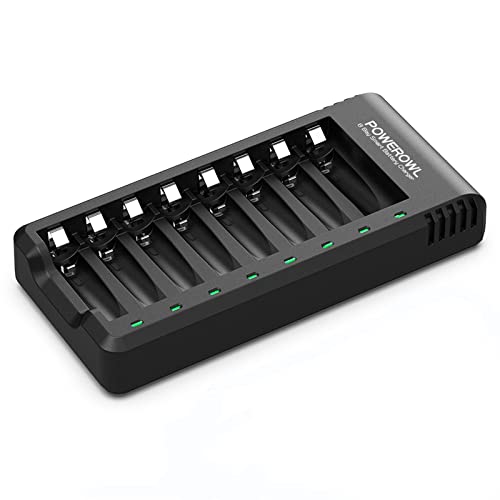
Eight-slot USB charger shows cost efficiency for bulk NiMH household batteries.
POWEROWL’s 8-bay charger targets users managing multiple AA or AAA NiMH cells at once. Independent slots let you mix sizes and charge odd quantities efficiently. Since it uses USB input, you can power it from laptops or wall adapters flexibly.
Trickle charging extends battery life by preventing overcharge damage automatically, and LED indicators give you visual status updates for each individual slot. Safety certification ensures reliable operation for daily household electronics. This unit demonstrates how mid-range pricing balances capacity with modern convenience features.
Families with numerous wireless devices benefit most from this high-capacity design. Charging eight batteries at once reduces downtime significantly compared to smaller units. Just note that it requires a separate 5V/2A adapter for optimal performance; without adequate input power, charging speeds decrease noticeably across all slots.
The independent circuitry prevents one bad cell from blocking the others. Durability holds up well under frequent daily use cycles. It represents good value for households standardizing on rechargeable NiMH chemistry.
|
3
|
Rechargeable AA Batteries with Charger, High Capacity 2800mAh Ni-MH Double A Battery, 4 Co |

Bundled 2800mAh set illustrates total cost of ownership for new users.
This kit combines four 2800mAh AA batteries with a dedicated four-slot charger. The high capacity suits power-hungry devices like cameras or game controllers. The included charger features a repair mode for reviving over-discharged cells, while intelligent protection prevents short circuits and stops charging when full.
Its portable design supports travel without carrying bulky separate components. Bundling eliminates compatibility guesswork for beginners entering the world of rechargeables. This package answers cost questions by showing complete system pricing upfront.
New adopters appreciate having matched components ready to use immediately. The repair functionality extends usable life beyond what standard chargers offer. Lightweight construction makes it practical for photographers or travelers.
Limitations include slower charging speeds compared to standalone premium units, and four slots may restrict heavy users needing faster turnover rates. Still, the bundled value proposition remains strong for moderate consumption. It simplifies the entry barrier for those calculating initial investment costs.
|
4
|
Amazon Basics Rechargeable Battery Charger for AA & AAA Ni-MH Batteries with USB Port, Por |

Travel-friendly AC charger demonstrates mid-tier pricing for portable reliability.
Amazon Basics offers a straightforward AC charger for AA and AAA NiMH batteries. Flip-down plugs enable compact packing for international travel, and universal voltage support works globally without external converters. A USB port adds device charging capability alongside battery replenishment. Over-charge protection and wrong polarity safeguards ensure safe operation.
The paired charging requirement reflects simpler internal circuitry at this price point. It represents accessible mid-tier pricing for reliable everyday performance.
Frequent travelers value the slim profile and switching power ability. Charging two or four batteries simultaneously covers most portable device needs, and the USB output provides emergency phone charging during transit. However, paired-only charging wastes time if you have odd numbers. Build quality feels adequate but lacks premium tactile feedback.
Safety cut-offs function reliably to prevent overheating incidents. This unit answers cost questions for users prioritizing portability over advanced features.
|
5
|
PZ.P 15-Amp 12V/24V Smart Battery Charger, Maintainer & Trickle Charger for LiFePO4, Lead |

15A smart charger justifies premium cost with LiFePO4 compatibility and diagnostics.
PZ. P’s 15-amp unit commands higher pricing through advanced multi-chemistry support. Nine-stage charging optimizes both LiFePO4 and lead-acid batteries safely. A color LCD displays real-time voltage, current, and temperature data clearly, while pulse repair technology attempts to restore sulfated batteries automatically.
Temperature compensation adjusts parameters for seasonal accuracy, and extended cables reach difficult battery locations in trucks or boats. This feature density explains why smart chargers cost more than basic models.
Professional mechanics and RV owners benefit from comprehensive diagnostic feedback. Fast 15A output reduces downtime for large automotive batteries significantly. Winter and summer modes prevent climate-related charging errors effectively. Note that it cannot activate completely dead batteries requiring a jump-start first.
The higher price reflects genuine utility rather than marketing gimmicks here. Durability suits shop environments with frequent daily use. It answers cost questions for users needing professional-grade versatility and speed.
|
6
|
12V 2A Lead-Acid Battery Charger and Maintainer, Trickle Charger for Lawn Mower, Car, Boat |

2A maintainer shows affordable middle ground for small engine upkeep.
This 12V 2A charger targets lawn mowers, ATVs, and backup power systems. Moderate amperage balances charging speed with gentle maintenance safely. An ABS flame-retardant shell meets safety standards at accessible pricing. LED indicators simplify status monitoring without complex screens, and a desulfation function helps restore neglected batteries over time.
Compatible with flooded, AGM, and gel types broadly, it occupies the affordable middle ground between trickle maintainers and fast chargers.
Homeowners with multiple small engines find this amperage ideal. It’s faster than 800mA units yet gentler than high-amp automotive chargers. Built-in protections guard against common connection mistakes safely. While it lacks the digital display found on premium smart charger models, its compact size stores easily in toolboxes or sheds permanently.
Reliable performance justifies the modest investment for seasonal equipment. It answers cost questions for users maintaining diverse small-engine fleets affordably.
|
7
|
Amazon Basics Smart Battery Charger for Rechargeable AA and AAA NiMh Batteries, 4-Bay, Fas |

Individual slot charging explains price premium over paired-only budget models.
Amazon Basics Smart Charger charges each NiMH battery independently, unlike cheaper paired designs. Rapid charging completes two AAs in 3. 5 hours efficiently. LED indicators show individual status for precise monitoring, and a foldable plug maintains a travel-friendly form factor despite added intelligence.
Detection technology prevents wrong polarity insertion damage automatically. Individual charging justifies slightly higher cost through superior flexibility. It bridges the gap between basic paired chargers and professional multi-bay units.
Users with mixed battery states appreciate independent slot management. You’re no longer forced to pair mismatched capacities or charge levels. Fast charging speeds reduce rotation delays for active users. It requires an AC plug converter for non-American regions internationally, but the slim profile still fits easily in luggage or drawers.
Reliability matches expectations for daily household use patterns. This explains why individual charging commands a premium over simpler paired alternatives.
|
8
|
Car Battery Charger 12V 15A Smart Trickle Charger Fully Automatic | Battery Maintainer wit |

LCD-equipped 15A charger demonstrates value of visual feedback at mid-premium cost.
This 12V 15A charger adds LCD visualization to smart charging functionality. Dual seasonal modes adjust voltage based on ambient temperature readings, and an eight-layer protection suite covers electrical faults comprehensively. Pulse repair mode targets sulfation in aging lead-acid batteries, and it supports both LiFePO4 and traditional chemistries versatilely.
Plug-and-play operation simplifies use despite advanced features. Visual feedback justifies the cost increase over indicator-light-only models.
DIY enthusiasts appreciate seeing exact voltage and percentage progress. Temperature compensation prevents seasonal charging errors automatically, and manual mode selection allows customization for specific battery conditions. You shouldn’t operate it unattended beyond twelve hours continuously. Cable lengths accommodate most passenger vehicle installations adequately. Build quality supports occasional garage use reliably.
It demonstrates how displays add tangible value at reasonable price premiums.
|
9
|
Sfmn® 2016 New Mobile Universal Battery Charger + USB-Port for Smartphone Battery |

Universal mobile charger addresses niche cost question for removable smartphone batteries.
Sfmn’s universal charger targets removable smartphone batteries specifically. Adjustable contacts accommodate various battery sizes and shapes flexibly. An LCD screen indicates connection status and completion clearly, while a safety cut-out circuit prevents overcharging delicate lithium cells. A USB port allows simultaneous device charging conveniently.
This niche application explains its specialized pricing structure. It answers cost questions for users maintaining older phones with swappable batteries.
Legacy phone users or technicians benefit from the adjustable contact design. It eliminates the need for model-specific proprietary chargers entirely. Note that a protective film must be removed before first use. Charging speeds remain slow compared to modern USB-C standards, and limited availability makes finding replacements difficult long-term.
Still, it serves a critical niche where alternatives no longer exist. It justifies cost through unique compatibility rather than performance metrics.
|
10
|
BONAI AA AAA Battery Charger 16 Bay for NiMH Rechargeable Batteries Independent Control wi |

Sixteen-bay capacity shows economies of scale for high-volume NiMH charging.
BONAI’s 16-bay charger maximizes throughput for heavy NiMH users. Independent control allows any combination of AA and AAA cells. A standard AC cord eliminates bulky external power bricks. LED indicators show charging, complete, and error states individually.
Silent operation avoids annoying buzzing sounds during overnight use, and wide voltage compatibility works internationally without converters. Bulk capacity demonstrates how per-slot cost decreases at scale.
Photographers, gamers, or offices draining dozens of batteries weekly benefit most. Mixing sizes and quantities optimizes charger utilization efficiently. Heating during use requires ventilation but remains within safety limits. It cannot charge alkaline or lithium chemistries safely. A twelve-month warranty provides assurance for intensive commercial use.
Per-slot economics improve dramatically versus smaller units. It answers cost questions for users prioritizing maximum volume throughput.
These examples span the full spectrum of battery charging costs and capabilities. From basic maintainers to professional smart chargers, each serves distinct needs. Understanding these differences helps match spending to actual requirements rather than assumptions.
Calculating True Ownership Cost Beyond Sticker Price
Recommended Products


Initial purchase price tells only part of the story. Energy consumption, battery longevity, and replacement frequency determine real expenses over time. Evaluating these factors reveals hidden costs or savings opportunities.
| Cost Factor | Budget Chargers | Smart Chargers |
|---|---|---|
| Energy Efficiency | Lower standby draw | Optimized charging cycles |
| Battery Lifespan Impact | Shorter due to heat | Extended via regulation |
| Safety Risk Cost | Higher failure probability | Protected investment |
| Replacement Frequency | More frequent purchases | Longer intervals |
Smart chargers often pay for themselves through extended battery life alone. Proper voltage regulation prevents the overheating that degrades internal chemistry prematurely. A battery lasting three years instead of one saves significant replacement costs. Energy-efficient designs also reduce electricity bills during long maintenance cycles.
Safety features prevent catastrophic failures that could damage vehicles or property. Budget chargers may seem cheaper initially but accumulate hidden expenses over time. I’d consider total cost of ownership when comparing options across price tiers. The math often favors investing in quality upfront for frequently used equipment.
Matching Charger Specs to Your Actual Needs
Recommended Products

Overbuying wastes money just as surely as underbuying risks damage. Accurate assessment of your specific batteries and usage patterns guides smarter purchases. Avoid paying for capabilities you will never utilize.
Identify exact battery chemistry and voltage requirements before shopping.
Calculate typical discharge depth to determine necessary amperage rating.
Assess storage duration to decide between charger and maintainer functions.
Count simultaneous batteries needed to select appropriate bay quantity.
Verify physical space constraints for installation or storage location.
When Basic Maintenance Suffices
Seasonal vehicles stored for months need only low-amperage maintenance. Trickle chargers or maintainers preserve charge without stressing batteries. Paying for fast-charging capabilities wastes money on unused features. Simple LED indicators provide adequate feedback for set-and-forget applications. Focus spending on reliability and safety rather than speed or displays.
This approach minimizes cost for infrequently accessed equipment effectively.
When Smart Features Justify Cost
Daily drivers or critical equipment benefit from advanced monitoring and repair. Multi-stage charging adapts to battery condition dynamically for optimal health. Temperature compensation prevents seasonal damage in extreme climates. Diagnostic displays help identify failing batteries before they cause problems. Professional users recoup investment through reduced downtime and replacements.
Match feature complexity to actual operational demands and risk tolerance.
How much a battery charge costs depends entirely on matching charger capabilities to your specific battery type and usage pattern. Start by identifying your battery chemistry and typical discharge cycles today. Then compare options using total ownership cost rather than sticker price alone.
This approach ensures you pay for necessary features without overspending on unused capabilities. The right charger protects both your batteries and your budget over the long term. Take inventory of your current batteries now to make an informed decision.

- 10 Best Battery For Generator Ev Battery Bank Marine 2026 - October 27, 2026
- 10 Best Battery For Generator Ev Battery Bank Lto 2026 - October 27, 2026
- 10 Best Battery For Generator Ev Battery Bank Low Voltage 2026 - October 27, 2026