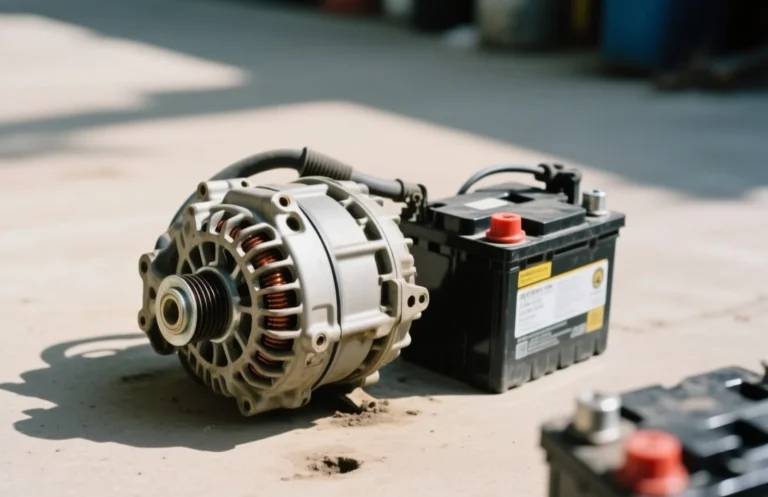
Does Putting A Battery On Concrete Drain It?
Not in any meaningful way. A battery stores charge chemically, independent of the floor it rests on. Temperature, moisture, and the battery’s chemistry are far more significant factors. In a typical garage at room temperature, a battery’s self-discharge rate is the primary cause of capacity loss, not the concrete beneath it.
Key Takeaways
- No charge drain. Concrete floors do not siphon charge; self-discharge is 1-5% per month at typical indoor temperatures.
- Temperature matters. Self-discharge roughly doubles with every 10°C rise above 20°C.
- Elevation helps. A dry, elevated platform reduces moisture contact and corrosion risk.
- Chemistry varies. Lead-acid, AGM, and Li-ion batteries aren’t drained by concrete; storage conditions drive aging.
- Practical setup. Use plywood or a rack to keep the battery off the concrete.
Does concrete drain a battery? The truth, in plain language?
Recommended Products


Concrete does not pull charge from a healthy battery. The misconception often arises from experiences in old workshops, where batteries rested on damp floors and corrosion formed around terminals. This corrosion results from moisture, salts, and electrolytes – not from a loss of stored energy. The floor won’t “leak” energy from the cells.
Two common scenarios mislead people into thinking concrete harms batteries. First, a battery on a cold concrete slab may experience slowed chemical reactions, increasing internal resistance and reducing performance. This is temperature-related, not a direct drain caused by the floor. Second, high humidity or spills can lead to rust on terminals and case deterioration, which creates resistance paths or leaks that mimic discharge but are really surface issues.
The self-discharge rate – the natural loss of stored energy without a load – dominates battery aging in typical indoor environments. Most common chemistries lose about 1-5% of capacity per month at room temperature. Temperature fluctuations can intensify or slow this rate. A 10°C rise above 20°C roughly doubles self-discharge, while cooler storage slows aging. The surface beneath the battery plays a minimal role in the chemical processes within the cells.
Placing a battery on concrete poses risks related to moisture and physical damage. Damp concrete can draw water and salts toward terminals, accelerating corrosion. Rough handling can chip plastic housings or stress interconnects, degrading reliability long before any meaningful change in stored energy occurs. The takeaway is simple: keep the battery dry, elevated, and free from spills, and the concrete becomes a non-factor for energy loss.
What actually happens when a battery sits on concrete?
Recommended Products


When a battery rests on concrete, three factors come into play: heat, moisture, and surface condition. Concrete can act as a heat sink or source, depending on ambient conditions. In a hot garage, it may help keep temperatures down, slowing aging. In cooler spaces, concrete can act as a chilling plate, slightly hindering chemical activity. Regardless, the floor itself does not drain charge.
Moisture poses the most significant risk. Damp concrete can wick moisture from the air or through the battery tray. If a battery leaks or spills electrolyte, moisture can conduct charge to nearby metal parts, potentially corroding terminals and diminishing reliability. This is a corrosion issue, not a self-discharge problem. Clean, dry conditions eliminate this risk.
Terminal integrity is crucial. Corrosion creates higher resistance, mimicking a “drain” by lowering effective voltage under load. A small amount of corrosion can significantly impact performance, especially with high current draws or sensitive electronics. The solution is straightforward: keep terminals clean and tight while shielding them from moisture or spills. The concrete floor’s impact is indirect – moisture management and surface cleanliness are more critical than the floor’s composition.
The best storage method for any battery is off the floor or on a non-conductive, dry surface. A wooden pallet, rubber mat, or plastic shelf provides a barrier against moisture and allows for airflow. Even a simple piece of plywood under the battery cuts direct moisture transfer and insulates against cold floors in winter. These small steps often prevent more issues than any capillary effect from concrete.
Does it matter for different chemistries?
Recommended Products



Different battery chemistries respond differently when placed on concrete, but none are drained by the floor itself. Lead-acid and its variants (flooded, AGM, and gel) share similar vulnerabilities: moisture sensitivity, electrolyte leakage risk, and temperature sensitivity. The concrete floor does not accelerate internal aging; ambient temperature and storage conditions are what matter.
Lithium-based cells – Li-ion and LiFePO4 – have built-in protections against overcharging and thermal runaway. While a failing charger or poor ventilation can cause issues, the concrete surface does not siphon charge. Temperature remains the primary factor affecting aging: high temperatures speed degradation, while low temperatures slow chemistry. A well-ventilated, stable temperature environment mitigates risks for all battery types.
| Chemistry | Concrete contact effect |
|---|---|
| Lead-acid (flooded) | No direct drain; risks come from moisture and spills; self-discharge 1-5%/month at 20-25°C; heat/humidity influence aging. |
| AGM (absorbed glass mat) | No direct drain; better moisture tolerance but still sensitive to leaks and high heat; self-discharge similar to flooded. |
| Li-ion | No direct drain; battery management system (BMS) governs charging; aging mostly temperature-driven; self-discharge 2-8%/month depending on chemistry and state. |
| LiFePO4 | No direct drain; higher thermal stability than Li-ion; aging governed by temperature and cycling; self-discharge often lower than Li-ion in practice. |
Ultimately, the differences hinge on temperature and moisture management, not merely resting on concrete. Maintain a dry, stable environment, and concrete becomes a non-issue for charge. Allowing moisture in creates corrosion and leakage risks, regardless of chemistry.
Best practices for storage
Recommended Products


To ensure safe storage, isolate the battery from damp floors and control temperature. Elevation and a dry surface yield the greatest benefits. If raising the battery isn’t possible, at least use a non-conductive mat to minimize moisture contact and cold transfer from the floor.
Start with a simple setup. Place a dry, non-absorbent board under the battery. Keep the area around the terminals clean and dry. Regularly check for signs of corrosion, especially after spills or in high-humidity environments. If the battery leaks, address it immediately; clean and dispose of the battery if the leak persists or indicates a failing cell.
Temperature control is essential. Aim for storage near room temperature (around 20-25°C). In colder environments, consider insulating mats or relocating the battery to a warmer, dry space. For multiple batteries, utilize insulated shelves with adequate airflow to avoid hot spots that could accelerate aging. Elevation, dryness, and stable temperature are crucial for protection.
A quick, practical checklist:
- Use a dry, elevated platform or rack.
- Place on a plywood sheet or non-conductive mat.
- Keep away from spills, cleaners, and moisture sources.
- Check terminals for corrosion every few weeks.
- Store at stable room temperature, avoiding direct sunlight and heat sources.
- If a battery shows swelling, leakage, or rapid discharge, retire it safely.
These steps are inexpensive insurance against accelerated aging. They keep your batteries in better condition, extending their life and reliability far more than worrying about the concrete itself.

Helpful pick
Amazon Basics Portable Battery Storage Case with Tester, Wall-Mounted Design, Carrying Handle, Holds 110 Batteries, 9.37 x 11.69 x 2.91 inches, Clear/Black
This portable battery storage case helps keep your batteries organized and elevated, minimizing moisture contact.
Essential Accessories for Safe Battery Storage

GlossyEnd Set of 4 – Two AA and Two AAA Battery Storage Box, Battery Storage Case Holder with Tester, Clear. Each Case Stores 48 Batteries
The GlossyEnd Battery Storage Case helps keep batteries organized and prevents accidental discharge by providing a secure storage solution away from concrete surfaces.

BTSKY 1 Pack Clear Acrylic Battery Storage Organizer for AA, AAA, 9V, C Batteries, 4-Drawer Storage Box Battery Holder Organizer for Common Types Batteries, Household Container(Batteries Not Included)
The BTSKY Battery Storage Organizer ensures that batteries are stored safely and separately, minimizing the risk of draining when placed on concrete or other conductive surfaces.

Zeee Fireproof Explosionproof Large Capacity Battery Storage Guard Pouch for Lipo Charge & Storage (8.46 x 6.5 x 5.71 in)
The Zeee Fireproof Battery Storage Pouch offers a protective environment for batteries, preventing any potential drainage issues that may arise from contact with concrete.
Common myths and misunderstandings
Recommended Products


Myth: concrete drains a battery immediately. Reality: the floor does not extract charge from the cells. Myth: cold concrete kills batteries overnight. Reality: temperature drives aging; cold floors can slow chemistry, not drain energy, if the environment is controlled. Myth: all moisture contact is dangerous. Reality: moisture accelerates corrosion and leaks more than it speeds up self-discharge; keeping surfaces dry minimizes risk.
The biggest myths stem from observed corrosion rather than a direct loss of stored energy. Corrosion around terminals, rust on hardware, and electrolyte leaks are surface problems. They are real risks but arise from moisture, spills, and poor ventilation, not from concrete alone. Addressing those environmental factors provides the most reliable protection.
For example, in a damp workshop, batteries stored directly on the floor showed more terminal corrosion after a season than those on a plastic rack with a small breathable gap. This isn’t a “drain” effect but surface deterioration that reduces reliability. Elevate and dry to eliminate the issue at the source.
Practical scenarios and decisions
Home users with a single car battery in a damp basement face different challenges than those with multiple deep-cycle batteries in a garage. Humidity control and airflow are critical when storing many units. Ideally, create a dedicated storage area with a dry surface and stable temperature – not just a corner of a cold workshop. If you must store batteries on a concrete floor, use a raised rack and avoid leaving them on the bare surface for long periods.
In workshops with frequent spills, additives can worsen corrosion. In such environments, even small leaks at terminals can lead to significant problems. The best strategy is to isolate the storage area from workshop activities, maintain cleanliness and dryness, and frequently check battery condition. If you see terminal discoloration, carefully clean them with proper protective equipment and re-tighten connections.
As a practical rule of thumb, consider concrete a non-issue for charge but a real risk for surface problems. Elevate, insulate, and maintain a dry environment. When evaluating a replacement battery or new storage location, prioritize a dry, elevated surface first, followed by temperature-stable space, and ensure adequate ventilation for any battery chemistry that may off-gas.
| Option | Why it helps | Price | Link |
|---|---|---|---|
| Ontel Battery Daddy Smart – Battery Organizer Storage Case with Tester, Stores & Protects Up to 150 Batteries, Clear Locking Lid, As Seen On TV, Smart – 150 Batteries (BADAS-MC4) | The Battery Daddy Smart organizer keeps your batteries safe and accessible, perfect for managing multiple units. | Check price | View → |
| Battery Organizer Storage Box with Tester, Battery Vault Case Fireproof Waterproof Explosionproof Holder Box with Tester BT-168 Checker Carrying Case Container Bag Fit for 200+ Batteries AA AAA C D 9V | This fireproof and waterproof battery vault ensures safe storage for your batteries in a damp environment. | Check price | View → |
Verdict and next
Concrete does not drain battery charge. Focus on maintaining dryness and temperature stability, and use an elevated, non-conductive surface for battery storage. To implement this effectively, place a plywood sheet on a shelf or rack and keep the area clear of leaks and spills. This approach will yield meaningful improvements in battery life and reliability over time.
To take action: inspect your storage area for humidity sources, install a small elevated platform, and schedule quarterly terminal health checks. These steps will minimize corrosion risk and ensure self-discharge remains the primary aging factor, not the concrete floor.
FAQ
Does concrete contact cause batteries to self-discharge faster?
Self-discharge primarily depends on temperature, chemistry, and storage conditions. Temperature is the dominant factor, with rates increasing as temperatures rise. In typical indoor environments, expect about 1-5% loss per month, with higher temperatures accelerating that rate.
Is it safer to store batteries on a shelf rather than on the floor?
Yes. Elevation reduces moisture wicking and makes spills easier to detect and clean. A 1-2 inch gap off the concrete significantly improves long-term terminal health and reliability.
Can I store lithium batteries on concrete if I keep them in a dry, ventilated area?
Lithium cells benefit from controlled temperature and humidity, not solely from being off the floor. A dry, ventilated space on a shelf is ideal; concrete does not drain energy, but managing moisture and heat is essential.
What is the best material to place under a battery on concrete?
Non-conductive, moisture-resistant materials are best. A plywood board, plastic tray, or rubber mat provide barriers against moisture and help with airflow, reducing corrosion risk.
Are there any signs that I should retire a battery because of concrete storage issues?
Look for terminal corrosion, swelling, leaks, or persistent rapid self-discharge. If any of these appear, replace the battery and reassess the storage setup to ensure a dry, temperature-stable environment.

- 10 Best Battery For Generator Battery Safety System 2026 - October 12, 2026
- 10 Best Battery For Generator Battery Safety Option 2026 - October 12, 2026
- 10 Best Battery For Generator Battery Safety 2026 - October 12, 2026