What Should A 12 Volt Battery Read When Fully Charged?
You stare at your multimeter, wondering if that 12. 6 reading means your battery is truly full or just resting. A fully charged lead-acid battery typically reads between 12. 6 and 12. 8 volts when the engine is off. However, surface charge can skew this number immediately after driving.
Understanding these nuances prevents premature replacements. This guide clarifies exact voltage thresholds for different battery types. We also review reliable testers to help you verify these readings accurately.
Understanding Resting Voltage Levels
Voltage readings fluctuate based on recent usage and battery chemistry. Knowing the baseline helps you interpret your multimeter results correctly without confusion.
A standard flooded lead-acid battery shows approximately 12. 6 volts when fully charged and at rest. Absorbed Glass Mat (AGM) batteries often read slightly higher, near 12. 8 to 13. 0 volts. These values assume the battery has not been charged or discharged for at least two hours.
Immediate post-charge readings include surface charge, which inflates the voltage temporarily. This false high dissipates quickly once the battery settles. Ignoring this settling period leads to inaccurate health assessments. Always wait before measuring to ensure the electrolyte stabilizes. Temperature also affects voltage slightly, with colder environments lowering readings.
Consistent monitoring helps identify gradual degradation early. Use a quality digital multimeter for precise decimal readings. Analog meters lack the resolution needed for subtle differences. Accurate baseline knowledge prevents unnecessary anxiety over normal fluctuations.
Voltage vs State of Charge
| State of Charge | Flooded Lead-Acid | AGM/Gel Battery |
|---|---|---|
| 100% | 12.6V – 12.7V | 12.8V – 13.0V |
| 75% | 12.4V | 12.6V |
| 50% | 12.2V | 12.4V |
| 25% | 12.0V | 12.2V |
| Discharged | <11.9V | <12.1V |
Factors Influencing Voltage Readings
Several external variables impact what your tester displays. Recognizing these factors ensures you do not misinterpret a healthy battery as faulty.
Immediate Post-Charge Spikes
After charging, electrons cling to the plate surfaces. This creates a temporary voltage spike above 13 volts. It does not reflect true capacity. Wait two hours for this charge to dissipate into the electrolyte. Testing too soon yields misleadingly high numbers. Patience ensures accuracy in your diagnostic process.
Load Application Impact
Applying a load drops voltage instantly. A healthy battery recovers quickly. A weak one struggles to rebound. Load testing reveals hidden weaknesses that static voltage misses. Always combine static checks with load tests for comprehensive diagnostics.
- Wait at least two hours after charging before testing.
- Ensure terminals are clean and free of corrosion.
- Use a digital multimeter with 0.01V resolution.
- Test in moderate temperatures when possible.
- Disconnect major loads like lights or radios.
Tools to Verify Your Battery Voltage
Accurate voltage measurement requires reliable equipment. Cheap testers often lack precision. The following tools provide clear readings. They help you confirm if your battery meets the 12.6V threshold. Each option suits different needs, from quick checks to deep diagnostics.
|
1
|
ANCEL BA101 Car Battery Tester, 12V Digital Automotive Alternator Meter Diagnostic Tool,10 |

ANCEL BA101 provides detailed State of Charge data alongside voltage, ensuring you know if that 12.6V reading reflects true capacity.
The ANCEL BA101 goes beyond simple voltage checks by analyzing State of Health and State of Charge. It supports 100-2000 CCA ratings, making it versatile for most vehicles. The black-and-white screen offers high contrast for easy reading in bright sunlight. Copper crocodile clips ensure a solid connection during testing.
This tool helps you distinguish between a surface charge and a truly full battery. It draws power directly from the vehicle, eliminating internal battery concerns.
This tester is ideal for DIYers who want deeper insights than a multimeter offers. It works with AGM, GEL, and flooded batteries. However, it does not support lithium batteries, limiting its use for newer EVs. The menu system is straightforward but requires entering correct CCA values for accuracy.
Its rugged ABS housing protects against drops in busy garages. It is a robust choice for regular maintenance checks.
|
2
|
MOTOPOWER MP0514A 12V Digital Car Battery Tester Voltmeter and Charging System Analyzer wi |
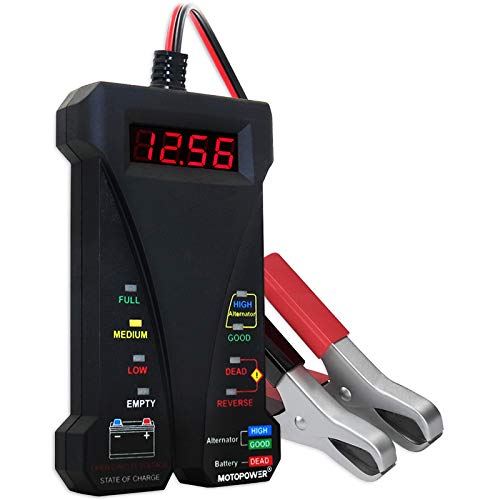
MOTOPOWER MP0514A offers 0.01V precision, allowing you to see if your battery hits the critical 12.6V or 12.8V mark clearly.
The MOTOPOWER MP0514A features a 4-digit LCD display that reads voltage up to 0. 01V accuracy. This precision is vital for distinguishing between a 75% and 100% charge. Eight colored LED indicators provide instant visual status updates. The plug-and-test design requires no complex setup, making it user-friendly.
It checks both battery voltage and alternator output efficiently. The compact form factor fits easily in any glove box.
Its rubberized coating ensures a secure grip even with oily hands. The 50cm extension cable adds flexibility for hard-to-reach batteries. While excellent for voltage checks, it lacks advanced CCA load testing capabilities. It is best suited for quick status checks rather than deep health diagnostics.
Reverse polarity protection safeguards the device from accidental misuse. It is a reliable, no-frills tool for basic voltage verification.
|
3
|
QWORK 12V 100A Battery Load Tester & Voltage Tester 24338 for Cars, Trucks, RVs, Golf Cart |

QWORK tester combines voltage checking with a 100A load test, proving if your 12.6V reading holds under actual stress.
The QWORK 12V 100A Battery Load Tester performs both voltage and load tests. It applies a significant load to verify if the battery maintains voltage under stress. This is crucial for confirming true capacity beyond static readings. The steel case provides durability for professional environments.
Heavy-duty copper-plated clamps ensure minimal resistance during testing. It supports 6V and 12V systems, adding versatility for older vehicles.
This analog-style tester is simple but effective for quick diagnostics. It does not require batteries or complex electronics to operate. However, interpreting the needle gauge requires some experience compared to digital screens. It is bulkier than modern digital alternatives, taking up more space. The handle aids portability despite its weight.
It is a tough tool for mechanics who prefer traditional load testing methods.
|
4
|
WINAMOO Automotive Test Light with 3-48V LED Digital Voltage Display, Auto Circuit Tester |

WINAMOO Test Light displays voltage digitally while probing circuits, helping you trace voltage drops from battery to components.
The WINAMOO Automotive Test Light combines a circuit tester with a digital voltmeter. It displays voltage with 0. 1V resolution on a bright LED screen. This allows for quick checks of battery terminals and fuse boxes. The stainless steel probe pierces insulation for direct wire contact.
Dual-color LEDs indicate polarity instantly, preventing reverse connection errors. The 96-inch spring wire offers extensive reach across large engine bays.
This tool is excellent for tracing electrical issues beyond just the battery. It helps identify voltage drops in wiring harnesses. However, 0. 1V resolution is less precise than dedicated multimeters for fine charge assessment. The protective sleeve prevents probe damage during storage. It is lightweight and ergonomic for prolonged use.
Ideal for electricians who need a versatile troubleshooting tool for various automotive circuits.
|
5
|
Car Battery Tester 6V 12V 24V Battery Voltage Tester, BR502 100-2000 CCA Internal Resistan |

BR502 analyzes internal resistance and voltage, giving a complete picture of why your battery might not hold a 12.6V charge.
The BR502 Battery Voltage Tester covers 6V, 12V, and 24V systems. It measures State of Health, State of Charge, and internal resistance. This comprehensive data helps explain voltage anomalies. The 1. 8-inch HD screen displays results in under two seconds. It supports a wide CCA range from 100 to 2000.
Polarity reverse protection prevents damage from incorrect connections.
Its plug-and-play design makes it accessible for beginners. It works on dead batteries, providing insights even when voltage is low. The clip connection must be secure to avoid screen flickering. It is compatible with AGM, GEL, and flooded batteries. This tester is a strong mid-range option for thorough diagnostics.
It balances price with professional-grade features effectively.
|
6
|
TOPDON BT100 12V Car Battery Tester, Automotive Battery Load Tester | 100-2000 CCA Auto Ba |

TOPDON BT100 delivers fast SOH and SOC readings, confirming if your 12.6V reading indicates a healthy or aging battery.
The TOPDON BT100 is a compact 12V battery load tester. It provides State of Health and State of Charge data quickly. Three colored LEDs offer instant visual feedback on battery status. It supports 100-2000 CCA ratings for various vehicle types. The menu system is intuitive, guiding users through testing steps.
Premium copper clamps ensure spark-proof connections for safety.
Its small size allows storage in tight spaces like glove boxes. It tests cranking and charging systems in addition to static voltage. This holistic approach helps diagnose starting issues comprehensively. It is suitable for cars, trucks, and marine applications.
The lack of an internal battery means it relies on the vehicle for power. A reliable choice for regular DIY maintenance routines.
|
7
|
KONNWEI KW208 12V Car Battery Tester, Battery Load Tester Automotive 12V Alternator Starte |

KONNWEI KW208 uses AI chips for 99.7% accuracy, ensuring your voltage reading is precise and trustworthy every time.
The KONNWEI KW208 features an advanced AI chip for high-precision testing. It claims 99. 7% accuracy in voltage and CCA measurements. Galvanized alloy clips improve contact durability and conductivity. The device tests 12V batteries ranging from 100 to 2000 CCA. It analyzes cranking and charging systems thoroughly.
Results appear rapidly on the digital display.
This tester is highly rated for its cost-effectiveness and reliability. It supports multiple languages for diverse users. The updated clips reduce resistance for better readings. It works on dead batteries, offering flexibility in testing scenarios. Storage is easy due to its compact design.
It is a popular choice for those seeking professional accuracy without a high price tag.
|
8
|
MOTOPOWER MP0515A 12V Car Battery Tester Automotive 100-2000 CCA Battery Load Tester Auto |

MOTOPOWER MP0515A shows real-time waveforms, letting you visualize voltage stability during cranking and charging cycles.
The MOTOPOWER MP0515A offers real-time wave display for detailed analysis. Its 3-inch color LCD screen provides clear visibility of data. It tests battery health, internal resistance, and charging status. The device supports 100-2000 CCA lead-acid batteries. Users can print data for record-keeping purposes. Nine language options make it accessible globally.
The waveform feature helps identify intermittent charging issues. It monitors alternator output curves in real time. This depth is useful for diagnosing complex electrical faults. The interface is user-friendly despite its advanced features. It is slightly larger than basic testers but offers more insight.
Ideal for enthusiasts who want graphical data alongside numerical values.
|
9
|
KINGBOLEN BM550 6V 12V 24V Car Battery Tester,Auto Battery Analyzer | 100-2000 CCA BM550 B |

KINGBOLEN BM550 handles 6V/12V/24V systems, making it versatile for checking voltage across different vehicle battery types.
The KINGBOLEN BM550 tests 6V, 12V, and 24V batteries. It supports a wide range of chemistries including AGM and GEL. The 1. 8-inch HD screen displays SOH and SOC clearly. It measures internal resistance and voltage accurately. Reverse connection protection ensures safe operation.
The device works on both in-vehicle and out-of-vehicle batteries.
Its plug-and-play design simplifies the testing process. It is suitable for DIY enthusiasts and professional garages. The tester does not support deep cycle batteries, limiting some uses. Clamps must be secured properly to avoid errors. It provides quick results for efficient diagnostics.
A versatile tool for households with multiple vehicle types.
|
10
|
ANCEL BT410 12V 24V Car Battery Tester for Lead-Acid & Lithium Batteries, 100-2000 CCA Aut |

ANCEL BT410 tests lithium and lead-acid batteries, ensuring accurate voltage readings for modern vehicles with diverse battery tech.
The ANCEL BT410 supports both lead-acid and lithium-ion batteries. It covers 12V and 24V systems extensively. The 2.4-inch color TFT screen offers adjustable contrast for visibility. It generates QR reports for sharing test data professionally. Accuracy exceeds 99.9% thanks to its smart chip. It tests cranking and charging systems comprehensively.
This tester is future-proof for vehicles with lithium starters. The QR code feature aids in tracking battery history. Short-circuit and reverse polarity protections enhance safety. It is slightly more expensive but offers broader compatibility. The reinforced clamps ensure durable connections. Best for users needing versatility across modern and traditional vehicles.
These tools provide the precision needed to verify your battery’s charge level. Whether you need basic voltage checks or deep health diagnostics, there is an option here. Accurate readings prevent unnecessary replacements and ensure reliability. Choose based on your vehicle type and desired detail level.
Interpreting Charging System Voltage
Voltage readings change when the engine runs. Understanding these shifts helps you verify if the alternator is replenishing the battery correctly after use.
When the engine runs, the alternator charges the battery. Voltage should rise to between 13. 7 and 14. 7 volts. Readings below 13. 5V suggest a weak alternator or poor connections. Values above 15V indicate overcharging, which damages battery plates. Monitor this range to ensure the charging system functions properly.
Fluctuations during acceleration may point to belt slippage. Consistent voltage within this range confirms healthy charging. Deviations require immediate inspection to prevent battery failure. Use your tester to check these levels regularly. It helps catch alternator issues before they strand you.
Connect the tester clips to the battery terminals securely.
Start the engine and let it idle for a few minutes.
Observe the voltage reading on the digital display.
Increase engine RPM to 2000 and check voltage again.
Ensure readings stay within the 13.7V to 14.7V range.
Common Voltage Misconceptions
Many drivers misinterpret voltage readings due to common myths. Clarifying these helps you make better maintenance decisions.
The Danger of Low Voltage
A reading of 12.0V indicates a deeply discharged battery. Leaving it in this state causes sulfation. This permanent damage reduces capacity significantly. Always recharge immediately if voltage drops below 12.2V. Regular monitoring prevents this harmful discharge cycle.
Engine Off vs Engine On
Comparing engine-off and engine-on voltages reveals system health. A small increase suggests poor alternator output. A massive spike indicates regulator failure. Context matters when interpreting these numbers. Always note the engine state during testing.
- Voltage below 12.4V indicates a need for charging.
- Readings above 15V signal dangerous overcharging.
- Rapid voltage drop under load suggests weak cells.
- Inconsistent readings point to loose terminal connections.
- Corrosion on terminals can cause false low readings.
A fully charged 12-volt battery should read between 12.6 and 12.8 volts when resting. Check your battery with a digital tester after it has sat for two hours. If the reading is lower, recharge it immediately to prevent damage. Keep a simple voltmeter in your car for quick monthly checks.

- 10 Best Battery For Generator Ev Battery Bank Marine 2026 - October 27, 2026
- 10 Best Battery For Generator Ev Battery Bank Lto 2026 - October 27, 2026
- 10 Best Battery For Generator Ev Battery Bank Low Voltage 2026 - October 27, 2026