What Does Battery Recond Mean?
There is a specific kind of dread that comes with turning your key and hearing nothing but a hollow click. Before you haul that heavy lead-acid block to the recycling center, it is worth understanding what actually went wrong inside it.
Mechanics often talk about ‘reconditioning’ rather than just charging, and the distinction matters for your wallet. Standard charging pushes power back in, but reconditioning targets the chemical buildup, specifically sulfation, that prevents the battery from holding that power in the first place.
I put this guide together to explain how those repair pulses work and which tools actually deliver them. We will look at the science behind reviving a neglected battery and break down ten options that handle the job differently.
The Science of Battery Reconditioning
To figure out if a reconditioner can save your battery, you need to know why it failed. Most lead-acid batteries do not just wear out; they choke on their own chemistry through a process called sulfation. Here is how that happens and why standard current cannot fix it.
- The battery holds a charge but lacks cranking power.
- The voltage drops significantly under a heavy load.
- The vehicle takes multiple attempts to start.
- The battery has been sitting idle for months.
- Standard charging fails to bring the voltage up.
How Reconditioning Differs From Charging
I see a lot of confusion between a basic trickle charger and a dedicated reconditioner. They might share the same clamps, but their internal logic is doing entirely different things. Mixing them up is usually how a struggling battery ends up permanently dead.
Comparison of Battery Maintenance Methods
| Feature | Standard Charging | Reconditioning |
|---|---|---|
| Primary Goal | Replenish Energy | Remove Sulfation |
| Electrical Output | Constant Current | High-Frequency Pulses |
| Best For | Daily Use | Old/Idle Batteries |
| Complexity | Low | High |
A standard charger does one thing: it forces current into the cells until the voltage reads full. That works fine if you just left the headlights on overnight. But if the battery has been sitting for months, lead sulfate crystals have hardened on the plates.
A reconditioner uses targeted electrical pulses to physically shatter those crystals. The vibrations break the sulfate down so it dissolves back into the acid, exposing the lead plates again.
Without that specific pulsing action, you are just pushing electricity against a wall, and the battery will never hold a real charge.
Picks To Recondition Your Battery
My read is that the right tool depends entirely on what sits in your garage. A motorcycle needs a different approach than a diesel truck, and deep-cycle marine batteries have their own quirks. I would shortlist based on whether you need rapid recovery or long-term maintenance.
These ten options cover that spectrum, each using specific pulse technology to address sulfation.
|
1
|
TowerTop 2/10/25 Amp 12V Smart Car Battery Charger, Fully Automatic Battery Maintainer wit |

The TowerTop 25A charger includes a dedicated repair mode to revive old and idle batteries.
If you are dealing with larger setups, the TowerTop 2/10/25 Amp Smart Charger gives you room to work. It cycles through an 8-stage process that specifically targets sulfation during its repair phase. I appreciate that it handles AGM, GEL, and deep-cycle chemistries without needing manual adjustments.
The 25A max output means you are not waiting all day for a 100Ah battery to recover.
I would point this toward anyone managing RVs, boats, or multiple vehicles. The HD LCD screen makes it easy to see exactly where the cycle is at without guessing.
Just keep in mind that if a battery has dropped completely to zero volts, this unit will not recognize it to begin the repair sequence.
|
2
|
2026 Upgraded 12V/24V 0-20A Heavy Duty Battery Charger/Maintainer with Auto Shutoff, Repai |
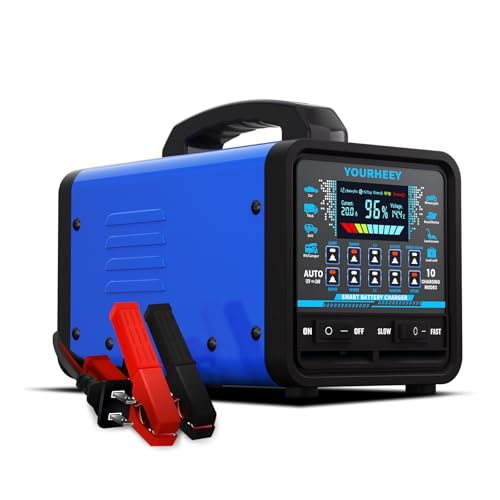
This charger uses dual-frequency pulse waves to dissolve harmful sulfation crystals.
The Yourheey Heavy Duty Charger feels built for actual shop abuse. It relies on thick copper coils and an aluminum housing to manage heat during long repair cycles. What caught my attention is the dual-frequency pulse technology designed to wake up batteries sitting as low as 3V.
For seasonal equipment that gets ignored all winter, that low-voltage recovery is the main selling point.
Because it auto-detects 12V and 24V systems, you do not have to worry about flipping the wrong switch before hooking it up to a heavy truck. It also adjusts its strategy for cold weather.
The one limitation I would flag is that it strictly handles lead-acid chemistries, so keep it away from lithium packs.
|
3
|
NOCO GENIUS1 1A 6/12V Smart Battery Charger, Trickle Charger & Maintainer | Overcharge Pro |

The NOCO GENIUS1 features a built-in desulfator to maintain battery health.
The NOCO GENIUS1 proves that physical size does not dictate capability. It manages to pack charging, maintaining, and desulfating into a unit small enough to lose in a toolbox. It covers both 6V and 12V systems, including lithium-ion, which is increasingly rare at this size.
The thermal sensor adjusting the charge rate based on ambient temperature is a detail I always look for to prevent cooking a battery in a hot garage.
I would shortlist this for motorcycles, ATVs, or smaller marine batteries where space is tight. Using Force Mode, it can even attempt to recover batteries that have dropped to 1 volt.
Because it only outputs 1A, though, do not expect it to quickly recharge a large automotive battery after a jump start.
|
4
|
NOCO GENIUS5 5A 6/12V Smart Battery Charger, Trickle Charger & Maintainer | Overcharge Pro |

The NOCO GENIUS5 provides a balanced 5A output for medium-sized battery needs.
Stepping up to the NOCO GENIUS5 gives you significantly more current while keeping the footprint manageable. It carries over the same desulfation logic and temperature compensation found in the smaller model.
For deep-cycle batteries used in trolling motors or weekend cars, 5A hits a sweet spot between maintaining health and actually recovering lost capacity without stressing the plates.
This is the one I would leave hooked up in a home workshop for daily drivers or lawn equipment. It monitors the state constantly, backing off when the battery is topped up.
If you are trying to rapidly fill a massive truck battery from empty, however, the 5A output will test your patience.
|
5
|
NOCO GENIUS10 10A 6/12V Smart Battery Charger, Trickle Charger & Maintainer | Overcharge P |

The NOCO GENIUS10 delivers 10A of power for faster recovery of sulfated batteries.
When sulfation is heavy, you generally want more current driving those repair pulses, which is where the NOCO GENIUS10 fits in. Pushing 10A, it moves through the reconditioning stages much faster than its siblings.
It still supports 6V and 12V architectures across lithium and lead-acid types, meaning you do not sacrifice compatibility for speed.
I would recommend this for anyone who regularly rotates batteries in and out of storage or manages a small fleet. The extra power makes quick work of standard car batteries.
It does carry a higher price tag than the lower-amp models, so weigh whether you actually need that 10A throughput before buying.
|
6
|
PLXX 12V 24V Car Battery Charger Heavy Duty 0-15A Automatic Smart Trickle Charger with Aut |

The PLXX charger offers a dedicated repair mode to restore old, idle batteries.
The PLXX 12V/24V Smart Charger takes a methodical approach with a 7-stage charging sequence. Its repair mode specifically targets stratified or deeply sulfated batteries that have been sitting idle.
I find the automatic voltage detection useful here, as it switches between fast charging for larger banks and slow trickle modes for smaller ones without user intervention.
Beyond standard charging, it includes an electrolysis function that appeals to people working on older restoration projects. It can also double as a 12V DC power supply if you need to run accessories while the battery is disconnected.
The interface gets the job done, though the display lacks the polish you might see on higher-end brands.
|
7
|
TowerTop 25A Max Pro Battery Charger: 12V Fully Automatic Smart Trickle Charger, Automotiv |

The TowerTop Max Pro provides an engine start aid to help jump-start vehicles.
The TowerTop 25A Max Pro blurs the line between a maintainer and emergency shop equipment. Alongside six distinct charging profiles for various chemistries, it includes a 100A engine start function.
That means it is not just repairing sulfation over hours; it can provide the immediate cranking amps needed to turn over a dead vehicle right now.
Because it uses SMPS technology rather than a traditional heavy transformer, it stays surprisingly portable for the amperage it delivers. I would consider this if your primary goal is having a single unit that handles both long-term battery repair and immediate roadside-style starting assistance in the driveway.
|
8
|
E-FAST 25A Smart Car Battery Charger, 12V/24V Automatic Automotive Battery Maintainer & De |

The E-FAST 25A charger includes a 200-second booster mode for emergencies.
Heat management is usually the biggest issue with high-amperage chargers, and the E-FAST 25A addresses this with a rugged aluminum shell and active cooling. It lets you dial the current from 2A up to 25A depending on the battery size.
The 200-second booster mode is a practical addition for forcing a quick surge into a large SUV or truck battery when you are in a hurry.
Handling both 12V and 24V systems makes it relevant for heavier commercial or agricultural equipment. The trade-off for that cooling capacity and metal housing is bulk, it takes up more bench space than plastic alternatives. But if you are running 25A repair cycles frequently, that thermal headroom matters.
|
9
|
CTEK – 40-206 MXS 5.0 Fully Automatic 4.3 amp Battery Charger and Maintainer 12V |

The CTEK MXS 5.0 features a patented reconditioning function to improve battery life.
CTEK built its reputation on reliability, and the MXS 5. 0 reflects that with a highly controlled 8-step process. Its patented reconditioning mode applies specific voltage steps to break down sulfation without aggressively gassing the battery.
Being splash and dustproof means I would trust it in damp marine environments or open garages where other electronics might fail.
This is my pick for a true ‘set and forget’ scenario. You can leave it connected through the winter without worrying about it damaging the cells.
The 5A output is deliberate and safe, but understand that it prioritizes battery longevity over speed, it will not bail you out if you need a rapid charge in twenty minutes.
|
10
|
Schumacher Electric 15A Car Battery Charger & Maintainer, 6V/12V – SC1280 | 3A Trickle Cha |

The Schumacher SC1280 uses microprocessor control to restore and maintain batteries.
The Schumacher Electric SC1280 functions as a four-in-one tool, handling charging, maintaining, testing, and restoring. The microprocessor control is the key feature here, as it constantly reads the battery’s response to adjust the voltage dynamically.
This prevents the kind of overcharging that ruins powersport and marine batteries left on tenders too long.
For someone who does not want to manually configure settings, the automatic detection makes this very approachable. You clamp it on, and it figures out the rest. It does not offer the extreme high-amp output of heavy-duty shop chargers, but for routine maintenance and mild reconditioning, it removes the guesswork.
Looking at these ten options, the split is clear: some prioritize raw amperage for fast recovery, while others focus on precise, long-term pulse maintenance.
Whether you need a tiny desulfator for a motorcycle or a 25A unit capable of starting a truck, the underlying technology to break down sulfate crystals is present across the board. Match the output and features to the specific batteries sitting in your garage.
Maximizing Your Reconditioning Results
Hooking up a reconditioner is only half the job. How you set up the environment dictates whether those electrical pulses actually dissolve the crystals or just generate dangerous heat. I would follow a few strict rules before pressing start.
Clean all battery terminals to ensure a solid electrical connection.
Inspect the battery casing for any cracks or leaking acid.
Connect the charger clamps directly to the positive and negative posts.
Select the correct battery type mode on your charger.
Allow the repair cycle to run for its full duration.
Test the battery voltage after the cycle is complete.
Always run a desulfation cycle in a space with actual airflow. Breaking down sulfate releases gas, and you do not want that accumulating in a closed room. Keep your hand near the casing periodically, if the battery becomes too hot to touch comfortably, disconnect immediately.
Excessive heat usually points to an internal short circuit that no amount of pulsing will fix. Finally, reset your expectations regarding time. Proper reconditioning often requires leaving the unit connected for days. Cutting the cycle short leaves partially broken crystals that will quickly harden again.
When to Retire Your Battery
I want to be clear that reconditioning has hard limits. Electrical pulses can reverse chemical buildup, but they cannot fix physical degradation. Knowing when to stop trying saves you wasted effort and potential safety risks.
- The battery casing is swollen or deformed.
- Visible acid leakage is present around the terminals.
- The battery fails to hold any charge after reconditioning.
- Internal short circuits are detected during testing.
- The battery develops a strong sulfur smell.
At its core, battery reconditioning is just applied chemistry, using targeted electrical stress to shatter the lead sulfate crystals choking your battery plates. If the failure is purely due to a vehicle sitting idle, a smart charger with a repair mode has a strong chance of bringing it back.
But if the plates are physically warped or a cell has shorted internally, no tool on this list will save it. Before you connect anything, take five minutes to inspect the terminals.
Wire-brush away any corrosion and ensure a clean connection, because even the best pulse technology cannot push through a layer of resistance on the outside of the battery.

- 10 Best Battery For Generator Ev Battery Bank Marine 2026 - October 27, 2026
- 10 Best Battery For Generator Ev Battery Bank Lto 2026 - October 27, 2026
- 10 Best Battery For Generator Ev Battery Bank Low Voltage 2026 - October 27, 2026