What Does Battery Discharge Warning Mean?
A battery discharge warning usually means the system has detected low voltage or a charge level that is falling faster than it is being replenished. You may see it on a vehicle, solar setup, backup system, or portable power device.
The alert is a prompt to check the battery, charging path, and connected load before continued use causes a shutdown or deeper discharge.
Why Battery Discharge Warnings Appear
Most battery discharge warnings appear when voltage falls below a programmed safety threshold. The threshold depends on the battery chemistry, the equipment, and the way the voltage is being measured.
In practical terms, the warning often appears when the battery reaches a preset cutoff voltage under load. A lead-acid battery generally needs more conservative discharge management than a lithium-ion pack, but the correct limit still comes from the battery or equipment documentation.
Depending on the system, the alert may appear as a message, indicator light, audible beep, or app notification.
- Check voltage regularly using a multimeter or onboard display.
- Recharge immediately after a discharge alert to prevent permanent damage.
- Label battery banks with safe operating voltage ranges.
- Avoid full discharges on lead-acid batteries to extend lifespan.
- Calibrate discharge sensors periodically for accuracy.
Picks To Alert And Protect Against Battery Discharge
The listings below cover the main ways to respond to a discharge warning: mark battery and electrical equipment, measure voltage while a battery is discharging, test a battery under a controlled load, or disconnect the load before over-discharge becomes a bigger problem.
|
1
|
Danger High Voltage Sign Stickers, 2 Pack 5×3.5 Inch Electrical Shock Hazard Warning Decal |

These stickers do not measure discharge, but they make battery banks, panels, and other high-voltage equipment harder to overlook during inspection or service.
The Danger High Voltage stickers use a familiar red, white, and black hazard layout to identify battery systems, solar equipment, EV charging stations, and electrical enclosures. Their adhesive backing is intended for clean, smooth surfaces such as metal cases, plastic housings, and panel covers, so placement should be straightforward.
I would use them as a visible safety layer in a workshop, utility area, or solar installation where multiple people may approach the equipment. They do not report voltage or explain why a discharge warning appeared, so a meter or built-in monitoring system is still needed for diagnosis.
|
2
|
Warning Sign Lead Acid Batteries Depth Of Discharge Rustic Multicolor Design 12×8 Inch Alu |

This sign puts depth-of-discharge guidance in the work area, which can be useful when several people handle lead-acid battery equipment.
The Lead Acid Batteries Depth Of Discharge sign is a static reminder rather than a diagnostic tool. Its aluminum plaque format suits a garage, battery shelter, or equipment room where a visible warning about discharge limits is more useful than a label placed directly on one battery.
The sign can reinforce a basic inspection routine, but it cannot tell you the battery‘s current voltage or state of charge. My read is that it makes sense for shared spaces that need a persistent reminder, provided the actual cutoff guidance comes from the battery documentation.
|
3
|
HiLetgo Battery Capacity Meter Discharge Tester Analyzer 1.5V-12V Battery Capacity Meter D |
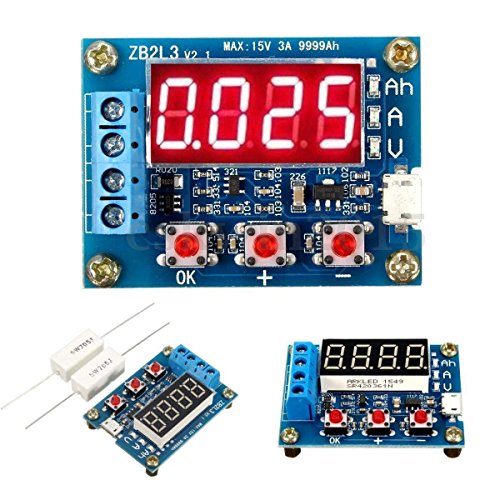
This meter is the most direct fit for checking whether a low-voltage alert corresponds to a battery that is actually approaching its discharge limit.
The HiLetgo meter is designed to monitor voltage and current while a battery discharges. It supports batteries from 1.5V to 12V, with a listed discharge-voltage range of 1.00V to 15.00V, and uses a micro USB connection for its own 4.5V to 6V power supply.
For hobby projects and smaller battery setups, the displayed readings can give more context than a warning light alone. The listed current resolution is 0.001A, but the meter’s stated measurement accuracy and operating limits should be considered before using it for higher-current or safety-critical work.
|
4
|
UN3480 Lithium ION Batteries Sticker | Hazardous Material Warning Decal | Safety Sign | Ba |

This UN3480 decal identifies lithium-ion batteries for shipping and handling; it is a compliance marker, not an indicator of the battery’s current discharge state.
The UN3480 Lithium ION Batteries sticker gives handlers a clear visual cue that a package or battery requires lithium-ion handling precautions. Its vinyl construction is intended for durable labeling where the battery or package may be moved through storage and shipping areas.
I would shortlist it when the immediate need is identification on packaging, containers, or battery equipment. It cannot distinguish a charged battery from a discharged one and does not replace voltage checks, protective circuitry, or the carrier’s current labeling requirements.
|
5
|
ET5410A+ Programmable DC Electronic Load Battery Tester,Single Channel DC Electronic Load |

This programmable electronic load can apply a controlled draw, making it useful for observing how a battery or power system behaves as voltage falls.
The ET5410A+ is a single-channel DC electronic load rated at 400W. It can be used to place a measured load on a battery and watch the voltage decline, which helps reveal whether a low-voltage warning appears at the expected point.
The listing also notes USB control, external trigger input, and data retention after a power outage.
The built-in fan and heat-dissipation openings matter when the load is run for longer periods. This is better suited to someone who already understands load testing and battery limits than to a casual check, since incorrect settings or wiring can stress the battery and the equipment under test.
|
6
|
Jauarta Battery Discharge Protector Module, 15A Capacity | High- voltage measurement, ener |

This protector is intended to watch battery voltage and disconnect the load at a selected cutoff, reducing the chance that normal use continues into harmful over-discharge.
The Jauarta Battery Discharge Protector covers DC 6V to 30V systems and is rated for loads up to 15A. The listing specifies 0.1V voltage resolution and a 1% voltage-dividing resistor, while the digital display provides a direct view of the monitored value during operation.
It is aimed at applications such as solar systems and UPS equipment where an automatic cutoff is more useful than waiting for a warning and reacting manually.
I would verify the module’s cutoff settings, battery chemistry compatibility, load current, and wiring arrangement before installation; a protection module is only as reliable as its setup.
These products address different parts of the problem. Labels and signs improve visibility around electrical equipment, the HiLetgo meter and ET5410A+ provide ways to observe discharge behavior, and the Jauarta module can disconnect a load at a chosen voltage.
The right pick depends on whether the warning needs to be explained, measured, or prevented from recurring.
What To Do When You See A Discharge Warning
When the warning appears, treat it as a diagnostic prompt rather than a message to dismiss. Reduce unnecessary load, confirm that charging is available, and check the battery and connections before returning the system to normal use.
Stop drawing power and switch off connected loads immediately.
Measure terminal voltage with a multimeter or onboard display.
Compare measured voltage to the manufacturer’s safe cutoff range.
Begin recharging the battery using the recommended charger or controller.
Reset any latch-off relays or alarms once voltage recovers above threshold.
Common Mistake: Restarting Without Recharging
Clearing the warning without finding the cause can leave the battery undercharged and lead to another shutdown. Check for loose or corroded terminals, damaged cabling, an inactive charger, or a load that is drawing more power than expected.
Pro Tip: Use Alarms As Maintenance Reminders
I would also compare the displayed voltage with a suitable meter and review the equipment’s cutoff setting. A reading taken under load can differ from a resting reading, so the measurement conditions matter.
How Battery Type Changes The Warning Meaning
The same voltage warning does not mean exactly the same thing for every battery. Chemistry, pack configuration, temperature, load, and the equipment’s cutoff settings all affect how the alert should be interpreted.
| Battery Type | Safe Discharge Limit | Typical Warning Voltage | Action Required |
|---|---|---|---|
| Lead-Acid | 50% | 10.5V (12V cell) | Recharge immediately |
| Lithium-Ion | 80-90% | 9.0V (12V cell) | Allow partial recharge |
| LiFePO4 | 80-100% | 10.0V (12V cell) | Monitor closely, avoid frequent deep cycles |
A 12V lead-acid system and a lithium-ion pack should not be judged by the same depth-of-discharge assumptions. Check the battery datasheet and the equipment manual for the correct voltage limits before charging, testing, or changing a cutoff setting.
A battery discharge warning generally means the system has reached a low-voltage or low-charge condition that needs attention. Reduce the load, confirm the charging path, and check the battery against its specified cutoff rather than relying on the alert alone.
For a recently flagged system, I would start with a voltage reading and an inspection of the terminals and wiring.

- 10 Best Battery For Generator Ev Battery Bank Marine 2026 - October 27, 2026
- 10 Best Battery For Generator Ev Battery Bank Lto 2026 - October 27, 2026
- 10 Best Battery For Generator Ev Battery Bank Low Voltage 2026 - October 27, 2026