What Does Battery Amp Hours Mean?
Imagine you’re checking a battery’s label and see ‘100Ah’, but what does that even mean? Amp hours might sound like a science term, but at its core, it’s just a way to measure how much electrical power your battery can hold over time.
Think of it like a fuel gauge for batteries: it tells you how much ‘fuel’ is left to power your devices. If you’re comparing batteries, sizing up a solar setup, or just making sure your trolling motor won’t die mid-day, understanding amp hours is key.
This guide breaks down the concept so you can trust those numbers and pick the right meter to track them in real time.
What Battery Amp Hours Actually Measure
Amp hours are the unit that tells you how much charge a battery can move. Before comparing batteries or trusting a state-of-charge reading, you need a plain-language grasp of what that number represents.
An amp hour is one amp of current flowing for one hour. If a battery is rated at 100Ah, it can theoretically deliver 1 amp for 100 hours, or 10 amps for 10 hours, or 100 amps for 1 hour.
That last example rarely holds in real life because high current drains a battery faster than the math suggests. The rating describes capacity, not power. A 12V 100Ah battery stores about 1,200 watt hours of energy.
Amp hours alone don’t tell you the voltage, so you always need both numbers to compare batteries fairly. Think of amp hours as the size of the fuel tank and voltage as the pressure of the fuel line. A bigger tank runs longer only if the load stays reasonable.
The 20-Hour Rate Explained
Most lead-acid batteries are rated at a 20-hour discharge rate, written as C/20. A 100Ah battery at C/20 means it delivers 5 amps for 20 hours. If you pull 20 amps instead, you might only get 80Ah before the voltage sags.
This happens because chemical reactions inside the battery can’t keep up with heavy loads. Lithium batteries hold their rated capacity better under load, which is one reason they cost more. When you compare two batteries, check the discharge rate used for the rating.
A 100Ah rating at C/20 is not the same as 100Ah at C/100. The number on the label is a reference point, not a guarantee.
Peukert’s Law In Plain Terms
Peukert’s law describes how capacity shrinks as current rises. Each battery chemistry has a Peukert exponent, usually between 1. 1 and 1. 4 for lead-acid and closer to 1. 05 for lithium. A higher exponent means the battery loses more usable capacity under heavy draw.
You don’t need to calculate the exponent to use a battery well. You just need to know that running a 100Ah battery at 50 amps will not give you two hours. It might give you 70 minutes.
This is why a battery monitor that counts actual amp hours is more useful than a voltage gauge. Voltage sags under load, but amp-hour counting tracks what really left the battery.
How Amp Hours Differ From Volts And Watts
Amp hours, volts, and watts get mixed up constantly. Each measures a different part of the electrical picture, and confusing them leads to undersized systems and dead batteries.
The Three Numbers Side By Side
| Term | What It Measures | Everyday Analogy |
|---|---|---|
| Amp hours (Ah) | Total charge capacity over time | Size of the fuel tank |
| Volts (V) | Electrical pressure or force | Pressure in the fuel line |
| Watts (W) | Rate of energy use right now | How fast the engine burns fuel |
- Multiply amp hours by volts to get watt hours, the true energy total.
- A 12V 100Ah battery and a 24V 50Ah battery store the same watt hours.
- Higher voltage systems deliver the same power with thinner, cheaper cables.
- Amp hour ratings assume a specific discharge rate, usually 20 hours.
- Lithium batteries often list usable amp hours; lead-acid lists total capacity.
- Never compare amp hours across different voltages without converting to watt hours.
Meters That Show Amp Hours In Real Time
Once you’ve got the basics of amp hours under your belt, the next step is watching them move in real time. A battery monitor with a shunt tracks current in and out, giving you a live reading of how much charge is actually being used.
These meters turn abstract numbers into actionable insights, whether you’re off-grid in an RV or running a solar-powered shed.
|
1
|
CGELE DC Multifunction Battery Monitor Meter with Shunt,0-200V,0-100A, LCD Display Digital |

It shows capacity up to 1000Ah and state of charge, making it a direct way to monitor how much charge is left.
The CGELE DC Multifunction Battery Monitor is a powerhouse of a meter, cramming nine key readings into one screen: capacity up to 1000Ah, state of charge, voltage up to 200V, and current up to 100A. You’ll see amp hours leaving your battery in real time, alongside power, impedance, and runtime.
The installation is a breeze with its pressing-terminal design, so you won’t need screws to wire it in. The 360-degree backlit LCD makes it easy to read day or night, which is handy if you’re checking your solar setup after dark.
The meter claims 1% accuracy, so you can trust its readings to a pretty tight margin.
This monitor is ideal for DIY solar setups, RV house batteries, and any 12V/24V/48V system where you want one screen to cover everything. The 100A ceiling means it won’t handle large inverter loads, so if you’re running a 200A inverter, this won’t cut it.
But for tracking amp hours properly, it’s a solid choice without breaking the bank. The permanent shunt installation is a downside if you’re not comfortable making that kind of modification.
|
2
|
bayite DC 8-100V 0-100A Amp Meter Voltmeter Battery Monitor with 100A Shunt | LCD Energy M |
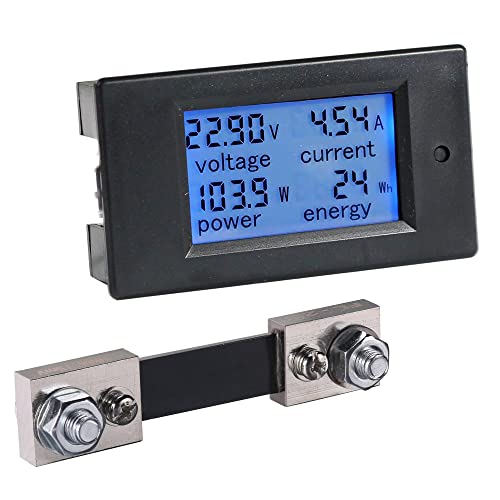
It stores energy data even when power is off, so you can track amp hours over time without losing your progress.
The bayite DC 8-100V monitor blends voltage, current, power, and energy tracking on a single large LCD, with a 100A shunt included. The best part? Energy data stays stored even when power is cut, so your accumulated amp-hour and kilowatt-hour totals don’t reset.
An overload alarm will flash the backlight and power value if current exceeds your threshold, giving you a heads-up before anything trips. The blue backlight can be toggled manually, which is useful if you don’t want the glare in a dark cabin at night.
This setup is perfect for solar, RV, or DIY projects running under 100A and 100V, especially if you want to keep track of cumulative energy over weeks.
The package includes only the display and shunt, so you’ll need to supply your own wires and connectors, which adds a little extra work. The 100A limit keeps it away from high-draw inverter banks.
If you’re working with a modest off-grid setup or a bench power project, the stored-data feature makes it a practical long-term choice.
|
3
|
QWORK Battery Monitor Voltmeter Ammeter, Voltage Range 8V-80V and up to 500A, Voltage Curr |

It tracks capacity up to 999Ah and reads like a fuel gauge, making it easy to see how much charge remains.
The QWORK Battery Monitor acts like a fuel gauge for your battery bank, showing voltage from 8V to 100V, charge and discharge current up to 350A, and state of charge.
It comes with a reinforced 350A shunt and a 13-foot custom cable, so you can mount the display far from the battery compartment. Amp-hour capacity reads up to 999Ah, covering most RV and off-grid solar banks.
The backlit LCD keeps volts, amps, and amp hours clear in low light, and a memory chip retains your last parameters after disconnecting.
The high 350A shunt rating means this is built for demanding systems with large inverters, not just small solar trickle setups. The 13-foot cable gives you real mounting flexibility in a van or boat, but the panel-mount design means you’ll need to cut a rectangular hole in your control panel.
If you’re looking for a permanent, high-current-capable amp-hour gauge for an RV or caravan, this is a solid pick.
|
4
|
DROK Voltage Amp Meter DC, Battery Monitor DC 0-300V 200A, Ammeter Voltmeter for Solar Sys |

Its Hall sensor measures up to 200A without needing a shunt, making it a great choice for systems where wiring a shunt isn’t practical.
The DROK 0-300V 200A Battery Monitor uses a Hall transformer for isolated current measurement, so you don’t need a shunt to get accurate readings. It displays remaining capacity in both percentage and amp hours, plus bidirectional current, voltage, and accumulated energy.
The 0-300V and 0-200A range covers large solar arrays and powerful inverter banks. Two-wire and three-wire connection options, along with a DC 5-90V power input, make wiring flexible. The full-angle LCD stays readable in sunlight, and the backlight can be switched off.
The Hall sensor design is perfect for systems where cutting the main negative cable for a shunt isn’t safe or practical, such as high-current lithium banks. It supports lead-acid, LiFePO4, and lithium polymer chemistries. Alarms trigger on over/under voltage and low remaining capacity, helping prevent unexpected shutdowns.
The trade-off is cost and complexity, Hall sensors need careful placement away from magnetic interference. For a 48V solar setup pulling serious current, the shunt-free design is a real advantage.
|
5
|
Mikako Digital Voltmeter Ammeter, DC 0-100V 0-100A Volt Amp Multimeter Panel with Current |

It shows voltage and current in real time with a simple dual-color LED display, letting you quickly check amps flowing in and out.
The Mikako Digital Voltmeter Ammeter uses a dual-color LED display, red for voltage and blue for current, to give you a quick, intuitive readout. It measures DC 0-100V and current in 10A, 50A, or 100A versions, so you can pick the range that matches your load.
Amp hours aren’t calculated directly, but watching current over time tells you the same story if you do the math. The plastic housing is built to handle -10°C to 65°C and resists impact, making it suitable for engine bays and workshop benches.
This meter is great for car batteries, RV systems, solar panels, and DIY electronics where you want a compact, inexpensive current readout. The catch: 50A and 100A versions must use the matching shunt or risk damaging the meter. You can���t mix a 50A meter with a 100A shunt.
It doesn’t log amp hours or state of charge, so it’s a real-time gauge rather than a capacity tracker. For quick current checks on a 12V system, it’s a budget-friendly entry point.
|
6
|
DROK DC 4.5-100V Digital Voltmeter Ammeter Multimeter Panel, DC Amp Meter Voltage Meter, C |

It shows voltage and current on a bright LED, letting you calculate amp-hour draw on small systems like motorcycles or RVs.
The DROK DC 4. 5-100V Digital Voltmeter Ammeter measures voltage from 4. 5V to 100V and current from 0 to 50A, displayed on a compact 0. 39-inch LED screen. Calibration potentiometers for both voltage and current let you fine-tune readings against a known reference, which is rare at this size.
It’s designed for storage batteries, solar panels, model railroads, RVs, motorcycles, and house batteries. The small form factor means it fits tight panels where a full-size monitor won’t go.
This is ideal for small 12V and 24V systems where you want a basic voltage and current readout without paying for amp-hour logging. The 50A limit keeps it away from large inverter loads.
Calibration is a nice bonus if you care about accuracy, but it requires a multimeter and some patience. It doesn’t track state of charge or cumulative amp hours, so it’s a real-time gauge rather than a capacity tracker. For a motorcycle or small solar panel, that’s often enough.
|
7
|
AILITRON TC147 Mini Battery Monitor with Shunt, 100A 6-36V Coulomb Meter Color Screen, Rea |

It’s a true coulomb meter with ±1.0% accuracy, counting amp hours directly and showing state of charge with precision.
The AILITRON TC147 is a true coulomb meter, meaning it counts amp hours flowing in and out rather than guessing from voltage. It delivers state of charge with ±1. 0% accuracy across a 0. 1-1000Ah range, covering 12V, 24V, 36V, and 48V systems.
The 320×172 TFT color screen shows voltage, current, power, remaining capacity, and runtime at once, along with a real-time charge and discharge curve. Compact at 52. 4 x 29. 4 x 9.
4 mm, it mounts almost anywhere, and the kit includes a matched 100A sampler, wire, copper lugs, and connecting line.
This is perfect for RVs, golf carts, solar setups, and both lithium and lead-acid banks where accurate amp-hour accounting matters. The live curve reveals weak chargers or hidden draws before they drain the bank. Password lock and data memory protect your settings and readings.
The 100A sampler caps high-current use, so a 200A inverter bank would exceed it. At this accuracy level, it’s the closest thing to a professional battery gauge without the professional price, and the one-year warranty adds peace of mind.
|
8
|
YOOREAL 12/24V 36/48V 72V Golf Cart Battery Meter,Hour Meter&Battery Gauge | Indicator Gau |

It shows discharge capacity as a 10-LED bar, giving you a simple visual answer to how much charge remains.
The YOOREAL Golf Cart Battery Meter uses a 10-LED bar in red, yellow, and green to show discharge capacity for 12V, 24V, 36V, 48V, and 72V lead-acid systems. It also includes an hour meter reading up to 999,999 hours, useful for tracking equipment runtime.
The snap-in design fits a 43x39mm panel cutout, and the bright LEDs stay readable at night. It’s a straightforward fuel-gauge approach to amp hours: instead of a number, you get a visual bar that tells you roughly how much capacity remains.
This is ideal for golf carts, forklifts, tractors, and RVs running lead-acid batteries, excluding Trojan brands. It won’t work with lithium chemistries, and it doesn’t show actual amp hours or current, so it’s a capacity indicator rather than a meter.
The two-year support and unconditional return policy reduce the risk if it doesn’t fit your setup. For a golf cart owner who just wants to know when to plug in, the LED bar is simpler than a digital monitor and harder to misread.
|
9
|
12V-24V DC LED Digital Voltmeter Ammeter, Waterproof Round Volt Amp Meter, Car Battery Vol |

It measures voltage and load current up to 10A in a waterproof round gauge, perfect for dash-mounted amp checks in boats or RVs.
The 12V-24V DC LED Digital Voltmeter Ammeter is a 2-in-1 round gauge measuring voltage up to 30V and load amperage up to 10A. Its circular design fits a 1-1/8-inch hole, making it a natural fit for dashboards and through-panel installations.
The waterproof housing handles wet environments, so it works on boats and marine applications where most meters would corrode. Insulated crimp terminals come included.
This suits 12V and 24V cars, motorcycles, RVs, boats, and ATVs where you want a compact voltage and current readout. The 10A current limit means it can’t monitor a starter or large inverter, only smaller loads like lights or accessories.
It doesn’t compute amp hours or state of charge, so it’s a real-time gauge. For a marine or off-road application where water exposure is a concern, the waterproof round form factor is the standout feature. Just don’t expect it to track capacity over time.
|
10
|
DROK Digital Multimeter DC 8-100V 20A Voltage Amperage Power Energy Meter, DC Volt Amp Tes |
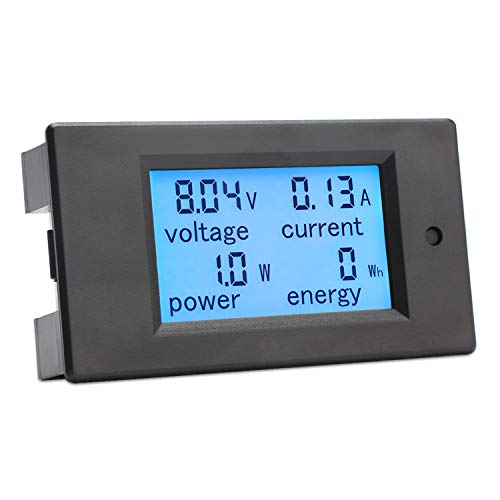
It has a built-in shunt and large LCD, making installation simple without extra wiring complexity.
The DROK DC 8-100V 20A Voltage Amperage Power Energy Meter has a built-in shunt, so you don’t need to mount a separate current sensor. It displays voltage, current, power, and accumulated energy on a large LCD, with energy up to 9999kWh.
The four-point terminal strip accepts two wires in and two out, and a wiring diagram on the back simplifies hookup. A recessed switch toggles the blue backlight, and accumulated energy can be reset by button, with data persisting through power-offs.
This is best for portable solar panels, small DC loads, and bench testing where 20A is enough. The built-in shunt makes installation the easiest in this group, since there’s no external sensor to wire. The trade-off is the 20A ceiling, which rules out larger inverters and high-current banks.
A voltage alarm flashes the backlight when thresholds are exceeded. For someone who wants amp-hour-adjacent energy tracking without a complex install, this is the simplest option.
These ten meters span the spectrum from simple LED indicators to true coulomb counters. If you want to watch amp hours directly, prioritize meters with a shunt or Hall sensor that tracks current over time, like the AILITRON TC147 or CGELE.
If you’re just checking live loads and don’t need capacity tracking, simpler gauges will suffice. The best pick depends on whether you’re sizing a battery or just monitoring a system in real time.
Reading Amp Hours Without Getting Fooled
A meter that counts amp hours can still mislead you if you ignore how it counts. These practical notes cover the common ways amp-hour readings drift and what to do about it.
Start with a fully charged battery so the meter’s 100% reference is real, not assumed.
Set the battery capacity value in the meter to match the actual Ah rating on the label.
Let the meter see a full charge cycle before trusting the state-of-charge percentage.
Check the shunt or Hall sensor wiring for tight connections; loose lugs cause undercounting.
Re-sync the meter to 100% whenever you know the battery is truly full, especially after partial cycles.
- State of charge drops faster than expected under light loads, suggesting a miscalibrated capacity setting.
- The meter shows 100% but voltage sags quickly, a sign the battery has lost real capacity.
- Amp hours consumed don’t match runtime times current, pointing to a shunt or sensor issue.
- Readings jump erratically, often caused by a loose negative cable or interference near a Hall sensor.
- The meter resets to full after every power-off, meaning data memory isn’t holding.
Matching Amp Hours To Your Actual Load
Knowing what amp hours mean is one thing; sizing a battery to your load is another. This section ties the concept to real decisions about how long your battery will actually last.
A 100Ah battery doesn’t give you 100 amp hours of usable power in most lead-acid cases. Discharging below 50% shortens battery life dramatically, so plan on 50Ah usable from a 100Ah lead-acid bank.
Lithium batteries, like LiFePO4, typically allow 80% to 90% depth of discharge, so a 100Ah lithium pack gives you 80Ah to 90Ah usable. That difference is why lithium costs more upfront but often delivers more usable capacity per rated amp hour.
To size a bank, add up the amps each device draws, multiply by hours of use, and total the amp hours. Then double that total for lead-acid or add 20% for lithium. A monitor that counts amp hours tells you whether your estimate was right.
Usable Amp Hours By Chemistry
| Battery Type | Rated Ah | Usable Ah | Depth Of Discharge |
|---|---|---|---|
| Lead-acid (flooded) | 100Ah | 50Ah | 50% |
| AGM lead-acid | 100Ah | 60Ah | 60% |
| LiFePO4 lithium | 100Ah | 85Ah | 85% |
| Lithium-ion | 100Ah | 80Ah | 80% |
When Amp Hours Stop Telling The Whole Story
Amp hours describe capacity, but they don’t capture everything about battery health. These are the situations where the number on the label and the number your meter shows start to diverge.
Why A 100Ah Battery Becomes An 80Ah Battery
Every battery loses capacity as it ages. A lead-acid bank cycled daily might retain 80% of its rated amp hours after a few hundred cycles. Lithium fades more slowly, often holding 80% after 2,000 to 5,000 cycles.
A monitor that counts amp hours reveals this fade: if your meter says 100% but you only draw 80Ah before voltage collapses, the battery’s real capacity has dropped. You can update the meter’s capacity setting to reflect the new reality, which keeps the state-of-charge reading honest.
Without amp-hour tracking, capacity fade stays invisible until a device dies unexpectedly.
Temperature And Amp Hours
Cold temperatures reduce usable amp hours in lead-acid batteries, sometimes by 20% to 50% at freezing. Lithium also loses capacity in cold, though less dramatically, and some chemistries shouldn’t be charged below freezing at all. A battery that delivers 100Ah in summer might only give 70Ah in winter.
Amp-hour meters don’t automatically compensate for temperature, so a reading that looks low in January may just reflect the cold. If you rely on amp hours for planning, factor in the season and keep the battery as warm as practical.
Amp hours also don’t capture discharge rate effects fully. A battery rated at 100Ah at the 20-hour rate may only deliver 60Ah at a 1-hour rate. If your load varies wildly, a single amp-hour number can’t describe every scenario.
This is why a monitor with a real-time current display matters: it shows the actual draw, so you can see when you’re pushing the battery hard. Pairing amp-hour counting with voltage and current readings gives you the full picture.
Amp hours tell you the size of the tank; current tells you how fast you’re draining it; voltage tells you how much pressure remains.
Amp hours measure how much charge a battery can deliver over time, one amp for one hour at the rated discharge rate. That single number tells you capacity, but only when you pair it with voltage and a realistic depth of discharge.
Your next move: check the amp-hour rating on your battery, note the discharge rate it’s based on, and consider a shunt-based monitor to watch those amp hours move in real time. Once you see the numbers live, sizing and maintaining a battery bank stops feeling like a guess.

- 10 Best Battery For Generator Ev Battery Bank Marine 2026 - October 27, 2026
- 10 Best Battery For Generator Ev Battery Bank Lto 2026 - October 27, 2026
- 10 Best Battery For Generator Ev Battery Bank Low Voltage 2026 - October 27, 2026