How Much Does The Average Car Battery Weigh?
You’re standing in the garage, holding a dead battery, wondering if you can lift the replacement yourself. The answer depends on chemistry , a standard lead-acid Group 24 battery usually lands between 40 and 50 pounds, while a lithium LiFePO4 equivalent can drop under 20.
That gap matters for your back, your front-end handling, and your fuel economy. This article breaks down the real weight ranges by battery type and size, then points to specific batteries that show exactly where the scale lands.
What Drives The Weight Of A Car Battery
Recommended Products

Battery weight isn’t random , it comes down to chemistry, group size, and how much lead or lithium sits inside the case. Understanding those three variables tells you roughly what to expect before you ever pick one up.
A traditional flooded lead-acid battery is heavy because lead plates and liquid electrolyte are dense. A Group 24 battery typically weighs 40 to 50 pounds, and a larger Group 31 can hit 60 to 70.
Absorbent Glass Mat (AGM) batteries use the same lead chemistry but pack it tighter, so they usually land 5 to 10 pounds heavier than a flooded equivalent.
Lithium iron phosphate (LiFePO4) batteries flip the equation entirely , they replace lead with lighter compounds and often weigh 15 to 25 pounds for the same cranking power.
The group size, which is a physical footprint standard, also caps how much material fits inside, so a Group 47 stays smaller and lighter than a Group 31 no matter the chemistry.
Typical Weight By Battery Chemistry And Group Size
| Battery Type | Group Size | Typical Weight | Cranking Power |
|---|---|---|---|
| Flooded Lead-Acid | Group 24 | 40-50 lbs | 500-700 CCA |
| Flooded Lead-Acid | Group 31 | 60-70 lbs | 800-1000 CCA |
| AGM Lead-Acid | Group 48 | 45-55 lbs | 700-850 CCA |
| LiFePO4 Lithium | Group 47 | 11-22 lbs | 600-800 CCA |
- Budget 45 pounds for a typical mid-size sedan lead-acid battery.
- Expect 55 to 65 pounds for a full-size truck or SUV battery.
- Cut that figure roughly in half for an AGM of the same group size.
- Drop to 15 to 25 pounds if you switch to LiFePO4 lithium.
- Add 5 pounds if the battery includes a built-in handle and thicker casing.
Why Battery Weight Matters More Than You Think
Recommended Products


Weight isn’t just a lifting problem. It affects how your car handles, how much fuel it burns, and how easy routine maintenance becomes. Here’s where the pounds actually show up.
Front-End Balance
A battery sits at the front of most cars, often over or ahead of the front axle. Shaving 30 pounds off that corner , which a lithium swap can do , reduces understeer and sharpens steering response. Enthusiasts and autocross drivers notice it immediately.
For daily drivers, the effect is subtler but real, especially in lighter compact cars where 30 pounds is a meaningful fraction of total curb weight.
Fuel Consumption
Every 100 pounds of vehicle weight costs roughly 1 to 2 percent in fuel economy. A battery that weighs 50 pounds versus 20 pounds is a 30-pound difference , small on its own, but it stacks with other weight reductions.
Some lithium battery makers claim up to 20 percent fuel savings, though that figure assumes broader weight and electrical efficiency changes, not just the battery swap alone.
Then there’s the practical side: your back. A 50-pound lead-acid battery is awkward to lift out of a tight engine bay, especially when you’re leaning over a fender. A 20-pound lithium unit is a one-hand carry.
That difference matters if you do your own maintenance, if you’re older, or if you ever need to remove the battery roadside. It also affects shipping costs if you order online, since many retailers charge by weight.
Finally, heavier batteries put more stress on the battery tray and hold-down hardware, which can crack over years of vibration in a way a lighter battery never would.
Batteries That Show The Weight Range In Practice
Recommended Products

These ten products span the full spectrum , from a 50-pound AGM workhorse to an 11-pound lithium upgrade, plus the jump starters and accessories that keep you from ever needing to lift a dead battery at all. Each one answers the weight question from a different angle.
|
1
|
Mighty Max Battery MM-H6 Start and Stop Car BCI Group Size 48 12V 70 AH, 120RC, 760 CCA Re |

A Group 48 AGM at 70Ah and 760 CCA , the heavy end of the typical weight range.
This Mighty Max MM-H6 is a Group Size 48 AGM battery rated at 12V, 70Ah, 760 CCA, and 120 minutes reserve capacity. AGM chemistry means it’s sealed, spill-proof, and heavier than a flooded equivalent , expect roughly 45 to 55 pounds depending on the exact build.
The 760 CCA and 120RC figures put it in the mid-to-upper range of cranking power, which is why it weighs what it does. If you’re trying to understand what a ‘normal’ car battery weighs, this is a solid reference point.
It fits start-stop vehicles and handles shock, vibration, and temperature swings well, making it a good choice for daily drivers in cold climates. The trade-off is weight: AGM packs more lead into the same footprint, so if you’re looking to shave pounds, this isn’t the battery for you.
It’s for the driver who wants reliability and doesn’t mind the heft.
|
2
|
Duracell 2032 Lithium Battery, 4 Count, AirTag & Key Fob, CR2032 3V Cell |

A CR2032 coin cell weighing under a gram , the opposite end of the battery weight spectrum.
This Duracell 2032 four-pack is a CR2032 3V lithium coin cell, not a car battery , but it’s here because it answers the weight question from the extreme low end. Each cell weighs roughly 3 grams, or about 0. 007 pounds.
It fits Apple AirTags, key fobs for Toyota, Honda, BMW, Ford, Chevrolet, and Lexus, plus tire pressure sensors and glucose monitors. If you’ve ever wondered how light a battery can get, this is it.
The bitter coating on both sides deters accidental ingestion by children, and the child-safe packaging adds another layer. Duracell claims longer life than Energizer’s 2032 3-in-1 in ANSI testing. The limitation is obvious: it won’t start your car.
But for the fob that unlocks it, this is the battery you need , and at a few grams, weight is a non-issue.
|
3
|
TPE Car Start-Stop Lithium Battery BCI Group47 LiFePO4 Lithium-ion Car Battery Lightweight |

An 11-pound LiFePO4 Group 47 , roughly a quarter the weight of a comparable lead-acid.
The TPE Car Start-Stop Lithium Battery is a Group 47 LiFePO4 unit rated 12. 8V, 600A, and 11. 02 pounds. That weight is the headline: a lead-acid Group 47 would typically run 35 to 45 pounds, so this is a 25-to-35-pound reduction. It measures 9. 60 x 6.
92 x 7. 75 inches with [- +] polarity. The BMS control circuit protects against overcharge, over-discharge, and overcurrent, and the emergency switch gives you 10 minutes of power if the board trips.
TPE claims up to 20 percent fuel reduction from the weight and efficiency gains, though that figure assumes ideal conditions. The cycle life runs into the thousands, far past lead-acid. The honest limitation: LiFePO4 costs more upfront and some older charging systems need verification before swapping.
It’s for the driver who wants the lightest possible battery and plans to keep the car long enough to recoup the cost.
|
4
|
JOLTEKON Car Battery Jump Starter with Air Compressor 4500A 150PSI, Car Jumper Starter Por |
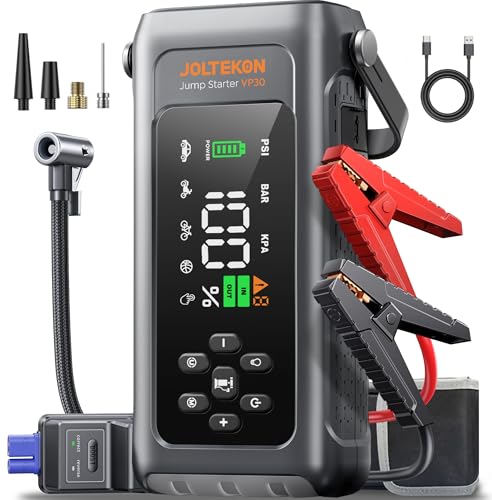
A 4500A jump starter with air compressor , skip the battery lift entirely.
The JOLTEKON Car Battery Jump Starter packs 4500A peak, a 150PSI air compressor, and an 8-in-1 toolkit into one portable box. It starts 9L gas and 8L diesel engines, handles completely drained batteries down to -20°C, and includes a 19-cylinder motor for tire inflation.
The 500-lumen light has four modes including SOS and red strobe. A 3. 3-inch smart display shows remaining charge.
This is for the driver who’d rather never lift a 50-pound battery again. It stays in the trunk, charges your phone via USB-C, and inflates a tire to 25 PSI in minutes.
The limitation is weight of its own , it’s a substantial unit, not a pocket device , and it won’t replace a battery that’s truly dead, only get you started until you can. But for roadside peace of mind, it’s hard to beat.
|
5
|
AstroAI S8 Car Battery Jump Starter 1500A – Portable 12V Lithium Jump Box | BOOST for Dead |

A 0.95-pound 1500A jump starter , lighter than the battery it replaces in your trunk.
The AstroAI S8 is a 1500A portable jump starter for 6. 0L gas and 3. 0L diesel engines, weighing just 0. 95 pounds and measuring 7. 9 x 4. 5 x 3. 7 inches.
It uses a 45C high-rate lithium battery and a smart boost mode that detects voltage below 9V and unlocks the boost button for fully-drained batteries. Eight integrated protections cover reverse polarity, overcurrent, overvoltage, and short circuit.
This is the answer for anyone who finds a 50-pound battery intimidating. It stores in a glovebox, starts motorcycles, cars, SUVs, and lawnmowers, and includes a three-mode flashlight and power bank. The limitation: 1500A won’t handle the largest diesel trucks, and it’s a jump starter, not a replacement battery.
For compact cars and daily drivers, though, it’s the lightest insurance you can carry.
|
6
|
Leaf Blower Cordless Handheld Blower 2×4.0Ah Batteries & Charger,Green | Small Lightweight |

A 1.12-pound cordless blower , proof that battery-powered tools can be featherweight.
This cordless leaf blower weighs 1. 12 pounds and runs on two 4. 0Ah batteries with a fast charger. The turbine motor pushes air at up to 65 m/s. It includes two extended nozzles, a shoulder strap, and stepless speed adjustment via trigger pressure.
Each battery delivers up to 30 minutes on low speed.
It’s not a car battery, but it’s here because it uses the same lithium cell technology that’s making car batteries lighter. If you’re curious how a battery-powered tool can weigh barely over a pound, this is a hands-on example.
The limitation: it’s for lawn care, patio dust, and drying car panels after a wash , not for jump-starting anything. But it shows where battery weight is heading.
|
7
|
OMUGO Group 47 H5 12V LiFePO4 Car Battery, 800CCA Start-Stop, Lightweight | Built-in BMS p |

A 20-pound Group 47 LiFePO4 , 30 percent lighter than the factory lead-acid it replaces.
The OMUGO Group 47 H5 is a 12V LiFePO4 car battery rated 800 CCA and just 20 pounds. It fires up Camrys, Civics, 3 Series, and Malibus at -30°C. The 8-layer BMS protects against overcharge, over-discharge, and shorts, and a built-in voltage display lets you check health at a glance.
Dimensions are 9. 60 x 6. 92 x 7. 75 inches with [- +] polarity.
OMUGO claims this sheds 30 percent weight versus factory lead-acid, which translates to less front axle strain and quicker steering. It’s built for start-stop systems that kill ordinary batteries in under two years.
The limitation: you must double-check the group size and polarity before ordering, and lithium upfront cost is higher. For drivers who keep their cars and want the weight savings, it’s a strong pick.
|
8
|
Scatach 3000A Car Battery Jump Starter,12V Jump Starter Battery Pack Portable (up to 9.0L |

A 3000A jump starter the size of a power bank , carry it instead of lifting a battery.
The Scatach 3000A Car Battery Jump Starter handles up to 9. 0L gasoline and 7. 0L diesel engines, delivering up to 50 jumps per charge. It’s compact , about the size of an ordinary power bank , and includes spark-proof, reverse polarity, low-temperature, high-temperature, and overload protection.
A three-mode LED flashlight covers flashlight, strobe, and SOS.
This is for the driver who wants big-engine capability without big weight. It starts cars, pickups, motorcycles, boats, RVs, tractors, lawnmowers, and snowmobiles. The limitation: it’s a jump starter, not a replacement battery, and the 3000A rating is peak, not continuous.
But for a portable unit that fits in a glovebox, the capability-to-weight ratio is excellent.
|
9
|
TREKURE Car Battery Jumper Starter Portable 5000A, Portable Car Jump Starter up to 10L Gas |

A 0.8-pound 5000A jump starter with magnetic light , the lightest way to answer a dead battery.
The TREKURE Car Battery Jumper Starter delivers 5000A peak for up to 10L gas and 8L diesel engines, weighing just 0. 8 pounds. It includes Force Start tech for 0V batteries, a magnetic full-panel LED light with four modes, and a power bank function.
The V0 fireproof casing and 10 safety protections cover reverse polarity, spark-proof, short-circuit, overvoltage, and overheating.
The magnetic light is the standout , it clings to metal car parts for hands-free illumination during tire changes or inspections. A detachable lanyard allows handheld, hanging, or magnetic placement.
The limitation: 5000A is peak, and the unit is pocket-sized, so it’s best for passenger vehicles and light trucks rather than heavy commercial diesels. For most drivers, it’s the lightest insurance available.
|
10
|
Team Associated FT Brass Under Battery Weights ASC91744 Electric Car/Truck Option Parts |

Brass under-battery weights for RC cars , showing weight tuning is a deliberate choice.
The Team Associated FT Brass Under Battery Weights (ASC91744) are option parts for electric RC cars and trucks. They mount under the battery to lower the center of gravity and tune handling.
These are tiny compared to a full-size car battery, but they’re here because they illustrate the same principle: weight placement matters as much as total weight.
RC racers use brass weights to dial in balance and traction on different track surfaces. The limitation: they’re for hobby-grade RC vehicles, not full-size cars, and the listing provides minimal specs.
But if you’re thinking about how battery weight affects handling in your full-size car, these little brass blocks are a physical reminder that even a few grams in the right place changes how a vehicle behaves.
Those ten products cover the full weight spectrum , from a 70Ah AGM around 50 pounds to an 11-pound LiFePO4 and a 0. 8-pound jump starter. The pattern is clear: chemistry and group size set the number, and you can choose where on that scale you want to land.
Next, let’s cover what to do once you’ve picked a battery and how to avoid the most common weight-related mistakes.
Matching Battery Weight To Your Actual Driving Needs
Knowing the average weight is one thing. Picking the right battery for your car, climate, and habits is another. Here’s how to translate the numbers into a decision you won’t regret.
Check your owner’s manual or the existing battery label for the required group size , that sets the baseline weight.
Decide if you need AGM (heavier, better for start-stop and cold) or can use flooded lead-acid (lighter, cheaper).
Weigh the lithium option if you want to cut 20 to 30 pounds and plan to keep the car several years.
Confirm your charging system supports lithium before buying , some older alternators need a regulator adjustment.
Measure the battery tray and hold-down hardware to ensure the new battery, whatever its weight, fits securely.
- Don’t assume all Group 24 batteries weigh the same , AGM versions run 5 to 10 pounds heavier.
- Avoid buying a lithium battery without verifying your alternator’s charging profile.
- Never skip the hold-down bracket; a lighter battery can still shift and short if unsecured.
- Don’t lift a 50-pound battery by the terminals , use the handle or a strap.
- Check shipping weight before ordering online; some retailers charge by the pound.
What Changes After You Swap To A Lighter Battery
If you move from lead-acid to lithium, or even from a Group 31 to a Group 24, you’ll notice a few things. Some are pleasant, some require adjustment. Here’s what to expect in the weeks after the swap.
The first thing you’ll notice is the lift. A 20-pound lithium battery comes out and goes in with one hand, which makes future maintenance far less of a chore. The second is steering feel, especially in lighter cars , 30 pounds off the front axle is noticeable in quick transitions.
Fuel economy may tick up slightly, though the gain is small unless you’ve made other weight reductions. What you won’t notice is a drop in cranking power if you bought a properly rated lithium unit; 600 to 800 CCA is plenty for most passenger cars.
Before And After A Lithium Swap
| Factor | Lead-Acid | LiFePO4 Lithium |
|---|---|---|
| Typical weight | 40-55 lbs | 11-22 lbs |
| Lifespan | 3-5 years | 8-10 years |
| Cold cranking | 600-800 CCA | 600-800 CCA |
| Upfront cost | Lower | Higher |
| Maintenance | Terminal cleaning | None required |
Charging System Compatibility
Lithium batteries charge at a slightly different voltage curve than lead-acid. Most modern alternators handle both, but older vehicles may need a regulator check. If your voltage gauge reads above 14. 8V, have a shop verify the charging profile before installing lithium.
A mismatch can shorten battery life or trigger the BMS protection circuit.
Cold Weather Performance
Lithium handles cold well when rated for it , the OMUGO, for example, claims -30°C starts. But lithium doesn’t like being charged below freezing without a heater or BMS management. If you park outdoors in a harsh winter, confirm the battery’s cold-charging spec.
Lead-acid is more forgiving here, which is one reason it remains common in fleet vehicles.
The average car battery weighs between 40 and 55 pounds for a typical lead-acid unit, while a lithium LiFePO4 replacement can drop to 11 to 22 pounds for the same cranking power.
If you’re replacing a battery soon, check your owner’s manual for the group size first , that single number tells you the weight range you’re dealing with. Then decide whether the weight savings of lithium are worth the higher upfront cost for your driving habits.
Today, just pop your hood and look at the label on your current battery; it’s the fastest way to know exactly what you’re lifting.

- 10 Best Battery For Generator Ev Battery Bank Marine 2026 - October 27, 2026
- 10 Best Battery For Generator Ev Battery Bank Lto 2026 - October 27, 2026
- 10 Best Battery For Generator Ev Battery Bank Low Voltage 2026 - October 27, 2026