5000mAh Power Banks: Phone Capacity, Weight and Magnetic Fit
If you’re eyeing a 5000mAh power bank, you’re probably trying to solve one specific problem: keeping your phone alive without lugging around a brick. The tricky part is figuring out what 5000mAh actually buys you in the real world.
It’s enough to fully top off an iPhone 15 once, but if you’re carrying a larger Android device like a Galaxy S23, you might only claw back about 60% of a charge before the bank runs dry.
My read is that this capacity hits a sweet spot for portability, you get something that slips into a pocket or small bag without weighing you down, but it requires realistic expectations.
Below, I’ll walk through how these numbers translate to daily use, then shortlist the options that stand out for speed, magnetic convenience, or sheer thinness.
How 5000mAh Compares to Your Phone’s Battery
It helps to look at a 5000mAh rating next to your actual phone battery. An iPhone 15 sits at 3,279mAh, while a Samsung Galaxy S23 pushes closer to 3,900mAh.
Because no charger transfers energy with perfect efficiency, a 5000mAh bank will comfortably refill most iPhones once, but it will fall short of a full cycle on larger Androids.
If your day involves heavy streaming, navigation, or gaming, I would treat a 5000mAh pack as an emergency bridge rather than a bottomless well. Here is how to match the right bank to your specific phone and habits.
| Phone Model | Battery Capacity (mAh) | 5000mAh Bank = Full Charges |
|---|---|---|
| iPhone 15 | 3,279 | 1 full charge |
| Samsung Galaxy S23 | 3,900 | 1.28 charges (60%) |
| iPhone 13 | 3,240 | 1 full charge |
| Google Pixel 8 | 4,575 | 1.12 charges (50%) |
| OnePlus 12 | 5,000 | 1 full charge |
Capacity tells you how much energy is in the tank, but charging speed dictates how fast it gets into your phone. A 20W USB-C output feels noticeably quicker than a standard 10W port when you only have fifteen minutes before heading out the door.
If speed matters to you, I would look for Power Delivery (PD) support or proprietary tech like Anker’s PowerIQ. Take the Anker Nano Power Bank with its 22.
5W output, it can push an iPhone 15 to roughly 50% in under half an hour, whereas a slower charger could easily double that wait time.
When you’re shopping in the 5000mAh range, prioritizing output wattage often makes a bigger difference in daily life than squeezing out a few extra milliamp hours.
When a 5000mAh Bank Fails You
A 5000mAh power bank isn’t meant to be your primary power source for a week-long camping trip; it’s designed for the daily commute, a long afternoon out, or a quick travel layover.
If you’re constantly running mapping apps or editing video on the go, you’ll drain both your phone and this size of battery faster than expected.
I’d suggest looking closely at where a 5000mAh unit shines, and where it falls short, so you know exactly when it makes sense to stick with this size or step up to a 10,000mAh alternative.
- If your phone’s battery is **4,500mAh or larger**, a 5000mAh bank will only give you **one partial charge**, not enough for a full day.
- For **travel or commuting**, a 5000mAh bank works if you only need **top-ups**, not full recharges.
- If you use **5G, GPS, or heavy apps** (like video editing), your phone drains faster, **5000mAh may not last** through a long workday.
- A **slow-charging bank** (under 15W) will feel useless if you need a quick boost, **speed matters more than capacity** in some cases.
- If you’re **outdoor hiking or camping**, consider a **rugged, waterproof** 5000mAh bank like the FLEXTAILGEAR model, standard banks may not survive drops or moisture.
Why Slim Doesn’t Always Mean Light
Physical footprint varies wildly even within the same capacity. Some 5000mAh banks, like the Aobbow MagSafe models, measure just 0. 4 inches thick and weigh around 4. 3 ounces, barely noticeable in a jacket pocket.
Others, like certain podoru magnetic packs, tip the scales closer to 120g, which starts to feel like you’re carrying a second phone. If you find yourself drawn to a heavier 5000mAh model, my advice is to pause and check whether a similarly sized 10,000mAh option exists.
For instance, ultra-thin designs like the Baseus Picogo (around 0. 3 inches and 3. 8oz) prove you don’t always have to sacrifice capacity for portability, but you should always verify the weight before buying.
When to Skip the Magnetic Snap
Magnetic, MagSafe-style power banks are incredibly convenient if you own a compatible iPhone, they snap right on and eliminate cable clutter. But I would hesitate to recommend them universally. They rely on precise magnetic alignment, meaning a thick, non-MagSafe case or an older Android phone will likely break the connection.
If you aren’t in the Apple ecosystem, a wired USB-C bank like the Anker Nano is simply more reliable. There’s also the thermal reality: wireless charging generates more heat than wired, which over months can degrade battery health slightly faster.
Weigh that trade-off carefully if you plan to use a magnetic charger every single day.
Best 5000mAh Banks for Daily Use
With the math and form factors sorted out, here is how I would shortlist the best 5000mAh power banks available right now.
Whether you care most about fast USB-C charging, a magnetic snap-on design, or a profile thin enough to slide into a wallet, the focus is on matching the charger to your actual phone and routine.
|
1
|
Anker Nano Power Bank,5,000mAh Portable Charger, Built-in USB-C Connector | 5,000mAh 22.5W |

Fastest wired charging for iPhone 15 users, 22.5W output means 50% charge in under 30 minutes.
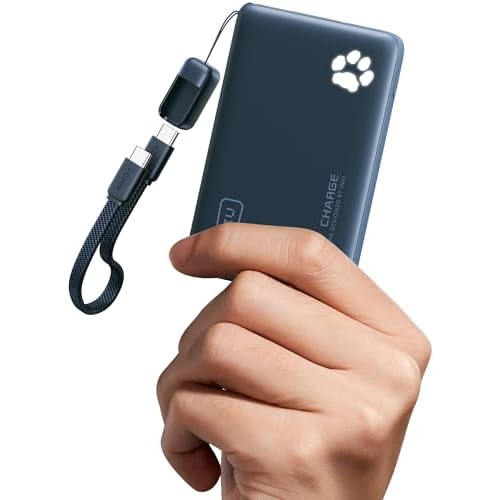
I would point to the Anker Nano Power Bank first if your main priority is getting back to a full battery quickly. Its 22. 5W USB-C output paired with PowerIQ 3. 0 technology is built specifically to push power fast into devices like the iPhone 15.
The foldable, built-in USB-C connector is the detail that stands out to me, it eliminates the need to dig through a bag for a stray cable, keeping everything flush and organized.
With 5000mAh on board, expect one full refill for an iPhone 15 or roughly a 60% top-up for a larger Android like the Galaxy S23.
My read is that this is the right pick for iPhone 15 owners who value speed over wireless convenience. Because it relies on a direct wired connection, you bypass the alignment quirks and heat generation of magnetic chargers.
That said, the built-in plug means it hangs directly off your phone’s port, so it’s better suited for tossing in a bag or using at a desk rather than sliding into a tight jeans pocket.
If you’re pairing it with an Android device, just keep in mind that you’ll only hit those peak speeds if your phone supports high-wattage USB-C input.
|
2
|
podoru for MagSafe Power Bank 5000mAh, Ultra-Slim Magnetic Portable Charger | 20W PD Fast |
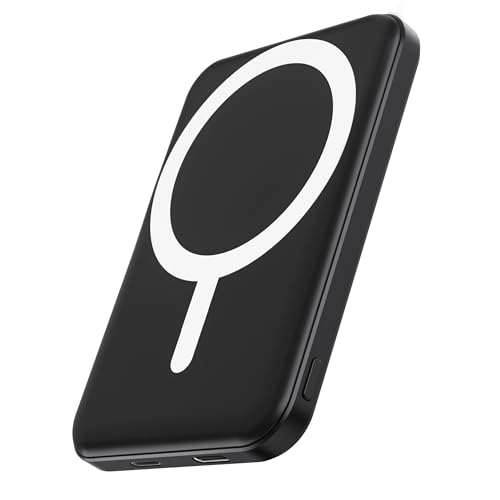
Wireless MagSafe charging that sticks to your iPhone like glue, no alignment struggles.
The podoru MagSafe Power Bank addresses the most common frustration with wireless chargers: the magnet slipping halfway through a charge. It uses upgraded magnetic alignment to grip the back of compatible iPhones firmly, so you can text, scroll, or take photos without the battery pack sliding off.
It delivers up to 15W wirelessly, which is competitive for this category, and includes a 20W USB-C port if you ever need to plug in a second device. The 5000mAh capacity is plenty for a daily iPhone top-up, though Android users won’t get much use out of the magnetic feature.
I would shortlist this if you’re an iPhone user who genuinely despises dealing with cables. The magnetic hold is noticeably secure, but remember that this convenience is strictly limited to MagSafe-compatible phones (iPhone 12 through the latest 18 series).
If you use a thick, non-magnetic case, the suction will fail, so you’ll either need a MagSafe-certified case or a bare phone. It’s also slightly bulkier than the ultra-slim wired alternatives, so factor that into your carry setup before committing.
|
3
|
Aobbow for MagSafe Power Bank 5000mAh, Ultra Slim Wireless Portable Charger | 0.4″ Ultra S |

Thinnest 5000mAh bank, fits in your wallet without adding bulk.
When I look at the Aobbow MagSafe Power Bank, the first thing that stands out is the physical profile. At just 0. 4 inches thick and 4.
3 ounces, it has roughly the footprint of a credit card, making it one of the easiest 5000mAh packs to slip into a small purse or jacket pocket.
The built-in magnets align cleanly with compatible iPhones for wireless charging, and the 5000mAh cell holds enough juice to recharge an iPhone 17 once or give a Samsung Galaxy S26 around a 70% boost. It stays attached reliably while you’re moving around, which is essential for a magnetic bank.
This is the model I would lean toward if minimizing bulk is your top priority. It provides enough everyday backup to get you through a long afternoon without feeling like you’re carrying extra hardware.
Just note that the magnetic snap-on design is really only useful if you own a MagSafe-compatible iPhone; if you’re on Android, you’re paying for magnets you can’t use. For Apple users who want a slim, unobtrusive safety net, it does exactly what it promises.
|
4
|
Aobbow for MagSafe Power Bank 5000mAh, Ultra Slim Wireless Portable Charger | 0.4″ Ultra S |

Same as above, just in blue. Pick this if you prefer color over specs.
This is functionally the exact same Aobbow MagSafe Power Bank mentioned above, 0. 4 inches thin, 4. 3 ounces, 5000mAh capacity, and the same strong magnetic alignment for iPhones. The only distinction here is the colorway.
If you happen to prefer a blue finish over the standard options to match your phone case or personal style, the performance remains identical.
It still snaps securely to the back of your device and provides that same single-charge backup for an iPhone 17 or partial fill for a Galaxy S26.
My advice here is straightforward: treat this purely as an aesthetic choice. There’s no performance upgrade or spec difference compared to the other Aobbow listing. If you’ve already decided that the ultra-slim magnetic form factor works for your daily routine, just pick whichever color you’d rather look at.
It remains a highly portable, iPhone-centric option.
|
5
|
Anker 621 MagGo Power Bank, 5,000mAh Magnetic Portable Charger | Travel Essential Battery |
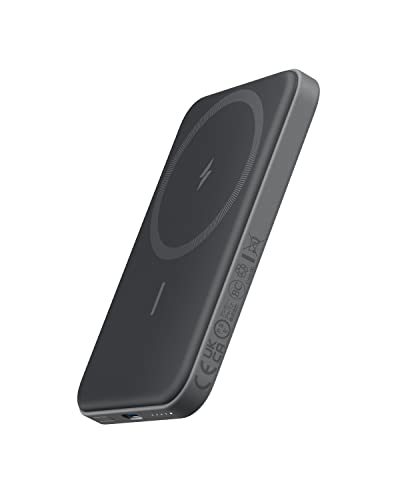
Anker’s smallest MagSafe bank, even slimmer than the Aobbow at 0.45 inches.
Anker’s 621 MagGo Power Bank takes a slightly different approach to shrinking a 5000mAh charger. Instead of just reducing the casing, it uses MiniCell technology to compress the internal components, resulting in a footprint of 4. 13 × 2. 62 × 0. 45 inches and a weight of just 4.
41 oz. The ultra-strong magnets lock onto compatible iPhones (like the 14 or 15 series) tightly enough that you can take selfies or make calls one-handed without worrying about the charger dropping. It’s designed to disappear into your pocket or bag while remaining attached to your phone.
I would consider this if you trust Anker’s build quality and want a magnetic charger that doesn’t feel like an afterthought stuck to your phone. The MiniCell tech genuinely keeps it compact, but because it’s wireless, it won’t match the raw charging speed of a 22.
5W wired alternative like the Anker Nano. It’s also exclusively beneficial for MagSafe-ready iPhones. If you want a minimalist, always-ready magnetic bank from a recognizable brand, this is a logical fit.
|
6
|
Anker Nano Power Bank,5,000mAh Portable Charger, Built-in USB-C Connector | 5,000mAh 22.5W |

Duplicate of product 0, same specs, different listing. Skip unless you need the cable included.
This listing mirrors the first Anker Nano Power Bank exactly: 5000mAh capacity, 22. 5W USB-C output, PowerIQ 3. 0, and the foldable built-in connector. It targets the same need, fast, cable-free wired charging for devices like the iPhone 15.
Since the internal hardware and external design are identical to the earlier Anker entry, it will deliver the same rapid top-ups, providing roughly one full charge for smaller iPhones or a significant percentage boost for larger batteries.
From an editorial standpoint, there is no functional reason to choose this over the first Anker Nano listing unless this specific page happens to include a bundled accessory you need or offers better availability. The core experience, plugging directly into your phone via the foldable USB-C connector for fast 22.
5W charging, remains unchanged. I would simply compare the two listings and buy whichever is easier to acquire.
|
7
|
podoru for MagSafe Power Bank 5000mAh, Ultra-Slim Magnetic Portable Charger | 20W PD Fast |

White version of podoru’s MagSafe bank, same performance, different color.
This is the white variant of the podoru MagSafe Power Bank, carrying the exact same specifications: 5000mAh capacity, 15W wireless charging, and the upgraded magnetic array designed to hold firmly to iPhones from the 12 through 18 series.
The lighter color might appeal if you use a white or light-colored MagSafe case and want the charger to blend in rather than contrast. Functionally, it behaves identically to the darker model, offering the same tangle-free wireless experience and compatibility across recent Apple devices.
I would treat this entirely as a cosmetic decision. The magnetic strength, charging speed, and 5000mAh limitations are all the same as the original podoru listing. If you’ve decided that a magnetic, wireless charger fits your workflow and you simply prefer a white aesthetic, this checks the box.
Just remember that the strong magnetic requirement still applies, meaning thick, non-MagSafe cases will interfere regardless of the color.
|
8
|
Baseus Picogo Power Bank, 0.3″ Ultra Slim 5000mAh MagSafe Portable Charger, Card-Size Magn |
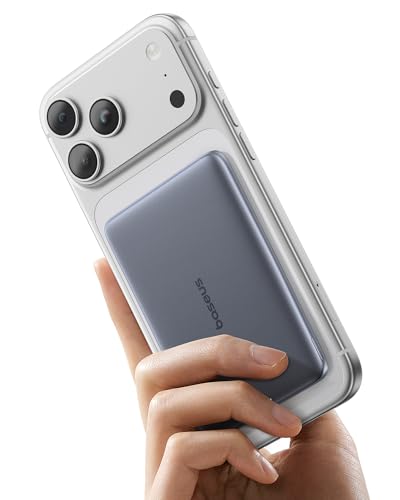
Baseus’s thinnest MagSafe bank, 0.3 inches thick, lighter than your phone.
The Baseus Picogo Power Bank pushes the boundaries of how thin a 5000mAh magnetic charger can get, measuring just 0. 3 inches thick and weighing a mere 3. 8 ounces. To put that in perspective, it’s lighter than many modern smartphones.
Despite the minimal profile, it doesn’t skimp on utility, the 11N magnetic force ensures a secure snap onto MagSafe-compatible iPhones, and the 20W USB-C output allows for surprisingly brisk wired charging when you need it. It’s built for people who notice every ounce in their pocket.
My read is that this is the standout option if extreme portability is your primary goal. Getting 5000mAh into a 0. 3-inch chassis is impressive, and the 20W USB-C fallback gives you flexibility if wireless charging feels too slow in a pinch.
However, like all magnetic banks on this list, its wireless utility is locked to the Apple ecosystem. If you’re an iPhone user who finds standard power banks too bulky, the Picogo is worth a close look.
|
9
|
FLEXTAILGEAR 5000mAh Power Bank, Outdoor Portable Power Bank | Ultra-Lightweight Outdoor T |

Only waterproof 5000mAh bank, built for hikers and outdoor adventures.
The FLEXTAILGEAR Power Bank steps away from the magnetic trend to focus purely on durability and weight. At just 3 ounces, it’s exceptionally light for a 5000mAh unit, and the IPX4 waterproof rating means it can handle unexpected rain or sweaty pockets during a hike.
Instead of relying on wireless charging, it uses a straightforward USB-C connection, which is inherently more efficient and avoids the heat buildup associated with MagSafe pads. The carbon fiber armor adds drop protection without adding bulk.
I would shortlist this specifically for outdoor use, travel in unpredictable weather, or for anyone who finds magnetic gimmicks unnecessary. By skipping the wireless charging hardware, FLEXTAILGEAR managed to keep the weight down to 3 ounces while adding rugged features.
It won’t snap magically to the back of your phone, but if you need a tough, featherlight backup battery that won’t die if it gets splashed, this fills a very specific niche perfectly.
|
10
|
Anker 621 MagGo Power Bank, 5,000mAh Magnetic Portable Charger | Travel Essential Battery |

Duplicate of product 4, same Anker MagGo specs, different listing.
This listing represents the same Anker 621 MagGo Power Bank detailed earlier, featuring the 5000mAh capacity, MiniCell compressed architecture, and the 4. 13 × 2. 62 × 0. 45-inch dimensions.
It relies on the same ultra-strong magnets to attach to iPhones (14 and 15 series specifically noted) for hands-free wireless charging. Because the underlying technology is identical, you can expect the same balance of compact portability and reliable magnetic grip.
As with any duplicate listing, my advice is to ignore the marketing copy and look at the practical differences, usually price, shipping speed, or bundle contents. If you want Anker’s compact magnetic solution, simply choose whichever version of the 621 MagGo is most readily available or cost-effective.
The charging experience itself will not change between these two pages.
Looking at these ten options, the divide comes down to how you prefer to connect. If you want the fastest possible refill and don’t mind plugging in, the 22. 5W wired Anker Nano stands out.
If you prioritize a seamless, cable-free experience on an iPhone, the magnetic options from podoru, Aobbow, and Anker’s 621 MagGo offer varying degrees of thinness and grip strength. For those counting every gram on a hiking trail, the FLEXTAILGEAR or Baseus Picogo deliver 5000mAh in remarkably lightweight packages.
Next, let’s cover how to keep whichever one you choose running efficiently over time.
How to Charge Your Power Bank Without Killing It
A 5000mAh power bank is generally rated for hundreds of charge cycles, but how you treat the lithium-ion cells inside dictates whether it lasts a year or three. Leaving it sitting at 100% capacity in a hot car or plugged into the wall indefinitely accelerates chemical degradation.
Here is how I would manage the battery to ensure it still holds a meaningful charge when you actually need it.
- Charge your power bank **only when it drops below 20%**, don’t let it sit at 100% for days.
- Use the **original cable** (or a high-quality USB-C cable) to avoid voltage drops that slow charging.
- Avoid **cheap knockoff chargers**, they can overheat and damage the battery over time.
- Store your power bank at **20-80% charge** if you’re not using it for weeks (e.g., in a drawer).
- If it **heats up excessively**, unplug it immediately, this can shorten its lifespan.
- For **long-term storage**, charge it to **40-60%** and store it in a cool, dry place.
Signs Your 5000mAh Bank Isn’t Enough
I would only recommend sticking with a 5000mAh bank if your daily power deficit is relatively small.
If you routinely drain your phone completely before dinner, or if you’re using a device with a massive battery like the Galaxy S23 Ultra (which exceeds 5000mAh on its own), this size will leave you short.
In those scenarios, stepping up to a 10,000mAh bank is necessary to guarantee at least one full, worry-free cycle. Heavy app usage, like continuous GPS navigation or mobile gaming, also burns through power faster than a 5000mAh cell can reasonably replace.
The Trade-Off: Size vs. Capacity
The trade-off for jumping to 10,000mAh is almost always physical size. Doubling the capacity usually means a thicker, heavier block that no longer slides effortlessly into a coin pocket.
If you’re a casual user who just needs a safety net for the commute home, the slim profile of a 5000mAh bank is worth far more than the extra juice you’d never actually use.
I’d suggest evaluating your typical day honestly before upgrading; carrying unnecessary weight defeats the purpose of buying a portable charger in the first place.
Common Mistakes That Drain Your Power Bank Faster
Even a well-built 5000mAh power bank can fail prematurely if subjected to bad habits. Using frayed cables, ignoring excessive heat, or treating it like a permanent desk accessory while plugged in constantly will shorten its lifespan significantly.
Here are the specific pitfalls I would avoid to keep the battery cells healthy.
Using a **cheap, slow USB-C cable** (under 18W) reduces charging speed and can overheat the power bank.
Leaving it **plugged in at 100% for weeks** causes battery degradation, unplug it once fully charged.
Charging in **direct sunlight or a hot car** speeds up battery wear, keep it in a cool, shaded place.
Using **non-MagSafe cases** with magnetic banks weakens the suction, causing misalignment and slower charging.
Ignoring **firmware updates** (if available) can lead to inefficient charging and overheating over time.
Storing it **fully discharged** for long periods (like a year) can permanently damage the battery.
Heat is the primary enemy of lithium-ion longevity. If your power bank becomes uncomfortably warm to the touch while charging your phone, disconnect it. This often happens when pairing a high-output bank with a low-quality, high-resistance cable.
Always use USB-C cables explicitly rated for the wattage your bank outputs, at least 18W to 20W for the fast-charging models listed here.
Furthermore, if you ever notice the casing bulging or swelling, stop using the device immediately and dispose of it properly; swollen cells indicate internal failure and pose a genuine fire risk.
Stick to reputable brands that back their products with warranties, so an early failure results in a replacement rather than a total loss.
Pairing Your Power Bank with the Right Cable
Not all USB-C cables are created equal. A **slow, cheap cable** can turn your **22.5W power bank into a 5W trickle charger**, making it useless in a hurry. Below, we’ll break down **which cables to use** (and which to avoid) to get the most out of your 5000mAh bank.
| Cable Type | Max Power (W) | Best For | Avoid If… |
|---|---|---|---|
| USB-C to USB-C (18W+) | 18-30W | Fast charging (iPhone 15, Galaxy S23) | Your bank only supports 10W |
| USB-C to Lightning (12W) | 12W | Older iPhones (13 and below) | You have an iPhone 15+ |
| USB-C to Micro-USB (5W) | 5W | Android phones with micro-USB | You need fast charging |
| Cheap no-name USB-C | Under 10W | Nothing, avoid at all costs | You want speed |
If your power bank supports **20W or more**, always use a **USB-C to USB-C cable rated for at least 18W**. Brands like **Anker, Belkin, or the cable included with your power bank** are safe bets. Avoid **Amazon Basics or no-name cables**, they often **underperform** and can **overheat** your power bank.
For **iPhone 15 users**, a **22. 5W cable** (like the one included with the Anker Nano) will give you the **fastest charging speeds**. If you’re unsure, check your power bank’s manual, it’ll specify the **minimum cable requirements** for optimal performance.
A 5000mAh power bank is a specialized tool: it excels at being lightweight, pocketable, and sufficient for a single emergency charge, but it isn’t designed to power you through a multi-day blackout.
If you’re deep in the Apple ecosystem, a magnetic MagSafe model from Aobbow or Baseus offers the cleanest daily experience. If you need raw speed regardless of your phone brand, a wired 22. 5W option like the Anker Nano is the logical route.
My final suggestion is to check your phone’s exact battery capacity in mAh, estimate how much power you typically burn through by mid-afternoon, and buy the charger that covers that specific gap, nothing more, nothing less.

- Marine Chargers and Backup Batteries: 9 Options Compared (2026) - October 27, 2026
- LTO Cells vs. SLA Generator Batteries: 5 Options Compared (2026) - October 27, 2026
- 12V/24V Backup Batteries and the EcoFlow DELTA Pro 3 (2026) - October 27, 2026