Checking Battery Level: State of Charge and Testing Different Cells
You grab a flashlight or turn the key and wonder whether the battery has enough juice left. That question , what is my battery level , has no single answer, because a AA in a remote and a 48V golf cart pack need completely different tools.
Household cells, car batteries, and lithium packs each report their state of charge in their own way. This guide explains how battery level is actually measured, then points to the right tester for each situation.
Why A Battery Level Is Hard To Pin Down
The phrase battery level sounds simple, but voltage, capacity, and state of charge are three different things. Understanding the gap between them explains why a quick test sometimes lies to you.
A battery’s voltage drops as it discharges, but the relationship is not linear. An alkaline AA may sit near 1. 5V when fresh and still read 1. 2V when it is nearly dead. A lead-acid car battery holds a fairly flat 12.
6V across much of its useful range, then falls off a cliff. Lithium packs behave differently again, staying near nominal voltage until the final stretch. That is why a simple voltmeter can mislead you.
Real battery level indicators combine voltage readings with chemistry-specific discharge curves, so the percentage on screen reflects usable capacity rather than a raw number.
How Different Batteries Report Their Level
| Battery Type | What You Measure | Best Tool |
|---|---|---|
| AA / AAA alkaline | Open-circuit voltage | Analog or LCD tester |
| 9V household | Voltage under light load | Universal battery checker |
| Car 12V lead-acid | Voltage plus CCA load | Digital load tester |
| Golf cart 48V pack | Pack voltage and percent | Panel-mounted monitor |
| Lithium-ion 1-8S | Cell string voltage | LED capacity module |
- Test a resting battery, not one that just came off a charger or heavy load.
- Match the tester’s chemistry setting to the battery type for an accurate percentage.
- Treat voltage alone as a rough guide; capacity percentage needs a calibrated curve.
- Recharge or replace anything that reads below 20 percent to avoid deep discharge.
- Note the temperature, since cold batteries read lower than they really are.
When You Actually Need To Check A Battery
Not every battery question calls for a gadget. Knowing which situations justify a tester helps you decide what to keep on hand.
The Drawer Full Of Mystery Cells
Most homes accumulate loose AA, AAA, C, D, and 9V batteries with unknown charge. A pocket tester lets you sort good from dead in seconds instead of guessing or tossing usable cells. Analog needle models need no power source and read good, low, or replace at a glance.
Digital LCD versions give a voltage number for finer judgment. Either way, the goal is the same: stop throwing away batteries that still have life and stop installing ones that do not.
Vehicles, Carts, And Solar Setups
A car, golf cart, RV, or solar bank holds a battery that costs far more than a pack of AAs. Here a simple voltage check is not enough. You want a monitor that shows remaining capacity as a percentage and warns you before the pack drops too low.
Panel-mounted meters wire directly to the battery and display state of charge continuously. For a car, a load tester that measures cold cranking amps reveals whether the battery can still start the engine on a cold morning.
Identify the battery chemistry and nominal voltage before you test anything.
Let the battery rest so surface charge from a recent charge or load dissipates.
Set the tester or monitor to the correct battery type and system voltage.
Connect positive and negative leads firmly, then read voltage or capacity percentage.
Compare the result to the expected range and act before the level gets critically low.
Tools That Answer What Your Battery Level Is
The right checker depends on what you are testing. A pocket tester handles the junk drawer, while a wired monitor watches a cart or car pack around the clock.
These ten options cover both ends and the middle, so you can pick the one that matches the battery in front of you.
|
1
|
Dlyfull Battery Tester for AA AAA C D 9V, Button Cell & Household Batteries | LCD Display |

It checks almost any household cell including button batteries, then shows good, weak, or poor on a clear LCD.
The Dlyfull tester handles the widest range here, covering AA, AAA, C, D, 9V, N, CR123A, CR2, CRV3, 2CR5, CR-P2, and a long list of button cells. That breadth matters when your question about battery level applies to a watch battery as much as a flashlight.
The LCD screen shows whether a cell is poor, weak, or good, so you get a verdict rather than a raw number to interpret.
Its compact anti-slip body fits easily in a drawer or glove box, and an included AAA means it works right out of the box. The main limitation is that it will not test rechargeable batteries, so keep it for disposable cells.
If your household runs on alkalines and coin cells, this covers nearly everything you own.
|
2
|
Frienda Golf Cart Battery Meter with Alarm, 12V-84V Compatible, Green | Capacity Voltage I |

It watches 12V to 84V packs continuously and flashes an alarm before a cart or bike dies on you.
The Frienda meter is built for larger systems, covering 12V through 84V and working with lead-acid, lithium-ion, ternary lithium, and AGM packs. A front button toggles between voltage and battery percentage, so you can see exactly where your charge stands.
The low-battery alarm flashes when capacity drops critically low, which is the early warning that keeps a golf cart from stranding you mid-round.
Installation is straightforward with a switch key and front settings, and the sturdy housing suits everyday outdoor use. The catch is that you must select the correct battery code in the settings, or the percentage will be off.
It fits anyone running an e-bike, scooter, RV, or cart who wants a permanent readout rather than a one-time test.
|
3
|
D-FantiX Battery Tester for AAA AA C D 9V, Universal Battery Charge Checker | Small 1.5V B |
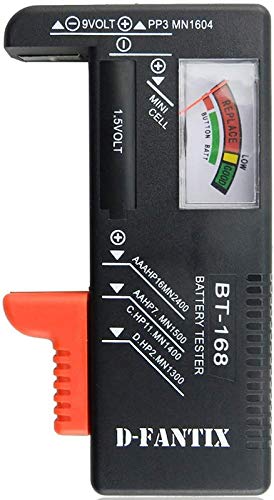
A no-battery analog tester that sorts AA through 9V cells into good, low, or replace in seconds.
The D-FantiX BT-168 is the classic analog household tester. It works with AA, AAA, C, D, 1. 5V, 9V, and button cells, and it needs no battery of its own because the cell under test powers it.
The needle moves across a color-coded scale, pointing to green for good, yellow for low, and red for replace or recharge. That simplicity is the whole appeal when you just want a fast answer.
Its small, light frame makes it easy to keep near the battery drawer, and it works with both standard and rechargeable cells. The honest limitation is precision: the needle shows a rough range, not a precise capacity figure.
For sorting a pile of loose batteries, though, it is quick and dependable, and it keeps you from discarding cells that still have charge.
|
4
|
SUPNOVA IPX7 Waterproof 7-100V Battery Monitor with Bracket, Temperature & Buzzer Alarm, D |

A waterproof 7-100V monitor that shows voltage, capacity percentage, and temperature with a buzzer alarm.
The SUPNOVA monitor covers 7V to 100V, handling 12V through 84V systems and supporting ternary lithium, lead-acid, AGM, and LiFePO4 packs. It displays both voltage and remaining capacity percentage, and a short press of the M key switches to temperature in Celsius.
The buzzer alarm can be set for low and high voltage thresholds, so you get an audible warning rather than a silent readout.
The fully sealed IPX7 shell survives dust and even prolonged water immersion, which suits boats, motorcycles, and outdoor rigs. It ships with a mounting bracket, adhesive, and screws, and the 60cm leads give some install flexibility.
The trade-off is that it defaults to 12V lead-acid, so you must confirm your battery type for an accurate percentage.
|
5
|
VTECHOLOGY 2Pcs Battery Tester for AA AAA C D 9V 1.5V Household Batteries | Universal Batt |

Two no-battery analog testers in one pack, ready for the whole drawer of AA through 9V cells.
The VTECHOLOGY set gives you two BT-168 testers, so you can keep one in the kitchen and one in the garage. Each handles AA, AAA, C, D, 1. 5V, 9V, and 1. 5V button cells, and neither needs its own battery because the cell under test activates it.
The analog needle points to good, low, or replace on a color-coded scale, giving you a fast read without any setup.
The compact, lightweight design makes these easy to store anywhere, and having a spare means you are never hunting for the tester. The manufacturer notes that the needle indicates voltage range rather than precise capacity, and that you should keep test times short to avoid draining the cell.
For everyday household use, the pair is a practical, low-cost answer.
|
6
|
DROK Waterproof Battery Monitor 12V 24V 36V 48V 72V Battery Meter 8-100V, Capacity Tester |

A waterproof 8-100V monitor that shows voltage, capacity, and percentage on one bigger screen without switching.
The DROK monitor covers 8V to 100V and suits 12V through 72V lithium, lead-acid, ternary lithium, and polymer lithium packs. Its upgraded larger screen displays voltage, capacity, and remaining percentage all at once, so you skip the button-pressing other meters require.
A voltage calibration potentiometer on the back lets you fine-tune readings for better accuracy.
The waterproof panel protects internals from moisture and corrosion, and it adds reverse polarity protection with automatic save on power loss. Low power consumption and a low voltage alarm round out the feature set. It fits motorcycles, golf carts, RVs, boats, and solar generators.
The main caveat is that you may need to adjust the calibration pot to match your system exactly.
|
7
|
Haldzemo 1S 2S 3S 4S 5S 6S 7S 8S 1-8S Lithium Battery Capacity Indicator Module 4 Sections |

Five tiny LED modules that wire straight to 1-8S lithium packs and show charge in four levels.
The Haldzemo modules are for lithium builders, working from 3V to 34V across 1S through 8S packs. You connect the board’s positive and negative ports to the battery, and a four-section LED display lights up to show real-time charge in green or blue.
With five modules in the pack, you can instrument several packs or keep spares on the bench.
Working current is just 5mA, so the module barely affects the pack it monitors, and the operating range covers -20 to 50 degrees Celsius. The important limitation is that these are not waterproof and must stay in a dry environment.
They suit hobbyists and DIY lithium builds more than finished vehicles, but for that audience they are a cheap, clear solution.
|
8
|
12V 24V 36V 48V Car Battery Meter, Lead-Acid Lithium-ion Battery Capacity Voltage Meter wi |

A 12V-48V panel meter that flashes below 20 percent and sounds an alarm before you run out of power.
This meter supports 12V, 24V, 36V, and 48V systems and works with lead-acid, lithium iron phosphate, and lithium batteries. An on-off button lets you check capacity or real-time voltage at a touch, and the display flashes once capacity falls below 20 percent.
A built-in alarm then warns you audibly, which is the feature that prevents accidental deep discharge.
The LCD screen has bright backlighting and a PVC waterproof film, and it draws a maximum of just 5mA. Installation is simple: the unit comes with its own wires and needs no separate power supply, detecting voltage automatically.
It fits motorcycles, cars, trucks, boats, and golf carts, though the 72V ceiling means very high-voltage packs need a different meter.
|
9
|
Xiqaler DC 12V 24V 36V 48V 60V 72V 84V Battery Meter, Front Setting Battery Capacity Volta |

A 12V-84V meter in a drop-resistant ABS housing that switches between voltage and charge percentage.
The Xiqaler meter spans 12V to 84V, covering electric golf carts, EVs, scooters, motorcycles, RVs, and solar systems. It works with lead-acid, ternary lithium, Li-ion 3-15 series, and AGM batteries.
A front button switches between voltage and remaining charge percentage, and the crisp fonts stay readable in both bright and dim light.
The ABS housing resists drops, wear, and impact, so it holds up in demanding environments. When charge drops critically low, the screen flashes an alert that reminds you to recharge before over-discharge damages the pack.
The main thing to verify is that your system voltage falls within the supported range and that you set the correct battery type for an accurate percentage.
|
10
|
ANCEL BA101 Car Battery Tester, 12V Digital Automotive Alternator Meter Diagnostic Tool,10 |

A load tester that goes beyond voltage to measure CCA, state of health, and cranking performance.
The ANCEL BA101 is a 12V load tester, not just a voltmeter. It measures state of health, state of charge, voltage, current, and cold cranking amps, plus cranking and charging system tests. That matters because a car battery can show 12. 6V and still fail to start an engine.
Copper crocodile clips and a precision chip deliver dependable results when you enter the correct battery rating.
The black-and-white screen with adjustable contrast and white backlight stays readable in sunlight, and the unit draws power from the vehicle so there is nothing to charge. Built-in protection guards against reverse polarity, shorts, overcurrent, and overvoltage.
It supports most 12V batteries over 30Ah but not lithium, 6V, 8V, or 24V packs, so check your battery label first.
A pocket tester answers the question for household cells, while a wired monitor or load tester answers it for vehicle and lithium packs. Match the tool to the battery type and voltage range, and you will get a reading you can trust.
The next section covers how to keep those readings accurate over time.
Keeping Your Battery Readings Accurate Over Time
A tester is only as good as the way you use it. These habits keep your battery level readings honest and help the batteries themselves last longer.
Battery level readings drift for predictable reasons. A cell tested right after charging shows a surface charge that makes it look fuller than it is, so let it rest first. Temperature shifts voltage too, and a cold battery reads lower than its true state.
For wired monitors, a wrong chemistry setting skews the percentage even when the voltage is correct. Recheck your settings after any battery swap, and recalibrate a monitor if the readings stop matching a known-good reference. Consistency in how and when you test matters more than the tester’s price.
- Recharge lead-acid and lithium packs before they drop below 20 percent capacity.
- Store loose household batteries at room temperature, away from metal that can short them.
- Recheck a car battery’s cold cranking amps each season, not just its resting voltage.
- Clean terminal contacts so resistance does not distort your voltage reading.
- Replace a tester’s own battery or recalibrate the unit when readings seem off.
Reading The Result: What The Numbers Mean
| Reading | Likely Meaning | Action |
|---|---|---|
| Green / above 80% | Healthy charge | Keep using |
| Yellow / 20-80% | Partial charge | Monitor or top up |
| Red / below 20% | Critically low | Recharge or replace |
| Voltage sags under load | Weak or aging cell | Test further or replace |
| Alarm flashing | Imminent shutdown risk | Recharge immediately |
Common Mistakes When Checking Battery Level
Most wrong answers about battery level come from a handful of avoidable errors. Steering clear of these will save you from replacing good batteries and trusting dead ones.
Do not test immediately after charging; wait for the surface charge to settle.
Never test a rechargeable cell with a tester rated only for disposables, or you get a false verdict.
Set the chemistry and system voltage on wired monitors before trusting the percentage.
Do not judge a car battery on voltage alone; run a load or CCA test for the real picture.
Keep analog test times short so the tester itself does not drain the cell you are checking.
Another frequent slip is assuming one tester covers everything. A button-cell checker will not tell you anything useful about a 48V golf cart pack, and a panel monitor will not sort your drawer of AAs.
Match the tool to the battery class, and keep a simple household tester alongside any vehicle monitor. Finally, remember that voltage is a snapshot while capacity is a trend.
If you check a pack regularly, you will notice a slow decline long before it fails, and that early signal is often more valuable than any single reading.
Your battery level depends on which battery you mean, so match the tool to the chemistry: a pocket tester for household cells, a wired monitor for carts and vehicles, and a load tester for car batteries.
Pick the one that fits the battery in front of you, then test it at rest for an honest reading.
Start today by gathering your loose household batteries and sorting them with a simple tester, and you will likely find several you were about to throw away still have plenty of charge left.

- Marine Chargers and Backup Batteries: 9 Options Compared (2026) - October 27, 2026
- LTO Cells vs. SLA Generator Batteries: 5 Options Compared (2026) - October 27, 2026
- 12V/24V Backup Batteries and the EcoFlow DELTA Pro 3 (2026) - October 27, 2026