What Is Inside A Lithium Battery?
If you’ve ever cracked open a dead remote or swapped out a coin cell in your car key fob, you might have wondered what’s actually doing the work inside.
Lithium batteries pack a surprising amount of chemistry into a small space, metals, salts, and specialized separators all collaborating to push out steady voltage for years. Here is a closer look at what makes up lithium battery contents, along with a rundown of options currently on the market.
The Science Behind Lithium Batteries
Recommended Products


Most consumer lithium cells we deal with daily are primary (non-rechargeable) batteries, though the underlying chemistry shares DNA with rechargeable lithium-ion packs. They rely on the movement of lithium ions to generate current.
What makes them stand out from older alkaline cells is their energy density and remarkably low self-discharge rate. Knowing what sits inside the casing explains why they hold up so well in storage and extreme weather.
Strip away the outer wrapper, and you’ll find four main components: an anode, a cathode, an electrolyte, and a separator. The anode often uses lithium metal or graphite to store ions.
The cathode, frequently a compound like lithium manganese dioxide in coin cells or iron disulfide in AA formats, releases those ions during use. A liquid or gel electrolyte acts as the bridge, letting ions flow between the two sides, while a thin porous separator keeps them from touching directly and shorting out.
This specific arrangement is why lithium cells maintain their charge for decades on a shelf.
Anode
The anode serves as the battery’s reservoir during idle periods. In many primary lithium cells, metallic lithium itself acts as the anode material because it readily gives up electrons. This is a big part of why these batteries weigh less than alkaline equivalents while packing more punch.
Cathode
On the flip side, the cathode dictates much of the battery’s voltage and discharge curve. Manufacturers tweak cathode materials, like using lithium cobalt oxide or manganese dioxide, depending on whether the cell needs to deliver a slow, steady trickle for a watch or a sudden burst of current for a camera flash.
Electrolyte
The electrolyte isn’t just a passive filler; it’s usually a lithium salt dissolved in an organic solvent, carefully formulated to stay stable across wide temperature swings.
Combined with advanced sealing rings and anti-leak layers, modern electrolyte chemistry is what allows brands to promise 10- to 25-year shelf lives without the cell drying out or corroding your devices.
Top Lithium Battery Picks
Recommended Products


Figuring out which lithium cell fits your gear comes down to form factor, capacity, and where you plan to use it. A trail camera left in the winter woods needs different internal chemistry tolerances than a TV remote sitting on your coffee table.
My read is that these ten picks cover the most common scenarios, from heavy-drain AA setups to tiny CR2032 coin cells.
|
1
|
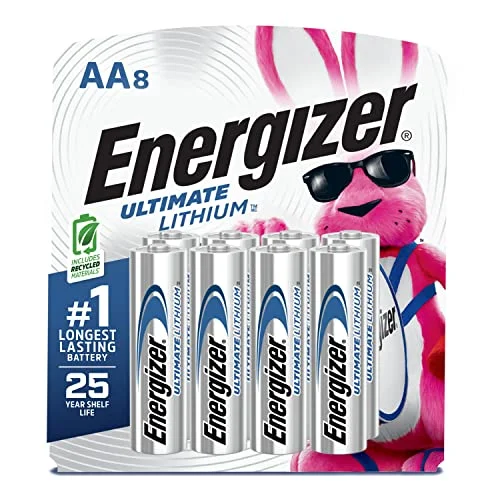
Energizer Ultimate Lithium AA Batteries (8 Pack), 1.5V Lithium Double A Batteries |

Energizer Ultimate Lithium AA Batteries use a specialized iron disulfide chemistry designed to be the longest-lasting AA option available.
Looking at the Energizer Ultimate Lithium AA 8-pack, the internal construction focuses heavily on longevity and weight reduction. Because lithium is significantly lighter than the zinc used in standard alkalines, these feel surprisingly light in hand.
Energizer engineered the contents to hold a charge for up to 25 years in storage, making them a staple for emergency kits. I’d point these toward high-drain gadgets like Blink outdoor cameras or digital point-and-shoots where weaker cells tend to die quickly.
What really sets the chemistry apart here is the temperature tolerance. The electrolyte formulation allows these to operate anywhere from -40°F to 140°F without stalling out. If you leave gear outside year-round, that thermal stability matters.
Keep in mind they are single-use cells, so once the lithium is depleted, you’re tossing them in the recycling bin rather than plugging them in.
|
2
|
Energizer Ultimate Lithium AA Batteries (24 Pack), AA Lithium Batteries | Double A Batteri |

Energizer Ultimate Lithium AA Batteries in the 24-pack offer the same long-lasting iron disulfide chemistry in bulk.
This 24-pack of Energizer Ultimate Lithium AAs contains the exact same lightweight, high-capacity chemistry as the smaller bundles, just scaled up for people who burn through power faster.
The internal spiral-wound design maximizes the surface area between the anode and cathode, which is how they manage to push consistent voltage to smart home hubs and handheld gaming devices.
Having 25 years of backup shelf life means you can buy in bulk without worrying about the contents degrading in your drawer.
I would shortlist these specifically for outdoor surveillance systems or trail cameras that sit in freezing conditions, since the electrolyte won’t thicken and stall the way alkaline paste does at -40°F. Just remember that despite the premium price tag, these remain non-rechargeable primary cells.
Once the chemical reaction finishes, the battery is spent.
|
3
|
Panasonic CR2032 3.0 Volt Long Lasting Lithium Coin Cell Batteries in Child Resistant, Sta |

Panasonic CR2032 3.0 Volt Long Lasting Lithium Coin Cell Batteries feature a lithium manganese dioxide chemistry optimized for steady, low-drain power.
Coin cells like this Panasonic CR2032 rely on lithium manganese dioxide chemistry, which is ideal for delivering a slow, steady 3 volts over a long period. Inside the child-resistant packaging, the cell itself is engineered to maintain its charge for up to 8 years when left unused.
I notice Panasonic specifically highlights compliance with Reese’s Law for their packaging, which is worth paying attention to if you have young kids around, given how easily these small discs can be swallowed.
You’ll typically find these powering motherboards, car key fobs, and small medical monitors like glucose meters. The flat, compact design means the separator and electrolyte layers are compressed tightly, leaving little room for error in manufacturing.
Like most coin cells, they aren’t meant for high-drain tasks, and once the internal lithium is exhausted, they need to be replaced.
|
4
|
YFCN CR2032 Battery 3V Lithium Batteries 5 Count Pack CR2032 Batteries – CR 2032 Coin Cell |

YFCN CR2032 Battery 3V Lithium Batteries use a zero-mercury formulation with advanced sealing technology to prevent leaks.
The YFCN CR2032 5-count pack takes a slightly different approach to its internal build, emphasizing a zero-mercury composition and advanced sealing rings to keep the electrolyte locked inside.
With a rated capacity of 240mAh, the lithium contents are tuned for low-draw items like LED tea lights, holiday decorations, and small remotes. They claim a 10-year shelf life, which suggests a very low self-discharge rate in their specific solvent mixture.
Temperature-wise, my read is that these are best suited for moderate climates, as they are rated from -20°C to 60°C, a narrower window than some heavy-duty AA lithiums. The child-resistant packaging requires scissors to open, adding a physical barrier to the small cells inside.
Since they are primary lithium cells, you’ll swap them out rather than recharge them once your flameless candles stop glowing.
|
5
|
Lithium AA Batteries 4 Count, 3200mAh Long Lasting 1.5V AA Battery, High Capacity 20-Year |

Lithium AA Batteries 4 Count utilize a three-layer safety design and spiral-wound technology to protect device internals.
These xuniuzero 3200mAh lithium AA batteries focus heavily on internal safety architecture. Instead of just relying on the base chemistry, they incorporate a three-layer design featuring an explosion-proof valve, an anti-short-circuit valve, and a leak-proof sealing ring.
For anyone putting batteries into expensive security systems or trail cameras, knowing the internal contents won’t leak corrosive electrolyte onto your circuit boards is a major plus. They claim to outlast standard alkalines by 8 to 10 times.
The 20-year emergency shelf life points to an annual self-discharge rate of under 1%, meaning the lithium ions stay relatively dormant until you actually need them. I’d lean toward these for hurricane kits or off-grid gear where reliability trumps everything else.
They handle temperatures down to -40°F, but again, they are strictly single-use cells.
|
6
|
Tenergy 3V CR2032 Batteries, Lithium Button Coin Cell 2032 Battery, Compatible with AirTag |

Tenergy 3V CR2032 Batteries use an anti-leak lithium formulation designed to perform across a wide temperature spectrum.
Tenergy’s 10-pack of CR2032 coin cells uses a lithium chemistry tailored for portable electronics like Apple TV remotes, heart rate monitors, and calculators. The standout detail here is the anti-leak construction paired with a low self-discharge rate that supports a 10-year shelf life.
When you look at what’s inside, the electrolyte is formulated to stay fluid and functional even when the temperature drops to -4°F or spikes to 140°F.
If you play outdoor augmented reality games or use GPS trackers in varying weather, that temperature flexibility matters. The internal separator keeps the anode and cathode safely divided until the circuit closes. Just note that like all CR2032s, these are disposable once the 3-volt charge runs dry.
|
7
|
PGSONIC CR2032 3V Lithium Coin Battery (20pcs) |

PGSONIC CR2032 3V Lithium Coin Batteries contain a high-capacity lithium formulation meant to hold a charge for up to 5 years.
The PGSONIC CR2032 cells take a straightforward approach to lithium coin chemistry, prioritizing a reliable 5-year shelf life. While some competitors push for a decade or more, a 5-year retention window is often plenty for everyday household gadgets like bathroom scales, key fobs, and motherboard clocks.
The internal contents are sealed to prevent the organic solvent electrolyte from evaporating over time.
I would consider these a practical pick for devices you access frequently enough that a 5-year reserve is more than adequate. They handle typical indoor and outdoor temperature shifts without the voltage dropping off a cliff.
As with any primary coin cell, once the lithium reacts fully, it’s time for a replacement.
|
8
|
EBL Lithium AA Batteries 12 Pack, Longest Lasting 3700mAh 1.5V Non-Rechargeable, Upgraded |

EBL Lithium AA Batteries 12 Pack use a high-density lithium core engineered to deliver 24% more power than standard alkalines.
EBL’s 12-pack leans into high-density lithium chemistry, claiming to outlast alkaline cells by seven times while delivering 24% more overall power.
Inside the casing, the ratio of active lithium material to the separator and electrolyte is optimized for devices that demand sudden bursts of energy, like camera flashes or motorized toys. This higher concentration of active material is exactly what drives that extended runtime.
What catches my eye is the extreme cold rating down to -68°F. That requires a highly specialized electrolyte blend that refuses to freeze or thicken in deep winter conditions. If you run equipment in unheated barns or arctic environments, the internal chemistry of these EBLs is built for that stress.
They are, however, non-rechargeable, so factor that into your long-term costs.
|
9
|
Energizer CR1632 3 Volt Lithium Coin Battery 10 Pack (2 packs of 5) |

Energizer CR1632 3 Volt Lithium Coin Battery 10 Pack relies on Energizer’s standard lithium manganese dioxide formula for smaller devices.
The CR1632 is physically smaller than the ubiquitous CR2032, but the internal chemistry remains largely the same lithium manganese dioxide setup. Energizer packages these in a 10-count, targeting niche electronics like specific car key fobs, laser pointers, or small wearable sensors.
The electrolyte and separator are scaled down to fit the 16mm diameter, yet they still manage to support operation from -30°C up to 60°C.
Because the total volume of lithium inside is smaller, these cells naturally drain faster than larger coin formats if placed in a high-draw circuit. I’d recommend double-checking your device’s manual to ensure a CR1632 is the correct spec before buying in bulk. Once depleted, the chemical reaction cannot be reversed.
|
10
|
YTKavq 3.7V 850mAh Battery 102535 Lithium Polymer Ion Rechargeable Li-ion Li-Po Battery wi |

YTKavq 3.7V 850mAh Battery features a rechargeable lithium-ion chemistry distinct from the primary cells on this list.
Unlike the disposable AA and coin cells above, the YTKavq 3. 7V 850mAh battery uses rechargeable lithium-ion chemistry. The internal contents differ significantly: instead of a consumable lithium metal anode, it typically uses graphite that shuttles lithium ions back and forth during charging and discharging cycles.
This means the 850mAh capacity can be replenished hundreds of times rather than being thrown away after one use.
My read is that this type of cell is intended for specific DIY electronics, small RC toys, or replacement packs where a soldered or plugged-in rechargeable source is required. You won’t drop this into a standard TV remote.
Because it’s rechargeable, managing the internal chemistry requires avoiding deep discharges and keeping it away from excessive heat to preserve the lifespan of the ion-transfer process.
Lithium battery contents vary wildly depending on the form factor. You have primary cells packed with reactive lithium metal for decades of shelf life, and rechargeable variants using graphite intercalation for repeated cycling.
Matching the right internal chemistry to your specific device, whether it’s a freezing outdoor camera or a tiny key fob, is the real trick to getting the performance you paid for.
How to Choose the Right Lithium Battery
Recommended Products


Picking the right cell isn’t just about matching the size printed on the plastic. The internal chemistry dictates how the battery behaves under load, how long it survives in a drawer, and how it handles the weather outside.
I always start by looking at the device’s power draw. High-drain gear like security cameras and motorized toys benefit from the spiral-wound internal construction found in premium lithium AAs, which exposes more surface area for the chemical reaction.
Low-drain items like watches or memory backups only need the gentle, slow-release chemistry of a standard CR2032 coin cell. Next, think about the environment.
If your gear sits in a freezing garage, check the electrolyte temperature ratings closely, a cell rated only to -4°F will fail where one rated to -40°F keeps running.
Finally, if you’re stocking up for emergencies, prioritize the cells advertising 10- to 25-year shelf lives, as their internal self-discharge rates are low enough to guarantee power when you actually need it.
- Consider the type of device you are powering.
- Look for a battery with a high energy density and a low self-discharge rate.
- Consider the expected usage duration.
- Consider the environmental conditions.
- Check the battery’s safety features, such as leak-proof construction.
Maintaining Your Lithium Batteries
Recommended Products


Even the best lithium chemistry degrades if handled poorly. Storing and using these cells correctly ensures the internal components stay intact until you’re ready to use them.
Heat is the enemy of lithium battery contents. Storing cells in a hot attic or a sun-baked glovebox accelerates the breakdown of the organic solvent electrolyte, effectively aging the battery before you even install it. I’d suggest keeping spares in a cool, dry drawer at room temperature.
Also, avoid mixing old and new cells in the same device; the differing internal resistances force the newer battery to overwork, which can lead to venting or leakage.
And while modern lithium cells feature robust anti-leak seals, it’s still good practice to remove them from seasonal gear, like holiday decorations, before putting everything back in storage for the year.
Store batteries in a cool, dry place when not in use.
Avoid exposing batteries to extreme temperatures.
Avoid leaving batteries in devices for long periods.
Regularly check batteries for signs of damage or leakage.
Replace batteries immediately if any issues are noticed.
Peeking past the label reveals that lithium batteries are far more than simple metal cylinders. From the specific solvent blends in the electrolyte to the safety valves preventing pressure buildup, every internal component plays a role in how long your gear stays powered.
Whether you need the extreme cold tolerance of an Energizer Ultimate Lithium AA or the compact, decade-long readiness of a Panasonic CR2032, understanding what’s inside makes it much easier to buy exactly what your devices require.

- 10 Best Battery For Generator Ev Battery Bank Marine 2026 - October 27, 2026
- 10 Best Battery For Generator Ev Battery Bank Lto 2026 - October 27, 2026
- 10 Best Battery For Generator Ev Battery Bank Low Voltage 2026 - October 27, 2026