Is A Car Battery Ac Or Dc Voltage?
You might wonder if your car runs on alternating current like your wall outlets. It’s an easy mix-up, especially since there’s an ‘alternator’ right under the hood. But getting the voltage type straight is key when you’re troubleshooting electrical gremlins or picking out the right gear. The bottom line?
Car batteries strictly use direct current (DC). I’ll walk you through why that matters and review some specific testers and monitors to help you verify that voltage safely.
Why Car Batteries Are Strictly Direct Current
Recommended Products


Car electrical systems run on chemical reactions that push electrons in one constant direction. Unlike the power in your house, which flips back and forth, automotive voltage stays steady.
Here, I’ll break down the fundamental difference between these currents and explain why vehicles specifically need that stable direct current flow for their sensitive electronics and starter motors.
Automotive batteries generate electricity through electrochemical processes involving lead plates and acid electrolyte. These reactions create a potential difference that pushes electrons consistently from the negative terminal to the positive terminal. That unidirectional flow is what we call direct current, or DC.
Alternating current, on the other hand, reverses direction periodically, usually fifty or sixty times a second. Cars simply can’t use that reversing flow because components like ECUs and sensors need a stable polarity to work.
If a vehicle tried to run on AC, those delicate microprocessors would likely fry immediately due to inconsistent voltage levels and shifting ground references. That’s why every modern automobile operates exclusively on a twelve-volt DC system, with some heavy-duty trucks stepping up to twenty-four-volt DC setups.
AC vs DC Characteristics in Vehicles
| Feature | Alternating Current (AC) | Direct Current (DC) |
|---|---|---|
| Direction of Flow | Reverses periodically | Flows one way only |
| Source in Car | None directly used | Battery and Alternator output |
| Component Compatibility | Incompatible with car ECUs | Required for all car electronics |
| Voltage Stability | Oscillates positive/negative | Constant positive value |
The Role of the Alternator in Creating DC Power
Recommended Products

A lot of people get tripped up by the alternator’s name. While it does generate AC internally, it converts that power into DC before sending it to the battery. Understanding this conversion helps clarify why the final result in your engine bay is still direct current.
This distinction is vital when you’re interpreting multimeter readings during diagnostic checks.
The spinning rotor creates magnetic fields inside the stator windings.
This induction produces raw alternating current within the alternator coils.
Internal diodes rectify the AC wave into pulsing DC electricity.
Capacitors smooth out the pulses into a steady DC voltage.
The resulting clean DC charges the battery and powers accessories.
Tools To Verify Your Car’s DC Voltage
Recommended Products


Knowing your car uses DC is just theory until you actually measure it. These ten products offer different ways to monitor and test that direct current. From simple plug-in meters to advanced analyzers, each tool gives you evidence of your battery’s health and voltage stability.
I’d suggest selecting the option that matches your technical comfort level and what you actually need to diagnose.
|
1
|
Mighty Max Battery MM-H5 Start and Stop Car BCI Group Size 47 12V 60 AH, 100RC, 680 CCA Re |

This AGM battery stores pure DC energy, proving cars rely on steady direct current for starting.
The Mighty Max MM-H5 is a sealed AGM battery built for start-stop systems. It delivers 680 Cold Cranking Amps at 12 volts. This unit really highlights the DC requirement by storing energy chemically without any alternating components. Its robust construction ensures consistent voltage output regardless of temperature swings.
I appreciate the spill-proof design, which simplifies maintenance while keeping that strict DC integrity needed for modern vehicle electronics.
It’s ideal for drivers in extreme climates who need reliable starts. The 100-minute reserve capacity supports extended idling, which is a nice bonus. However, it lacks the smart charging indicators you find in newer models. Some users might find the physical weight a bit challenging during installation.
Despite that, it serves as a solid baseline for understanding how DC storage functions in high-demand automotive applications without complex circuitry getting in the way.
|
2
|
MOTOPOWER MP0514A 12V Digital Car Battery Tester Voltmeter and Charging System Analyzer wi |
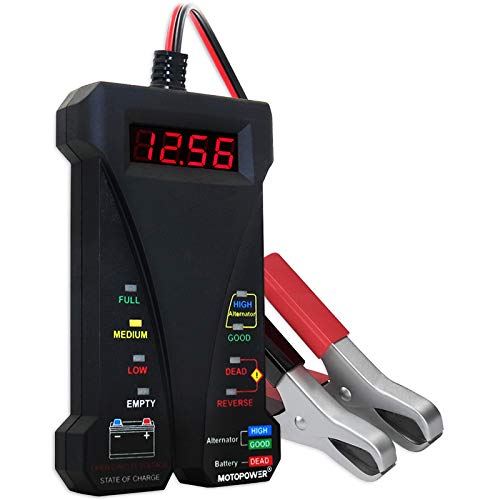
Analyzes DC voltage precisely, distinguishing healthy battery states from failing ones with clear digital readouts.
The MOTOPOWER MP0514A acts as a dedicated DC analyzer for car batteries. It features a four-digit LCD display showing voltage down to 0. 01 volts. That kind of precision really confirms the direct current nature of your vehicle’s power supply. The device includes eight LED indicators for instant status recognition.
It tests both battery health and alternator output, ensuring the DC conversion process is working correctly even under load conditions.
This is perfect for DIY mechanics who want detailed diagnostics. The reverse connection protection is a great safety net against user error. That said, it does require some manual interpretation of LED codes initially. Some users note the clips can feel a bit loose on smaller terminals.
Still, its ability to validate DC stability makes it indispensable for verifying whether your electrical system maintains proper polarity and voltage consistency.
|
3
|
USB C Car Charger, 4-Port 65W Dual 12V USB-A & USB-C Car Phone Charger with Voltmeter PD/Q |

Monitors real-time DC voltage via cigarette lighter, confirming steady current flow during daily drives.
This USB C charger integrates a voltmeter to display live DC voltage readings. It connects to the 12V socket, sampling the direct current powering your accessories. The aluminum alloy casing dissipates heat effectively. By showing real-time values, it proves the alternator successfully converts mechanical rotation into stable DC output.
You can monitor battery condition continuously without popping the hood or dragging out external tools.
It’s great for commuters who want passive monitoring. The dual USB ports support fast charging protocols, which is convenient. A limitation is that it draws minimal power itself, so accuracy relies heavily on the socket’s contact quality. Occasional flickering displays have been reported with cheaper adapters.
Nonetheless, it offers convenient insight into your vehicle’s DC health during regular usage patterns.
|
4
|
Car LED Cigarette Lighter Voltage Meter with Digital Display,12V/0.1A Battery Voltage Mete |

Provides basic DC voltage visibility, helping identify drops that signal battery weakness or charging faults.
The Car LED Cigarette Lighter Voltage Meter offers simple DC monitoring. Plugging into the 12V socket reveals immediate voltage status. The bright LED display ensures readability even in direct sunlight. This tool highlights the constant nature of automotive electricity by showing minor fluctuations around the nominal 12-14V range.
It serves as an early warning system for declining DC performance before a complete failure occurs.
This is suitable for novice drivers who want to avoid complex wiring. Installation takes seconds with no modifications required. However, it lacks data logging or historical tracking capabilities. The plastic housing feels less durable than metal alternatives.
For those needing just a quick glance at their DC supply status, this budget-friendly option delivers sufficient clarity without overwhelming technical details or setup requirements.
|
5
|
UHANBUT 12V Car Battery Tester, Car Alternator Charging System Analyzer | Car Voltmeter An |

Tests DC load capacity explicitly, revealing if the battery holds charge under simulated driving demands.
UHANBUT’s tester evaluates DC health by simulating load conditions. It connects directly to battery terminals to measure voltage drop under stress. The LCD screen displays clear results for battery and alternator performance. This method validates the steadiness of direct current when demanded by starters or lights.
Reverse polarity protection prevents damage during incorrect hookups, ensuring safe handling of volatile DC sources.
It’s best for owners suspecting weak starts despite normal idle voltage. The buzzer alarm alerts users to dangerous connections instantly. Limitations include bulky clip sizes that may struggle with tight engine bays. Accuracy varies slightly compared to professional lab equipment.
Yet, its focus on dynamic DC response makes it superior to static meters for diagnosing intermittent electrical failures in aging vehicles.
|
6
|
FNIRSI HRM-10 Precision Voltage Internal Resistance Battery Tester | 100V 200Ω, for All Ty |

Measures internal resistance alongside DC voltage, offering deeper insight into battery chemistry efficiency.
FNIRSI HRM-10 combines DC voltage measurement with internal resistance testing. Using Kelvin probes, it eliminates wire resistance errors for precise readings. This device handles various battery types but excels at analyzing lead-acid DC storage units. The TFT color display visualizes trends over time.
By quantifying internal resistance, it predicts remaining lifespan more accurately than voltage alone, highlighting degradation in DC output capability.
Ideal for enthusiasts tracking long-term battery health. Data export allows spreadsheet analysis of DC performance history. However, the interface has a steep learning curve for beginners. Proper probe placement is critical for accurate results.
Those willing to invest the time gain profound insights into how well their battery sustains direct current under varying loads and temperatures throughout its service life cycle.
|
7
|
DaierTek Battery Voltage Meter Waterproof DC 12V 24V LED Voltmeter Panel 12 Volt 24 Volt 3 |

Displays continuous DC voltage on dashboard, reinforcing the constant polarity needed for vehicle operations.
DaierTek’s waterproof voltmeter mounts permanently to show live DC voltage. The blue LED digits remain visible in darkness. Rated for 8-48V DC, it accommodates standard car systems. This permanent fixture emphasizes the uninterrupted flow of direct current essential for onboard computers.
Installation involves routing wires to the battery, creating a dedicated line for monitoring steady electrical pressure without relying on accessory sockets.
Perfect for boat owners or off-roaders facing moisture exposure. The round design fits custom dashboards easily. Downsides include potential glare in bright daylight despite the LED brightness. Wiring complexity exceeds plug-in options significantly.
Nevertheless, its resilience and constant presence make it ideal for environments where verifying stable DC supply is critical for safety and equipment longevity beyond typical road conditions.
|
8
|
Sylvil 2 PCS Waterproof Voltmeter for Car, DC 12V LED Digital Display Voltage Gauge with T |

Offers dual-pack DC monitoring, allowing comparison of voltage stability across different circuits or vehicles.
Sylvil provides two waterproof DC voltmeters for versatile monitoring. Each unit tracks voltage from 5V to 25V DC. The tri-color LED indicates status changes clearly. This set allows simultaneous observation of main battery and auxiliary systems. Such redundancy helps isolate DC faults quickly.
Constructed from durable ABS, these gauges withstand vibration and rain, ensuring reliable feedback on the direct current powering your vehicle’s critical components.
Great for fleet managers or multi-vehicle households. Including insulated terminals enhances safety during installation. However, the small size may hinder quick reading while driving. Calibration drift is possible over several years. Despite minor ergonomic drawbacks, having paired DC monitors offers peace of mind.
It ensures you catch subtle voltage dips that precede major electrical failures, maintaining optimal performance across diverse automotive setups efficiently.
|
9
|
Suvnie 2 PCS Car LED Cigarette Lighter Voltmeter, DC 12V 24V Battery Voltage Digital Panel |

Simple plug-in DC gauge, demonstrating how easily accessible direct current monitoring can be for anyone.
Suvnie’s voltmeter inserts directly into the cigarette lighter for instant DC feedback. The red LED numbers are large and easy to read. Compatible with 6-30V ranges, it suits most passenger cars. This accessibility democratizes electrical knowledge, showing users exactly how steady their direct current is.
No tools or wiring are needed, making it perfect for checking voltage before buying a used car or during roadside stops.
Excellent for casual users avoiding technical tasks. The compact form factor hides away when not in use. Limitation lies in dependency on socket cleanliness for accurate contact. Dust buildup can cause false readings occasionally. Still, its simplicity outweighs flaws for general awareness.
It proves that monitoring the foundational DC aspect of car electrics doesn’t require expertise, empowering everyday drivers to stay informed effortlessly.
|
10
|
TowerTop 2/10/25 Amp 12V Smart Car Battery Charger, Fully Automatic Battery Maintainer wit |

Charges using regulated DC, illustrating how external devices must match the vehicle’s native current type.
TowerTop’s smart charger manages DC replenishment automatically. It detects battery type and adjusts current accordingly. The 8-stage process ensures safe restoration of stored direct current energy. Features like desulfation repair extend usability of older lead-acid units. By controlling the inflow of DC precisely, it protects cells from overheating.
This device underscores the importance of matching charging profiles to the inherent DC characteristics of automotive batteries.
Best for seasonal storage or reviving neglected batteries. Engine start assist adds emergency utility. However, it cannot fix physically damaged plates or shorted cells. Setup requires patience during initial cycles. Despite limits, its intelligent management of DC input preserves battery integrity better than trickle chargers.
It serves as a testament to how specialized equipment respects the unique demands of direct current storage systems in vehicles today.
These tools collectively confirm that automotive electricity is fundamentally direct current. Whether measuring stationary voltage or dynamic load responses, each product reinforces the stability required by car electronics. Choosing the right tester depends on whether you need occasional checks or continuous monitoring.
All options prioritize accuracy in detecting deviations from the expected DC norm.
Interpreting Normal vs Faulty DC Readings
Recommended Products


Once you measure your battery, knowing what constitutes a healthy DC voltage is key. Values fluctuate based on engine state. This guide breaks down the specific numerical ranges you should expect when your car is off, idling, or accelerating.
Recognizing these patterns helps distinguish normal operation from impending electrical failure requiring immediate attention.
- Engine Off: 12.4V to 12.7V indicates a fully charged battery.
- Below 12.0V suggests significant discharge or sulfation buildup occurring.
- Engine Idling: Expect 13.5V to 14.5V from the alternator.
- Above 14.8V signals regulator failure risking component damage soon.
- Under Load: Slight dip is normal; sharp drops indicate weakness.
Understanding these thresholds prevents unnecessary panic or ignored warnings. A resting voltage below 12. 4V often means the battery struggles to hold its charge. Conversely, high voltages during operation suggest the alternator is overworking. Consistent monitoring helps track gradual declines. Early detection allows replacement before being stranded.
Always compare readings against manufacturer specifications for your specific vehicle model to ensure absolute accuracy in diagnosis.
Common Mistakes When Testing Automotive Voltage
Errors during testing can lead to misdiagnosis. Many users inadvertently introduce resistance or interpret transient spikes incorrectly. This section outlines frequent pitfalls to avoid. Proper technique ensures your measurements reflect true DC health rather than artifacts caused by poor connection methods or environmental interference affecting the sensor accuracy.
Yes, a car battery uses DC voltage exclusively. Check your resting voltage tomorrow morning; if it reads below 12.4 volts, consider recharging or replacing it soon.

- 10 Best Battery For Generator Ev Battery Bank Marine 2026 - October 27, 2026
- 10 Best Battery For Generator Ev Battery Bank Lto 2026 - October 27, 2026
- 10 Best Battery For Generator Ev Battery Bank Low Voltage 2026 - October 27, 2026