What Is A Std Battery?
I’ve seen radios go silent mid-transmission because someone grabbed a pack labeled STD-FNB-83 thinking it was a generic ‘standard’ battery. That label isn’t generic, it’s specific. You’ll find “STD” on everything from marine handhelds to lithium motorcycle cells, and it rarely means what people first assume.
Sometimes it points to the Standard Horizon brand; other times, it marks a standard terminal size or a baseline configuration. Mixing these up leads to wrong voltage, polarity, or chemistry. My read is that you need to know exactly what that three-letter code signals for your device.
The nine packs below show how the term actually appears in the wild.
Why The STD Label Causes Confusion On Batteries
Recommended Products


Those three letters show up on battery labels for three totally different reasons. Knowing which one applies to your gear is the only way to avoid costly fitment mistakes or dead equipment.
The biggest source of confusion I see is the brand Standard Horizon. They make marine handheld VHF radios, and their replacement packs carry model numbers starting with STD, like STD-FNB-83. When buyers search for a generic “standard battery,” they often land on these specific radio packs by mistake.
Here, the letters just identify the manufacturer, not a universal category. Then there’s physical termination. Industrial lithium cells use STD to denote a standard button top. This tells engineers the cell fits normal D-size holders without needing custom tabs or soldering. The Xeno XL-205F uses this exact designation.
Finally, powersports manufacturers sometimes append STD to indicate a baseline configuration, separating a standard output model from a high-performance variant. None of these meanings relate to each other. I would always check the device manual to clarify which definition applies before buying any replacement cell.
Three Meanings Of STD On Power Cells
| Context | Meaning | Example Device |
|---|---|---|
| Marine Radio Brand | Standard Horizon prefix | HX370S handheld VHF |
| Industrial Cell Terminal | Standard button top | D-size lithium thionyl chloride |
| Powersports Variant | Baseline configuration | Lithium motorcycle starter battery |
Matching Chemistry To Your Actual Device Needs
Recommended Products


Voltage and size matter, sure, but internal chemistry is what really determines how a battery handles temperature swings, storage time, and heavy current draws.
Nickel-Metal Hydride Packs
Handheld marine radios typically rely on Nickel-Metal Hydride chemistry. A 1400mAh NiMH pack provides steady voltage for long shifts on the water. These cells handle hundreds of recharge cycles before capacity drops noticeably, tolerating the constant charging routines typical of daily radio users.
However, they self-discharge faster than lithium alternatives during long winter storage. If I were storing one, I’d keep it topped off monthly to preserve its lifespan.
Older Nickel Cadmium Cells
Some older Standard Horizon models still depend on 7. 2V Nickel Cadmium packs. NiCad chemistry delivers reliable cranking power even in cold marine environments. These 1100mAh cells are heavier and hold less total energy than modern NiMH equivalents. They also suffer from memory effect if repeatedly charged before fully draining.
Finding new NiCad replacements is getting harder as manufacturers shift toward lithium. If you have legacy gear, I’d verify the exact FNB number before ordering.
- Match the original voltage rating exactly to avoid frying radio circuits.
- Check terminal layout before buying powersports replacements to prevent short circuits.
- Prioritize low self-discharge lithium cells for equipment stored over winter months.
- Verify the specific FNB model number rather than relying on generic size descriptions.
- Avoid mixing old and new cells inside multi-battery devices.
Packs That Clarify What STD Means In Practice
Recommended Products


These nine products show exactly how the STD label pops up across different industries. Some represent the Standard Horizon radio brand, others highlight standard terminal configurations, and some mark baseline powersports specs. Looking at them together reveals why context always dictates the correct interpretation.
|
1
|
Standard STD-FNB-83 1400mAh NiMH Replacement Battery Pack for HX370S Handheld VHF Radio |

Shows STD as a Standard Horizon brand prefix for HX370S radio replacements.
This 1400mAh NiMH pack carries the STD-FNB-83 designation, serving as a direct replacement for Standard Horizon handheld VHF radios. It’s compatible with models like the FT60R, HX270S, HX370S, and several VX series units.
The nickel-metal hydride chemistry supports repeated daily charging cycles, which marine operators rely on to keep communications active offshore. In this case, the STD prefix strictly identifies the Standard Horizon brand lineage.
If you’re boating with legacy HX series radios, you likely need this exact FNB number. Generic 7. 2V packs often lack the precise connector alignment required. One limitation is the older NiMH chemistry, which self-discharges during long storage.
I’d recommend topping off the charge periodically if the radio sits unused for months. It fits snugly into the waterproof battery compartment without modification, but always verify your radio model against the compatibility list before purchasing.
|
2
|
Standard 7.2 V 1100 mAh NiCad is Battery/STD-FNB-V57AIS / |

Demonstrates STD used in a legacy NiCad radio battery model number.
This 7. 2V 1100mAh NiCad cell uses the STD-FNB-V57AIS identifier, belonging to the same Standard Horizon naming convention seen across marine electronics. Nickel cadmium chemistry was standard in older handheld transceivers before NiMH took over. The 1100mAh capacity reflects the lower energy density of early rechargeable tech.
Despite the smaller capacity, NiCad cells perform reliably in freezing temperatures, which is why cold-weather boaters historically preferred them for emergency communications.
Legacy radio owners maintaining older fleets still seek out these specific NiCad packs. Just note that modern chargers must support NiCad profiles to avoid damaging the cells. A major drawback is the memory effect, requiring full discharges between charges.
Sourcing fresh NiCad inventory grows harder as environmental regulations phase them out. Ensure your charger matches the 7. 2V requirement precisely; using a higher voltage charger will permanently damage the internal plates.
|
3
|
Standard STD-FNB-V57AIS / 7.2 V 1100 mAh NiCad is Battery |
Confirms the STD-FNB-V57AIS model exists as a distinct catalog entry.
Listed separately, this item represents the same 7. 2V 1100mAh NiCad architecture. The STD-FNB-V57AIS part number targets Standard Horizon communication devices. Catalogs sometimes split identical items due to regional distribution channels. The nickel cadmium construction provides stable voltage delivery under heavy transmission loads.
Older VHF units draw significant current when broadcasting at maximum wattage, and this pack meets those peak demands without severe voltage sag.
When comparing listings, I’d double-check to ensure you aren’t accidentally ordering duplicates, as both entries serve the exact same hardware requirements. The primary limitation remains the inherent weight of NiCad technology. While lithium upgrades exist for some models, they require modified charging circuits.
Stick to this pack if the original equipment lacks smart charging capabilities. Also, always inspect the connector pins for corrosion before installing an older NiCad unit.
|
4
|
Xeno XL-205F D STD 3.6V Lithium Thionyl Chloride Battery |

Uses STD to mean standard button-top termination on an industrial cell.
The Xeno XL-205F redefines the STD abbreviation entirely. Here, STD indicates a standard D-size button top termination. This 3. 6V lithium thionyl chloride cell targets industrial applications rather than consumer electronics. It boasts a shelf life exceeding ten years due to sub-one-percent annual self-discharge.
Engineers choose this chemistry for remote sensors and utility meters, and the hermetically sealed case prevents leakage in harsh outdoor environments.
Facilities deploying equipment in extreme temperatures rely on its -55°C to +85°C range. The improved transient minimum voltage design ensures quick recovery after high-pulse demands. A key limitation is that lithium thionyl chloride cells are primary non-rechargeable units. Once depleted, the entire cell requires proper hazardous waste disposal.
Do not attempt to recharge this D-size battery. It fits standard holders perfectly thanks to the precise STD termination specification.
|
5
|
TYKOOL LFP30L-BS-STD Lithium Battery, Replaces YTX30L-BS, 650CCA 12Ah Fits for Motorcycle |

Applies STD to denote a baseline lithium motorcycle starter configuration.
TYKOOL uses the LFP30L-BS-STD designation for a LiFePO4 motorcycle battery. The STD suffix distinguishes this baseline model from potential high-output variants. It replaces the heavy YTX30L-BS lead-acid pack while delivering 650 cold cranking amps. Weighing only 4. 5 pounds, it reduces motorcycle mass significantly.
An integrated digital readout displays real-time voltage and state of charge. Harley-Davidson touring models from 1997 to 2024 accept this direct drop-in replacement.
Riders storing cruisers through winter benefit from the ultra-low self-discharge rate. The smart BMS prevents overcharging during extended maintenance charging sessions. One honest limitation involves extreme cold weather starting performance; lithium iron phosphate cells struggle below freezing compared to traditional lead-acid.
Riders in northern climates may need a battery warmer for January starts. Otherwise, the reinforced terminals handle heavy V-Twin vibration exceptionally well without loosening.
|
6
|
Energizer AAAA Batteries, 1.5 Volt Battery AAAA Alkaline, 2 Count |

Proves everyday alkaline sizes never actually use the STD terminology.
Energizer’s AAAA two-pack highlights what a standard consumer battery looks like. Notice the complete absence of any STD labeling on these 1. 5V alkaline cells. Everyday household batteries use IEC or ANSI size designations instead.
These miniature quadruple-A cells power stylus pens, laser pointers, and small flashlights, delivering dependable alkaline discharge curves for low-drain electronics. The zero-mercury formulation minimizes environmental impact upon disposal.
Consumers searching for a standard AAAA battery might mistakenly add STD to queries. This search habit leads them toward industrial or marine products instead. These Energizer cells cannot be recharged, limiting their long-term value, and high-drain devices will deplete them rapidly compared to lithium alternatives.
I’d keep them stocked for niche gadgets requiring the unique AAAA footprint. They represent the true baseline for everyday portable power needs.
|
7
|
Ozonics SG-BA02XL Extended Life Battery – Smart Battery Technology for HR230, HR200, or HR |

References standard operating modes without using STD in the name.
The Ozonics SG-BA02XL powers hunting scent eliminators for up to ten hours. It operates in a Standard Mode, though the battery itself lacks an STD prefix. Smart battery technology automatically optimizes output based on ozone generation demands. Hunters switch to Boost Mode for eight hours of intensified coverage.
This rechargeable pack fits HR230, HR200, and HR150 units seamlessly, ensuring consistent voltage delivery so the ozone generator maintains effective scent masking throughout long sits.
Deer hunters relying on wind shifts need this dependable runtime extension. The smart circuitry prevents deep discharges that ruin typical lithium cells. A notable limitation is proprietary fitment restricting use outside Ozonics gear; you cannot adapt this pack for general camping electronics or radios.
Store it partially charged during the off-season to preserve cell health. Field replacement takes seconds thanks to the tool-free compartment design.
|
8
|
TYKOOL LFP10S-STD Lithium Battery, Replaces YTZ10S, 300CCA 5Ah Fits for Motorcycle ATV PWC |
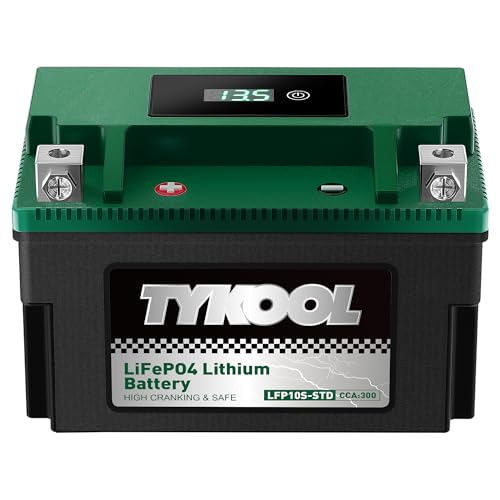
Another TYKOOL example where STD marks the standard powersports spec.
This TYKOOL LFP10S-STD replaces the YTZ10S lead-acid battery in sportbikes. Like the larger cruiser version, the STD tag denotes the standard output tier. Premium LiFePO4 cells generate 300 cold cranking amps from a one-kilogram package. Yamaha R6 and BMW S1000RR owners gain noticeable handling improvements from the weight reduction.
An LCD screen provides instant state-of-charge monitoring without external multimeters, and the IP66 waterproof rating protects against pressure washing and trail mud.
Track day enthusiasts appreciate the seventy percent weight savings over stock batteries. The built-in BMS balances cells automatically during charging cycles. One drawback involves charging system compatibility on older motorcycles; regulators designed for lead-acid batteries can occasionally overcharge sensitive lithium cells. Verify the stator output voltage before installing this upgrade.
Once confirmed compatible, the vibration-resistant structure handles aggressive cornering forces effortlessly.
|
9
|
Motorcycle Battery YTX20HL-BS, UPLUS EB20H-3 Snowmobile UTV ATV YTX20L-BS YUAM320BS Mainte |

Omits STD entirely, showing standard AGM packs use different naming conventions.
The UPLUS EB20H-3 represents a traditional AGM powersports battery. It replaces YTX20HL-BS and YTX20L-BS models across various brands. Notably, it does not use the STD designation anywhere in its naming scheme. This 12V 18Ah sealed battery delivers 310 cold cranking amps.
Polypropylene casing resists heat deformation better than cheaper ABS plastic alternatives, and maintenance-free construction eliminates the need for periodic acid top-offs.
Snowmobile and ATV owners favor AGM chemistry for its spill-proof reliability. The five-year expected lifespan relies on avoiding deep discharge events. A clear limitation is the 13. 1-pound weight compared to lithium competitors. Riders prioritizing absolute lowest mass will prefer LiFePO4 despite higher costs.
This UPLUS unit excels as a budget-friendly direct replacement, and US-based warehousing simplifies warranty claims if premature failure occurs.
These nine examples prove the STD label changes meaning depending on the industry. Marine radio packs use it as a brand prefix, industrial cells use it for terminal shape, and motorcycle lithium packs use it for trim levels. Always check the device manual before trusting the acronym alone.
How To Avoid Buying The Wrong STD Pack
Recommended Products


Misinterpreting the three-letter code leads to incompatible purchases. Following a strict verification process prevents wasted money and damaged electronics.
Locate the original battery and photograph the exact alphanumeric model string printed on the label.
Identify whether STD precedes a brand-specific code like FNB or follows a base model number.
Cross-reference the voltage and chemistry type against your device owner manual specifications.
Measure the physical dimensions if replacing an industrial cell to ensure terminal alignment matches.
Confirm the seller lists your exact device model in the compatibility chart before finalizing checkout.
Skipping these steps frequently results in ordering a Standard Horizon radio pack when an industrial D-cell was needed. The visual similarity of part numbers tricks many buyers. Retailers rarely accept returns on opened battery packaging due to safety regulations.
Taking thirty seconds to decode the prefix saves hours of frustration later. Pay special attention to chemistry mismatches. Plugging a NiCad pack into a charger optimized for NiMH creates overheating risks. Similarly, dropping a lithium starter battery into a motorcycle lacking a compatible regulator destroys the cells internally.
The STD label tells you nothing about safe charging parameters. I would always defer to the device manufacturer documentation for chemistry requirements. When in doubt, contact the battery vendor directly with photos of the original unit.
Maintaining Replacement Batteries After Installation
Installing the correct STD-labeled pack is only half the process. Proper maintenance extends service life regardless of the underlying chemistry type.
Lithium Iron Phosphate Care
LiFePO4 cells prefer partial charges during long storage periods. Leaving a motorcycle lithium battery at one hundred percent for months stresses the management system. Aim for sixty percent charge before winterizing any powersports vehicle. Disconnect the negative terminal to eliminate parasitic draws from alarm systems or ECUs.
These cells tolerate cold storage well but should warm to room temperature before attempting engine cranks. Never jump-start a deeply depleted lithium pack using another vehicle.
NiMH And Alkaline Handling
Nickel-metal hydride radio batteries benefit from monthly cycling if stored unused. Run the radio until the low-battery warning triggers, then recharge fully. This practice recalibrates the fuel gauge indicator inside the pack. Alkaline cells like the AAAA variety should simply be removed from devices during storage.
Leaking alkaline electrolyte ruins battery contacts permanently. Check flashlight compartments every six months for early signs of white crystalline corrosion around the terminals.
When The STD Label Actually Matters Most
Recommended Products


Not every battery purchase requires deep analysis of the prefix. Certain scenarios demand strict attention to the exact STD designation used.
The distinction matters most when sourcing replacement parts for discontinued equipment. Older Standard Horizon marine radios no longer receive factory support. Third-party manufacturers produce compatible packs using the original STD-FNB numbering system. Matching that exact string guarantees the connector geometry aligns properly.
A single millimeter offset prevents the waterproof seal from engaging on a handheld VHF. Industrial procurement also relies heavily on precise termination codes. Engineers specifying remote monitoring stations cannot substitute a flat-top cell where a standard button top is required.
The STD designation on datasheets prevents assembly line errors during mass production. Consumer buyers shopping for everyday electronics rarely encounter these constraints. Recognizing when precision matters versus when general sizing suffices saves unnecessary research time. Focus verification efforts exclusively on mission-critical or hard-to-replace hardware.
- Ordering replacements for discontinued marine communication equipment with proprietary connectors.
- Specifying bulk industrial cells for automated manufacturing assembly lines.
- Upgrading powersports vehicles where regulator compatibility depends on exact chemistry labels.
- Replacing remote sensor batteries deployed in inaccessible locations for multi-year intervals.
A STD battery refers either to a Standard Horizon radio pack, a standard terminal type, or a baseline powersports configuration. The acronym holds no single universal meaning across the battery industry. Identify the context of your specific device before interpreting the label.
Pull the old battery out today and photograph the exact model string printed on it. Compare that string against your owner manual rather than relying on search engine assumptions. Getting the prefix right ensures your radio transmits, your sensor reports, or your motorcycle starts without expensive return shipping headaches.

- 10 Best Battery For Generator Ev Battery Bank Marine 2026 - October 27, 2026
- 10 Best Battery For Generator Ev Battery Bank Lto 2026 - October 27, 2026
- 10 Best Battery For Generator Ev Battery Bank Low Voltage 2026 - October 27, 2026