Will Concrete Drain A Battery?
If you‘ve spent any time around older mechanics, you’ve probably heard the warning: never set a car battery directly on a concrete garage floor, or it’ll drain dead by morning.
It’s one of those shop-floor myths that refuses to die, and I completely understand why people still worry about it when parking in an unfinished garage or storing equipment for the winter. But does cold masonry actually siphon electricity out of a sealed cell?
My read is no, and below we’ll unpack where that legend came from before looking at the real culprit, terminal corrosion, and the products that actually keep your electrical system healthy.
The Truth About Concrete And Power Loss
Recommended Products


From a pure physics standpoint, solid concrete doesn’t magically pull current through a modern plastic battery case. Today’s batteries are sealed inside thick polypropylene shells that fully insulate the internal lead plates from whatever surface they’re sitting on.
The myth makes sense if you rewind to the early days of motoring. Back then, batteries were built with hard rubber or tar-lined wooden casings that soaked up moisture like a sponge.
Set one of those on a damp workshop floor, and the moisture created a conductive path right across the bottom of the case, slowly bleeding off the charge. Modern plastics shut that door completely.
If your battery dies sitting on the garage floor today, I’d point the finger at internal self-discharge or a parasitic draw from something left plugged in, not the concrete. Cold weather absolutely slows down the chemical reactions inside lead-acid cells, but the floor itself isn’t stealing your power.
Why Terminal Corrosion Causes Electrical Drain
Recommended Products


So while the concrete floor is innocent, actual corrosion building up on your battery terminals is very real. That crusty buildup creates severe electrical resistance, which leads to sluggish starts and eventual power loss.
- White or green powdery buildup forms around the metal post connections.
- Your starter motor cranks slowly on cold mornings because resistance limits current flow.
- Dashboard lights flicker erratically when you turn the key in the ignition switch.
- Accessories lose power intermittently while the vehicle engine runs.
Cleaners And Protectors To Keep Batteries Charged
Recommended Products


Since terminal corrosion is what actually causes voltage leaks and drains batteries, my approach is always to clean the posts thoroughly and seal them up. These ten maintenance products tackle that exact problem, stopping power loss at the source by keeping your connections free of acid buildup.
|
1
|
CRC Battery Terminal Protector Spray – Anti-Corrosion Coating – 7.5 oz | Battery Terminal |

I would shortlist this spray because it lays down a soft protective layer over the terminals to block the exact type of corrosion that causes power drain.
The CRC Battery Terminal Protector Spray comes in a 7. 5 oz can and applies a lead-free coating meant to seal your electrical connections against moisture and acid fumes.
By creating a physical barrier over the posts and bulkhead connectors, it stops the white, crusty buildup that eventually leads to hard starting and unnecessary electrical resistance.
My read is that this works best as a follow-up step after you’ve already scrubbed the terminals clean. The main thing to keep in mind is that the coating stays soft, so you’ll likely need to reapply it during major seasonal maintenance.
It fits the bill for everyday drivers who want a quick, preventative spray without fussing with heavy greases.
|
2
|
48V Cordless Power Concrete Screed Vibratory Kit, 59-Inch Stainless Steel Vibratory Screed |

This cordless concrete finishing tool happens to use a reliable lithium battery system, showing how modern battery tech powers heavy-duty masonry work rather than being drained by it.
The 48V Cordless Power Concrete Screed Vibratory Kit pairs a 59-inch stainless steel blade with a high-performance brushless motor. Running off a 4800mAh lithium battery, it delivers the high-frequency vibration needed for smoothing floors without dragging around gas engines or tripping over tangled power cables.
Contractors tend to appreciate the waterproof, dustproof motor design when working in harsh job site conditions. Obviously, this is a specialized piece of construction equipment rather than basic automotive care, so I wouldn’t buy it just to fix a battery issue.
But it perfectly suits professional contractors pouring new garage slabs and driveways where you actually park your vehicles.
|
3
|
CRC Tech Grade Battery Cleaner w/Acid Indicator – 11 oz | Battery Acid Cleaner, Terminal a |

I’d reach for this tech-grade cleaner when dealing with stubborn, baked-on acid residue around heavy-duty vehicle battery trays.
The CRC Tech Grade Battery Cleaner comes in an 11 oz container and is formulated specifically for heavy fleet and vehicle maintenance. Its job is to break down the harmful acid deposits that naturally collect around battery trays, cables, and hold-downs during normal operation.
Shop technicians generally rely on formulas like this to keep commercial vehicles running without unexpected electrical faults creeping in. One limitation worth noting is that it focuses purely on cleaning, it doesn’t leave behind a long-term protective barrier once you wipe it away.
Because of that, it makes the most sense for busy commercial fleets and truck maintenance shops doing frequent turnaround work.
|
4
|
NOCO NCP2 M401 Battery Terminal Cleaner and Protector Kit with Brush | Clean and protect c |

This kit handles both sides of the equation, dissolving existing corrosion instantly and sealing the posts to prevent future power loss.
The NOCO NCP2 M401 Battery Terminal Cleaner and Protector Kit gives you an all-in-one system to clean and seal your electrical connections. The formula neutralizes acid on contact and leaves behind a protective layer designed to stop corrosion for the life of the battery, making surfaces impenetrable to acid fumes.
I find the straightforward spray-on application really appealing for quick weekend jobs, especially since it includes a wire brush so you don’t have to hunt one down separately. The only drawback is that the included brush is somewhat compact, so heavily caked terminals might require a bit more elbow grease.
It’s a logical pick for car owners wanting a complete starter care kit in one box.
|
5
|
Battery Terminal Cleaner Tool Kit, 2-Pack Battery Post Wire Brush with Metal Case and 10 A |

If you prefer mechanical scrubbing over chemicals, this dual-ended brush and fiber washer set physically removes stubborn oxide buildup from car battery terminals.
The Battery Terminal Cleaner Tool Kit includes two stainless steel wire brushes housed in metal cases, along with anti-corrosion fiber washers. The color-coded washers, red for positive, green for negative, block harmful acid mist from settling around the base, while the stiff wire bristles scrub away oxidation that blocks conductivity.
Users often find the dual-ended brush design incredibly handy for navigating tight engine bays in modern cars and trucks. Just be aware that manual wire scrubbing takes noticeably more physical effort than simply spraying on a chemical foaming cleaner.
I’d recommend this for budget-conscious owners performing basic seasonal tune-ups who don’t mind getting their hands dirty.
|
6
|
Corrosion Gone Battery Spring and Contact Cleaner |

This specialized formula cleans leaked battery acid from delicate electronics and small compartments, handling the smaller-scale corrosion issues that ruin gadgets.
Corrosion Gone Battery Spring and Contact Cleaner targets chemical leakage from alkaline, NiCad, nickel metal hydride, and zinc-carbon cells. Instead of automotive posts, it revitalizes corroded springs in music equipment, remote controls, computer keyboards, and camera battery compartments.
Audio technicians and hobbyists frequently rely on targeted cleaners like this to rescue expensive gear ruined by a forgotten, leaking battery. The main limitation here is volume; it’s strictly designed for small electronics rather than heavy-duty car batteries.
It perfectly suits musicians and electronics hobbyists repairing gadgets where standard automotive sprays would be far too aggressive.
|
7
|
WirthCo 16204 Battery Doctor E2000 Anti-Corrosion Gel – 4 oz. Jar with Brush |

I’d consider this gel jar if you prefer a thicker paste that stays exactly where you put it on vehicle battery connections.
The WirthCo Battery Doctor E2000 Anti-Corrosion Gel comes in a 4 oz jar equipped with a built-in application brush. Rather than a thin spray, the thick gel formula coats battery terminals heavily to block moisture and acidic fumes from reaching the bare metal underneath.
Vehicle owners typically apply it directly to the posts right after cleaning to prevent that stubborn white powdery buildup from returning. One practical limitation is that brushing on a thick paste can be messier than using a quick aerosol spray.
Still, it suits truck and boat owners who prefer manual coatings that won’t easily drip off in hot engine bays.
|
8
|
NOCO NCP2 B603 Anti-Corrosion Battery Terminal Protector Washers, 50 Count | 50 Felt Corro |

These felt pads sit right at the base of the battery posts to catch acid fumes before they can climb up and cause terminal corrosion.
The NOCO NCP2 B603 Anti-Corrosion Battery Terminal Protector Washers pack includes fifty felt pads saturated with a preventative compound. You slide them directly under the cable clamps, sealing the vulnerable gap where corrosion almost always starts first.
Service shops and fleet managers tend to buy these in bulk to protect dozens of vehicles against voltage drops without spending hours applying sprays. A limitation to keep in mind is that they only fit standard post configurations unless you modify them yourself.
I’d point commercial fleet operators servicing multiple identical vehicles toward this pack.
|
9
|
NOCO E404 Battery Terminal Cleaner Spray with Acid Detector, 12.25 oz | Find and remove ba |
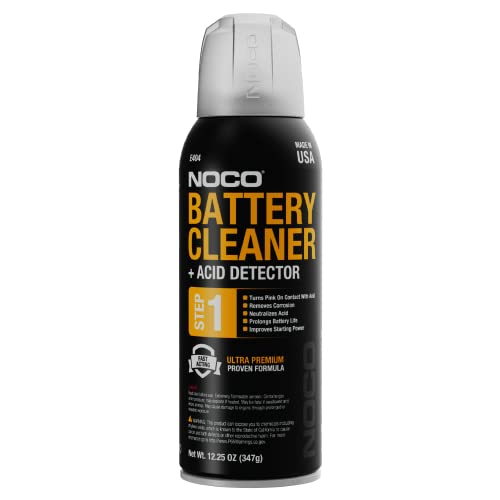
I really like that this foam spray changes color to detect battery acid, letting you see exactly where corrosive buildup is hiding before neutralizing it.
The NOCO E404 Battery Terminal Cleaner Spray features a built-in acid detector, the yellow foam turns pink upon contact with active corrosion. This visual indicator helps you locate hidden acid on cables and hold-downs before the formula neutralizes and dissolves the buildup in minutes.
Mechanics appreciate knowing exactly where acid residue remains instead of just guessing and spraying blindly. The minor catch is that you must rinse the area thoroughly with water afterward to wash away the dissolved debris. It suits users who want undeniable visual confirmation of a thorough clean.
|
10
|
CRC 05023 Battery Cleaner 11 Wt Oz 05046 Battery Terminal Protector 7.5 Wt Oz. Bundle |

This two-part bundle combines a powerful cleaner and a protective spray, which is how I’d approach complete battery maintenance from start to finish.
The CRC 05023 and 05046 Battery Cleaner and Terminal Protector Bundle pairs an 11 oz cleaner with a 7.5 oz protective coating. Together, they handle the full workflow: removing stubborn acid buildup first, then sealing the connections to ensure reliable engine starting going forward.
Vehicle owners use this two-step process to restore old, neglected terminals and prevent future corrosion issues from creeping back immediately. One logistical limitation is managing two separate aerosol cans during your maintenance routine. It suits car owners seeking a complete cleaning and sealing system without having to research compatible brands.
Using dedicated cleaners and protective coatings eliminates the resistance that quietly causes electrical power loss. Keeping your battery terminals free of crust means reliable engine starts, regardless of whether you park on concrete, asphalt, or gravel.
Proper Maintenance Steps For Storage
Recommended Products


If you plan to store a vehicle on a concrete floor for several months, proper preparation prevents unexpected battery failure, though the floor itself isn’t the enemy.
Disconnect the negative battery cable to eliminate any hidden parasitic electrical draws from vehicle computers.
Clean the battery terminals thoroughly with a wire brush and a neutralizing spray to remove existing oxidation.
Apply a protective anti-corrosion gel or spray over the metal posts to seal out moisture.
Store the vehicle in a dry location and connect a smart trickle charger if storage exceeds one month.
Common Garage Myths To Ignore
Sorting out garage folklore from actual automotive science saves you time and prevents unnecessary replacement costs when winter rolls around.
I still see motorists placing wooden boards or thick rubber mats under their car batteries during winter storage based entirely on outdated advice. Modern battery casings feature high-density plastics that completely eliminate ground discharge risks from concrete.
Instead of worrying about masonry floors, I’d focus my energy on testing your alternator output and cleaning terminal corrosion regularly. That kind of simple preventative care ensures your vehicle starts reliably every single time you turn the key.
Concrete floors will not drain a healthy battery, but terminal corrosion certainly will. Pick up a quality terminal cleaner today to keep your electrical connections secure and your engine turning over.

- 10 Best Battery For Generator Ev Battery Bank Marine 2026 - October 27, 2026
- 10 Best Battery For Generator Ev Battery Bank Lto 2026 - October 27, 2026
- 10 Best Battery For Generator Ev Battery Bank Low Voltage 2026 - October 27, 2026