How Much To Replace Hybrid Car Battery?
That dashboard warning light changes the mood in the car instantly. Suddenly, the abstract idea of hybrid maintenance becomes a very real line item in your budget. Most of us buy hybrids to save on fuel, so seeing a potential battery replacement cost feels like a betrayal of that promise.
Dealer quotes can be staggering, especially if you weren’t expecting them. Independent shops might offer lower numbers, but that just adds another layer of uncertainty. Breaking down what actually drives these costs helps you navigate the conversation with your mechanic.
Here is where the money goes, and which replacement options actually make sense for different hybrid setups.
Why Hybrid Car Battery Prices Vary So Much
The final bill depends heavily on your specific vehicle model and the type of battery chemistry it uses. Labor rates add another variable that is hard to predict without a quote. Understanding these factors beforehand helps avoid sticker shock at the counter.
Hybrid vehicles rely on high-voltage packs made up of individual modules. Swapping the entire pack is naturally more expensive than replacing just the faulty modules. Older nickel-metal hydride designs have different price points than newer lithium-ion systems.
Dealerships usually charge a premium for original equipment manufacturer (OEM) parts, while independent hybrid specialists often source refurbished or aftermarket cells to keep costs down. Labor time also varies wildly depending on where the manufacturer hid the battery.
Some are accessible under the rear seat, while others require significant disassembly of the chassis. Location matters too; labor rates in major cities are typically higher than in rural areas. Ask for an itemized quote that separates parts from labor. This clarity shows you exactly what you are paying for.
Typical Cost Ranges By Battery Type
| Battery Source | Estimated Part Cost | Expected Lifespan |
|---|---|---|
| New OEM Pack | $2,000 – $8,000 | 10 – 15 years |
| Refurbished Modules | $800 – $2,500 | 3 – 7 years |
| Aftermarket AGM Cells | $150 – $400 | 4 – 6 years |
- Always ask if the quote includes core return fees.
- Verify whether the shop tests individual modules first.
- Confirm the warranty covers both parts and labor separately.
- Check if diagnostic fees apply toward the final repair cost.
- Ensure the technician specifies exact battery group sizes needed.
Replacement Batteries To Lower Your Hybrid Costs
Keeping the hybrid car battery replacement cost manageable starts with picking the right part. The options below range from standard AGM support batteries to actual hybrid traction modules. Each one addresses a specific failure scenario. Matching the correct spec prevents wasted trips to the shop and ensures the repair sticks.
|
1
|
ACDelco – Advantage AGM Hybrid Vehicle Battery |

This GM-compatible AGM battery is a solid, affordable option for replacing auxiliary power in compatible hybrids.
The ACDelco Advantage AGM Hybrid Vehicle Battery is designed for drivers who need reliable auxiliary power. Many hybrids use a secondary 12-volt battery alongside the main traction pack. When this smaller unit fails, it can trigger error codes across the entire hybrid system.
This ACDelco model is built for easy installation, making it a quick fix for many common issues. It carries the engineering standards of former GM Original Equipment parts. Replacing this component often clears dashboard warnings without needing to touch the expensive high-voltage pack.
It is a smart first step before committing to larger repair estimates.
This battery is engineered to fit General Motors hybrid platforms and compatible models. If you are seeing electrical glitches, testing this 12-volt unit is a logical first move. It handles the constant start-stop cycling typical of hybrid driving. Note that it does not replace the large high-voltage traction battery.
Confirm your vehicle requires an AGM auxiliary unit before buying. Using a standard flooded battery here will likely lead to rapid failure, as the hybrid charging system specifically demands the absorption glass mat technology this unit provides.
|
2
|
Weize Platinum AGM Battery BCI Group 65 Automotive Battery, 12V 70ah, 120RC, 750CCA, 36 Mo |
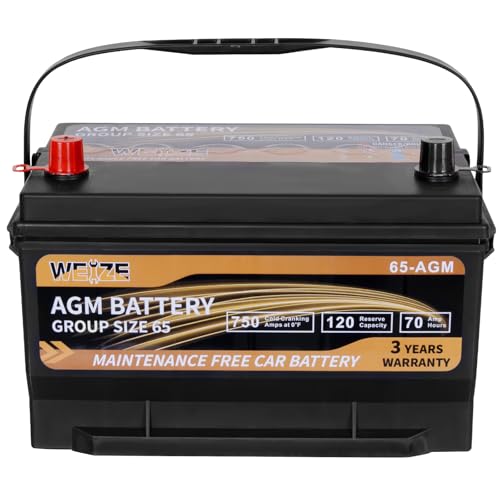
With 70Ah capacity and 750 CCA, this battery offers robust backup power for hybrids with demanding electrical systems.
The Weize Platinum AGM Battery BCI Group 65 delivers strong electrical performance. Rated at 12V 70Ah with 750 cold cranking amps, it handles heavy loads with ease. Hybrids put significant strain on their 12-volt systems during engine transitions.
This Weize battery offers up to twice the cycle life of conventional units. Its 120 reserve capacity rating helps keep electronics powered during engine-off coasting. The 36-month warranty adds some peace of mind for long-term ownership. At 12.
05 inches long, you will want to verify dimensions before purchasing to ensure a proper fit.
Resistance to heat and cold makes this battery a good choice for extreme climates. The absorbed glass mat design prevents acid leaks near sensitive hybrid electronics. If your vehicle originally came with an AGM battery, you cannot downgrade to a flooded type. This Weize unit maintains that required specification.
It is well-suited for SUVs and larger hybrids that draw significant accessory power. One limitation is its physical size, which may exclude compact hybrid models. Always check terminal positions, as this unit places the positive terminal on the left.
|
3
|
Weize Platinum AGM Battery BCI Group 49-12v 95ah H8 Size 49 Automotive Battery, 160RC, 900 |

The high 900 CCA output supports the intense electrical demands of modern start-stop hybrid architectures.
The Weize Platinum AGM Battery BCI Group 49 brings substantial power to hybrid replacements. Its 12V 95Ah capacity pairs with 900 cold cranking amps for exceptional output. This H8 size battery targets vehicles using advanced start-stop technology.
Since hybrids constantly cycle their engines on and off, they demand rapid recharge capabilities. The 160 reserve capacity rating helps keep systems stable during extended electric-only driving. Weize engineered this unit to resist internal corrosion from high operating temperatures. It measures 13.
9 inches long, so it fits securely in larger battery trays.
Drivers with heavy electrical accessories benefit most from this 95-amp-hour capacity. Navigation systems, heated seats, and audio amplifiers can drain weaker batteries quickly. This Weize model cycles more frequently and recharges faster than standard options. Its low self-discharge rate is helpful for hybrids that sit unused for weeks.
The primary drawback is its substantial physical footprint. Smaller hybrid sedans may lack the tray space for Group 49 dimensions. Verify the terminal layout carefully, as this model places the negative terminal on the left.
|
4
|
Weize Platinum AGM Battery BCI Group 48-12v 70ah H6 Size 48 Automotive Battery, 120RC, 760 |

Group 48 sizing fits many mid-size hybrids while delivering strong 760 CCA starting reliability.
The Weize Platinum AGM Battery BCI Group 48 balances size and performance well. Rated at 12V 70Ah with 760 cold cranking amps, it suits mid-size hybrids. This H6 size battery targets vehicles utilizing frequent start-stop driving cycles. The 120 reserve capacity provides steady voltage when the gas engine shuts down.
Weize designed this unit to deliver consistent power over extended service intervals. Its 36-month warranty protects against premature manufacturing defects. At 10. 94 inches long, it fits standard hybrid battery compartments without modification.
Cold weather performance remains strong thanks to the 760 CCA rating. The AGM construction absorbs acid within glass fiber mats, enhancing safety. This prevents corrosive damage to nearby hybrid control modules and wiring. It works well for daily commuters facing stop-and-go traffic patterns.
Buyers should note that the acceptable charging current caps at 18 amps. Exceeding this limit during external charging can damage the internal plates. Always match the charging voltage between 14. 4 and 15. 0 volts precisely.
|
5
|
UPLUS BCI Group 48 Car Battery, AGM-L70-M 12V 70Ah 760CCA 120RC AGM H6 | L3 Maintenance Fr |

Four times the cycling life directly reduces how often owners face another hybrid battery expense.
The UPLUS BCI Group 48 Car Battery focuses heavily on longevity and durability. This AGM-L70-M model delivers 12V 70Ah power with 760 cold cranking amps. UPLUS engineered it specifically for vehicles featuring start-stop technology. The standout feature is four times the extra cycling compared to standard batteries.
High-density negative paste and silver calcium alloy extend its usable lifespan significantly. Maintenance-free operation means you never have to check fluid levels. It fits the international H6 L3 standard size, measuring 10. 98 inches long.
Deep-cycle capability allows this battery to handle repeated partial discharges safely. Hybrids frequently drain the 12-volt system while running in electric mode. The calcium lead positive grid maximizes conductivity for instant power delivery. UPLUS built this unit to resist vibration fifteen times better than conventional designs.
This matters because hybrid battery trays often experience road harshness directly. One consideration is ensuring the terminal layout matches your original equipment. This model places the negative terminal on the left side.
|
6
|
UPLUS BCI Group 140R Car Battery, AGM-L50-UP 12V 50Ah 570CCA 80RC AGM H4 | LN1 Maintenance |

Compact Group 140R sizing solves replacement challenges for smaller hybrid vehicles needing reliable AGM power.
The UPLUS BCI Group 140R Car Battery serves smaller hybrid applications well. This AGM-L50-UP model provides 12V 50Ah capacity with 570 cold cranking amps. Compact hybrids often use the H4 LN1 size due to tight packaging constraints. Measuring just 8. 15 inches long, it fits where larger batteries cannot.
UPLUS applied the same four-times extra cycling technology found in their bigger models. Silver calcium stamped alloy ensures the battery withstands constant charging cycles. It operates maintenance-free with no free acid inside the casing.
Vehicles used for frequent short trips benefit greatly from this design. Short drives prevent standard batteries from fully recharging, leading to early failure. This UPLUS unit recovers from deeply discharged states much faster than flooded alternatives. The vent cap design resists acid leakage even during aggressive cornering.
Safety is paramount when placing batteries near hybrid passenger compartments. Buyers must recognize that the lower 50Ah capacity limits high-draw applications. It excels in efficient compacts rather than larger hybrid SUVs or trucks.
|
7
|
Mighty Max Battery MM-H4L Start and Stop Car BCI Group Size 140 Positive Terminal on Left |

Spill-proof AGM construction protects sensitive hybrid electronics from potential acid damage during replacement.
The Mighty Max Battery MM-H4L provides reliable start-and-stop power for hybrid systems. This BCI Group Size 140 battery delivers 12V 50 Ah with 570 CCA. Mighty Max engineered the sealed AGM design to be completely spill-proof. Hybrids generate complex electrical environments where leaking acid can cause catastrophic damage.
The 80-minute reserve capacity supports longer run times between engine restarts. High discharge output ensures the battery responds instantly to computer commands. Deep discharge recovery helps prevent permanent damage if the vehicle sits unused.
Rugged internal construction resists shock and vibration from rough road surfaces. Hybrid battery locations often lack the thick padding found around standard engines. This Mighty Max unit meets CE standards and comes from an ISO-certified facility. Quality control matters when replacing components tied to high-voltage systems.
The positive terminal sits on the left side for specific vehicle compatibility. One honest limitation involves availability during peak winter failure seasons. Stock shortages can occasionally delay shipping for this particular group size.
|
8
|
2004-2015 Toyota Prius Hybrid Battery NiMH Prismatic OEM Module Cells – Balanced, 7.6V+ – |

Reconditioned OEM Prius modules drastically cut the hybrid car battery replacement cost versus buying new.
These 2004-2015 Toyota Prius Hybrid Battery NiMH Prismatic OEM Module Cells address traction pack failures directly. Unlike the 12-volt options above, these modules replace parts of the actual high-voltage hybrid battery. EVG Auto Parts sources original Japanese manufactured cells for professional USA reconditioning.
Each module undergoes precision testing for capacity, internal resistance, and power output. Technicians balance every cell to 7. 6V+ before shipping them ready to install. This targeted approach avoids replacing the entire expensive pack assembly. It represents a direct way to reduce overall replacement expenses.
Owners of second-generation Prius models frequently face degraded battery warnings. Buying brand-new OEM packs from dealerships costs thousands of dollars. These reconditioned modules allow independent shops to swap only the weak cells. The included one-year warranty provides coverage against premature reconditioning failures.
Installation requires specialized knowledge of high-voltage hybrid safety protocols. DIY enthusiasts must understand the severe shock risks involved. This product strictly fits compatible Toyota hybrid architectures using NiMH prismatic designs.
Selecting the correct battery type determines whether the repair costs hundreds or thousands of dollars. Auxiliary AGM units solve 12-volt issues quickly. Reconditioned modules tackle actual high-voltage pack degradation. Every option listed above targets a specific point of failure within hybrid electrical systems.
Matching the exact specification prevents unnecessary return trips to the mechanic.
Avoiding Hidden Fees During Hybrid Battery Service
The initial quote rarely tells the whole story. Shops frequently add mandatory fees after disassembling the vehicle. Knowing which charges are legitimate protects your wallet throughout the repair process.
Paying For The Initial Scan
Hybrid systems require specialized diagnostic computers to read high-voltage fault codes. Shops invest heavily in this equipment and pass the cost forward. Expect a diagnostic fee ranging from one hundred to two hundred dollars. Legitimate facilities apply this fee toward the final repair if you proceed.
Always ask about this policy before handing over the keys. Refusing the repair means losing that initial investment entirely. Some dealerships waive diagnostics during warranty claims, but expired warranties offer no such protection. Understanding this upfront prevents arguments when the final bill arrives.
Returning The Old Battery Core
Every battery purchase includes a core charge deposit. This encourages proper recycling of hazardous lead and acid materials. The deposit typically ranges from twenty to fifty dollars for 12-volt units. High-voltage hybrid cores carry much larger deposits due to rare earth metals.
Failing to return the old battery means forfeiting this money permanently. Keep the receipt showing the core charge clearly. Return the old unit promptly to secure your full refund. Some mobile mechanics handle core returns automatically, simplifying the process for busy owners.
When To Repair Modules Versus Replacing The Pack
Not every hybrid battery failure requires a complete replacement. The severity of degradation dictates the most cost-effective repair strategy. Making the wrong choice wastes significant money unnecessarily.
Modern hybrid battery management systems monitor individual cell voltages constantly. When one module drops significantly below the others, the computer triggers a warning. In many cases, replacing just the failed modules restores full functionality. This targeted repair costs a fraction of a complete pack replacement.
However, this strategy only works when the remaining modules test healthy. If the entire pack shows uniform degradation, chasing individual failures becomes endless. Mechanics call this playing whack-a-mole with bad cells. Older vehicles exceeding ten years usually benefit from complete pack replacements.
Newer cars experiencing isolated faults respond well to module-level repairs. Always request a full capacity report before approving any work. This data reveals whether the rest of the pack holds sufficient charge. Making informed decisions here controls the ultimate hybrid car battery replacement cost effectively.
Request a complete battery health scan showing individual module voltages.
Compare the weakest module readings against the strongest ones in the pack.
Ask the technician to estimate remaining overall pack capacity percentage.
Determine if replacing weak modules restores balance across the entire system.
Calculate whether module repair costs less than half a full replacement.
Factor in your planned ownership duration before committing to either option.
Maintaining Your Replacement Battery For Maximum Lifespan
Installing a new battery solves the immediate problem but introduces future responsibilities. Proper habits extend the service life significantly. Neglect forces owners back into the repair shop far too early.
Hybrid batteries thrive on consistent usage and moderate temperatures. Leaving a hybrid parked for months allows the battery to self-discharge deeply. Deep discharges permanently damage the internal chemistry of both AGM and NiMH cells. Drive the vehicle regularly, even for short distances, to keep electrons flowing.
Extreme heat accelerates chemical degradation faster than almost any other factor. Parking in shaded areas or garages protects the battery from thermal stress. Cold weather temporarily reduces available capacity but causes less permanent harm. Avoid aggressive acceleration habits that demand massive current draws repeatedly.
Smooth driving allows the regenerative braking system to recharge the battery gently. This balanced charge-discharge cycle preserves the internal structure of the cells. Following these practices ensures the investment in a replacement battery pays dividends over many years of reliable hybrid operation.
- Drive the hybrid at least twice weekly to prevent deep discharge cycles.
- Park inside garages whenever possible to shield the battery from extreme heat.
- Avoid rapid acceleration bursts that force maximum current from the pack.
- Keep the cooling vents near the battery completely clear of obstructions.
- Schedule annual hybrid system inspections to catch minor voltage imbalances early.
- Use only manufacturer-approved charging equipment if plugging in externally.
Replacing a hybrid car battery costs anywhere from a few hundred dollars for auxiliary units to several thousand for full traction packs. The final price depends entirely on the specific failure point and chosen repair strategy. Start by having a qualified technician perform a complete module-level diagnostic scan.
That single report reveals whether you need a simple 12-volt swap or high-voltage module reconditioning. Armed with that data, you can confidently select the exact replacement battery your vehicle requires. Taking control of the diagnostic process prevents unnecessary spending and gets your hybrid back on the road efficiently.

- 10 Best Battery For Generator Ev Battery Bank Marine 2026 - October 27, 2026
- 10 Best Battery For Generator Ev Battery Bank Lto 2026 - October 27, 2026
- 10 Best Battery For Generator Ev Battery Bank Low Voltage 2026 - October 27, 2026