How Often Do You Need To Replace Car Battery?
Your car cranks slowly on a cold morning, and you start wondering whether the battery is finally done. That hesitation is the exact moment most drivers ask how often a car battery needs replacing.
The honest answer depends on where you park, how far you drive, and what kind of battery is under the hood. This article walks through the real replacement timeline, the warning signs that shorten it, and the batteries that tend to live longest when it’s time to swap one in.
Why Car Batteries Age At Different Speeds
No single number fits every car. A battery in Phoenix dies years before one in Seattle, and a short-commute car chews through batteries faster than a highway cruiser. Understanding what actually ages a battery helps you predict your own replacement window instead of guessing.
A car battery ages through two main forces: heat and cycling. Heat speeds up the chemical reactions inside the battery, which is why batteries in hot climates often fail in two to three years while cooler regions see four to six. Cycling matters too.
Every start pulls energy out, and the alternator puts it back. Short trips never fully recharge the battery, so it lives in a partial state that shortens life. Add vibration, parasitic drains from alarms and computers, and the calendar itself, and you get a wear pattern unique to your driving.
That is why the common advice of three to five years is a range, not a rule. Your habits decide where you land inside it.
Typical Replacement Windows By Condition
| Condition | Typical Lifespan | What Shortens It |
|---|---|---|
| Hot climate, daily driving | 2-3 years | Constant heat, high under-hood temps |
| Mild climate, daily driving | 4-5 years | Short trips, parasitic drains |
| Cold climate, daily driving | 4-6 years | Freezing nights, hard cold starts |
| Infrequent use, stored car | 3-4 years | Deep discharge, sulfation |
| Start-stop equipped vehicle | 3-4 years | Heavy cycling, AGM required |
- Engine cranks slowly or hesitates on cold mornings, especially below freezing.
- Headlights dim at idle and brighten when you rev the engine.
- The battery warning light flickers or stays on after startup.
- You need a jump start more than once in a single month.
- The battery case looks swollen, cracked, or leaks fluid at the terminals.
- A load test at any auto parts store reads below 12.4 volts at rest.
How To Tell If Your Battery Is Actually Due
Age alone does not condemn a battery. A four-year-old battery that passes a load test may have another year left, while a two-year-old one in a hot state can already be failing. Testing beats guessing every time.
Check the date sticker on the battery case. Most carry a month and year of manufacture.
Measure resting voltage with a multimeter. A healthy battery reads 12.4 to 12.7 volts.
Start the engine and check charging voltage. It should sit between 13.7 and 14.7 volts.
Visit an auto parts store for a free load test. This simulates a real starting demand.
Note any corrosion, swelling, or acid residue on the terminals and case.
If voltage drops below 12.4 or the load test fails, plan a replacement soon.
The date sticker is the most overlooked clue. Batteries sit on shelves and in warehouses before installation, so a battery you bought last year may already be eighteen months old. Once installed, the clock starts from the manufacturing date, not the purchase date.
That is why two identical cars can need batteries a year apart. Load testing is the other half of the picture. A battery can hold a surface charge and still fail under the heavy draw of a starter motor.
If your car cranks slowly but the voltage looks fine at rest, a load test will expose the weakness. Combine the sticker, the voltage reading, and a load test, and you have a reliable verdict rather than a guess.
Batteries Built To Last Through The Replacement Cycle
When the test says it’s time, the battery you choose decides how long until the next replacement. AGM batteries generally outlast flooded ones, handle heat better, and suit modern start-stop vehicles. Here are nine options that fit common group sizes and driving patterns, with the specs that matter for longevity.
|
1
|
ACDelco Gold 48AGM (88864541) 36 Month Warranty AGM BCI Group 48 Battery |
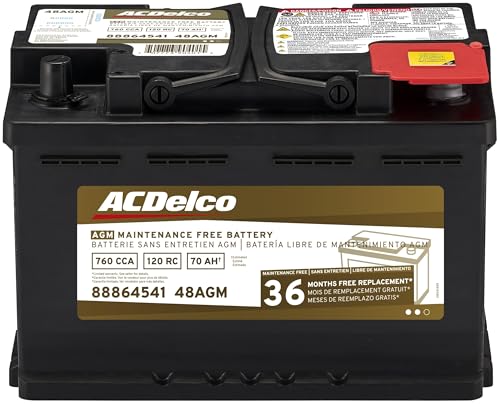
ACDelco’s Gold AGM uses high-density paste and calcium alloys to stretch cycle life, pushing replacement further out.
The ACDelco Gold 48AGM is a Group 48 AGM battery backed by a 36-month warranty. Its high-density negative paste and silver calcium stamped alloy are designed to increase cycle life, which directly addresses the question of how long a battery lasts.
The calcium lead positive grid maximizes conductivity and keeps internal resistance low, while the envelope separator improves acid circulation to hold down heat. A vent cap design resists acid leakage, which matters for under-hood longevity.
This battery fits many European sedans and SUVs that specify Group 48 AGM from the factory. Drivers who want a factory-style replacement with a clear warranty window will find it a natural fit. The main limitation is availability and price, since ACDelco Gold sits above budget flooded batteries.
If your car came with AGM, this is a safe, long-lived match rather than a downgrade.
|
2
|
Mighty Max Battery MM-H6 Start and Stop Car BCI Group Size 48 12V 70 AH, 120RC, 760 CCA Re |

Mighty Max’s MM-H6 pairs 760 CCA with a sealed AGM build, giving start-stop cars a long-lived replacement.
The Mighty Max MM-H6 is a Group 48 AGM battery rated at 12V, 70Ah, 760 CCA, and 120 minutes of reserve capacity. Those numbers matter because higher reserve capacity supports longer run times and a longer overall lifespan.
The sealed, spill-proof AGM design handles high discharge output and deep discharge recovery, which is exactly what start-stop systems demand. Its rugged construction resists shock, vibration, and temperature swings, and it is built in an ISO-certified facility to CE standards.
This battery suits drivers who want strong cold-weather starting and a maintenance-free AGM build without paying a premium brand name. It fits vehicles that call for Group 48 sizing, including many start-stop equipped cars and SUVs.
The honest limitation is that AGM batteries still age faster in extreme heat, so a Phoenix driver should expect the shorter end of the lifespan range. Verify terminal position before ordering.
|
3
|
Mighty Max Battery MM-H5 Start and Stop Car BCI Group Size 47 12V 60 AH, 100RC, 680 CCA Re |

The MM-H5 delivers 680 CCA in a Group 47 AGM case, a direct fit for many start-stop cars needing reliable cycling.
The Mighty Max MM-H5 is a Group 47 AGM battery rated 12V, 60Ah, 680 CCA, with 100 minutes of reserve capacity. It targets vehicles that use the smaller Group 47 footprint, common in certain European and domestic models.
The sealed AGM construction resists spills and corrosion, and the deep discharge recovery keeps power steady through repeated start-stop cycles. Rugged internal construction handles vibration and temperature extremes, which is where batteries often fail early.
This is a good match for compact cars and crossovers that specify Group 47 and came with AGM from the factory. Drivers who park outside in cold winters will appreciate the 680 CCA rating for confident cold starts.
The limitation is capacity: at 60Ah it carries less reserve than larger Group 48 or 94R batteries, so cars with heavy electrical loads may prefer a bigger unit. Confirm your group size before buying.
|
4
|
Mighty Max Battery MM-G35 Start and Stop Car BCI Group Size 35 12V 55Ah, 100RC, 650 CCA Re |

The MM-G35 fits Group 35 vehicles with 650 CCA and a sealed AGM design that resists heat and vibration.
The Mighty Max MM-G35 is a Group 35 AGM battery rated 12V, 55Ah, 650 CCA, with 100 minutes of reserve capacity. Group 35 is a common fitment for many Japanese and domestic sedans and small SUVs.
The sealed AGM design is spill-proof and handles high discharge output with deep discharge recovery, which supports a longer service life than a basic flooded battery. It resists shock, vibration, and harsh conditions across a wide temperature range.
This battery suits drivers of Group 35 vehicles who want AGM benefits without stepping up to a larger case. It is a solid choice for daily commuters in moderate climates where heat is not extreme.
The main limitation is the 55Ah capacity, which is modest for vehicles with lots of accessories or stop-start systems that cycle heavily. If your car originally used AGM, staying with AGM here avoids charging issues.
|
5
|
Weize Platinum AGM Battery BCI Group 48-12v 70ah H6 Size 48 Automotive Battery, 120RC, 760 |

Weize’s Group 48 AGM offers 760 CCA and a 36-month warranty, a direct answer for long-life replacement.
The Weize Platinum AGM Group 48 is a 12V, 70Ah battery rated 760 CCA and 120 minutes of reserve capacity, with a 36-month warranty. Weize claims up to twice the cycle life of conventional batteries, which speaks directly to how often you replace.
The AGM design is built for start-stop vehicles and accessories that demand extra power. Dimensions are 10. 94 by 6. 89 by 7. 48 inches with tapered terminals, left negative and right positive.
This battery fits cars, trucks, and SUVs that specify Group 48 and came with AGM from the factory. Drivers who want a clear warranty and strong cold-cranking power will find it a practical pick.
The limitation is fitment precision: the listing warns to verify dimensions and terminal position before purchase, because Group 48 cases vary slightly between models. Measure your tray and check terminal orientation first.
|
6
|
Weize Platinum AGM Battery BCI Group 94R – 12v 80ah H7 Size 94R Automotive Battery, 140RC, |

The Group 94R Weize packs 850 CCA and 80Ah, giving large vehicles the reserve to stretch replacement intervals.
The Weize Platinum AGM Group 94R is a 12V, 80Ah battery rated 850 CCA and 140 minutes of reserve capacity, backed by a 36-month warranty. The higher capacity and reserve support longer run times and, in practice, a longer service window before replacement.
It is designed for start-stop vehicles and accessories that draw heavy power. Dimensions are 12. 4 by 6. 89 by 7. 48 inches with tapered terminals, left negative and right positive.
This battery suits larger sedans, SUVs, and trucks that call for Group 94R or H7 sizing and came with AGM. The 850 CCA rating gives confident cold starts even in serious winter conditions.
The limitation is size and weight: it is one of the larger units here, so it will not fit Group 48 or 35 trays. Verify your group size and terminal layout before ordering to avoid a return.
|
7
|
ACDelco Gold Automotive Battery 94RAGM | PN 88864542 | 12V Car Battery AGM Group 94R/H7 Ba |

ACDelco’s 94RAGM brings GM-backed engineering and a 36-month warranty to Group 94R replacement.
The ACDelco Gold 94RAGM is a Group 94R/H7 AGM battery with a 36-month warranty and GM-backed engineering. It uses a leak-resistant pressurized valve system, robust envelope separators, and high-density plate construction to support long-term performance.
ACDelco positions it as a reliable replacement for select Audi, Buick, Cadillac, Mercedes-Benz, Chevrolet, Jeep, and GMC vehicles. The Group 94R sizing fits many luxury and sports models.
This battery suits drivers of GM and other Group 94R vehicles who want a factory-adjacent replacement rather than a generic unit. The warranty and brand support add confidence for long-term ownership.
The limitation is application specificity: it only fits vehicles that call for Group 94R, so verify year, trim, and engine before buying. Use the fitment tool to confirm compatibility rather than assuming.
|
8
|
Weize Platinum AGM Battery BCI Group 24F Automotive Battery, 120RC, 710CCA, 36 Months Warr |

Weize’s Group 24F AGM uses glass fiber mats to resist heat, a key factor in how long a battery lasts.
The Weize Platinum AGM Group 24F is a 12V battery rated 70Ah and 710 CCA with a 36-month warranty. Its AGM construction uses glass fiber mats and specialized separators that resist heat better than flooded designs, helping the battery hold capacity in hot climates.
Low self-discharge means it keeps charge during storage, which matters for cars that sit. Dimensions are 10. 75 by 6. 81 by 8. 98 inches with tapered terminals, left negative and right positive.
This battery fits many Asian and domestic vehicles that use Group 24F sizing, especially those in hot regions where flooded batteries die early. Drivers who park for extended periods will appreciate the low self-discharge.
The limitation is that if your car came with a flooded battery and no start-stop system, an AGM is more than you strictly need. It still works well but costs more than a basic replacement.
|
9
|
Weize Platinum AGM Battery BCI Group 35 Automotive Battery, 100RC, 650CCA, 36 Months Warra |

The Group 35 Weize AGM offers 650 CCA and heat resistance, a sensible long-life pick for hot climates.
The Weize Platinum AGM Group 35 is a 12V, 55Ah battery rated 650 CCA with a 36-month warranty. Like its siblings, it uses glass fiber mats and specialized separators for better heat resistance, helping it maintain capacity in hot weather.
The low self-discharge rate keeps voltage up during storage, and the sealed design reduces acid leak risk. Dimensions are 9. 06 by 6. 89 by 8. 82 inches with tapered terminals, left negative and right positive.
This battery suits Group 35 vehicles in warm regions where heat is the main killer of battery life. Drivers who want a sealed, maintenance-free AGM with a clear warranty will find it a practical choice.
The limitation is capacity: 55Ah is modest, so vehicles with heavy electrical loads or start-stop systems may prefer a larger unit. If your original battery was AGM, this is a safe like-for-like swap.
Every battery above is an AGM design, and that is deliberate. AGM chemistry resists heat, recovers from deep discharge, and cycles more times than flooded batteries, which is exactly what determines how often you replace one.
Match the group size to your vehicle, confirm the terminal layout, and pick the capacity that suits your climate and driving habits. The right AGM can realistically push your next replacement several years down the road.
Getting More Years Out Of A New Battery
Installing a fresh battery is only half the job. How you drive, park, and maintain it decides whether it lasts three years or six. These habits are simple, and they directly affect your next replacement date.
- Drive at least twenty minutes at highway speed weekly to fully recharge the battery.
- Keep terminals clean and tight, and apply a corrosion inhibitor after cleaning.
- Park in shade or a garage where possible to reduce under-hood heat.
- Turn off lights, fans, and accessories before shutting the engine down.
- Use a trickle charger if the car sits for weeks at a time.
- Address charging system issues promptly so the alternator does not overwork the battery.
Short trips are the quiet killer of battery life. Every start draws a big pulse of energy, and the alternator needs roughly twenty minutes of driving to replace it.
If your commute is five minutes each way, the battery never fully recharges, and it spends most of its life in a partial state that accelerates sulfation. That is why two identical batteries in two identical cars can have wildly different lifespans.
The fix is easy: take a longer drive once a week, or connect a maintainer if the car sits. Heat is the other factor. Parking in a garage or shade lowers under-hood temperatures and slows the chemical aging that shortens battery life.
Neither habit costs much, and both push your replacement date out.
What Each Habit Buys You
| Habit | Effect On Lifespan | Effort |
|---|---|---|
| Weekly long drive | Restores full charge, slows sulfation | Low |
| Terminal cleaning | Prevents resistance and corrosion | Low |
| Shaded parking | Reduces heat-driven aging | Low |
| Trickle charger for stored cars | Prevents deep discharge | Low |
| Prompt charging repairs | Avoids overworking the battery | Medium |
Mistakes That Make Batteries Die Early
Some replacement decisions backfire. Installing the wrong chemistry, ignoring fitment, or skipping the charging system check can leave you buying another battery far sooner than expected. Here is what to avoid.
The most common mistake is downgrading from AGM to flooded. If your car came with an AGM battery, its charging system is calibrated for AGM voltage and current. A flooded battery in that system may never fully charge, and it will fail early.
The reverse also causes problems: installing an AGM in a car designed for flooded is usually fine, but it costs more than necessary. Fitment errors are the second trap. Group sizes look similar but differ in length, height, and terminal position.
A battery that is slightly too tall can contact the hood, and reversed terminals can damage electronics. Finally, replacing a battery without checking the alternator means the new one may be drained by a failing charging system within months. Test the charging voltage before and after installation.
Read the group size from your old battery label or owner’s manual.
Note the terminal layout, left negative and right positive or the reverse.
Confirm whether the original was AGM or flooded, and match the chemistry.
Test the alternator output to rule out a charging fault.
Measure your battery tray to confirm the new case will fit.
Record the new battery’s manufacture date for future reference.
When To Replace Instead Of Recharge
Not every weak battery needs replacing. Sometimes a recharge or a terminal cleaning buys another year. Knowing the difference saves money and avoids an unnecessary swap.
A battery that reads low after sitting may simply need a full charge. If it holds voltage after charging and passes a load test, it has life left. The same goes for a battery with corroded terminals: cleaning them can restore normal starting.
Replacement becomes the right call when the battery fails a load test, shows physical damage like swelling or cracks, or will not hold a charge overnight after a full recharge. Age matters too.
Once a battery passes its warranty window and starts showing weak cranking, the cost of a jump start or tow outweighs the price of a new unit. A five-minute load test at any parts store gives you the answer, and it is free.
- Replace if the case is swollen, cracked, or leaking acid.
- Replace if a load test fails even after a full charge.
- Replace if the battery will not hold voltage overnight.
- Recharge first if voltage is low but the battery holds after charging.
- Recharge first if terminals are corroded but the case looks healthy.
- Replace if the battery is past warranty and cranks weakly.
Most car batteries need replacing every three to five years, with hot climates and short trips pushing that toward the low end. The single best step you can take today is a free load test at any auto parts store.
It takes five minutes, tells you exactly where your battery stands, and removes the guesswork from your next replacement. If the test says it is time, match your group size and chemistry, and choose an AGM if your car came with one.
That combination keeps you from repeating the same replacement sooner than you should.

- Marine Chargers and Backup Batteries: 9 Options Compared (2026) - October 27, 2026
- LTO Cells vs. SLA Generator Batteries: 5 Options Compared (2026) - October 27, 2026
- 12V/24V Backup Batteries and the EcoFlow DELTA Pro 3 (2026) - October 27, 2026