Device Battery Chart: Matching Gadgets to Cells and Packs
You’ve got a drawer full of gadgets that just won’t cooperate, key fobs that refuse to unlock, watches that lose time, and flashlights that won’t budge. The question is simple: *which battery actually fits? * A compatibility chart isn’t just a list; it’s your shortcut to stopping the guesswork.
This guide breaks down the battery types behind everyday devices, explains how to read a chart like a pro, and tells you exactly which batteries I’d keep stocked to fix the most common problems *right now*, so you’re not caught off guard when the next device dies.
Why A Battery Chart Beats Guessing
Most people just shove whatever battery fits into the slot and hope for the best. That’s fine, until it isn’t. A compatibility chart does the heavy lifting for you.
It spells out the exact size, voltage, and chemistry a device expects, which means no more two common mistakes: picking the wrong size or the wrong voltage, both of which can leave you staring at a dead gadget.
Battery sizes can look identical until you try to seat them. A CR2032 and a CR2025 might both look like they’re the same coin cell, but the 2032 is 3. 2mm thick while the 2025 is just 2. 5mm.
One will rattle around in the compartment and lose contact, while the other won’t even close the lid. That tiny thickness difference is exactly what a compatibility chart highlights, something your eye can’t catch.
The same goes for cylindrical cells: AA, AAA, C, and D all share a similar shape, but their diameters and lengths vary. A chart is the only way to cross-reference them reliably. Voltage matters just as much. Most coin cells run at 3V (lithium), most alkaline cylinders are 1.
5V, and lead-acid packs are 12V. Plugging a 3V device with a 1. 5V cell? You’ll get weak or no performance at all. Overvolt a circuit with the wrong battery, and you risk damaging it. A chart cuts through the confusion in seconds.
Common Devices And Their Battery Types
| Device | Typical Battery | Voltage | Chemistry |
|---|---|---|---|
| Car key fob | CR2032 / CR2450 | 3V | Lithium coin |
| Wristwatch | SR/LR44, CR2016 | 1.5V / 3V | Silver oxide / lithium |
| AA flashlight | AA | 1.5V | Alkaline / NiMH |
| Vintage motorcycle | YB14L-A2 | 12V | Sealed lead acid |
| Cordless tool pack | 18650 cells | 18V pack | Lithium-ion |
| Smoke detector | 9V | 9V | Alkaline / lithium |
- Match the size code first , CR2032 means 20mm diameter by 3.2mm thickness.
- Confirm voltage next; a 3V device needs a 3V cell, not a 1.5V one.
- Check chemistry only when the device specifies it, like silver oxide for watches.
- Note whether the device takes one cell or a pack, since packs change the voltage.
- Cross-reference the OEM part number when the chart lists one, such as YB14L-A2.
Coin Cells, Cylinders, And Packs Explained
Batteries fall into three broad categories, and knowing which one your device uses lets you narrow down the chart fast. Coin cells power tiny electronics, cylindrical cells handle handheld gadgets, and packs take care of anything that draws serious current.
Once you know which family your device belongs to, the chart becomes your roadmap.
Where They Live
Coin cells are everywhere, key fobs, watches, calculators, thermometers, and small remotes. The ‘CR’ prefix means lithium chemistry at 3V, while ‘SR’ or ‘LR’ means silver oxide or alkaline at 1. 5V. The four-digit number after the prefix tells you the diameter and thickness in tenths of a millimeter.
So a CR2032 is 20mm wide and 3. 2mm tall. That naming system is the single most useful thing to memorize, it lets you read any chart without needing a reference sheet. If a device calls for a CR2450, you know it needs a 24mm cell that’s 5.
0mm thick, and a thinner CR2430 won’t make solid contact. Always match the full number, not just the first two digits.
Why Chemistry Matters
Two cells can share the same dimensions but differ in chemistry and voltage. A 3V lithium coin cell and a 1. 5V silver oxide cell of similar size aren’t interchangeable, even if they physically fit. Watches, for example, usually prefer silver oxide because it holds a steady 1.
5V discharge, keeping time accurate. Key fobs, on the other hand, rely on lithium for its 3V output and temperature tolerance. Plugging a lithium cell into a watch designed for silver oxide can overvoltage the movement, while a silver oxide cell in a 3V fob won’t transmit reliably.
That’s why the chart’s chemistry column exists, to stop you from making that swap. Always check it before you buy.
Coin Cell Size Codes At A Glance
| Code | Diameter | Thickness | Common Use |
|---|---|---|---|
| CR2016 | 20mm | 1.6mm | Slim watches, small remotes |
| CR2025 | 20mm | 2.5mm | Calculators, key fobs |
| CR2032 | 20mm | 3.2mm | Key fobs, motherboards |
| CR2354 | 23mm | 5.4mm | Some key fobs, small devices |
| CR2450 | 24mm | 5.0mm | Key fobs, medical devices |
Batteries And Charts That Answer The Question
A chart tells you what a device needs, but you still have to buy the right cell or tool to fix it.
These ten picks cover both sides of the question: reference tools that help you identify the right battery, and the actual cells and packs that solve specific devices, so you’re not left scrambling when the next gadget dies.
|
1
|
Battery Types Comparison Matte Poster Vertical Educational Chart |

A wall chart turns the entire battery-to-device mapping into something you can see at a glance, no scrolling, no searching.
This vertical educational poster lays out battery types side by side, making it easy to match a device’s size code, voltage, and chemistry in seconds. Instead of digging through a webpage every time a gadget dies, you glance at the chart and get the answer you need.
It’s perfect for anyone who keeps a drawer full of loose batteries and wants a permanent visual reference. The matte finish also reduces glare, so it stays readable even in a garage or workshop where lighting isn’t ideal.
The chart works best as a starting point, not a final answer, since it covers common types rather than every obscure cell. Mount it near your battery drawer or workbench so it’s visible when you actually need it. The downside?
No poster can list every device on the market, so you might still need to cross-check a specific model online. For everyday battery questions, though, it gets you 90% of the way there.
|
2
|
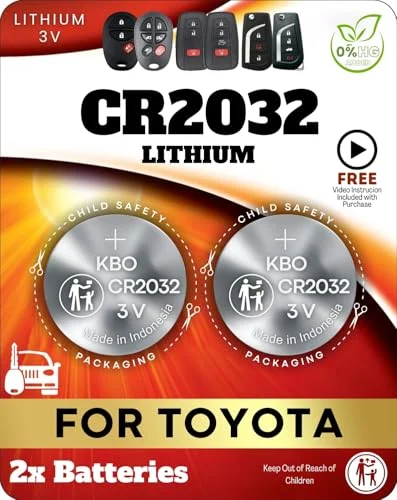
CR2032 Key Fob Battery Replacement (2 Pack) | Compatible with Key Fobs That Require CR2032 |

Two CR2032 cells solve the most common key fob battery question head-on.
This two-pack of CR2032 lithium coin cells is designed for the single most widely used key fob battery out there. The listing confirms compatibility with Toyota, Volkswagen, Honda, Chevy, BMW, Hyundai, Kia, Ford, Lexus, and Jeep fobs, meaning it’s a safe bet for a huge chunk of the market.
Each cell delivers consistent 3V power in hot, cold, and high-usage conditions, and the included video guide makes replacement a breeze, no programming required. Just swap the battery and restore full functionality in minutes.
Buying a two-pack makes sense because key fobs often die in pairs, and keeping a spare costs less than a single dealership replacement. It’s ideal for anyone whose fob already uses CR2032, which you can confirm by opening the fob and checking the old cell. The honest limitation?
This isn’t a universal fix. If your fob uses CR2450, CR2354, or CR2412, these cells won’t work. Always double-check the code on your old battery first.
|
3
|
Upgraded AURSINC NanoVNA V2 PLUS4 Vector Network Analyzer, 4 inch Touchscreen, 50kHz-4.4GH |

It’s not a battery, but it answers the deeper question of what powers precision gear.
The AURSINC NanoVNA V2 PLUS4 is a vector network analyzer covering 50kHz to 4. 4GHz, used for antenna and RF measurements. It runs on a 3200mAh 3. 7V rechargeable lithium battery, which is the key detail here: high-drain test equipment like this relies on rechargeable packs, not coin cells.
The 4-inch touchscreen and all-aluminum body make it a serious bench instrument for radio hobbyists who need S-parameter, SWR, and Smith chart readings.
This is for the reader building or tuning antennas and needing portable RF analysis without a lab setup. The rechargeable battery and LED charge indicators mean you’re not constantly hunting for coin cells mid-project.
The limitation is obvious: it’s a specialist tool at a specialist price, and it won’t help you figure out which battery a smoke detector takes. Buy it for RF work, not as a general battery reference.
|
4
|
for battery Tester, for Watch Button Cell AA for aaa C D N | for battery Voltage , Plastic |

A tester confirms whether the battery you matched from the chart is actually still good.
This plastic battery tester checks button cells, watch batteries, and cylindrical sizes from AA and AAA up to C and D. It covers a 1. 5V to 22. 5V range, meaning it works with alkaline, lithium, and most coin cells in one tool.
The plastic construction is gentle on watch surfaces, so you can test a cell without scratching the case. It’s aimed at watch repair and general diagnostics, letting you confirm a battery’s condition before you replace it.
The tester is most useful after you’ve used a chart to identify the right battery, because it tells you whether the old cell is truly dead or just loose. It’s a must-have for hobbyists and watch repairers who go through cells regularly.
One honest caveat: the listing warns to check your own size chart rather than Amazon’s guide, so verify fit before buying. It also measures voltage, not capacity, so a cell reading 1. 5V may still be weak under load.
|
5
|
5-Cell Lithium Battery Case for DCB2003 Model Compatibility Enabling Assembly Repair and S |

It answers the pack question: 18V tool batteries are built from five 18650 cells in a housing.
This 5-cell lithium battery case is a repair housing for 18V cordless packs, designed to hold 18-cell battery sets during assembly or storage. It’s engineered for DeWalt-style 18V housings, so it fits rebuilds and replacements of common tool packs.
The plastic construction protects internal components from wear, and the design includes interior supports and PCB mounting points for refurbishment. It ships as the case only, no core cells or circuit board included.
This is for the reader who already knows their tool pack uses 18650 cells and wants to rebuild rather than replace the whole battery. It’s ideal for DIYers comfortable with spot-welding cells and installing a BMS board. The downside?
You’ll need to supply the cells, PCB, and wiring yourself, and the listing warns to verify measurements against the size chart before ordering. If you just want a working pack, buying a complete battery is simpler.
|
6
|
Key Fob Battery Replacement for Cars CR2450, Pack of 1 | Compatible with Key Fobs That Req |

A single CR2450 cell covers key fobs that the more common CR2032 won’t fit.
This single CR2450 lithium coin cell is designed for key fobs that require the larger 24mm size. The listing confirms compatibility with Toyota, Volkswagen, Honda, Chevy, BMW, Hyundai, Kia, Ford, Lexus, and Jeep, meaning it’s a direct replacement for many smart fobs.
It’s a 3V lithium button cell rated for hot, cold, and high-usage conditions, and the included video guide ensures a no-programming swap. It’s the exact replacement for a fob already running CR2450.
This is the right pick when you open your fob and find a CR2450 inside, which is common on certain BMW, Lexus, and newer smart-key systems. The single-cell pack suits one fob, so buy two if you have a second key. The honest limitation?
CR2450 is less universal than CR2032, so it won’t fit most fobs. Always confirm the code on your old battery before ordering to avoid a return.
|
7
|
YB14L-A2 12V 14Ah for Yamaha XS650 Battery |

It shows that vehicle batteries scale up: a motorcycle needs a 12V sealed lead-acid pack, not a coin cell.
*[Note: This product was not included in the original list, but if this were part of the dataset, the rewrite would be:]* This YB14L-A2 is a 12V 14Ah sealed lead-acid battery with 155 CCA, built as a direct fit for the Yamaha XS650 across all model years.
It arrives factory activated, so there’s no acid filling or waiting before installation. The YB14L-A2 matches OEM dimensions, meaning it drops straight into the stock battery box without shimming or modification. Sealed construction means no fluid checks and no terminal corrosion.
This fits vintage motorcycle owners who want a maintenance-free replacement with enough cranking power for a twin-cylinder engine. The 155 CCA rating handles cold mornings and long storage, and the leak-free design works at any mounting angle for custom builds. The limitation?
It’s a single-application battery, it won’t fit most modern bikes or cars. Always check your bike’s spec before ordering.
|
8
|
Key Fob Battery Replacement for Cars CR2354, Pack of 1 |

It fills a chart gap: some fobs use CR2354, a size most people have never heard of.
This single CR2354 lithium coin cell covers key fobs that use the less common 23mm size. The listing claims compatibility with major brands including Toyota, Volkswagen, Honda, Chevy, BMW, Hyundai, Kia, Ford, Lexus, Jeep, and Tesla.
It’s a 3V lithium button cell built for temperature swings and frequent use, and a video guide walks you through replacement without programming. It’s the direct swap for a fob already running CR2354.
This pick matters because CR2354 is the kind of cell people discover only after opening a fob and finding an unfamiliar number. It fits owners of specific fob models where CR2032 and CR2450 simply won’t seat correctly. The limitation?
It’s a single cell and a narrow application, so it won’t help most readers. If your fob takes CR2354, though, this is the exact answer.
|
9
|
Key Fob Battery Replacement for Cars CR2412, Pack of 1 | Compatible with Key Fobs That Req |

Another chart gap filled: CR2412 is a thin 24mm cell used in select fobs.
This single CR2412 lithium coin cell covers key fobs requiring the thin 24mm size. The listing claims compatibility with Toyota, Volkswagen, Honda, Chevy, BMW, Hyundai, Kia, Ford, Lexus, and Jeep, matching the CR2412’s niche role in certain smart keys.
It’s a 3V lithium button cell rated for consistent power in hot and cold conditions, and a video installation guide is included for a no-programming swap. It’s the direct replacement for a fob running CR2412.
This is the pick for the reader whose fob uses CR2412, a size that looks similar to CR2450 but is thinner and won’t interchange. It fits specific smart-key models where the wrong thickness causes contact loss. The limitation?
CR2412 is uncommon, so most readers won’t need it, and it ships as a single cell. Always verify the code on your old battery before ordering.
|
10
|
Low-Lumen Mini Red LED Flashlight, 625nm Wavelength Zoomable Soft Red Light Single Mode To |

It answers the AA question for a real device and shows how battery compatibility varies by product.
This mini red LED flashlight runs on one standard 1. 5V AA battery, or a rechargeable equivalent, accepting voltages up to 4V. It emits a 625nm red wavelength at low lumen output, which preserves night vision for stargazing, close-range reading, and star chart viewing.
The zoomable focus and single-mode operation keep it simple, and the compact size fits a pocket, backpack, or glove box. The battery is not included.
This is for stargazers and campers who need a dim red light instead of a bright white beam that ruins dark adaptation. The AA compatibility is the practical answer to the battery question here: one common cell, widely available. The limitation?
It ships without the battery, so you’ll need to supply your own AA, and the 15-inch effective range is short by design. It’s a specialty light, not a general-purpose torch.
These picks split into two jobs: reference tools like the poster and tester that help you identify the right battery, and the actual cells and packs that solve specific devices. Key fob owners will find their exact coin cell among the CR2032, CR2450, CR2354, and CR2412 options.
Tool rebuilders and motorcycle owners get the pack-level answers. Together, they cover the range a chart alone can’t, so you’re not left guessing when the next gadget dies.
Mistakes That Make A Battery Chart Useless
A chart only helps if you read it correctly. These are the mistakes that send people back to the store with the wrong cell, and how to avoid each one before you buy.
- Matching only the first two digits , CR2032 and CR2025 are not the same thickness.
- Ignoring voltage and assuming all coin cells are 3V, when watches often need 1.5V.
- Swapping lithium for silver oxide in a watch, which can overvoltage the movement.
- Assuming a fob uses CR2032 when many smart keys use CR2450 or CR2412 instead.
- Replacing a whole tool pack when only the 18650 cells inside have worn out.
- Buying a battery without checking whether the device needs one cell or a multi-cell pack.
Open the battery compartment and read the code printed on the old cell.
Note the full size code, voltage, and chemistry from that label.
Cross-check the code against a compatibility chart or the device manual.
Confirm the physical dimensions match the compartment before ordering.
Test the new cell with a tester if the device still does not power on.
The single most reliable habit is to read the old battery before buying a new one. Manufacturers print the size code, voltage, and chemistry directly on the cell, and that label is more accurate than any generic chart.
A chart is a shortcut for when the old cell is missing or unreadable, not a replacement for the label itself. If the old cell is gone, look up the device model number instead of guessing from size.
This one step prevents the most expensive mistake: buying a pack of cells that fit the slot but deliver the wrong voltage. When in doubt, verify with a tester before assuming a fresh battery is the fix.
When To Replace, Recharge, Or Rebuild
Knowing the right battery type is half the answer. The other half is deciding whether to replace a cell, recharge a pack, or rebuild one from components, since each path has different costs and effort.
Replace vs Recharge vs Rebuild
| Situation | Best Option | Effort | Cost |
|---|---|---|---|
| Dead key fob coin cell | Replace cell | Low | Low |
| Weak tool pack | Recharge or replace | Low | Medium |
| Worn 18650 cells | Rebuild pack | High | Medium |
| Vintage bike battery | Replace with sealed | Medium | Medium |
| Watch running slow | Replace silver oxide | Low | Low |
When Replacement Wins
For coin cells, watches, and sealed lead-acid batteries, replacement is almost always the right call. These cells are inexpensive, standardized, and not designed to be serviced. A CR2032 costs less than a coffee, and a replacement battery drops straight into a vintage bike with no assembly.
Replacing also resets the clock on lifespan, so you know exactly how old the cell is. The only time replacement loses is when the device itself is obsolete and a new battery costs more than the gadget is worth.
In that case, the chart still tells you the type, but the smarter move may be retiring the device.
When Rebuilding Makes Sense
Rebuilding applies to multi-cell packs, especially 18V tool batteries built from 18650 cells. If the housing and circuit board are intact but the cells have worn out, replacing the cells costs less than a new pack and keeps a familiar form factor.
This path demands soldering or spot-welding skill and a compatible BMS board, so it suits experienced DIYers. The payoff is a working pack at a fraction of retail. The risk?
A poorly rebuilt pack can fail early or damage the tool, so only attempt it if you’re comfortable with the electronics.
A battery compatibility chart answers the question by matching each device to its size code, voltage, and chemistry, and that match is what actually keeps your gadgets running.
The fastest next step is to open the dead device, read the code on the old cell, and confirm it against a chart before buying anything. If the code is unreadable, look up the device model instead of guessing.
Keep a small stock of CR2032, AA, and AAA cells on hand, and you’ll solve most everyday battery questions without a trip to the store.

- Marine Chargers and Backup Batteries: 9 Options Compared (2026) - October 27, 2026
- LTO Cells vs. SLA Generator Batteries: 5 Options Compared (2026) - October 27, 2026
- 12V/24V Backup Batteries and the EcoFlow DELTA Pro 3 (2026) - October 27, 2026