What Does Service Battery Charging System Mean?
When you see the ‘Service Battery Charging System’ light on your dashboard, it’s more than just a warning, it’s a red flag that something is amiss in your car’s electrical system.
While your vehicle might still start, the message is a direct indication that the charging circuit isn’t functioning as it should. This could mean your alternator isn’t generating enough power, your battery is struggling to hold a charge, or there’s an issue with the wiring connecting them.
Ignoring it could lead to a dead battery and a stalled engine, especially if you’re driving long distances. This guide explains what the warning means, why it happens, and how a battery charger can help you diagnose or recover your battery before you waste money on unnecessary repairs.
What The Battery Charging Warning Actually Tells You
Recommended Products

This section explains the warning itself, where it comes from, and what the car’s computer is monitoring when it appears. Understanding the system helps you decide whether to keep driving or pull over.
When the “Service Battery Charging System” message appears, your car’s computer has detected a voltage problem in the charging circuit. The system monitors the alternator output, the battery voltage, and the wiring between them.
If voltage drops below a target range, or if the alternator is not sending enough current, the message triggers. A healthy charging system holds roughly 13. 5 to 14. 5 volts while the engine runs. If the reading falls under about 12.
5 volts, the battery is doing all the work. That means the car is running on stored energy alone, and it will eventually stall once the battery drains. The warning is not the same as a simple low-battery light. It points to the charging side, not just the battery itself.
Common Causes Behind The Warning
| Cause | Typical Symptom | Urgency |
|---|---|---|
| Failing alternator | Dim lights, slow crank | High – stop soon |
| Worn serpentine belt | Squealing, slipping | High – stop soon |
| Corroded battery terminals | Intermittent warning | Medium – clean now |
| Old or weak battery | Hard starts, low voltage | Medium – test soon |
| Loose ground strap | Flickering dash lights | Medium – inspect now |
| Faulty voltage regulator | Over or under charging | High – diagnose soon |
- Pull over safely and check whether the headlights dim or brighten with engine speed.
- Turn off accessories like the radio, AC, and phone charger to reduce electrical load.
- Inspect battery terminals for white or green corrosion and tighten any loose clamps.
- Check the serpentine belt for cracks, glazing, or slack if you can see it safely.
- Drive directly to a shop if the warning stays on and the lights are dim.
- Avoid long trips with the message active; the battery may not carry you far.
Why A Charger Helps You Diagnose And Recover
A battery charger is not a replacement for a working alternator, but it plays a real role in diagnosing and recovering a weak battery. This section covers how charging tools fit into the picture.
Many drivers see the warning and assume the battery is dead, but the battery may simply be undercharged. A smart charger can bring a low battery back to full, then you can test whether the warning returns. If it does, the alternator or wiring is the likely culprit.
If it does not, the battery or a parasitic draw may be the issue. Chargers with desulfation modes also help recover batteries that sat unused for months. That matters because a sulfated battery can trigger the same warning as a failing alternator.
Testing the battery after a full charge gives you a clearer picture before you spend money on parts.
Charge the battery fully with a smart charger and let it rest for an hour.
Measure resting voltage with a multimeter; a healthy 12V battery reads about 12.6 volts.
Start the engine and measure again; you should see 13.5 to 14.5 volts at the battery.
If voltage stays near 12V with the engine running, the alternator is not charging.
If voltage reads fine but the warning returns, check for parasitic draws or a bad sensor.
A charger also protects your investment if the car sits for long stretches. Seasonal vehicles, boats, and motorcycles often trigger charging warnings simply because the battery self-discharged. Keeping a maintainer connected during storage prevents that cycle. For a car already showing the warning, a charger buys you time and clarity.
It lets you rule out the battery before you replace an alternator. It also gives you a way to top up the battery so you can drive to a shop without stalling. The right charger does not fix the underlying fault, but it removes one variable from the diagnosis.
Chargers That Help You Diagnose And Recover A Weak Battery
If you’re seeing the ‘Service Battery Charging System’ warning, it often points to issues with your battery rather than the alternator. A smart charger can help you identify the root cause, whether it’s a sulfated battery, a drained charge, or a parasitic draw, before you spend money on unnecessary repairs.
These chargers range from simple maintainers for seasonal storage to high-amp units designed to revive deeply discharged batteries. Pick one that fits your vehicle’s needs and how much control you want over the charging process.
|
1
|
MOTOPOWER MP00205A 12V 800mA Automatic Battery Charger, Maintainer, Trickle and Desulfator |

This charger is ideal for ruling out sulfation as the cause of your warning, thanks to its automatic desulfation feature.
The MOTOPOWER MP00205A is a compact yet powerful 12V charger that combines charging, maintaining, trickling, and desulfating in one device. It’s designed to work with lead-acid, flooded, AGM, and gel batteries, making it a versatile solution for cars, motorcycles, and off-road equipment.
What sets it apart is its automatic desulfation mode, which uses pulse current technology to break down sulfate buildup that builds up over time. This can be a silent culprit behind your charging system warning, especially if your battery has been sitting unused for months.
The charger automatically detects sulfation issues and applies the right current to restore battery performance without any manual effort.
If your vehicle has been parked for weeks or longer, sulfation could be the reason behind the warning. This charger is perfect for such scenarios because it gently charges and maintains your battery at 13. 6V, preventing it from overcharging or gassing.
Once the battery reaches full charge, it switches to a maintenance mode that keeps it topped up over 24 hours, so you can leave it connected without worrying about overuse. It’s a budget-friendly way to check if sulfation is the issue before you consider more expensive repairs.
|
2
|
PZ.P 15-Amp 12V/24V Smart Battery Charger, Maintainer & Trickle Charger for LiFePO4, Lead |

This charger is built for quick testing and recovery, especially for larger vehicles and batteries that need faster charging.
The PZ. P 15-Amp charger is a standout option for those who need to quickly assess and charge a battery, especially in larger vehicles like trucks, SUVs, or boats. It supports both 12V and 24V systems, including LiFePO4 and various lead-acid types like AGM, GEL, SLA, and flooded batteries.
With its 9-stage charging process, it ensures safer and more efficient battery care. The large color screen lets you monitor real-time data, including voltage, current, internal temperature, and charge percentage, even in bright sunlight. A 6. 7ft charging cable makes it easy to reach batteries in less accessible spots.
This charger’s 15-amp output means it can charge larger batteries faster than standard 8-amp or 10-amp units, which is ideal if you’re dealing with a battery that’s still holding some charge but triggering the warning.
It includes pulse repair technology to address sulfation and acid stratification, restoring lost performance for better starts. Temperature compensation ensures the battery charges correctly in both hot and cold weather, so you don’t have to worry about overcharging.
However, it won’t work on a completely dead battery, which is a limitation if your battery shows zero volts.
|
3
|
E-FAST 25A Smart Car Battery Charger, 12V/24V Automatic Automotive Battery Maintainer & De |

This charger is perfect for heavy-duty use, offering both rapid charging and an emergency booster mode for large vehicles.
The E-FAST 25A charger is built for heavy-duty applications, delivering 25 amps at 12V and 15 amps at 24V to charge larger batteries quickly. It’s compatible with a wide range of battery types, including lead-acid (AGM, GEL, SLA, flooded, EFB) and LiFePO4.
The charger features five adjustable current settings, allowing you to choose 2A for small batteries to prevent overheating or 25A for large vehicles with 75-400AH batteries. An Emergency Booster Mode delivers a 200-second surge to help jump-start a depleted battery, making it a must-have for garages and off-road enthusiasts.
If your vehicle is large, think trucks, SUVs, boats, or RVs, and you’re dealing with a battery that’s either undercharged or sulfated, this charger is a game-changer. The 25A output ensures rapid charging, and the 16-hour repair mode is specifically designed to tackle sulfated batteries.
The aluminum housing and cooling fan help manage the heat generated during high-amp charging, so it can handle repeated use without issues. Note that the Booster mode is only for 12V batteries, so 24V users won’t have access to that feature.
|
4
|
TOPDC 8A 4-Bank Charger & Trickle Maintainer, 6V/12V 2A/Bank, AGM/STD | 4 Independent Bank |
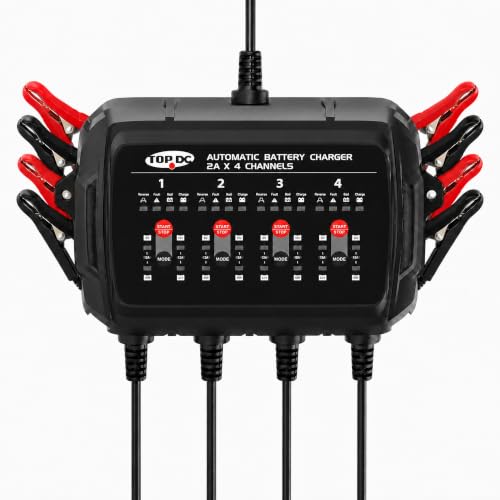
This charger is a smart choice for anyone with multiple vehicles or equipment needing battery maintenance.
The TOPDC 8A charger stands out with its 4-bank design, allowing you to charge and maintain up to four batteries simultaneously. Each bank can be set independently to 6V AGM, 6V standard, 12V AGM, or 12V standard, making it perfect for cars, motorcycles, ATVs, RVs, and seasonal equipment.
It uses a 9-stage intelligent charging system that detects battery conditions, charges them, and switches to maintenance mode once fully charged. Battery Activation Mode is particularly useful for weak batteries that refuse normal charging, and it includes clamp and O-ring leads for secure connections.
If you have multiple vehicles or equipment that need battery maintenance, this charger is a practical solution. You can charge four batteries overnight and compare their responses, which helps identify which one might be the culprit behind your warning.
Each bank operates independently, so one bad battery won’t affect the others. The 2A output per bank is slower for large batteries, so plan on overnight sessions. It’s ideal for households with motorcycles, ATVs, and a car, replacing four separate maintainers with one unit.
|
5
|
10Amp Battery Charger Smart Car Trickle Charger 12V 24V Battery Maintainer | 7-Stage Safet |
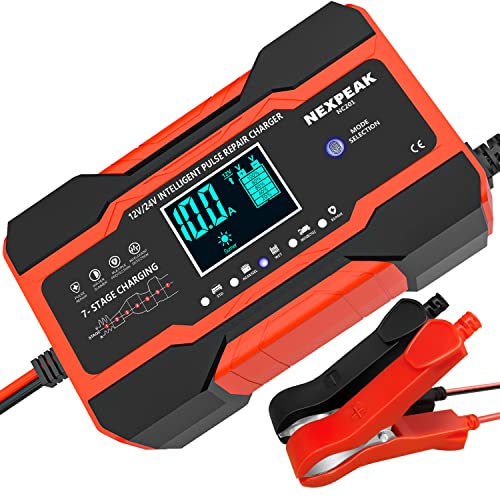
This charger is a balanced pick for daily use, offering both charging and maintenance capabilities with a clear display.
The 10-amp charger is a versatile option that works with both 12V and 24V lead-acid batteries, including AGM, GEL, SLA, and flooded types.
Its 7-stage charging process is faster than 8-amp or 5-amp automatic chargers, and it includes pulse repair technology to address sulfation and acid stratification, restoring battery performance for stronger starts.
A large LCD screen displays charge voltage, current, internal temperature, charge percentage, and summer/winter modes, making it easy to monitor progress even in extreme weather.
This charger is great for cars, trucks, SUVs, motorcycles, lawn mowers, and boats. Its plug-and-play design means you can connect it and walk away, making it a convenient solution for daily use.
It won’t revive a completely dead battery, so if your battery reads zero volts, you’ll need a different approach. The 10-amp output is a middle ground, faster than a simple maintainer but gentler than a 25-amp unit.
If you want a charger that can both charge and maintain your battery during winter storage, this is a solid choice. The LCD makes it easy to track charge status without any guesswork.
|
6
|
Schumacher Electric 1.5A Car Battery Charger & Maintainer, 6V/12V – SC1355 | Restores Batt |

This is a reliable option for long-term battery health, especially for vehicles that sit unused for extended periods.
The Schumacher SC1355 is a 1. 5A charger, maintainer, and reconditioner designed for 6V and 12V batteries. It automatically detects voltage for both types, so you don’t need to manually select 6V or 12V.
Advanced desulfation mode helps reverse sulfate buildup, which is a common issue for batteries that haven’t been used in a while. Smart trickle charging keeps the battery topped up without overcharging, and reverse hook-up protection prevents any damage from misconnections.
The package includes quick-connect clamps and ring connectors for easy installation.
This charger is perfect for motorcycles, ATVs, cars, trucks, and boats that sit between uses. The 1. 5A output is slow, so it’s best suited for maintaining a healthy battery rather than quickly reviving a drained one. Schumacher’s reputation in battery care adds confidence to buyers.
If your warning appears after winter storage, this is a simple and safe way to bring your battery back to full charge and see if the message clears.
|
7
|
EV Charger BLACKBOX 240V 125A to 200A Service- No Electrical Panel Upgrade or Service Upgr |

This device is for EV load management, not 12V car battery charging.
The BLACKBOX EVEMS240-200 is a 240V load management device for EV charging, not a 12V car battery charger. It’s designed for services rated 125A to 200A and allows charge rates up to 48 amps without needing an electrical panel upgrade.
The compact unit installs near your panel and monitors available capacity, pausing EV charging when household demand spikes and resuming when capacity returns. It works with any brand of EV charger, which is sold separately. Installation should be done by a qualified electrician.
This product is for EV owners looking to avoid costly service upgrades and manage charging capacity efficiently. It doesn’t address the ‘Service Battery Charging System’ warning on a dashboard. If you’re dealing with a 12V car battery issue, this isn’t the right tool.
It’s only relevant if you’re also managing home EV charging capacity. The limitation is clear: it requires professional installation and isn’t designed for standard car batteries.
|
8
|
TowerTop 2/10/25 Amp 12V Smart Car Battery Charger, Fully Automatic Battery Maintainer wit |

This charger offers manual control for battery recovery, including engine start and repair modes.
The TowerTop charger provides 2A, 10A, 25A, and AUTO settings for 12V batteries, supporting a wide range of battery types, including STD, AGM, GEL, wet, MF, EFB, calcium, and deep-cycle batteries. Its 8-stage process includes desulfurization, soft start, bulk charge, absorption, analysis, repair, float, and pulse maintenance.
Independent desulfurization and repair buttons let you manually target sulfated batteries, and an HD LCD shows current charging parameters.
This charger is ideal for car, boat, RV, and power-sports owners who want manual control over repair modes. The engine start feature adds an emergency capability, allowing you to quickly revive a depleted battery.
The 25A rate charges large batteries quickly, but you should match the setting to the battery size to avoid overheating smaller ones. It won’t repair completely drained batteries, which is a common limitation across this category.
If your warning is due to a sulfated battery that still holds some charge, the manual repair mode gives you a direct way to attempt recovery.
|
9
|
NOCO GENIUS2X4 6/12V 4-Bank Battery Charger, Trickle Charger & Maintainer | Charges 4 Batt |

This charger is the best for deeply discharged batteries, thanks to its Force Mode and four-bank design.
The NOCO GENIUS2X4 charger charges four batteries at once across 6V and 12V systems, supporting lead-acid types like AGM, Gel, SLA, VRLA, and lithium-ion LiFePO4. An integrated thermal sensor adjusts charging based on ambient temperature, preventing overcharging in heat and undercharging in cold.
It can charge batteries from as low as 1 volt, and Force Mode lets you manually charge completely dead batteries down to zero volts. The unit constantly monitors battery status, so you can leave it connected indefinitely for maintenance.
This is the strongest option if you have multiple batteries, including deeply discharged ones that other chargers can’t handle. Four banks mean you can diagnose a whole fleet of batteries in one session.
The trade-off is price and the fact that each bank shares the total output, so charging four large batteries at once is slower than a single-bank high-amp unit. Force Mode is a real advantage for neglected batteries that sat dead for months.
If your warning is tied to a battery that hasn’t been used in a long time, this gives you the best chance of recovery.
|
10
|
1.5A 6V/12V Car Battery Charger – Automatic Trickle Charger, Battery Maintainer & Desulfat |

This charger is a budget-friendly option for reviving neglected batteries with its Recovery Mode down to 1V.
This 1. 5A charger works with 6V and 12V lead-acid and LiFePO4 batteries. It functions as a charger, maintainer, trickle charger, and desulfator. The 1. 5A output is 50% faster than standard 1A chargers, and Pulse Repair technology detects sulfation and acid stratification.
Recovery Mode can manually charge dead batteries from as low as 1V, making it a unique feature for this price point. An integrated thermal sensor adjusts charging to prevent overcharging in heat and undercharging in cold. The package includes 10ft heavy-duty cables and LED indicators for quick status checks.
This charger is perfect for cars, motorcycles, lawn mowers, ATVs, tractors, and RVs that sit for long periods. The 1. 5A rate is slow, so it’s best suited for maintaining a battery or overnight recovery of a mildly drained one. Seven-layer protection includes reverse polarity and overheat safeguards.
The 10ft cables make it easy to reach batteries in awkward spots. If your charging warning appeared after months of storage and you want an affordable way to revive your battery, this is a sensible starting point.
Choosing the right charger depends on your specific needs. If you’re maintaining a healthy battery or dealing with a fleet of vehicles, a four-bank charger like the TOPDC or NOCO is ideal. For larger vehicles and advanced repair modes, high-amp chargers such as the E-FAST or TowerTop are better suited.
Simple maintainers from MOTOPOWER and Schumacher are perfect for seasonal storage. None of these chargers fix a failed alternator, but they help you rule out battery issues before you invest in parts.
How To Test Whether The Battery Or Alternator Is At Fault
Once you have charged the battery, the next step is figuring out which component caused the warning. This section walks through a practical test sequence you can run at home with basic tools.
Charge the battery fully, then let it rest for at least one hour before testing.
Set a multimeter to DC volts and measure across the battery terminals with the engine off.
A healthy 12V battery should read about 12.6 volts; anything under 12.2 suggests a weak battery.
Start the engine and measure again; you want to see 13.5 to 14.5 volts if the alternator works.
Turn on headlights and AC, then measure once more; voltage should stay above 13 volts under load.
If voltage drops below 13 with the engine running, the alternator or its wiring is the likely fault.
Reading The Results
| Engine Off | Engine Running | Likely Cause |
|---|---|---|
| 12.6V or higher | 13.5-14.5V | Intermittent fault or sensor |
| Below 12.2V | 13.5-14.5V | Weak or aging battery |
| 12.6V or higher | Below 13V | Alternator or wiring fault |
| Below 12.2V | Below 13V | Both battery and alternator |
| Over 15V running | Over 15V | Faulty voltage regulator |
The test takes about fifteen minutes and costs nothing if you own a multimeter. The key is to charge the battery first, because a partially drained battery skews every reading.
If the battery reads healthy at rest and the running voltage stays low, you can stop chasing the battery and focus on the alternator, belt, and ground connections. If the battery reads low at rest but the alternator pushes proper voltage, the battery itself is the problem.
That is the scenario where a charger and a replacement battery solve the warning. Many shops charge for the same test, so running it yourself saves both time and diagnostic fees.
Mistakes That Keep The Warning Coming Back
Even after charging or replacing a battery, the message can return if you skip a few common steps. These are the mistakes that send drivers back to the shop with the same warning.
- Replacing the battery without testing the alternator first; a bad alternator kills a new battery fast.
- Ignoring corroded terminals; white or green buildup adds resistance and mimics a charging fault.
- Leaving a maintainer on a battery in a hot garage without temperature compensation.
- Skipping the belt inspection; a glazed or loose serpentine belt causes intermittent charging.
- Assuming a cleared warning means a fixed problem; some codes reset after a few drive cycles.
- Using a trickle charger to revive a battery that reads zero volts; most cannot activate dead cells.
The most expensive mistake is replacing parts by guesswork. A new alternator on a healthy charging system wastes hundreds of dollars, and a new battery on a failing alternator fails within months. The warning is a symptom, not a diagnosis.
Clean the terminals, charge the battery, run the voltage test, and check the belt before you buy anything. If the warning persists after all of that, a scan tool can pull the specific code stored by the computer.
That code narrows the fault to a circuit, a sensor, or a component. A twenty-dollar scan tool often pays for itself in one visit.
Warning Plus Dim Lights
If the warning appears alongside dimming headlights, a fading radio, or a sluggish power steering feel, the battery is carrying the whole electrical load. The car will stall once voltage drops far enough, often within twenty to thirty minutes of driving.
Pull over in a safe spot and arrange a tow or a jump start. Continuing to drive risks stalling in traffic, which is far more dangerous than the inconvenience of stopping. This combination almost always points to a failed alternator rather than a weak battery.
Warning Alone With Normal Lights
If the lights stay bright and the car runs normally, the fault may be intermittent or sensor-related. You have some margin to drive to a shop or your own garage. Avoid long highway trips and keep accessories off to reduce load.
Charge the battery when you get home and run the voltage test. Many drivers in this situation find a loose connection or a failing voltage regulator rather than a dead alternator. Either way, do not ignore the message for weeks; intermittent faults tend to become permanent ones.
The ‘Service Battery Charging System’ warning means your car detected a voltage problem in the charging circuit, likely involving the alternator, battery, or wiring. The fastest solution is to charge your battery fully and then measure the voltage with the engine running. If you see 13. 5 to 14.
5 volts, the alternator is likely fine, and the battery is the problem. If voltage stays low, get an alternator test before you buy anything. A quick twenty-minute check today can save you from a tow and a wrong replacement tomorrow.

- 10 Best Battery For Generator Ev Battery Bank Marine 2026 - October 27, 2026
- 10 Best Battery For Generator Ev Battery Bank Lto 2026 - October 27, 2026
- 10 Best Battery For Generator Ev Battery Bank Low Voltage 2026 - October 27, 2026