Do Rechargeable Batteries Go Bad?
Most rechargeable batteries lose usable capacity with time and use, and the spec that matters most is the cell capacity in mAh plus rising internal resistance, not a single resting voltage number. A common mistake is judging health by voltage alone. First check the battery chemistry label and the nominal voltage printed on the cell or pack.
Rechargeable batteries do go bad: capacity drops and internal resistance rises with use. Typical ranges are NiMH about 300-500 cycles, Li-ion about 300-600 cycles, and LiFePO4 often 2000+ cycles; replace cells when capacity reaches roughly 70-80% or if they swell, leak, or show severe voltage sag.
Do Rechargeables Go Bad?
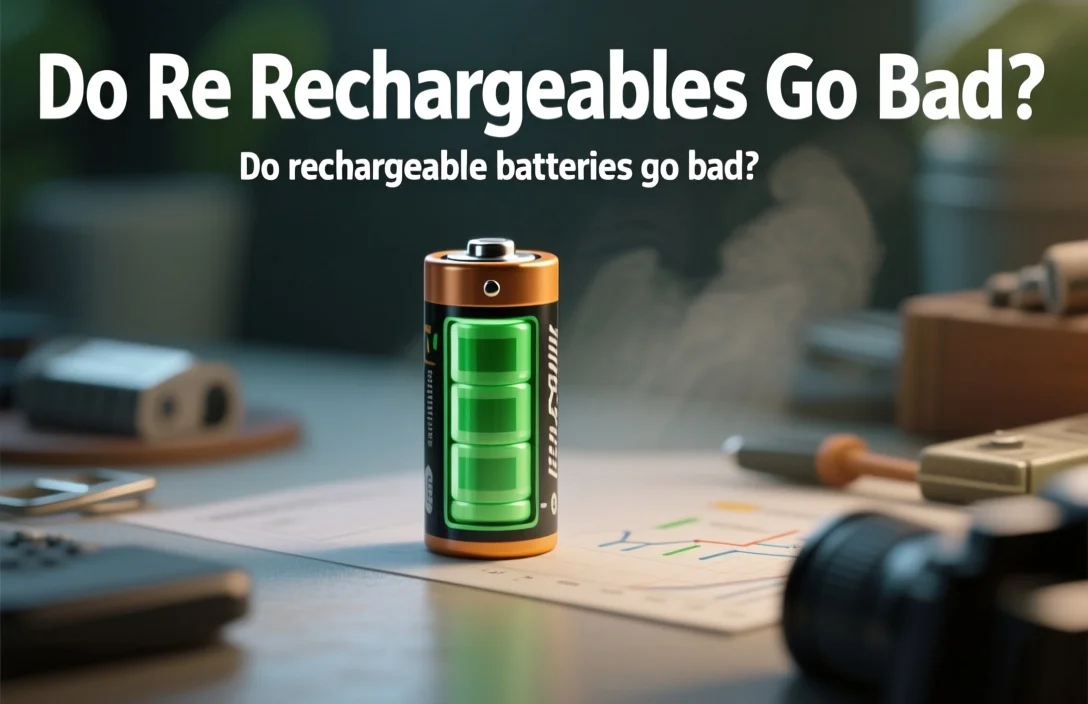
Yes, rechargeable batteries do go bad, but how fast and how they fail depends on the chemistry, usage, and storage. Some cells lose usable capacity slowly over hundreds to thousands of cycles; others can swell, overheat, or develop high internal resistance that makes devices shut down early.
| Chemistry | Typical cycle life (approx) | How degradation shows |
|---|---|---|
| NiMH | 200 to 500 cycles | Reduced runtime, higher self-discharge, lower measured mAh |
| NiCd | 500 to 1000 cycles | Gradual capacity loss, tolerates abuse better but prone to memory under poor charging |
| Li-ion / LiPo | 300 to 1000 cycles | Capacity fade with cycle count, voltage sag under load, possible swelling if damaged |
| LiFePO4 | 2000 to 5000 cycles | Slow capacity fade, very stable voltage, heavy but long-lived |
When to worry now versus later depends on use. Replace cells immediately if you see swelling, persistent overheating while charging, visible leakage, or if a battery causes device shutdowns despite showing voltage.
For longer term concerns, watch capacity and runtime. If a battery drops below about 70 to 80 percent of its original capacity and you need the original runtime or peak output, replace it. For casual use where short runtime is acceptable, you can keep using it longer, but performance will continue to decline.
Myth: “Memory effect kills modern rechargeables.” Fact: NiCd can show memory under poor charge discipline, but NiMH and lithium chemistries do not suffer the classic memory effect in normal use.
Myth: “You should trickle-charge everything overnight.” Trickle charging is okay for some NiCd and NiMH if the charger is intended for it, but continuous trickle on lithium cells is unsafe and can damage the battery or the device.
Myth: “Rated mAh is always accurate.” Labels can be optimistic, especially on cheap cells. If runtime is critical, verify with a capacity test and prefer reputable cells and smart chargers that report capacity and internal resistance.
Chemistry Comparison Table
Yes, rechargeable batteries do go bad, and how fast they age depends on chemistry, cycle count, temperature, and storage state-of-charge. Some chemistries lose usable capacity slowly over hundreds to thousands of cycles, others fail faster or show sudden safety signs like swelling or overheating.
| Chemistry | Approx cycles to 70 – 80% capacity | Typical self-discharge (percent per month) | Recommended storage state-of-charge | Safe storage / operating temp ranges (approx) | Common failure signs |
|---|---|---|---|---|---|
| NiMH | About 200 – 500 cycles (depends on cell quality and charge profile) | 5 – 30% (standard cells higher; low self-discharge types much lower) | Store partly charged, roughly 30 – 50% | Storage: cool, 0 to 20 C; Operating: 0 to 45 C (charging lower than discharging) | Reduced runtime, rapid self-discharge, heat while charging, poor performance at low temp |
| NiCd | About 500+ cycles (robust to abuse but toxic, older tech) | 5 – 20% | Store partially charged, roughly 30 – 50% | Storage: cool, 0 to 20 C; Operating: 0 to 45 C | Memory-effect myths aside, look for capacity loss, leakage, swelling |
| Li-ion / LiPo | Roughly 300 – 1000 cycles (varies widely by cell design and temperature) | 1 – 5% | Store at about 40% state-of-charge | Storage: ~0 to 25 C recommended; Operating: -20 to 45 C (charging usually 0 to 45 C) | Gradual capacity fade, higher internal resistance, swelling, heat, BMS cutouts |
| LiFePO4 | ~1000 – 5000 cycles (longest calendar and cycle life among common lithium types) | 1 – 3% | Store at about 40 – 60% state-of-charge | Storage: cool, near 0 to 25 C; Operating: -20 to 60 C (cell chemistry is more tolerant) | Slow capacity loss, occasionally higher internal resistance, rare swelling |
Read these numbers as planning tools, not exact guarantees. “Cycles to 70 – 80% capacity” means the point where useful runtime is noticeably reduced; real life depends on charge rate, depth of discharge, and heat exposure.
For example, if a 2000 mAh NiMH pack has degraded to 1200 mAh, that is a 40 percent loss. If your device draws 500 mA, runtime falls from 4 hours to 2.4 hours, which may justify replacement for critical use. For a 3000 mAh Li-ion that drops to 2400 mAh, runtime falls by 20 percent, often still acceptable for noncritical use.
Failure Modes & Signs

Yes, rechargeable batteries do go bad, and how fast they fail depends on the chemistry, number of cycles, temperature, and how they are charged and stored. Common failure modes are capacity loss, rising internal resistance, physical swelling, electrolyte breakdown, and in some chemistries, dendrite growth that can cause shorts.
Lithium cells age because the solid electrolyte interphase, SEI, grows and consumes cyclable lithium, and repeated charge cycles raise impedance and sometimes cause lithium plating or dendrites under abusive charging. NiMH and NiCd lose active material and can suffer increased self discharge or surface effects that reduce usable capacity. LiFePO4 resists chemical breakdown better but still shows capacity fade from particle fracture and electrolyte degradation at high temperatures.
For example, if a 2000 mAh NiMH pack used in a flashlight now runs 40 percent shorter, replacement is reasonable for tasks where runtime matters; for noncritical uses you may accept the loss until other failure signs appear.
Storage and safety basics: store lithium cells at about 40 to 50 percent state of charge in a cool, dry place and avoid sustained temperatures above 40 degrees Celsius. Do not use damaged, swollen, or leaking cells; stop charging them and recycle through an approved battery program.
Replace when you see persistent voltage sag under load, capacity below what you need (commonly replace at 20 to 40 percent loss for critical gear), swelling, leaks, or repeated overheating. Use smart chargers and battery analyzers to monitor health, and treat physical damage as an immediate safety replace-and-recycle event.
Step-by-Step Testing
Yes, rechargeable batteries do go bad, and you can quantify that decline by measuring open-circuit voltage, capacity in mAh, and internal resistance. Run a few simple tests with a multimeter and either a smart charger or a fixed load, then compare results to the cell’s rated specs to decide whether to keep or replace the cell.
For example, a 2000 mAh NiMH tested at 400 mA that runs 3 hours yields 1200 mAh, which is 60 percent of rated capacity, indicating substantial degradation and likely replacement if you need original runtime. Always verify cutoffs and nominal voltages from the manufacturer when you interpret test numbers.
Maintenance, Chargers & Tools
Yes, rechargeable batteries do go bad, and the speed and mode of failure depend on chemistry, temperature, and charge habits. Li-ion cells lose usable capacity with charge cycles and high temperature, NiMH ages faster with heat and prolonged high SOC, and LiFePO4 resists calendar aging but still degrades under abuse.
Store Li-ion cells at about 40 percent state of charge, in a cool dry place, ideally 10 to 25 degrees Celsius. For short term storage a wider band is acceptable, but higher temperatures accelerate capacity loss; avoid leaving cells above 45 degrees Celsius for extended periods.
Charge routines by chemistry: Li-ion needs CC-CV charging with proper termination current and no continuous float charge, and a BMS that balances cells and cuts off on overvoltage or overtemperature. LiFePO4 uses lower per-cell voltages and benefits from cell balancing and the same no-float rule. NiMH/NiCd require charge termination by negative delta-V detection, delta temperature, or timed cutoff; occasional refresh cycles can help but deep regular discharge is harmful.
For example, if a 2000 mAh NiMH now returns 1200 mAh on a capacity test, capacity has fallen about 40 percent, so replace if you need original runtime or if capacity is below 80 percent and the device is critical. If Li-ion cells show voltage sag under moderate load, swell, or have elevated internal resistance, treat them as end of life and remove them from service.
| Item | Amount / Specification | Notes |
|---|---|---|
| Li-ion storage SOC | ≈40 percent | Best long-term tradeoff between calendar life and readiness |
| Storage temperature | 10 – 25 °C preferred | Above 45 °C accelerates degradation |
| Charge temperature | 0 – 45 °C | Charging below 0 °C can cause plating, avoid unless specified |
| NiMH refresh | Every 3 – 6 months or when self-discharge increases | Use smart refresh cycle, not continuous deep discharge |
| Float charging | Not for Li-ion | Lead acid may accept float, Li-ion will degrade |
Troubleshooting & Replacement Rules
Yes, rechargeable batteries do go bad, and the how and when depend on chemistry, cycle count, storage state, temperature, and abuse. Degradation shows as reduced runtime (capacity), higher internal resistance (voltage sag under load), increased self-discharge, and in severe cases swelling or leakage, which require immediate replacement.
| Chemistry | Typical cycle life (range) | Common EOL signs | Recommended storage SoC | Replacement trigger (rule) |
|---|---|---|---|---|
| NiMH | ~300 to 500 cycles | Falling mAh, high self-discharge | 40 to 60 percent | Replace if capacity <70% for critical use, <50% for convenience |
| NiCd | ~500 to 1000 cycles | Memory-like capacity loss, self-discharge | 40 to 60 percent | Replace at same numeric thresholds; consider recycling due to cadmium |
| Li-ion / LiPo | ~300 to 1000 cycles (varies) | Reduced runtime, voltage sag, possible swelling | ~40 to 50 percent | Immediate replace for swelling or leakage; replace if capacity <70% for critical use |
| LiFePO4 | ~1500 to 3000+ cycles | Gradual capacity loss, higher IR | ~50 percent | Replace when capacity <70% for critical use; inspect BMS and cell balance |
Quick fixes that are safe to try include replacing bad cables or chargers, cleaning contacts, recalibrating the device gauge, and running 1 to 3 controlled deep discharge/charge cycles for NiMH. For lithium cells, do not deep-discharge or try “reconditioning”; instead check charger, BMS, and balance charge if pack-level balancing is available.
Repurposing rules: if a cell is mechanically sound (no swelling, no leakage), has steady open-circuit voltage, and remaining capacity is between 40 and 70 percent, you can reuse it in low-risk, low-current applications such as LED lighting, hobby projects, or non-critical backups. Do not repurpose swollen, leaking, or high-IR cells, and do not mix cells with more than 10 percent capacity difference in the same pack.
Safety, Swell & Disposal
Yes, rechargeable batteries degrade and can fail, and when they become hot, swollen, smoking, or leaking they present a real safety hazard that needs immediate action. Isolate the cell from people and combustibles, then follow the steps below to reduce risk and prepare the battery for safe transport and recycling.
Bring clear information to any drop‑off point: chemistry (for example, lithium‑ion), number of cells, approximate capacity if known, and a short description of the condition. Retail take‑back programs, municipal household hazardous waste centers, and manufacturer or retailer recycling schemes commonly accept damaged cells; call ahead to confirm procedures and hours.
For resources, check your local municipal household hazardous waste program, regional electronics recycler, or retailer take‑back policies. In addition, consult national agencies such as the U.S. EPA, Department of Transportation, FAA, or your country’s equivalent for rules on transporting and shipping batteries and for lists of authorized drop‑off centers.
For example, if a phone battery starts to bulge, stop using the phone, place it on concrete outdoors away from structures, tape the terminals, and call your municipal HHW program or the device maker for instructions on drop‑off or a manufacturer recall. Keep documentation of condition and when you stopped using the device in case a warranty or safety program applies.
Safety bottom line: do not puncture or try to repair swollen, hot, smoking, or leaking cells, and do not ship them without explicit approval from authorities or carriers. Replace or recycle batteries that show swelling, severe capacity loss, high self‑discharge, or visible damage; safety trumps convenience.
Quick Summary
Yes, rechargeable batteries do go bad over time, with capacity and performance declining depending on chemistry, use, and storage.
Frequently Asked Questions
Do rechargeable batteries lose capacity over time?
Yes, rechargeable batteries can lose capacity over time due to a phenomenon called capacity fade. Typically, lithium-ion batteries can retain about 80% of their original capacity after 500 to 1000 charge cycles.
How can I tell if my rechargeable batteries are bad?
You can check if your rechargeable batteries are bad by observing signs of swelling, leakage, or reduced runtime. If a battery no longer holds a charge or depletes rapidly, it may need to be replaced.
Is heat a sign that my rechargeable battery is failing?
Yes, excessive heat during charging or use can indicate a failing battery. A temperature rise above 60 degrees Celsius (140 degrees Fahrenheit) is a red flag and could lead to safety hazards.
When should I replace my rechargeable batteries?
You should consider replacing your rechargeable batteries if they consistently provide less than 80% of their rated capacity or if they show physical damage. Regular battery maintenance can help extend their life.
What mistakes should I avoid when buying rechargeable batteries?
A common mistake is to purchase batteries that are not compatible with your device, which can lead to performance issues. Always check the voltage and capacity specifications to ensure compatibility with your equipment.