How Long To Charge A Car Battery 10 Amp Charger?
A 10-amp charger hits the sweet spot for home use: fast enough to refill a battery overnight, yet gentle enough to avoid stress. How long it actually takes depends on three variables: your battery’s amp-hour rating, how deeply it’s drained, and the charger’s real-world output.
Most 12V car batteries sit between 45Ah and 75Ah, which puts a typical charge in the four-to-eight-hour range. I’ll walk through the math, explain what stretches or shrinks that window, and highlight smart chargers that handle the timing for you.
How Long A 10 Amp Charger Actually Takes
The math behind charging time is simpler than most manuals suggest. Divide the battery’s amp-hour capacity by the charger’s amperage, then add a buffer for the slow final stage. The table below shows realistic windows for common battery sizes, assuming a fully discharged start.
These ranges assume the charger holds a steady 10 amps through the bulk phase.
A 10-amp charger pushes roughly 10 amps into the battery during its main bulk stage. A fully drained 60Ah battery needs about six hours for that bulk phase alone. But charging isn’t linear.
As the battery nears full, the charger tapers current to protect the cells, adding another one to two hours for absorption. Cold weather thickens the internal chemistry and slows everything down. If your battery is at 50 percent rather than dead, cut the wait in half.
Temperature compensation helps here by adjusting voltage to the season, which is why most 10A smart chargers promise “overnight” results rather than exact minutes.
Realistic 10A Charge Times By Battery Size
| Battery Size | Fully Drained | Half Discharged | Typical Vehicle |
|---|---|---|---|
| 40Ah | 4 to 5 hours | 2 to 3 hours | Small car, motorcycle |
| 60Ah | 6 to 8 hours | 3 to 4 hours | Average sedan |
| 75Ah | 8 to 10 hours | 4 to 5 hours | Truck, SUV |
| 100Ah | 10 to 13 hours | 5 to 7 hours | Large truck, marine |
What Stretches Your Car Battery Charging Time
Real-world charging rarely matches label math. Several variables push the time up or down, and knowing them saves you from unplugging too early. The guidelines below separate what helps from what hurts, so your next charge finishes on schedule instead of dragging into a second day.
Battery age matters as much as size. A three-year-old battery with sulfated plates accepts charge slowly and may never reach full voltage, making the charger run longer for less result. Deep discharges also change the equation. A battery drained below 10.
5 volts enters a recovery phase that some chargers handle gracefully and others refuse to attempt. Smart chargers with pulse repair detect sulfation and work around it, while basic units simply stall. Cable quality plays a role too; thin leads drop voltage before it reaches the battery.
If your charger shows an amp reading well below 10 early in the cycle, a poor connection is often the culprit rather than the battery itself.
- Charge in a warm garage when possible, since cold batteries accept current far more slowly.
- Do not interrupt the absorption stage, because the last 20 percent takes the longest.
- Match the charger mode to the battery type before starting the session.
- Clean corroded terminals so full current actually reaches the plates.
- Avoid charging a fully dead battery unattended overnight.
- Check that clamps grip firmly, because loose connections throttle amperage.
Chargers That Answer The 10 Amp Question
Every charger below runs a true 10-amp circuit or close to it, so the timing math above applies directly. Each one monitors voltage and switches to maintenance mode when the battery fills, removing the guesswork of watching a clock.
I’d pick based on battery chemistry, display clarity, and whether you need repair modes for older packs.
|
1
|
Car Battery Charger 12V 10A Smart Trickle Charger Fully Automatic | Battery Maintainer Tem |

Its true 10A circuit refills a drained car battery overnight, and the LCD tracks voltage so you can watch the timer.
This 12V 10A smart charger handles AGM, GEL, SLA, VRLA, and LiFePO4 batteries across cars, trucks, motorcycles, boats, and mowers. The LCD displays battery voltage, ambient temperature, current, and charge level at a glance.
Five selectable modes cover CAR, AGM/GEL/LiFePO4, WET, MOTO, and PULSE REPAIR, ensuring the 10 amps go where the chemistry needs them. Eight layers of protection, including reverse polarity and overheating safeguards, guard the session while automatic temperature compensation adjusts voltage seasonally.
It fits owners who want one compact unit for mixed fleets and seasonal vehicles, and the pulse repair function can recover aging lead-acid packs showing early sulfation. Because it is a charger rather than a jump starter, connect it to AC power before use.
The listing also advises against leaving it running unattended beyond twelve hours. That caveat matters for anyone planning a truly hands-off overnight charge in a detached garage.
|
2
|
NOCO GENIUS10 10A 6/12V Smart Battery Charger, Trickle Charger & Maintainer | Overcharge P |

Force Mode charges batteries down to zero volts, so even a deeply drained car battery reaches full within the standard 10A window.
The GENIUS10 is a 10A smart charger, maintainer, and desulfator for 6V and 12V lead-acid and LiFePO4 batteries, including flooded, AGM, and deep-cycle types. An integrated thermal sensor adjusts charging voltage to ambient temperature, preventing summer overcharge and winter undercharge.
It starts charging from as low as one volt, and Force Mode handles completely dead batteries. The unit is 17 percent smaller than the older G7200 while delivering over 115 percent more power.
Its strongest suit is indefinite maintenance: the charger monitors the battery continuously, so a stored classic or RV stays topped off without overcharge risk. Deeply discharged batteries that other units reject are its specialty.
The trade-off is price, since you pay for desulfation intelligence and cold-weather precision a basic commuter may never use. For a daily driver on a budget, simpler options charge just as fast.
|
3
|
Schumacher Electric 15A Car Battery Charger & Maintainer, 6V/12V – SC1280 | 3A Trickle Cha |

Its 15A rapid mode tops a car battery faster than 10 amps, while the 3A trickle setting handles long maintenance windows.
The SC1280 is a microprocessor-controlled 6V/12V charger and maintainer that charges, tests, and restores batteries for cars, ATVs, trucks, and boats. It delivers 15A rapid charging to standard, AGM, gel, and deep-cycle batteries, then drops to a 3A trickle for maintenance.
Automatic voltage detection removes setup guesswork, and advanced desulfation mode addresses sulfated plates during longer sessions for stored vehicles.
It suits seasonal vehicles and infrequently driven cars that need periodic revival rather than constant care. The 15A rate shortens the wait for a fully drained battery compared to a strict 10A unit.
One honest limitation: its 15A bulk phase exceeds what small motorcycle batteries tolerate, so check ratings before connecting a powersport pack. As a garage upgrade for standard car batteries, though, it covers the full charge window efficiently.
|
4
|
10Amp Battery Charger Smart Car Trickle Charger 12V 24V Battery Maintainer | 7-Stage Safet |
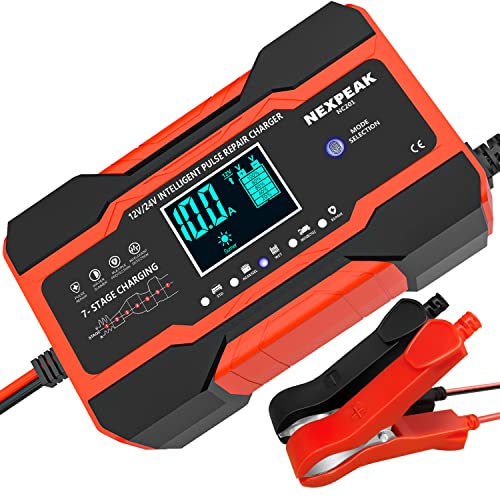
It runs 10A at 12V and 5A at 24V, charging car and truck batteries predictably across a 7-stage program.
This smart charger delivers 10A at 12V and 5A at 24V across a 7-stage sequence for AGM, GEL, SLA, and flooded lead-acid batteries in cars, trucks, SUVs, motorcycles, and marine applications. A large LCD shows charge voltage, current, percentage, inside temperature, and seasonal modes.
Pulse repair detects sulfation and stratification to restore lost performance in aging packs without manual intervention.
The 24V capability sets it apart for trucks and heavier equipment that smaller units cannot touch. Winter and holiday maintenance is the intended use case, with multiple protections including reverse polarity, overcurrent, and fireproof housing. The limitation is clear in the listing: it cannot activate or charge totally dead batteries.
Keep that in mind if you routinely revive fully drained packs, and choose it for maintained or partially discharged batteries instead.
|
5
|
Car Battery Charger 12V 10A Automatic Smart Trickle Charger & Maintainer | Temperature Com |

A true 10A circuit with winter and summer modes keeps charging time consistent regardless of the season or garage temperature.
This 12V 10A charger works with AGM, GEL, SLA, VRLA, and LiFePO4 batteries across cars, motorcycles, trucks, boats, and mowers. Dual seasonal modes adjust charging voltage to ambient temperature, guarding against winter undercharging and summer overcharging. A backlit LCD shows voltage, current, temperature, and battery level.
Eight-in-one protection covers reverse connection, short circuit, overcurrent, and overheating during long sessions.
It fits anyone who charges in an unheated garage and wants the timing math above to hold true year-round. Cable lengths are specified at 102 cm input and 60 cm output, so plan clamp placement accordingly.
Like its sibling models, the listing advises against unattended operation beyond twelve hours, which limits set-and-forget overnight charging. As a straightforward temperature-compensated 10A unit, it does the core job reliably.
|
6
|
TowerTop 2/10/25 Amp 12V Smart Car Battery Charger, Fully Automatic Battery Maintainer wit |

Selectable 2A, 10A, and 25A currents match the charge rate to the battery, cutting a 100Ah fill to under 3.5 hours.
The TowerTop offers four current settings, including 10A for standard overnight charging and 25A for speed, claiming a 100Ah battery charges in under 3. 5 hours at maximum. An 8-stage sequence covers desulfation, bulk, absorption, repair, float, and pulse maintenance, with an HD LCD tracking each stage.
It supports STD, AGM, GEL, wet, MF, EFB, calcium, and deep-cycle 12V batteries for cars, boats, and RVs.
It suits impatient owners and larger batteries that strain single-rate chargers. Automatic restart resumes charging after outages, and the unit remembers your last settings. The engine start and repair buttons add flexibility, though the listing notes it cannot repair completely drained batteries.
At 25A bulk rates, verify your battery’s maximum charge acceptance before selecting the top setting to avoid unnecessary heat and shortened battery life.
|
7
|
CRAFTSMAN 12A Car Battery Charger & Maintainer, 6V/12V – CMXCESM258 |

Its 12A rate fills a car battery faster than 10 amps, and auto voltage detection simplifies setup across 6V and 12V packs.
The CRAFTSMAN CMXCESM258 is a 4-in-1 charger, maintainer, tester, and restorer for 6V and 12V standard, AGM, deep-cycle, and 12V LiFePO4 batteries. It delivers 12A rapid charging with microprocessor control, digital display, and reverse hook-up protection. Multi-stage algorithms and a desulfation mode target battery health during longer sessions.
The package includes the charger and a user manual.
It fits DIYers who trust established tool brands and want one unit for cars, motorcycles, ATVs, and boats. The 12A rate trims an hour or so from a typical 60Ah charge compared to strict 10A units.
One limitation: feature-for-feature it matches several less expensive generic chargers, so value depends on warranty support and brand preference. For straightforward charging with a familiar name, it delivers without surprises.
|
8
|
Car Battery Charger 12V 10Amp Fully Automatic Smart Trickle Charger |

A 10A output with 9-stage intelligence claims 30 percent faster charging, tightening the overnight window for mid-size car batteries.
This 12V 10A smart charger covers LiFePO4, AGM, GEL, EFB, VRLA, and flooded batteries from 2Ah to 150Ah across cars, trucks, motorcycles, boats, and lawn equipment. Its 9-stage program promises charging roughly 30 percent faster than comparable units. Automatic temperature compensation with winter and summer modes adjusts voltage seasonally.
An LED display shows real-time voltage, current, and charging status during the session.
It suits households maintaining several idle vehicles, including vintage cars and mowers that sit for months. The desulfation mode requires at least 0. 3V and cannot activate fully depleted or lithium batteries, so truly dead packs are beyond its reach.
Multiple protections cover reverse polarity, spark, overcharge, overvoltage, and short circuit. For routine maintenance charging within its voltage floor, it is a capable all-rounder.
|
9
|
Schumacher Electric 6A Car Battery Charger & Maintainer, 12V – SC1361 | 50A Engine Start – |

Its 10A boost mode and 50A engine start revive a dead car battery fast, while 6A smart charging covers the maintenance window.
The SC1361 is a 3-in-1 starter, charger, and maintainer for 12V car, motorcycle, ATV, truck, and marine batteries. It provides a 50A engine start to fire a dead vehicle immediately, a 10A boost to build charge quickly, and microprocessor-controlled 2A to 6A smart charging with automatic maintenance.
Reverse hook-up protection prevents operation if clamps are reversed, protecting both battery and vehicle electronics.
It fits drivers who need emergency starts more than overnight fills, since the 6A steady rate roughly doubles charge time versus a true 10A unit. Auto restart resumes after power interruptions, and low-profile clamps reach tight terminals.
As a dedicated charger for large drained batteries, a strict 10A model finishes sooner. As a garage safety net that also maintains, it earns its space.
Across these nine units, the true 10A models hit the four-to-eight-hour window most car batteries need. Higher-amp options trade a little gentleness for speed. Match the chemistry, respect the voltage floors, and the timing math from earlier holds.
Running The Charge So It Finishes Safely
Knowing the hours is only half the job; executing the charge correctly protects both battery and charger. The steps below walk through a typical 10A session from inspection to maintenance mode. Follow them and most charging disappointments disappear before they start.
Inspect the battery for swelling, cracks, or leaking fluid, and stop if any damage is visible.
Clean terminals with a wire brush so the clamps make full, direct contact with the posts.
Connect red to positive and black to negative, then plug the charger into AC power.
Select the mode matching your battery chemistry, then confirm the display reads near 10 amps.
Let absorption complete, then allow the charger to switch into maintenance mode automatically.
Ventilation deserves more attention than it gets. Charging releases hydrogen gas, especially in the final absorption stage, so charge in an open garage rather than a sealed closet. Keep the charger on a stable surface away from the battery, since some units warm noticeably during the bulk phase.
If the display shows voltage rising but current dropping within the first hour, check the connections before assuming the battery is full. A healthy 12V battery rests around 12. 6 volts disconnected.
Anything persistently below 12 volts after an overnight charge suggests sulfation that pulse repair may need extra time to address. Patience here saves replacement cost later, and a simple multimeter check confirms the result.
Mistakes That Stretch Charging Time Further
Most charging delays trace back to a handful of repeatable errors rather than faulty equipment. The guidelines below cover the habits worth keeping and the shortcuts worth avoiding. Prevent them and a four-hour job stays a four-hour job.
- Do charge soon after a deep discharge, since leaving a drained battery sitting invites sulfation.
- Do not assume a green light means full; verify resting voltage the next morning.
- Do keep the battery above freezing before connecting the charger to it.
- Do not use extension cords that drop voltage below what the charger expects.
- Do log charge hours for older batteries so slow patterns become visible over time.
- Do not mix charger modes across AGM and flooded settings without checking first.
The single most common time-waster is charging through a parasitic drain. If the vehicle’s alarm, stereo, or computer modules draw current while charging, the charger fights that load and the battery never fully fills. Disconnecting the negative terminal before charging removes the competition.
Undersized extension cords cause a similar stall by starving the charger of line voltage. Finally, age catches everyone: a battery past its fifth year may absorb charge so slowly that even a perfect 10A session leaves it below capacity.
When that pattern repeats across multiple charges, the battery rather than the charger is the bottleneck. Replacement becomes the faster fix.
A 10-amp charger typically takes four to eight hours for a standard car battery, and longer for bigger or deeply drained packs. Today, grab your battery’s amp-hour rating from the label and divide by ten. That rough figure tells you exactly when to check back.
Charge in a ventilated space, pick the right chemistry mode, and let the charger finish its absorption stage instead of unplugging early. If the math keeps stretching across sessions, test the battery rather than blaming the charger. A little arithmetic now saves a lot of waiting by the garage door.

- Marine Chargers and Backup Batteries: 9 Options Compared (2026) - October 27, 2026
- LTO Cells vs. SLA Generator Batteries: 5 Options Compared (2026) - October 27, 2026
- 12V/24V Backup Batteries and the EcoFlow DELTA Pro 3 (2026) - October 27, 2026